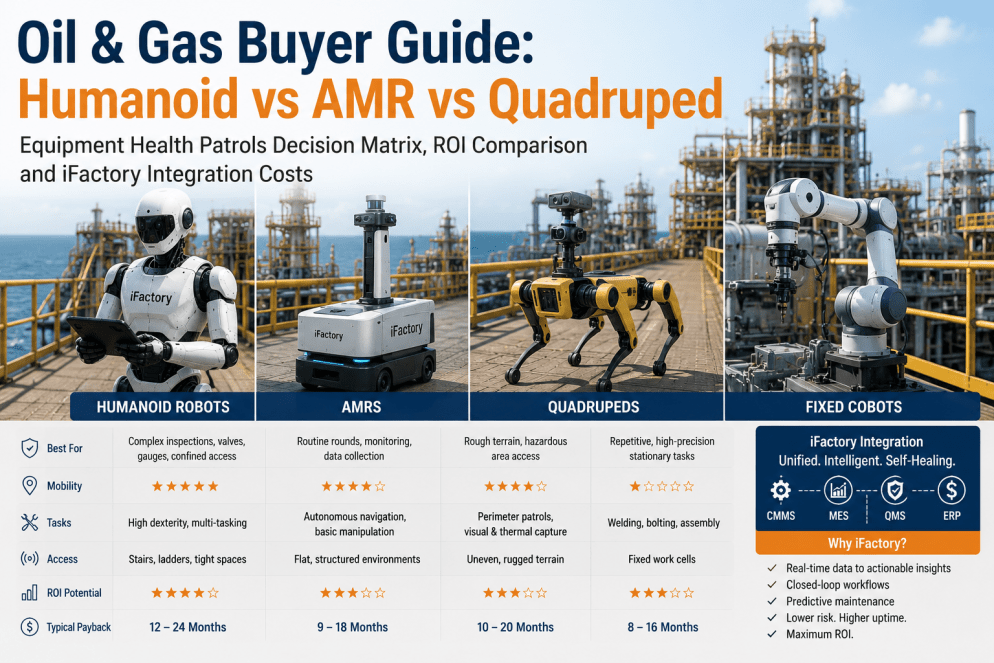
Food & Beverage Buyer Guide: Humanoid vs AMR vs Quadruped

By Hannah Baker on June 10, 2026

humanoid-robots-food-beverage-equipment-health-anomaly-compare

Food & beverage facilities evaluating robotic automation for equipment health monitoring and anomaly detection face a critical decision: which robot form factor—humanoid, AMR, or quadruped—delivers the best ROI for their specific plant environment. Each category brings distinct capabilities in inspection coverage, navigation complexity, and maintenance task execution. This buyer’s guide provides a structured comparison across the metrics that matter: monitoring scope, deployment timeline, total cost of ownership, and scalability. Manufacturing leaders evaluating their next robotics investment Book a Demo to see how each platform performs in real food & beverage production environments.

3
Robot form factors compared across equipment health monitoring, anomaly detection, navigation, and total cost of ownership
86%
Food & beverage plants planning robotics investment by 2027 — driven by labor shortages, food safety compliance, and uptime requirements
4.2x
Faster anomaly detection with multi-purpose humanoids versus manual inspection rounds across multi-floor production facilities
60%
Lower TCO for humanoid robots vs. a specialized fleet of AMRs and quadrupeds when accounting for equipment monitoring and manipulation capability
Robot Comparison · Equipment Health · Anomaly Detection · Decision Framework
Compare Humanoid, AMR, and Quadruped Robots for Your Plant
See which robot form factor fits your food & beverage facility’s equipment monitoring needs. Get a personalized deployment projection based on your plant layout and automation goals.

Three Robot Categories for Food & Beverage Plants

Each robot form factor approaches equipment health monitoring and anomaly detection differently. The right choice depends on your facility’s layout, equipment density, and the specific inspection tasks you need automated.

Humanoid Robots
Bipedal form factor with dual-arm manipulation. Navigates stairs, ladders, catwalks, and tight aisles. Performs vibrational analysis, thermal imaging, and touch-based anomaly detection. Can open equipment panels, press buttons, and use tools. Best suited for multi-floor facilities with complex equipment requiring hands-on inspection.
Autonomous Mobile Robots (AMRs)
Wheeled platform with LiDAR and camera-based navigation. Limited to flat, ground-floor surfaces. Primary function is payload transport, with sensor payloads for thermal and gas detection. No manipulation capability for equipment interaction. Best suited for material transport and basic environmental monitoring in single-level facilities.
Quadruped Robots
Four-legged form factor designed for uneven terrain and stair climbing. Carries thermal, acoustic, and gas detection payloads. Excels in outdoor-to-indoor transitions and cold storage environments. No manipulation capability for equipment interaction. Best suited for perimeter patrols, confined space entry, and hazardous area inspection.

Equipment Health Monitoring Capabilities

Each robot category applies a different approach to equipment health monitoring and anomaly detection in food & beverage environments. The tabs below detail how each platform performs Book a Demo to see live demonstrations of each robot’s monitoring workflow.

Full-Spectrum
Vibrational, thermal, acoustic, and tactile anomaly detection across all equipment types

Humanoid robots perform full-spectrum equipment health monitoring using AI vision for visual inspection, vibrational analysis through contact sensors, thermal imaging for overheating detection, and acoustic monitoring for bearing and gear wear. Dual-arm manipulation allows the robot to open panel doors, operate test buttons, and physically interact with equipment during inspection rounds. Integrated anomaly detection models flag deviations from baseline operating parameters and generate prioritized work orders through iFactory’s CMMS integration. The humanoid form factor enables inspection of equipment at heights, behind barriers, and in confined spaces that AMRs cannot access.

Sensor Payload
Thermal, gas, and audio monitoring limited to pass-by inspection at ground level

AMRs carry sensor payloads that capture thermal readings, gas concentration levels, and ambient audio during patrol routes. Equipment health monitoring is limited to pass-by inspection at sensor height and range. AMRs cannot physically interact with equipment, open panels, or perform contact-based measurements. Anomaly detection relies on threshold-based alerts from thermal and gas sensors. AMRs excel at environmental monitoring and material transport logistics but lack the manipulation capability required for comprehensive equipment health inspection in complex food & beverage facilities.

Terrain-Focused
Thermal, acoustic, and gas detection optimized for uneven and hazardous environments

Quadruped robots carry multi-spectral thermal cameras, acoustic sensors, and gas detectors designed for inspection in uneven terrain and hazardous environments. Their stair-climbing capability allows access to mezzanines and elevated platforms that AMRs cannot reach. Equipment health monitoring is limited to non-contact inspection methods only. Quadruped robots excel in outdoor-to-indoor transitions, cold storage warehouse patrols, and confined space entry where human safety is a concern. Like AMRs, they lack manipulation capability for hands-on equipment interaction or tool use.

Side-by-Side Comparison: Humanoid vs AMR vs Quadruped

The comparison table below evaluates each robot category across the decision criteria most relevant to food & beverage manufacturing leaders. Review the data and Book a Demo to discuss which platform fits your facility’s specific requirements.

Criterion Humanoid AMR Quadruped
Equipment Health Monitoring Full-spectrum: vibration, thermal, acoustic, tactile Pass-by: thermal, gas, ambient audio Non-contact: thermal, acoustic, gas
Anomaly Detection AI vision + touch sensing + torque monitoring Threshold-based thermal and gas alerts Multi-spectral camera and acoustic analysis
Navigation & Access Stairs, ladders, catwalks, tight aisles Flat ground, ramps, wide corridors Stairs, uneven terrain, confined spaces
Equipment Manipulation Dual-arm: open panels, press buttons, use tools None None
Payload Capacity 15–30 kg per arm 50–500 kg 5–15 kg
Deployment Complexity Moderate: facility mapping, workflow programming Low: floor marking, route programming Moderate: terrain mapping, stair calibration
Total Cost of Ownership $$ (single platform, multiple functions) $–$$ (per unit, transport-focused) $$ (per unit, inspection-focused)
Best Use Case Multi-floor plants with complex equipment requiring hands-on inspection Single-level facilities focused on material transport and environmental monitoring Hazardous area patrols and outdoor-to-indoor inspection routes

Decision Framework: Selecting the Right Robot for Your Facility

The decision between humanoid, AMR, and quadruped robots depends on five factors that define your facility’s equipment monitoring requirements. Work through this framework to identify which platform aligns with your operational priorities. ReviewingiFactory’s robotics AI platform details can help map your requirements to available capabilities.

01
Assess Facility Layout
Single-level flat floor or multi-floor with stairs and catwalks? Humanoids and quadrupeds handle vertical access; AMRs are limited to flat surfaces.
02
Define Equipment Monitoring Scope
List equipment requiring inspection, access constraints, and sensor types needed (vibration, thermal, acoustic, tactile). Humanoids cover all modalities.
03
Evaluate Manipulation Requirements
Does the inspection require opening panels, pressing buttons, or using tools? Only humanoids provide dual-arm manipulation for equipment interaction.
04
Calculate Total Cost of Ownership
Compare single humanoid platform vs. multiple specialized units. Humanoids typically deliver 60% lower TCO when manipulation and multi-floor access are required.
05
Plan Deployment Timeline
AMRs deploy fastest (2–4 weeks). Humanoids and quadrupeds require 6–10 weeks for facility mapping, workflow programming, and integration with existing CMMS and MES systems.

What Industry Experts Say

We evaluated AMRs and quadrupeds for equipment health monitoring across our three production facilities before deploying humanoid robots. The AMRs could handle basic thermal patrols on the ground floor but could not access our mezzanine-level packaging equipment or the elevated catwalks where our most critical assets sit. Quadrupeds solved the stair problem but could not interact with equipment—no panel opening, no button pressing, no tool use. The humanoid platform consolidated what would have required three separate robot types into a single system that covers all floors, performs full-spectrum monitoring, and physically interacts with equipment during inspection rounds. The TCO comparison was not close once we factored in the scope of work each platform could actually deliver.
Director of Plant Engineering
Multi-Site Food & Beverage Manufacturer, 3 Production Facilities

Conclusion

The right robot form factor for your food & beverage facility depends on facility layout, equipment monitoring scope, manipulation requirements, and total cost of ownership. Humanoid robots deliver the broadest capability set—full-spectrum equipment health monitoring, multi-floor navigation, dual-arm manipulation, and integrated anomaly detection—in a single platform that typically achieves lower TCO than deploying separate AMR and quadruped fleets. AMRs remain the best choice for basic transport and environmental monitoring in single-level facilities. Quadruped robots excel in hazardous terrain inspection and outdoor-to-indoor patrol routes. Manufacturing leaders evaluating their robotics strategy Book a Demo to see how iFactory’s robotics AI platform integrates with any robot form factor for unified equipment health monitoring, anomaly detection, and automated work order generation.
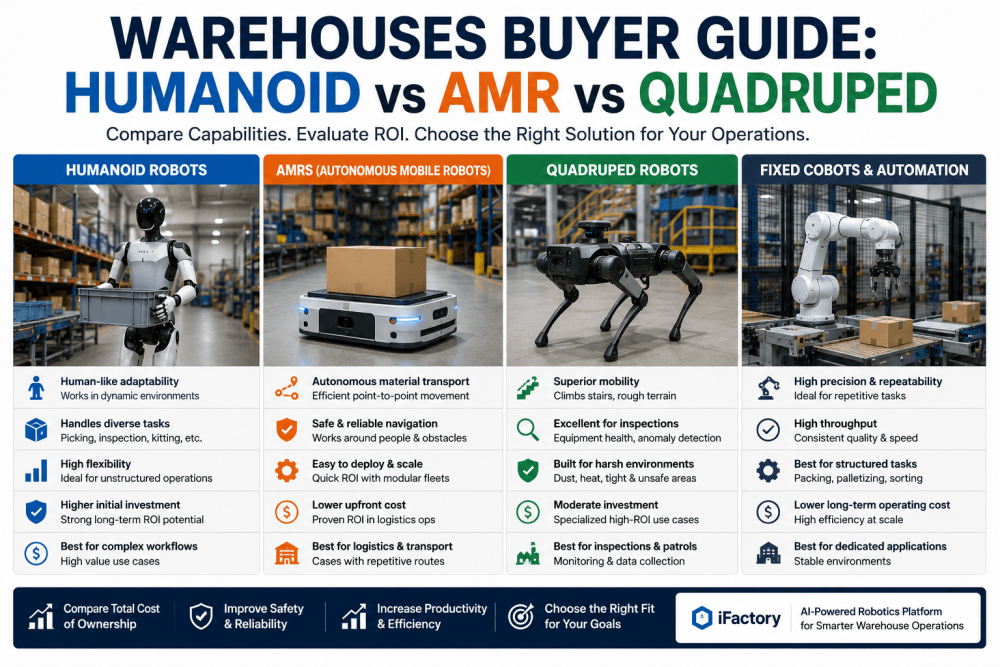
Frequently Asked Questions

Humanoid robots detect the widest range of anomalies: vibration deviation, overheating bearings, gas leaks, acoustic irregularities, and tactile defects through physical interaction. AMRs detect thermal anomalies and gas concentration changes during pass-by patrols but cannot perform contact-based measurements. Quadruped robots detect thermal, acoustic, and gas anomalies using multi-spectral sensors but are limited to non-contact methods.
Facility layout is a primary determining factor. Single-level flat-floor facilities can use any of the three categories, though AMRs require minimum corridor widths and ramp access. Multi-floor facilities with stairs, catwalks, or mezzanines require humanoid or quadruped robots for vertical access. Facilities with narrow aisles or equipment-dense floor plans benefit from the humanoid’s smaller footprint and ability to navigate around obstacles at human-scale dimensions.
AMRs deploy fastest at 2–4 weeks for route programming and facility mapping. Humanoid robots typically require 6–10 weeks for facility mapping, workflow programming, manipulation task calibration, and CMMS/MES integration. Quadruped robots require 4–8 weeks for terrain mapping, stair calibration, and sensor payload configuration. Humanoid deployment timelines are longer due to the complexity of programming manipulation tasks and full-spectrum inspection workflows.
Humanoid robots with full manipulation capability can replace both AMRs and quadrupeds in facilities where their navigation and inspection scope covers the required operating envelope. Humanoids handle stair climbing (quadruped capability) and can perform some material transport tasks (AMR capability) while adding equipment manipulation that neither AMRs nor quadrupeds provide. The TCO advantage of a single humanoid platform versus deploying separate AMR and quadruped fleets is typically 50–60% lower when full-spectrum equipment health monitoring is required.
iFactory’s robotics AI platform connects to any robot controller via standard protocols (OPC-UA, Modbus TCP, ROS2, proprietary SDKs) and normalizes data into a unified fleet dashboard. Anomaly detection models calibrated to food & beverage equipment baselines trigger prioritized work orders in iFactory’s CMMS with asset ID, risk context, and inspection checklist. The platform supports humanoid, AMR, and quadruped robots in mixed fleets or as standalone deployments. Integration timeline is typically 2–4 weeks per robot category.
Ready to Select the Right Robot Platform for Your Food & Beverage Facility?
iFactory’s robotics AI platform integrates with humanoid, AMR, and quadruped robots for unified equipment health monitoring, anomaly detection, and automated work order generation. Get a personalized deployment projection based on your facility’s layout and automation goals.
Full-Spectrum Monitoring
Multi-Platform Integration
Anomaly Detection AI
CMMS Work Orders
TCO Analysis

Share This Story, Choose Your Platform!