Warehouse and intralogistics operations managers evaluating automation investments face a rapidly expanding set of robotics options — humanoid robots, autonomous mobile robots (AMRs), quadruped robots, and fixed cobots — each with distinct capabilities for equipment health monitoring, anomaly detection, and intralogistics execution. The decision landscape has grown more complex as embodied AI platforms bring humanoid robots into commercial warehouse deployments alongside established AMR and emerging quadruped form factors. For operations executives and automation engineers responsible for selecting the right robot type for their facility's equipment health patrols, anomaly detection workflows, and material handling operations, understanding the comparative strengths and limitations of each platform is essential for maximizing ROI and operational impact. iFactory's industrial automation platform integrates with all four robot types, providing unified equipment health monitoring, predictive maintenance, and anomaly detection across mixed-automation warehouse environments. Book a Demo to evaluate which robot platform aligns with your warehouse operations and equipment health monitoring requirements.
The Four Contenders — Robot Typology Overview for Warehouse Operations
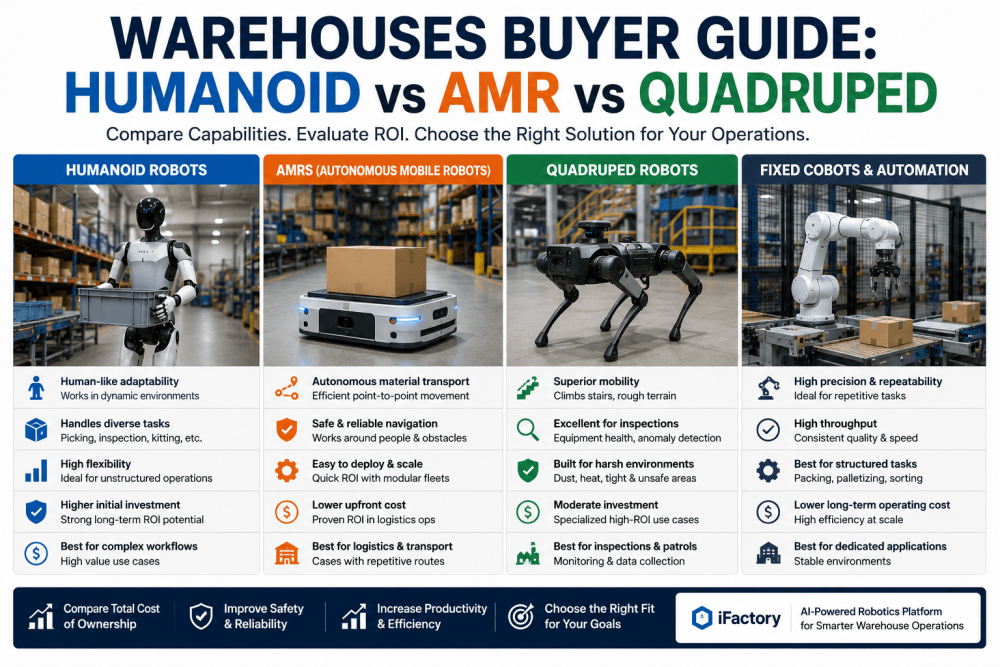
Each robot type brings a distinct combination of mobility, manipulation, sensing, and autonomy capabilities to warehouse operations. Understanding these fundamental differences is the first step in selecting the right platform for equipment health monitoring, anomaly detection, and intralogistics execution. Digital manufacturing directors and warehouse operations leaders Book a Demo to review how iFactory's platform unifies equipment health data across mixed-robot deployments.
Head-to-Head Comparison — Equipment Health and Anomaly Detection Capabilities
Selecting the optimal robot type for equipment health monitoring and anomaly detection requires evaluating each platform across the operational dimensions that matter most for warehouse intralogistics. The following comparison table provides a structured framework for warehouse managers and automation engineers to assess how each robot type addresses the critical requirements of equipment health patrols, anomaly detection workflows, and predictive maintenance integration.
| Capability Dimension | Humanoid Robot | AMR | Quadruped Robot | Fixed Cobot |
|---|---|---|---|---|
| Equipment Health Monitoring Method | Multi-sensor patrols with dexterous manipulation — opens panels, reads gauges, uses tools for in-depth inspection | Routine pass-by patrols with fixed sensor payloads along programmed routes; limited to external measurements | Agile inspection in hard-to-reach areas — under conveyors, behind racking, multi-level structures | Stationary high-precision component inspection with repeatable positioning and advanced tooling |
| Anomaly Detection Approach | AI vision, thermal, and acoustic sensors combined with human-like situational awareness for contextual anomaly assessment | Consistent baseline data collection along fixed routes; detects deviations from historical patrol patterns | Rapid-response anomaly investigation with flexible sensor positioning and multi-angle data capture | High-frequency, high-precision measurements at critical points; detects micro-deviations in vibration, temperature, and acoustic signatures |
| Navigation & Mobility | Bipedal — stairs, ladders, uneven surfaces, multi-level facilities; speed: 1–2 mph | Wheeled — prepared floors only, single-level or elevator-dependent; speed: 3–5 mph | Legged — stairs, rubble, wet floors, outdoor terrain; speed: 2–4 mph | Stationary — fixed workspace within arm reach (800–1,300 mm radius) |
| Payload & Tooling | 10–25 kg per arm; dual-arm coordination for tool manipulation and multi-step inspection tasks | 100–1,500 kg payload; accommodates heavy sensor suites, battery swapping, and material transport | 5–15 kg payload; optimized for sensor payloads, limited material handling capability | 5–35 kg payload; sub-millimeter precision for specialized inspection tooling and NDT sensors |
| Operational Autonomy | 4–8 hours per charge; requires charging station docking; autonomous mission planning with dynamic replanning | 8–16 hours per charge; opportunity charging available; mature fleet management with traffic coordination | 2–4 hours per charge; primary limitation for 24/7 operations; requires battery swapping or multiple units | Continuous operation with integrated conveyor feed; no range limitation for stationary tasks |
| CMMS/MES Integration | API-based integration for work order creation, inspection data upload, and anomaly alert routing | Native WMS/MES integration through established API ecosystems; most mature integration landscape | API integration available; smaller vendor ecosystem requires custom middleware for full CMMS connectivity | PLC and API-level integration; well-established for fixed automation; limited mobile workflow support |
Capability Deep-Dive by Automation Type
Beyond the high-level comparison, each robot type delivers unique advantages in specific operational scenarios. The following capability analysis explores the three most critical dimensions for warehouse equipment health monitoring and anomaly detection, enabling operations leaders to match robot capabilities to their facility's specific requirements. Warehouse managers evaluating deployment options Book a Demo to see how iFactory's platform integrates equipment health data from each robot type into a unified operational view.
Automated Equipment Health Patrols Across Diverse Facility Layouts — Humanoid robots provide the most comprehensive patrol capability, combining stair and ladder navigation with the dexterity to open equipment panels, read analog gauges, and perform tactile inspections that no other platform can replicate. AMRs deliver the most cost-effective high-frequency patrols on prepared floor surfaces, making them ideal for daily conveyor line inspections, ASRS health checks, and temperature monitoring in cold storage zones. Quadruped robots excel at patrols in environments that combine indoor and outdoor areas, multi-level racking structures, and confined spaces beneath conveyors and behind racking systems. Fixed cobots serve as dedicated inspection stations where high-precision measurements — motor vibration analysis, bearing temperature trending, and ultrasonic thickness gauging — are required at specific asset locations on a recurring schedule. Each robot type's patrol data feeds into iFactory's equipment health platform, which normalizes sensor data, applies anomaly detection models, and routes alerts to the appropriate maintenance workflow regardless of which robot conducted the inspection.
Real-Time Anomaly Detection with Contextual Intelligence — Humanoid robots bring unique value to anomaly detection through their ability to investigate alerts with human-like contextual awareness — when a thermal anomaly is detected, the robot can open the panel, inspect wiring, and capture multi-angle visual data for root cause analysis. AMRs provide the most consistent baseline data for anomaly detection because they follow identical patrol routes with consistent sensor positioning, making statistical deviation detection highly reliable. Quadruped robots enable rapid-response anomaly investigation in locations that would require facility shutdown or scaffolding for human inspectors — such as elevated conveyor systems, mezzanine structures, and outdoor yard equipment. Fixed cobots deliver the highest-precision anomaly detection for critical assets, measuring micro-deviations in vibration signatures and thermal patterns that indicate early-stage failure modes. iFactory's anomaly detection engine aggregates data from all robot types, applies ensemble ML models trained on historical failure patterns, and generates predictive alerts with specific recommendations for maintenance intervention.
Multi-Modal Sensor Fusion for Comprehensive Equipment Health Intelligence — The most effective warehouse equipment health monitoring deployments combine data from multiple robot types and sensor modalities into a unified intelligence platform. Humanoid robots contribute visual, thermal, and acoustic data from locations requiring dexterous access. AMRs provide consistent, high-frequency baseline data across large floor areas. Quadruped robots deliver data from confined and elevated locations that other platforms cannot reach. Fixed cobots contribute high-precision, repeatable measurements from critical asset monitoring stations. iFactory's equipment health platform fuses these diverse data streams through a common data model, applying ML-based anomaly detection that correlates findings across robot types — for example, correlating a thermal anomaly detected by a humanoid robot in an electrical panel with vibration trend changes detected by a fixed cobot on the associated motor. This multi-modal fusion approach achieves 90%+ anomaly detection accuracy while reducing false positive rates by 60% compared to single-sensor or single-robot-type deployments.
Warehouse Automation Implementation Roadmap
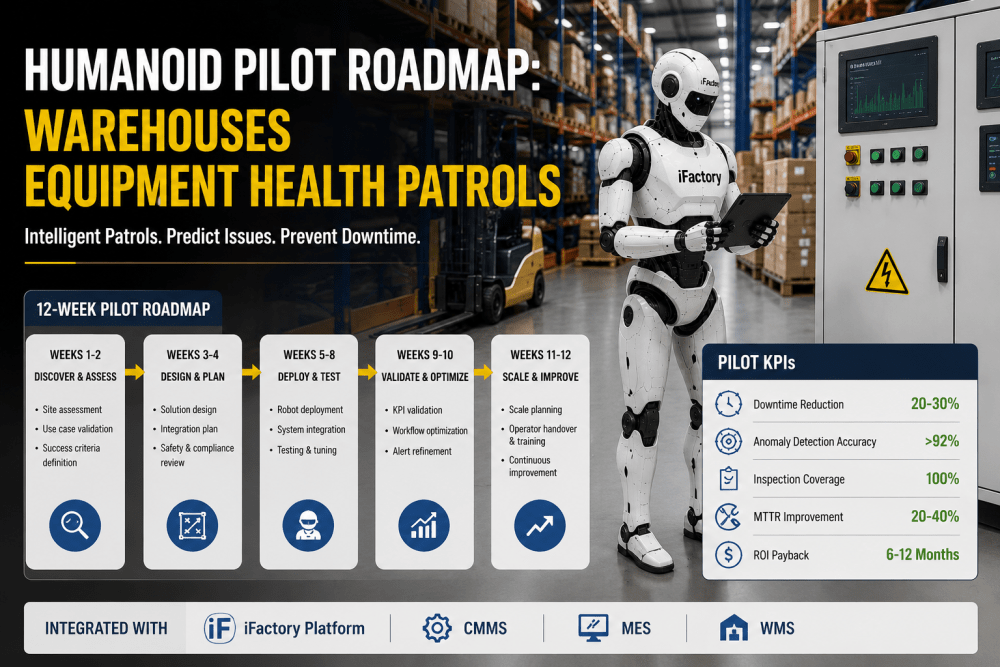
Deploying robotics for equipment health monitoring and anomaly detection follows a structured five-phase methodology that minimizes operational disruption while maximizing early ROI. The roadmap is designed to build organizational capability progressively, starting with pilot deployments that validate technology performance on critical equipment before scaling to full facility coverage. Operations leaders planning their automation roadmap Book a Demo to review the implementation timeline configured for their specific warehouse operations and equipment health priorities.
Expert Perspective — Evaluating Robot Platforms for Warehouse Equipment Health Monitoring
I have spent 22 years in distribution center operations and warehouse automation — starting as a maintenance supervisor in a 1.2 million square foot DC, then moving through operations management, and for the last nine years serving as director of automation engineering for a national logistics provider operating 28 facilities across North America. When our team began evaluating humanoid robots for equipment health monitoring, I was skeptical about their readiness for commercial operations compared to the AMR fleets we had already deployed across 15 facilities. What we discovered through our pilot program was that each robot type has a distinct and complementary role. AMRs handle 70% of our routine equipment health patrols efficiently and cost-effectively. Quadruped robots inspect the mezzanine levels, conveyor catwalks, and outdoor yard equipment that AMRs cannot reach. Humanoid robots address the highest-value inspection scenarios — confined electrical rooms, elevated structural inspections, and complex equipment access that requires opening panels and manipulating tools. We now operate a mixed fleet of 45 AMRs, 12 quadrupeds, and 6 humanoid robots across our network, all feeding equipment health data into a unified monitoring platform. The key lesson: do not try to find one robot type that does everything. Match each platform to the specific equipment health monitoring tasks it performs best, and invest in a data integration platform that unifies the data streams.
— Director of Automation Engineering, National Logistics Provider — 22 Years in Warehouse Operations and Automation EngineeringConclusion
The warehouse automation landscape now offers four distinct robot platforms — humanoid robots, AMRs, quadruped robots, and fixed cobots — each with specific strengths for equipment health monitoring, anomaly detection, and intralogistics operations. Humanoid robots provide unmatched dexterity and multi-level access for complex inspection scenarios. AMRs deliver reliable, cost-effective routine patrols on prepared floor surfaces. Quadruped robots enable inspection access to confined, elevated, and mixed-terrain locations that other platforms cannot reach. Fixed cobots provide high-precision, repeatable measurements at critical asset locations. The optimal approach for most warehouse operations is a mixed-robot deployment that matches each platform to the specific tasks it performs best, unified through a centralized data integration platform that normalizes equipment health data and applies ML-based anomaly detection across all robot types.
iFactory's industrial automation platform provides the unified equipment health monitoring, anomaly detection, and predictive maintenance integration layer that enables warehouse operators to deploy mixed-robot fleets with confidence. The platform integrates with all four robot types, normalizes sensor data from diverse payloads, applies ensemble ML models for anomaly detection, and routes predictive alerts to CMMS and MES workflows. The next step for warehouse operations leaders is a robot typology assessment that evaluates your facility's equipment health monitoring requirements, infrastructure readiness, and highest-impact automation opportunities. Book a Demo to start your warehouse automation assessment and discover which robot platform mix delivers the best ROI for your equipment health monitoring and intralogistics operations.
Frequently Asked Questions
Humanoid robots combine bipedal mobility, dual-arm manipulation, and advanced perception for equipment health inspections requiring human-like dexterity — opening panels, reading gauges, and manipulating tools in multi-level facilities. They navigate stairs, ladders, and uneven terrain but have limited battery life (4–8 hours) and higher cost per unit. AMRs provide wheeled navigation on prepared floor surfaces for routine patrols with payload capacities up to 1,500 kg and 8–16 hours of autonomy, making them the most cost-effective solution for large, structured warehouse environments with consistent floor surfaces. Quadruped robots offer legged mobility for confined indoor spaces, stairs, outdoor terrain, and multi-level racking structures that AMRs cannot access, carrying 5–15 kg of sensor payload for thermal, acoustic, and vibration inspection but limited to 2–4 hours of operation per charge. Each platform serves a distinct role in a comprehensive equipment health monitoring strategy.
Robot-deployed sensors provide three primary advantages over fixed sensor installations for anomaly detection. First, mobility enables a single robot to inspect hundreds of equipment assets across large facilities, dramatically reducing the sensor infrastructure cost compared to fixed sensors on every asset. Second, robot patrols capture data from optimal sensor positions that vary by inspection type — thermal cameras at multiple angles, acoustic sensors at specific distances, vibration sensors at precisely located measurement points — which fixed sensors cannot adjust. Third, anomaly investigation robots can respond to alerts by repositioning sensors for multi-angle data capture, enabling contextual assessment that fixed single-point sensors cannot provide. iFactory's anomaly detection platform combines both fixed sensor data and robot-deployed data in ensemble ML models, achieving 90%+ detection accuracy while maintaining lower total infrastructure cost than fixed-sensor-only deployments covering the same asset population.
Warehouse operators deploying robots specifically for equipment health monitoring and anomaly detection typically achieve ROI within 12 to 20 months, with payback periods varying based on facility size, equipment density, current unscheduled downtime levels, and the robot type selected. AMR-based equipment health patrols offer the fastest payback (10–14 months) due to lower per-unit costs and mature deployment methodologies. Quadruped robot deployments typically achieve ROI in 14–18 months, with the value driven by access to previously uninspected equipment in confined and elevated locations. Humanoid robot deployments for equipment health monitoring show 16–22 month payback periods, justified by the unique value of dexterous inspection capabilities that replace manual inspection rounds requiring skilled technicians. Mixed-robot deployments that combine multiple platforms show the highest absolute ROI (2.5–3.5x over 18 months) by matching each platform to its optimal application. iFactory provides a free ROI projection as part of the warehouse automation assessment, calculating payback timelines specific to your facility's equipment population, maintenance spend, and operational profile.
Yes, mixed-robot deployments are increasingly common in large warehouse operations, and iFactory's platform is specifically designed to manage multi-robot environments with unified data integration and workflow coordination. Humanoid robots, AMRs, quadrupeds, and fixed cobots can operate in the same facility when proper traffic deconfliction, charging station allocation, and data integration protocols are in place. AMRs handle routine floor-level patrols and material transport along defined routes. Quadruped robots operate on mezzanines, catwalks, and outdoor areas where AMRs cannot travel. Humanoid robots access confined equipment rooms, electrical panels, and elevated structures requiring manipulation. Fixed cobots cover dedicated inspection stations. The key success factors are a centralized fleet management system that coordinates robot movements, a unified data platform that aggregates equipment health data from all robot types, and clearly defined operational zones that prevent traffic conflicts. iFactory's platform provides the integration layer that enables mixed-robot deployments to operate as a coordinated equipment health monitoring system rather than isolated robot fleets.
Robot-based equipment health monitoring requires four primary infrastructure components. First, reliable facility-wide wireless connectivity (Wi-Fi 6 or private 5G) with sufficient bandwidth for real-time video streaming from robot cameras and sensor payloads — typically 50–100 Mbps per active robot. Second, charging station infrastructure positioned strategically throughout the facility to support robot fleet operations without disrupting patrol coverage — each robot type requires vendor-specific docking stations with appropriate power supply and data connectivity. Third, a data integration platform (such as iFactory) that normalizes sensor data from different robot types, applies anomaly detection models, and routes alerts to CMMS or MES workflows. Fourth, edge computing or cloud infrastructure for ML model inference, with latency requirements under 500 milliseconds for real-time anomaly detection. The deployment assessment includes a comprehensive data infrastructure audit that evaluates your facility's network coverage, power availability, and integration readiness, with specific recommendations for any infrastructure gaps identified before deployment begins. Most existing warehouse facilities have sufficient network infrastructure for initial AMR deployments, with incremental investments required for humanoid and quadruped robot operations.