Aerospace and defense facilities — MRO hangars, engine test cells, airframe assembly lines, and defense depot operations — are among the most demanding environments in modern industry. Asset failures are not just expensive; they can be catastrophic. The pressure to reduce inspection cycle times, eliminate human exposure to hazardous zones, and extract actionable data from aging equipment has pushed procurement teams to evaluate a new category of industrial automation: humanoid robots capable of equipment health monitoring, anomaly detection, and autonomous inspection. This buyer guide evaluates the four leading platforms — Figure AI, Tesla Optimus, Unitree H1, and Agility Digit — against the operational requirements of aerospace and defense, with detailed analysis of their equipment health monitoring capability, anomaly detection maturity, deployment risk profile, and ROI readiness for 2026 procurement decisions.
2026 Buyer Guide · Platform Comparison · Aerospace & Defense
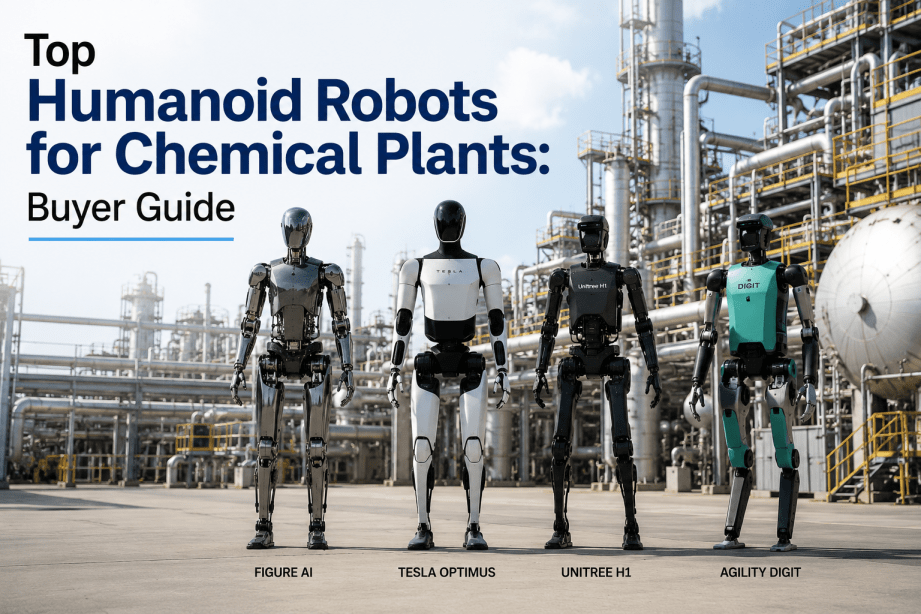
Top Humanoid Robots for Aerospace and Defense: Complete Platform Comparison
Compare Figure AI, Tesla Optimus, Unitree H1, and Agility Digit across equipment health monitoring, anomaly detection, inspection readiness, and ROI for aerospace and defense operations.
4
Platforms evaluated against aerospace requirements
12
Evaluation criteria across inspection and anomaly detection
2026
Current deployment readiness benchmarks and ROI data
AMS
Integration with iFactory AI predictive maintenance platform
Why Humanoid Robots Are Entering Aerospace and Defense Now
The shift from fixed-mount sensors and traditional CMMS workflows to embodied AI in aerospace facilities is being driven by three converging pressures. First, the inspection density problem: a single MRO hangar may require thousands of discrete inspection points per aircraft visit, many in confined spaces that are difficult to access with wheeled platforms and impossible to automate with fixed sensors. Second, the aging workforce problem: the FAA and major defense primes have documented a sustained shortage of qualified aviation maintenance technicians — humanoid robots capable of performing Level 1 visual inspection and basic NDT data collection have a direct workforce augmentation case that is easy to quantify in procurement. Third, the data latency problem: most aerospace facilities still log equipment health data on paper or in forms that feed weekly or monthly reporting cycles. Humanoid robots equipped with onboard sensors and edge AI create a continuous, real-time stream of equipment health data that integrates directly with platforms like iFactory AI for automated anomaly detection, predictive maintenance scheduling, and work order generation.
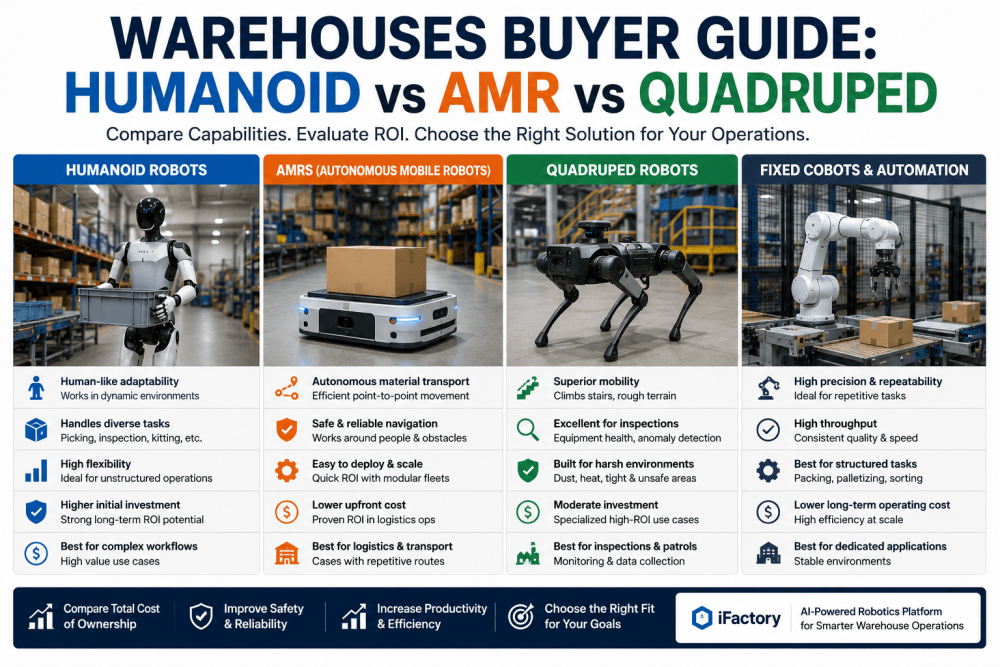
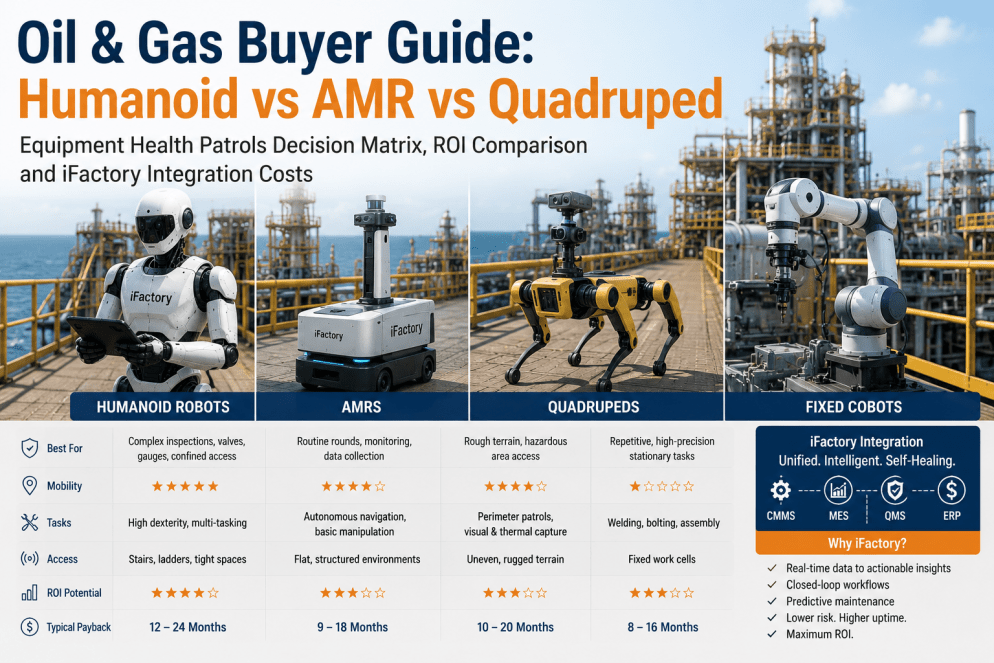
The four platforms evaluated in this guide represent the current state of the humanoid robotics market as of mid-2026: one research-to-commercial transition (Figure AI), one vertically integrated industrial program (Tesla Optimus), one open-architecture research platform with industrial deployments (Unitree H1), and one purpose-built logistics-and-inspection platform with the longest commercial track record (Agility Digit). None of the four is a finished aerospace product. All four are serious procurement candidates for facilities with the integration capability and operational context to deploy them effectively.
Platform Profiles: Figure AI, Tesla Optimus, Unitree H1, and Agility Digit
Equipment Health Monitoring and Anomaly Detection: Platform Capability Matrix
The primary value case for humanoid robots in aerospace and defense is not locomotion — it is the ability to collect equipment health data continuously, from positions and with sensor types that fixed infrastructure cannot cover, and feed that data into a platform like iFactory AI for automated anomaly detection and predictive maintenance. The matrix below scores each platform across the twelve capability dimensions that aerospace procurement teams consistently identify as decision-critical.
| Capability Dimension |
Figure AI |
Tesla Optimus |
Unitree H1 |
Agility Digit |
Aerospace Importance |
| Visual anomaly detection (surface cracks, corrosion, FOD) |
High |
High |
Medium |
High |
Critical |
| Thermal imaging / heat anomaly detection |
Medium |
Low |
High |
Medium |
Critical |
| Vibration / acoustic emissions sensing |
Medium |
Low |
High |
Low |
High |
| Confined-space access (engine bays, wheel wells) |
High |
Medium |
Medium |
Low |
Critical |
| CMMS / CMMS platform API integration |
Medium |
Low |
High |
Medium |
Critical |
| Real-time edge inference (onboard AI, no cloud dependency) |
High |
High |
Medium |
High |
Critical |
| Inspection data logging (structured, exportable) |
High |
Medium |
High |
High |
Critical |
| Autonomous inspection route execution |
Medium |
Medium |
Medium |
High |
High |
| ITAR / security compliance readiness |
Medium |
Low |
Low |
Medium |
Critical |
| Deployment timeline to operational (weeks) |
12–20 wk |
16–24 wk |
8–16 wk |
8–14 wk |
High |
| Unit cost (indicative 2026 range) |
$150K–$200K |
$100K–$150K est. |
$30K–$50K |
$80K–$120K |
High |
| Predictive maintenance data output quality |
High |
Medium |
Medium |
High |
Critical |
Deployment Readiness: A Five-Stage Framework for Aerospace Facilities
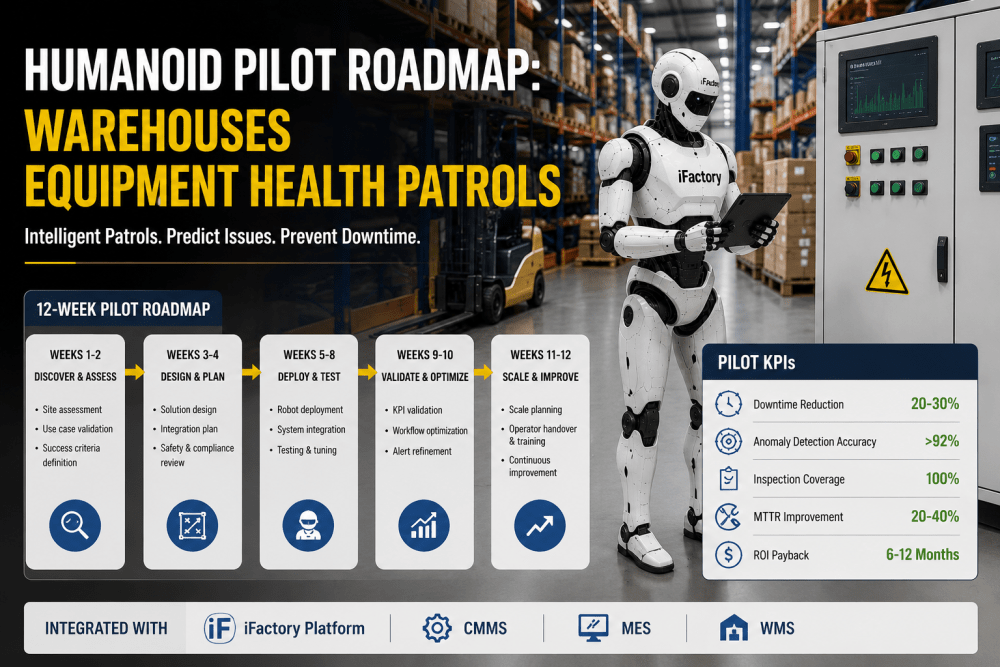
Aerospace and defense facilities cannot deploy humanoid robots the way a general manufacturing plant deploys a new machine — the regulatory, security, and operational complexity is substantially higher. The five-stage framework below maps a realistic deployment path from initial capability assessment to full operational integration with a predictive maintenance platform. Each stage has a different risk profile and a different set of requirements for platform selection. The iFactory AI platform supports integration at Stages 3–5 through its predictive maintenance and inspection management modules.
Operational Mapping and Use Case Selection
Document all inspection points, access constraints, equipment health data gaps, and current anomaly detection failure modes. Identify the 3–5 highest-value inspection tasks where robot deployment would replace human technician time at scale or where current sensor coverage is inadequate. Platform selection should begin here — not with vendor demos.
Duration: 4–8 weeks
Risk: Low
Platform Evaluation and Security Review
Conduct a structured evaluation of shortlisted platforms against your use cases — not vendor capability claims. For defense facilities, initiate ITAR compliance review, network segmentation planning, and data sovereignty assessment. Agility Digit and Figure AI have published ITAR compliance documentation; Tesla Optimus and Unitree H1 require facility-specific assessment.
Duration: 6–12 weeks
Risk: Medium — security review can extend timeline
Controlled Pilot Deployment (Single Use Case)
Deploy one robot on one defined inspection task in a non-critical zone. The goal is not to prove commercial ROI — it is to validate data quality, integration with your CMMS or predictive maintenance platform, and technician workflow compatibility. Connect the robot's inspection output to iFactory AI for anomaly detection and work order generation. Document every exception, failure mode, and workflow gap.
Duration: 8–16 weeks
Risk: Medium — integration complexity varies by platform
Multi-Task Expansion and Fleet Baseline
Expand from one task to three to five tasks across multiple inspection zones. Begin accumulating the equipment health baseline data needed for anomaly detection model training. Establish the data pipeline from robot sensor output through edge processing to the iFactory AI platform for continuous predictive maintenance signal generation. This stage typically requires 3–6 months of continuous data collection before anomaly detection models achieve production accuracy.
Duration: 12–24 weeks
Risk: Low — execution risk if Stage 3 was thorough
Full Operational Integration and ROI Documentation
Robot inspection data is fully integrated with the predictive maintenance and work order management workflow. Anomaly detections trigger automated work orders in iFactory AI with asset history, failure mode classification, and recommended action attached. Document cost per inspection point, unplanned downtime events avoided, and technician hours redeployed. This is the stage where ROI becomes measurable and the business case for fleet expansion is built.
Duration: Ongoing — quarterly ROI review cycle
Risk: Low — depends on data quality from Stages 3–4
Ready to Integrate Humanoid Robot Inspection Data with Predictive Maintenance?
iFactory AI connects robot-generated inspection data, equipment health signals, and anomaly detection outputs to automated work orders, predictive maintenance schedules, and real-time cost reporting. Book a demo to see the aerospace inspection workflow in action.
ROI Framework: Quantifying the Return on Humanoid Robot Deployment in Aerospace
ROI analysis for humanoid robot deployment in aerospace should never begin with the robot's unit cost — it should begin with the current cost of the inspection and monitoring activities the robot will replace or augment. The three most defensible ROI pathways for aerospace and defense are technician hour redeployment, unplanned downtime reduction through earlier anomaly detection, and inspection coverage expansion without headcount addition.
Technician Hour Redeployment
Level 1 visual inspection and routine data collection tasks consume between 20–40% of line maintenance technician time at high-volume MRO facilities. At a fully-loaded technician cost of $85–$120/hour in U.S. aerospace MRO, a single robot capable of handling 15–20 inspection tasks per shift frees 4–6 technician hours per day for higher-value diagnostic and repair work.
Annual impact: $280K–$520K per robot at medium MRO scale
Unplanned AOG Event Reduction
The cost of an aircraft-on-ground (AOG) event ranges from $10,000 to $150,000 per day depending on aircraft type, contract penalties, and recovery logistics. Humanoid robots conducting continuous equipment health monitoring generate anomaly signals 48–96 hours ahead of failure events that currently cause AOG incidents — enabling scheduled maintenance interventions that eliminate the unplanned downtime cost entirely.
Annual impact: $200K–$2M+ per fleet depending on AOG frequency
Inspection Coverage Expansion
Most aerospace facilities inspect a fraction of their equipment at the frequency their maintenance plans specify, due to access constraints, technician availability, and shift scheduling limits. Robots operating across all three shifts and accessing confined spaces without safety stand-down procedures increase inspection coverage per aircraft visit without adding headcount — directly reducing the risk of missed anomalies.
Annual impact: Reduced re-work and warranty claims, $50K–$400K per facility
Regulatory Compliance Data Quality
FAA and DoD inspection records require structured, traceable documentation of every inspection action. Humanoid robot inspection systems that feed structured data directly to a CMMS platform like iFactory AI eliminate manual documentation errors, reduce audit preparation time, and create an immutable digital inspection record that satisfies both commercial aviation and defense depot compliance requirements.
Annual impact: $30K–$150K in compliance overhead reduction per facility
$10K–$150K
Cost per AOG day — the primary ROI driver for predictive anomaly detection
40%
Of technician time in MRO spent on Level 1 inspection tasks addressable by humanoid robots
48–96 hr
Anomaly detection lead time achievable with continuous robot-driven equipment health monitoring
3–5 yr
Typical payback period for humanoid robot deployment at mid-scale MRO operations
Expert Review: Operations Director Perspective on Platform Selection
"We evaluated all four platforms over a 14-month period across two facilities — a commercial MRO hangar and a defense depot operation. The conclusion that surprised us most was that platform locomotion capability was not the differentiating factor. Every one of these systems can walk around a hangar floor. What separated them was data quality and integration architecture. When we ran the Unitree H1 with a custom thermal and acoustic sensor package against Figure AI's out-of-box visual inspection configuration, the H1 generated significantly richer equipment health data — but the Figure AI output integrated with our CMMS in two weeks versus the four months it took us to build the H1 pipeline. The facilities that will get the fastest ROI from humanoid robot deployment are the ones that already have a mature predictive maintenance platform in place to receive the data. The robot is the sensing layer. The platform is where the value is realized. Our recommendation to peer operations directors: do not evaluate humanoid robot platforms in isolation. Evaluate them as data sources for your existing analytics and maintenance management infrastructure. The platform that connects fastest to your predictive maintenance system is almost always the right choice, regardless of which robot walks the fastest or lifts the most weight."
Director of Maintenance Operations
Tier 1 Commercial MRO Provider — U.S. Southeast — 22 Years Aviation Industry — 3,200 Aircraft Visits Per Year
Conclusion: Selecting the Right Platform for Your Aerospace Operation
The humanoid robotics market for aerospace and defense in 2026 is past proof-of-concept and entering the early commercial deployment phase. The four platforms evaluated — Figure AI, Tesla Optimus, Unitree H1, and Agility Digit — each represent a serious capability at different price points, integration architectures, and operational maturity levels. No single platform is the correct choice for every aerospace facility. The selection decision should be driven by three factors: the specific inspection and equipment health monitoring use cases your facility needs to address, the integration architecture of your existing predictive maintenance and CMMS platform, and your facility's internal robotics engineering capability.
For facilities with mature predictive maintenance infrastructure — including an AI-driven predictive maintenance platform, structured work order management, and real-time equipment health dashboards — the humanoid robot is best understood as a mobile sensor and inspection execution layer that dramatically expands the data coverage of that infrastructure. The iFactory AI platform is designed to receive, process, and act on the equipment health data that humanoid robots generate, connecting inspection findings to automated work orders, predictive maintenance schedules, and per-asset cost tracking. The most important investment decision in aerospace humanoid robotics is not which robot to buy — it is ensuring the data platform it feeds into is capable of converting inspection data into maintenance action at the speed and accuracy the platform promises. Book a demo to see how iFactory AI integrates with humanoid robot inspection platforms for aerospace and defense operations.
Connect Your Humanoid Robot Inspection Data to iFactory AI — See the Integration Live.
iFactory AI's predictive maintenance, inspection management, and work order platforms are designed to receive and act on equipment health data from humanoid robot deployments. Book a demo or contact our aerospace solutions team to discuss your specific use case.
Frequently Asked Questions