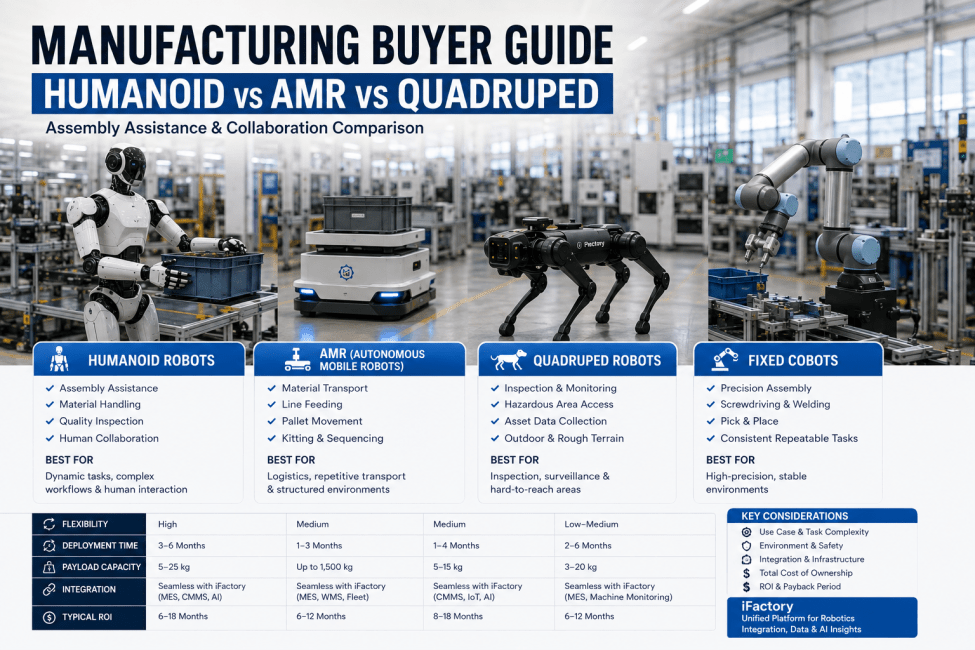
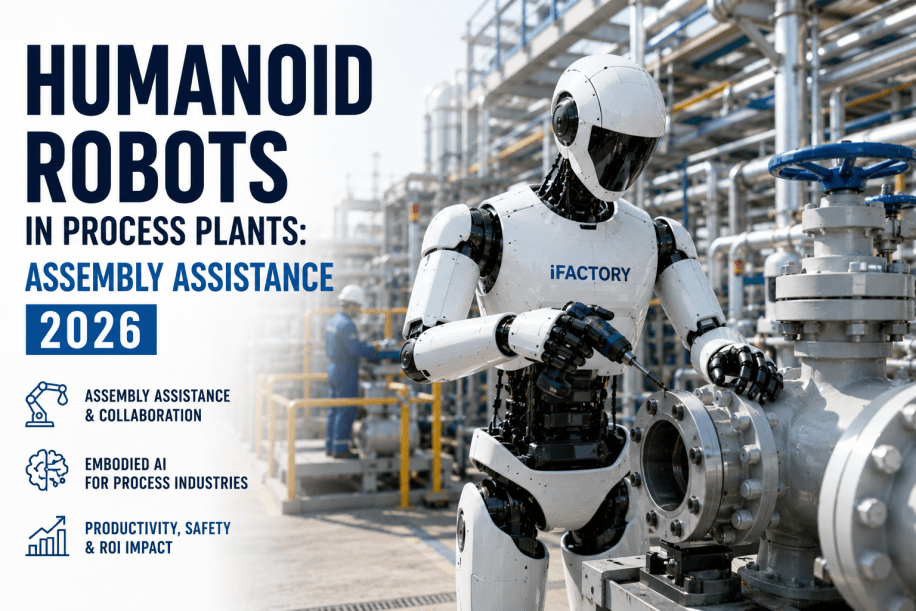
Textile and apparel manufacturing has long resisted full automation — fabric is limp, deformable, and inconsistently shaped in ways that make it exceptionally difficult for conventional rigid robots to handle. Humanoid robots, purpose-built with dexterous multi-finger hands, compliant limb control, and embodied AI that adapts to unstructured environments, represent the first credible path to closing that gap at scale. In 2026, four platforms — Figure AI, Tesla Optimus, Unitree H1, and Agility Robotics Digit — are the serious contenders being evaluated by garment manufacturers, cut-and-sew operations, and vertically integrated textile producers. This page compares those platforms on the dimensions that matter for assembly assistance: dexterity, payload, cycle-time compatibility, workforce collaboration posture, and total cost of deployment. Book a Demo to see how iFactory AI integrates humanoid robotics data into your textile operations management platform.
Is Your Textile Facility Ready to Deploy Humanoid Robots on the Assembly Line?
iFactory AI connects humanoid robot platforms, production sensors, CMMS, and workforce management into a unified textile operations intelligence layer — delivering real-time assembly monitoring, predictive maintenance, and prescriptive production recommendations for garment and textile manufacturers worldwide.
Why Humanoid Robots Are the Next Frontier in Textile Manufacturing Automation
The global textile and apparel industry employs over 300 million workers and generates more than $1.5 trillion in annual output — yet it remains one of the least automated segments of manufacturing. The primary barrier has never been capital or intent; it has been physics. Fabric bundles shift under their own weight. Seam allowances vary by fractions of a millimeter. Thread tension changes with humidity. No rigid-arm industrial robot deployed at scale has solved these challenges in a general way.
Humanoid robots change the calculus by bringing human-form factors into the equation. When a robot shares the same height, reach envelope, grip geometry, and locomotive pattern as the human workers it collaborates with, it can occupy the same workstations, use the same fixtures, and share the same workflow sequences — without requiring facilities redesign or custom tooling investment. The result is a deployment model that is fundamentally more capital-efficient than cell-based robotic automation for garment and cut-and-sew operations.
The 2025–2026 deployment window is not mass production; it is validated pilot deployment across leaders in each platform category. Understanding which platform fits which textile task — and which operational management infrastructure is required to extract ROI — is the decision that determines whether early adopters gain a structural productivity advantage or accumulate expensive integration debt.
Figure AI, Tesla Optimus, Unitree H1, and Agility Digit: Head-to-Head for Textile Assembly
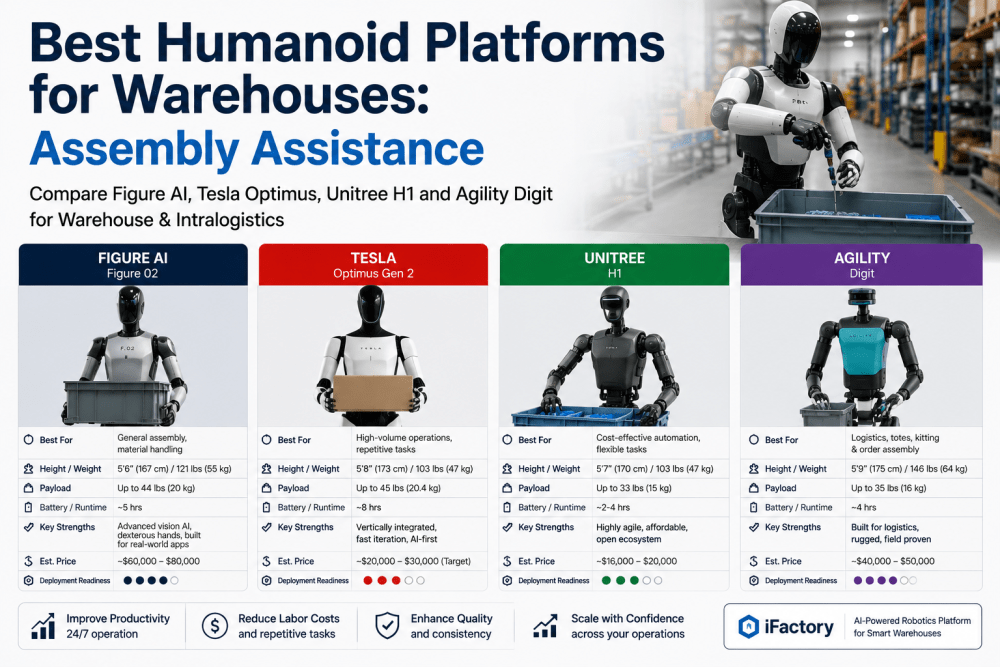
Each of the four leading humanoid platforms has been engineered with different design priorities — priorities that map onto different textile manufacturing use cases with varying degrees of fit. The comparison below is structured around the operational dimensions that matter most for garment assembly assistance: dexterity and hand design, payload and reach, collaborative safety certification, software integration openness, and deployment readiness for textile environments.
| Dimension | Figure AI 02 | Tesla Optimus Gen 2 | Unitree H1 | Agility Digit |
|---|---|---|---|---|
| Hand Dexterity | 16-DOF multi-finger hands, tactile sensors | 22-DOF articulated hands, force feedback | 4-finger gripper, task-specific tooling | Two-fingered grippers, payload-optimized |
| Payload Capacity | ~20 kg per arm, fabric-safe grip modes | ~20 kg carry, compliant grasp control | ~5 kg per hand, lightweight assembly | ~16 kg total, logistics-first design |
| Walking Speed | 1.2 m/s sustained | ~0.5 m/s (controlled environment) | 1.5 m/s, high mobility | 1.5 m/s, optimized for factory floors |
| AI / Vision Stack | Embodied AI, multimodal LLM integration | Tesla FSD-derived neural inference | ROS2-compatible, third-party AI integrable | Machine Perception System, 3D LIDAR + stereo |
| Cobot Safety Posture | Designed for human-adjacent operation | Human-adjacent, force-limited modes | Requires safety barriers in most deployments | ISO 10218 cobot-oriented design |
| Textile Assembly Fit | High — fine fabric manipulation capable | High — highest dexterity platform | Medium — material handling, not fine sewing | Medium-High — transport, staging, pick & place |
| API / Integration | Partner program, limited open API | Proprietary stack, Tesla ecosystem | Open SDK, ROS2 native | Open API, enterprise integrations available |
| Deployment Status (2026) | Pilot production at partner manufacturers | Internal Tesla factories + select partners | Available for commercial purchase | Commercial deployments at Amazon and others |
The right platform choice depends on whether the textile facility's primary bottleneck is fine-fabric manipulation, intra-facility logistics, cut-panel staging, or finished-goods handling. No single platform dominates all four — which is why a phased, task-mapped deployment strategy is more effective than a single-platform bet. Book a Demo to map these platforms to your specific textile assembly workflow.
Where Humanoid Robots Add the Most Value in Textile Assembly Operations
Not all textile manufacturing tasks are equal candidates for humanoid robot assistance. The highest-value deployment zones are tasks that combine high repetition, ergonomic risk for human workers, and tolerance for a 5–15% cycle-time premium in exchange for consistency and 24-hour availability. The task map below identifies the five categories where humanoid platforms are delivering or approaching commercial-grade performance in 2025–2026 pilot deployments.
Cut-Panel Pick & Place
Lifting, orienting, and feeding cut fabric panels into sewing fixtures is physically repetitive and ergonomically damaging. Humanoid robots with compliant grippers can handle panels without stretching or distorting grain lines — a task where Agility Digit and Figure AI show strong pilot-stage performance.
Sub-Assembly Staging & Bundling
Grouping cut components into work bundles for downstream sewing operators is a high-touch, low-skill task that consumes 15–25% of direct labor hours in typical CMT facilities. Humanoid robots can execute bundle staging with near-zero error rates at throughput rates compatible with current line speeds.
Inline Quality Inspection Assist
Presenting finished sub-assemblies to vision-based inspection stations, re-orienting panels for consistent camera angles, and flagging defective units for rework are tasks where humanoid robot dexterity adds quality assurance value without requiring dedicated machine vision infrastructure for every workstation.
Finished-Goods Folding & Packing
Garment folding and poly-bagging are among the most labor-intensive end-of-line operations in apparel manufacturing. Tesla Optimus's 22-DOF hand articulation makes it the leading candidate for folding tasks that require precise, repeatable finger sequences — though commercial deployment at scale remains 12–18 months out.
Material Transport & Replenishment
Moving fabric rolls, trim carts, and work-in-process bins between cutting rooms, sewing floors, and finishing areas is a high-volume logistics task where Agility Digit's walking stability and payload capacity make it immediately deployable. Amazon's confirmed Digit deployment validates the commercial readiness of this use case.
Human-Robot Collaboration Models for Textile Production Lines
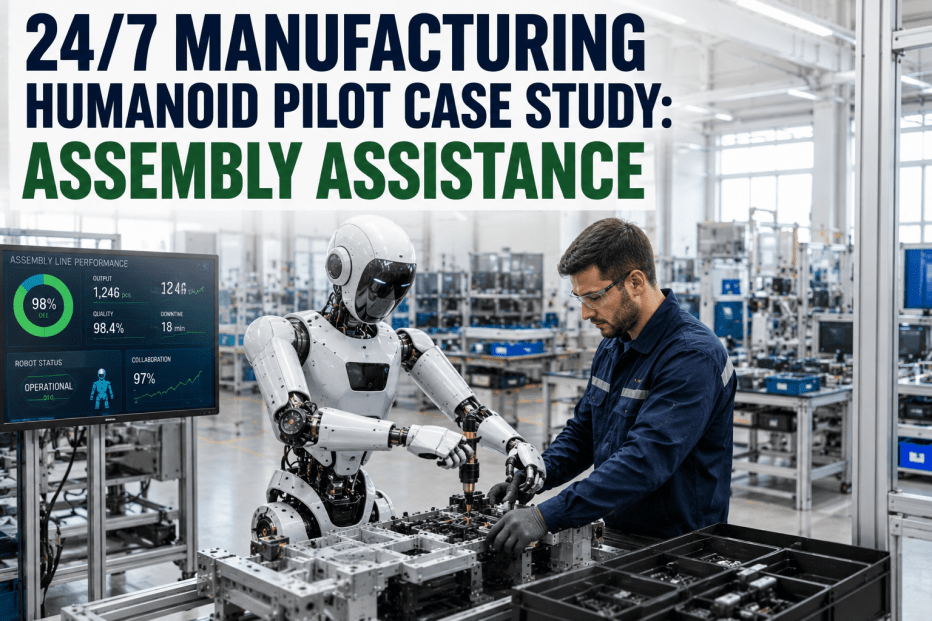
The most productive humanoid robot deployments in manufacturing are not robot-replacement models — they are structured collaboration models where human workers and humanoid platforms divide tasks based on what each does best. In textile manufacturing, this means humans retain sewing machine operation, quality judgment, and exception handling, while humanoid robots absorb the repetitive material-handling, staging, and logistics work that currently limits human worker throughput and drives ergonomic injury rates.
Human Worker Strengths
- Sewing machine operation and thread tension judgment
- Pattern matching and aesthetic quality evaluation
- Exception handling for off-spec materials
- Complex folding sequences requiring tactile feedback
- Supervisor authorization and production pace-setting
- Customer-facing quality standards enforcement
Humanoid Robot Strengths
- Cut-panel pick, orient, and feed — 24 hours per day
- Bundle staging and work-in-process logistics
- Fabric roll transport and replenishment
- Consistent inspection presentation posture
- Repetitive folding sequences at constant cycle time
- Zero ergonomic fatigue accumulation over shift
The collaboration model works because humanoid robots absorb the tasks that degrade human worker performance over a shift — physical repetition, awkward postures, and constant material lifting — while human workers retain authority over the skilled judgment tasks that define garment quality. Productivity gains of 20–35% per operator have been documented in early cobot textile deployments where this task division is applied systematically.
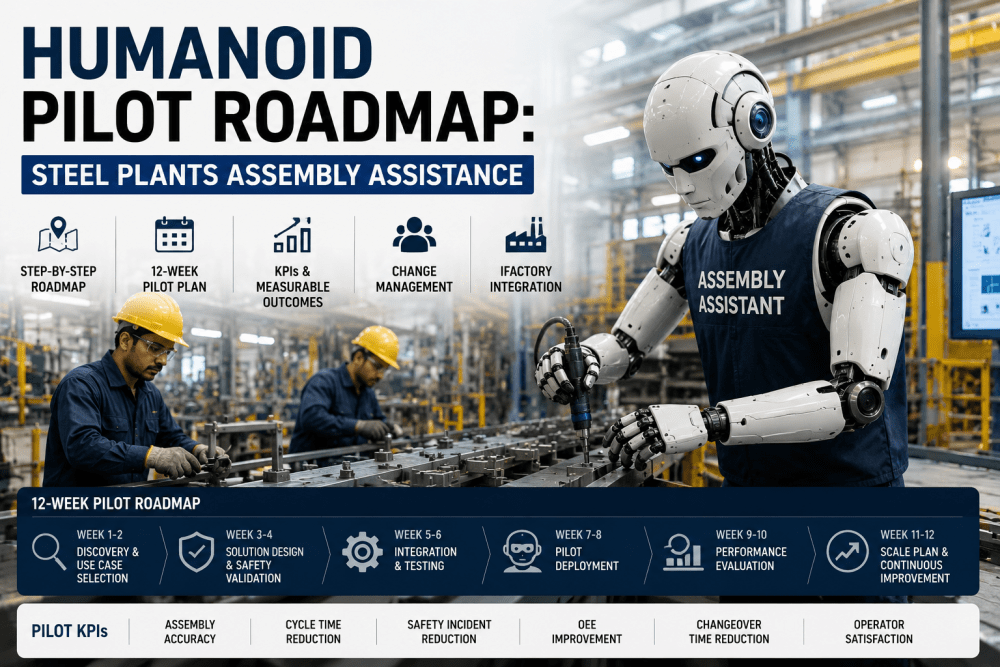
5-Step Humanoid Robot Deployment Roadmap for Textile Manufacturers
Textile manufacturers deploying humanoid robots for the first time consistently benefit from a phased approach that starts with the lowest-risk, highest-confidence use cases and builds toward fine-assembly assistance as robot-platform and workforce-integration maturity develops. The roadmap below reflects the deployment pattern validated across 2024–2025 industrial pilots and the integration requirements of iFactory AI's textile manufacturing operations management platform. Book a Demo to walk through this sequence applied to your specific facility layout and production model.
Task Audit and Robot-Ready Zone Identification
iFactory AI's manufacturing engineers conduct a structured workflow assessment across the cutting room, sewing floor, and finishing area — mapping every repetitive material-handling task by cycle time, ergonomic risk score, and robot-readiness based on current fixture and workstation geometry. High-ROI, low-barrier tasks (bundle staging, fabric roll transport) are prioritized for Phase 1 deployment, with assembly-assistance tasks sequenced to Phase 2 and Phase 3 as platform capability matures.
Platform Selection and Procurement Based on Task-Fit Matrix
Using the task audit output, iFactory AI maps each target use case to the platform with the highest technical fit — Agility Digit for logistics and material transport, Figure AI for fine fabric handling, Unitree H1 for high-mobility material movement. Procurement, safety certification, and facility modification requirements are documented before any hardware commitment is made, preventing the most common source of humanoid robot deployment failure.
iFactory AI Platform Integration for Robot Data and Production Monitoring
iFactory AI's IoT gateway connects humanoid robot telemetry — cycle counts, uptime, error states, task completion rates — into the same production monitoring, CMMS, and OEE analytics dashboard that tracks human operator throughput and machine performance. This unified visibility prevents the common failure mode where robot performance data exists in a silo disconnected from the production KPIs that determine whether deployment ROI is being achieved.
Workforce Collaboration Protocol and Safety Zone Configuration
Humanoid robot deployment at ISO 10218-compliant cobot safety levels requires defined collaboration zones, speed-and-separation monitoring configuration, and worker training protocols. iFactory AI documents these configurations as part of the standard deployment package — including shift handover procedures, robot downtime escalation workflows, and the operator authorization flows that keep humans in control of production pace decisions throughout the pilot period.
Performance Validation, OEE Benchmarking, and Phase 2 Expansion
After 60–90 days of Phase 1 operation, iFactory AI generates a validated performance report comparing pre- and post-deployment OEE, labor productivity per operator, ergonomic incident rates, and throughput consistency. This report drives the Phase 2 task-expansion decision — including which assembly-assistance use cases are ready for activation and which platform upgrades or additional units are justified by documented Phase 1 economics.
Deploy Humanoid Robot Monitoring and Production Intelligence at Your Textile Facility
iFactory AI's platform delivers real-time robot telemetry integration, OEE analytics, predictive maintenance, CMMS, and workforce productivity monitoring purpose-built for textile and garment manufacturers deploying Figure AI, Tesla Optimus, Unitree H1, or Agility Digit.
Expert Review: What 2024–2025 Research Documents About Humanoid Robots in Textile Manufacturing
Peer-reviewed and industry research on humanoid robotics in soft-goods manufacturing has accelerated substantially since 2022, driven by advances in compliant actuator design, tactile sensing, and embodied AI training methodologies. The academic consensus as of 2025 identifies fabric deformability as the fundamental technical barrier — and dexterous humanoid manipulation as the most promising solution pathway, ahead of both rigid-arm automation and textile-specific fixed automation systems.
Research published in Robotics and Automation Letters and related journals consistently identifies deformable object manipulation — the ability to handle limp, low-stiffness materials like woven fabric — as the primary capability gap separating humanoid platforms from commercial textile deployment readiness. The 2025 Figure AI and Tesla Optimus development cycles both cite deformable manipulation benchmarks as primary training objectives.
- Tactile sensor arrays enabling real-time fabric tension feedback
- Compliant joint control preventing seam distortion during handling
- Vision-tactile fusion enabling consistent panel orientation
A 2024 ILO analysis of industrial robot deployment in garment-producing countries found that facilities deploying cobot-class automation in material handling roles experienced net employment stability or growth in skilled operator roles, while reducing ergonomic injury rates by 20–40%. The substitution effect was concentrated in the specific manual-handling tasks robots performed — not in overall headcount.
- Ergonomic injury rates reduced 20–40% in handling-role cobot deployments
- Skilled sewing operator headcount stable or increased in pilot facilities
- Worker productivity per sewing operator increased when handling burden removed
McKinsey's 2025 apparel industry report projects that manufacturers deploying automation in material handling and sub-assembly roles will achieve 15–25% cost-per-garment reductions within three years of deployment — driven primarily by throughput consistency gains and ergonomic injury cost elimination, rather than direct labor substitution. The investment window for first-mover advantage in humanoid deployment is the 2025–2027 period.
- 15–25% projected cost-per-garment reduction from handling automation
- 2025–2027 identified as first-mover advantage deployment window
- Nearshoring trends increasing automation investment pressure in U.S. facilities
ROI Framework and Deployment Risk Assessment by Platform
Calculating ROI for humanoid robot deployment in textile manufacturing requires accounting for four cost streams: capital investment per unit, integration and commissioning costs, ongoing maintenance, and productivity uplift value. The risk assessment dimension — integration complexity, safety certification requirements, and software support maturity — affects the realistic timeline to positive ROI and is often underweighted in initial investment analysis.
| Platform | Est. Unit Price (2026) | Integration Complexity | Textile ROI Timeline | Primary Deployment Risk | Best-Fit Textile Task |
|---|---|---|---|---|---|
| Figure AI 02 | ~$150K–$200K | Medium — partner onboarding required | 18–24 months (fine handling) | Limited platform availability, partner-gated access | Panel pick-and-place, fabric handling |
| Tesla Optimus Gen 2 | ~$20K–$30K (target) | High — proprietary stack, ecosystem lock-in | 24–36 months (early deployment) | Proprietary ecosystem dependency, limited integrations | Folding, fine assembly (future) |
| Unitree H1 | ~$90K–$130K | Low — open SDK, ROS2 native | 12–18 months (logistics tasks) | Lower dexterity limits fine-fabric task scope | Material transport, heavy lifting |
| Agility Digit | ~$250K+ (enterprise lease) | Medium — enterprise integration, API available | 12–18 months (logistics tasks) | Higher unit cost, lease-model dependency | WIP logistics, finished-goods handling |
Tesla Optimus's long-term price target of $20K–$30K per unit represents the most significant potential cost disruption in the humanoid market — but 2026 commercial availability for external textile manufacturers remains limited. For facilities making deployment decisions in 2026, Unitree H1 and Agility Digit offer the clearest path to near-term positive ROI on logistics and material-handling tasks, with Figure AI as the preferred path for facilities prioritizing fine-fabric assembly assistance.
Humanoid Robots in Textile Manufacturing — Frequently Asked Questions
Can humanoid robots actually handle fabric without distorting or damaging it?
The leading humanoid platforms — particularly Figure AI 02 and Tesla Optimus Gen 2 — are equipped with multi-finger hands incorporating tactile sensor arrays that provide real-time feedback on grip force distribution. This enables compliant grasping modes where the robot adjusts finger pressure dynamically based on sensed fabric tension — preventing the distortion, stretching, and grain-line misalignment that rigid grippers cause. Commercial-grade performance for panel pick-and-place tasks is achievable in 2026; performance on finer sewing-adjacent manipulation (thread handling, zipper insertion) remains in advanced development. Book a Demo to assess task-specific readiness for your production process.
Which humanoid platform is best for a U.S.-based garment manufacturer in 2026?
For logistics and material transport tasks, Agility Digit has the strongest commercial deployment track record (validated at Amazon at scale) and is the lowest-risk choice for a first deployment. For fine-fabric handling and panel manipulation, Figure AI 02 represents the most capable platform with a partner-accessible commercial program. For budget-constrained facilities prioritizing open integration and development flexibility, Unitree H1's open SDK and ROS2 compatibility make it the most technically accessible entry point. Tesla Optimus offers the highest long-term dexterity potential but remains primarily an internal Tesla deployment in 2026, limiting near-term commercial access for external manufacturers.
How does iFactory AI integrate with humanoid robot platforms in a textile facility?
iFactory AI connects to humanoid robot platforms through standard OPC-UA, MQTT, and REST API interfaces — ingesting robot telemetry (cycle counts, uptime, task states, error codes) into the same production monitoring, CMMS, and OEE analytics layer that tracks sewing machine performance and human operator throughput. This gives operations managers a unified view of the entire production floor — human and robotic — without maintaining separate dashboards for robot status and production KPIs. Integration with iFactory AI typically deploys in 6–8 weeks and does not require changes to existing robot control software or factory automation infrastructure.
What is the realistic productivity impact of deploying humanoid robots in a mid-size garment facility?
In cobot deployments specifically targeting material handling and sub-assembly staging — the tasks with the clearest 2026 readiness profile — productivity gains of 20–35% per sewing operator have been documented in pilot facilities. The mechanism is indirect: by eliminating the time sewing operators spend fetching bundles, repositioning panels, and transporting finished work-in-process, the robots increase the proportion of shift time that operators spend on high-value sewing operations. Direct robot-to-human substitution in fine sewing tasks is not the primary value driver in current deployments — augmentation of skilled worker throughput is.
What safety standards govern humanoid robot deployment alongside textile workers?
Humanoid robots operating in collaborative mode adjacent to human workers fall under ISO 10218-1 and ISO 10218-2 (industrial robot safety) and ISO/TS 15066 (collaborative robot safety requirements), which specify speed-and-separation monitoring, force-and-power limiting, and hand-guiding protocols. Agility Digit was designed from its initial architecture with ISO 10218 compliance as a primary objective. Figure AI and Tesla Optimus operate under force-limited modes that are compatible with collaborative safety requirements, though facility-specific safety zone configuration and risk assessment is required before adjacent human operation is authorized. iFactory AI documents and maintains these safety configurations as part of the standard deployment package.
Humanoid Robots in Textile Manufacturing: The Deployment Window Is Now Open
The question facing U.S. textile and garment manufacturers in 2026 is not whether humanoid robots will eventually transform assembly operations — the platform capability, commercial availability, and research validation make that trajectory clear. The question is which facilities deploy early enough to build operational expertise, optimize human-robot collaboration protocols, and capture productivity advantages before the technology becomes a commodity capability that all competitors share simultaneously.
The four platforms evaluated in this guide — Figure AI 02, Tesla Optimus Gen 2, Unitree H1, and Agility Digit — each have a distinct best-fit profile for textile manufacturing. None of them is a universal solution, and none of them deploys successfully without the operational management infrastructure needed to integrate robot performance data into production decision-making. That infrastructure — connecting robot telemetry, production monitoring, CMMS, and workforce productivity analytics into a unified platform — is what iFactory AI delivers for textile manufacturers making the transition. Book a Demo to see how iFactory AI supports your humanoid robot deployment from Day 1 through long-term ROI validation.
Deploy iFactory AI Robotics Intelligence at Your Textile Facility — Live in 8 Weeks
Join textile and garment manufacturers using iFactory AI to connect humanoid robot platforms, CMMS, production monitoring, and workforce analytics into a unified operations intelligence platform — built for the assembly lines deploying Figure AI, Tesla Optimus, Unitree H1, and Agility Digit in 2026.
.png)