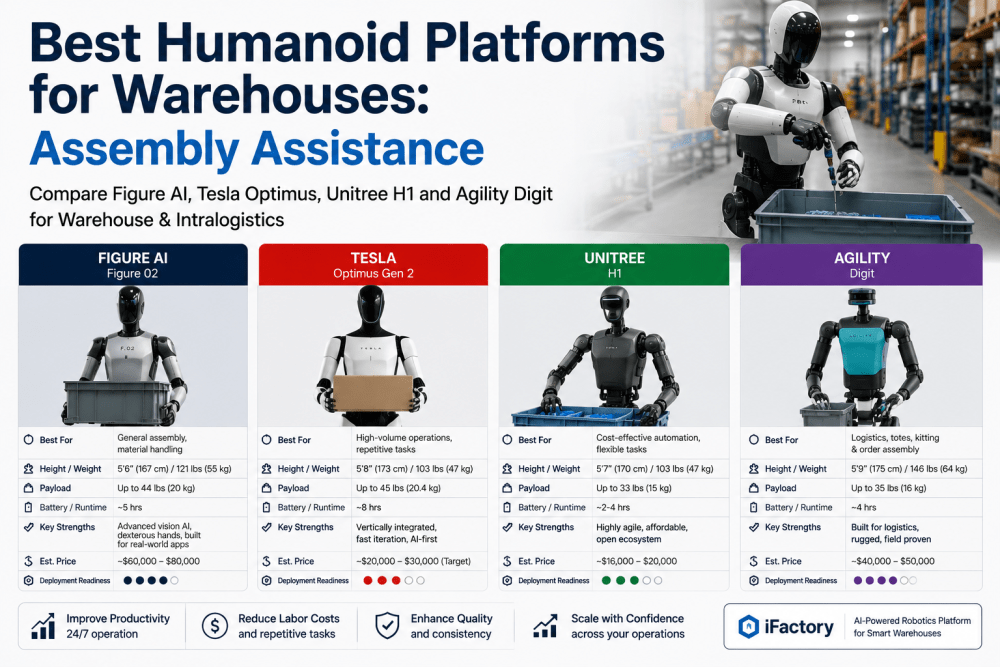
At 2:47 AM in a 1.2-million-square-foot e-commerce DC outside Dallas, the overnight shift supervisor watches the WMS dashboard freeze. Three humanoid units from different vendors — one running Figure AI's latest build, another a Tesla Optimus prototype on loan, a third a Unitree H1 that passed safety inspection just last week — are all stalled at the same pick module. The supervisor has no unified view of their fleet. No way to tell which robot has a thermal anomaly, which one lost its SLAM reference, and which one is simply waiting for a command that never arrived. By the time maintenance reaches the floor, 47 minutes of throughput are gone and the sortation system downstream is starved. This scene repeats nightly across the fastest-growing warehouse operations in the country, and it's not a robot problem — it's an operations management problem that no single vendor's telemetry dashboard was designed to solve.
Stop Managing Humanoid Robots Vendor-by-Vendor — Unify Fleet Visibility, Safety Compliance, and Throughput in One Operations Platform
iFactory gives warehouse operators a single pane of glass across Figure AI, Tesla Optimus, Unitree H1, Agility Digit, and any industrial humanoid fleet — with real-time safety inspections, AI-driven throughput monitoring, and turnkey deployment in 6–12 weeks, all on-premise with zero data egress.
Why Your Warehouse's Humanoid Robots Are Underperforming — and Nobody's Dashboard Tells You Why
Your warehouse has invested in the most advanced embodied AI logistics hardware available. But each vendor — Figure AI, Tesla, Agility, Unitree — ships its own proprietary monitoring stack. None of them talk to each other. None of them integrate with your existing WMS, PLCs, or safety systems. The result is a blind spot that costs you throughput, safety compliance, and operational sanity.
Vendor-Specific Dashboards Create Operational Silos
Your Figure AI units report status through one portal, your Tesla Optimus fleet through another, and your Unitree H1 safety logs live in a third. There is no cross-vendor view of fleet health, task completion rates, or battery states. Supervisors waste 35–50 minutes per shift toggling between interfaces — time that directly reduces pick-and-pack throughput in a labor-constrained market.
Safety Inspections Are Manual, Inconsistent, and Lagging
Every industrial humanoid robot requires periodic safety inspections — thermal checks, torque validation, collision-avoidance calibration. Today, most warehouses rely on clipboard-based walkarounds or vendor-specific maintenance schedules that don't align with shift cadence. A single missed inspection on a Unitree H1 or Agility Digit unit can lead to a 3–5 day operational shutdown if an incident occurs, costing $150K–$400K in downtime per event.
No Real-Time Throughput Correlation Across Robot Types
When a Tesla Optimus unit slows down at a pick station, does the downstream Agility Digit unit get starved? When a Figure AI robot takes a suboptimal path, does it create a bottleneck for human pickers? Without a unified AI warehouse monitoring layer, you cannot correlate individual robot performance to overall intralogistics throughput. You're flying blind on the very metrics your ROI case was built on.
Digital Transformation Initiatives Stall on Integration Complexity
Your smart warehouse automation roadmap includes humanoid robots as a key pillar. But every new robot platform requires separate API integration, separate data pipelines, and separate safety compliance documentation. IT teams spend 8–14 weeks per vendor just to get basic telemetry flowing — and that's before any advanced monitoring or AI-driven optimization begins. The result: your warehouse digital transformation is perpetually six months behind schedule.
Robot Platform Comparison Becomes an Apples-to-Oranges Nightmare
When you need to decide whether to expand your Figure AI fleet or invest more heavily in Agility Digit, you need apples-to-apples data on throughput, uptime, safety incidents, and total cost per pick. But each vendor reports metrics differently — different time windows, different definitions of "uptime," different cost models. You cannot make data-driven procurement decisions without a neutral, unified operations management layer that normalizes data across all industrial humanoid robots in your fleet.
Your warehouse already has the robots. What's missing is the operations platform that makes them work together. Book a 30-min walkthrough and we'll show you how iFactory unifies your humanoid fleet in one on-premise dashboard.
From Fragmented Fleets to Unified Intralogistics Intelligence — in Four Steps
iFactory connects directly to each robot platform's data source — whether it's Figure AI's API, Tesla Optimus telemetry, Unitree H1's diagnostics port, Agility Digit's cloud endpoint, or any other industrial humanoid robot — and normalizes the data into a single operations view. No cloud dependency. No vendor lock-in. No custom integration projects.
Connect Once, Monitor All
iFactory's on-premise NVIDIA appliance connects to your plant network and ingests telemetry from every humanoid robot platform in your fleet — Figure AI, Tesla Optimus, Unitree H1, Agility Digit, and others — through their native APIs or edge gateways, with no cloud data egress.
Normalize & Correlate in Real Time
The platform transforms vendor-specific data formats into a unified schema — battery state, task completion, safety flags, path efficiency, thermal status — and correlates them against your WMS throughput data to reveal cross-fleet bottlenecks and optimization opportunities.
Automate Safety Inspections & Compliance
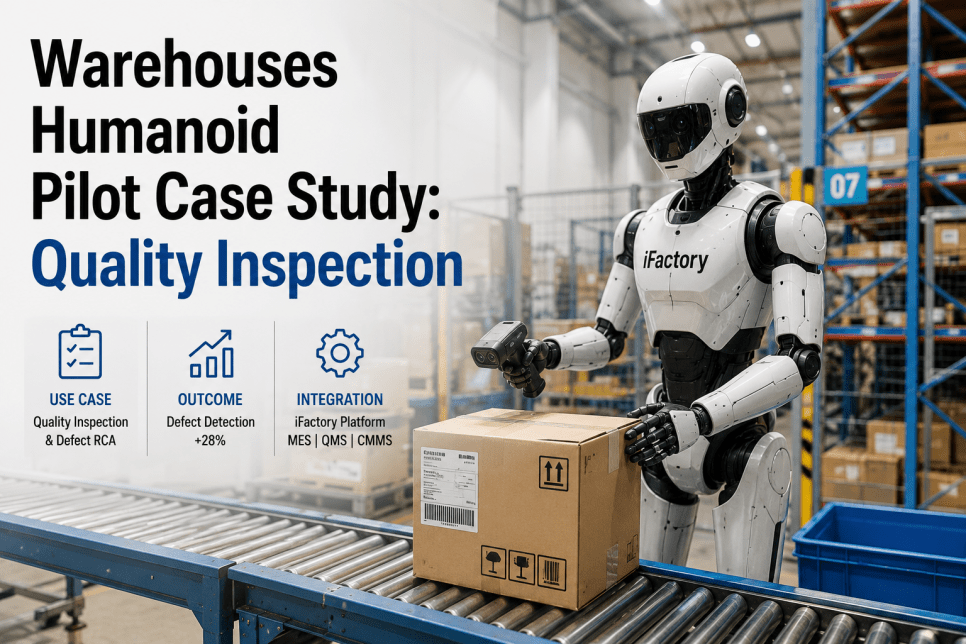
iFactory continuously monitors each robot's safety-critical parameters — torque limits, collision-avoidance system health, thermal thresholds — and triggers automated inspection workflows when deviations are detected, with full audit trails for OSHA and internal compliance requirements.
Deliver Actionable Fleet Intelligence
Your operations team gets a single dashboard with real-time fleet health, throughput-by-robot comparisons, predictive maintenance alerts, and ROI analytics that let you compare Figure AI vs. Tesla Optimus vs. Agility Digit on the metrics that matter to your operation — all without leaving the iFactory interface.
What iFactory's Humanoid Fleet Operations Platform Does That Vendor Dashboards Can't
iFactory is not a robot management tool — it's an operations management platform built for the reality of multi-vendor humanoid fleets in production warehouses. Here's what that means for your team.
Cross-Platform Fleet Health Dashboard
See every Figure AI, Tesla Optimus, Unitree H1, and Agility Digit unit on a single map with real-time status, battery level, task assignment, and safety flags. No more toggling between vendor portals or building custom integration scripts.
Automated Safety Inspection Engine
iFactory continuously monitors safety-critical parameters across all robot platforms — thermal limits, torque profiles, collision-avoidance system health — and triggers automated inspection workflows when thresholds are breached, with full audit trail for compliance reporting.
AI-Driven Bottleneck Detection
Our AI warehouse monitoring engine correlates individual robot performance against overall intralogistics throughput, identifying bottleneck robots, suboptimal pick paths, and starved downstream stations before they impact your shift targets.
Vendor-Agnostic Robot Platform Comparison
Compare Figure AI, Tesla Optimus, Unitree H1, and Agility Digit on throughput, uptime, safety incidents, and cost per pick — with normalized metrics that let you make data-driven fleet expansion decisions without vendor-biased reporting.
Fleet-Wide Health Forecasting
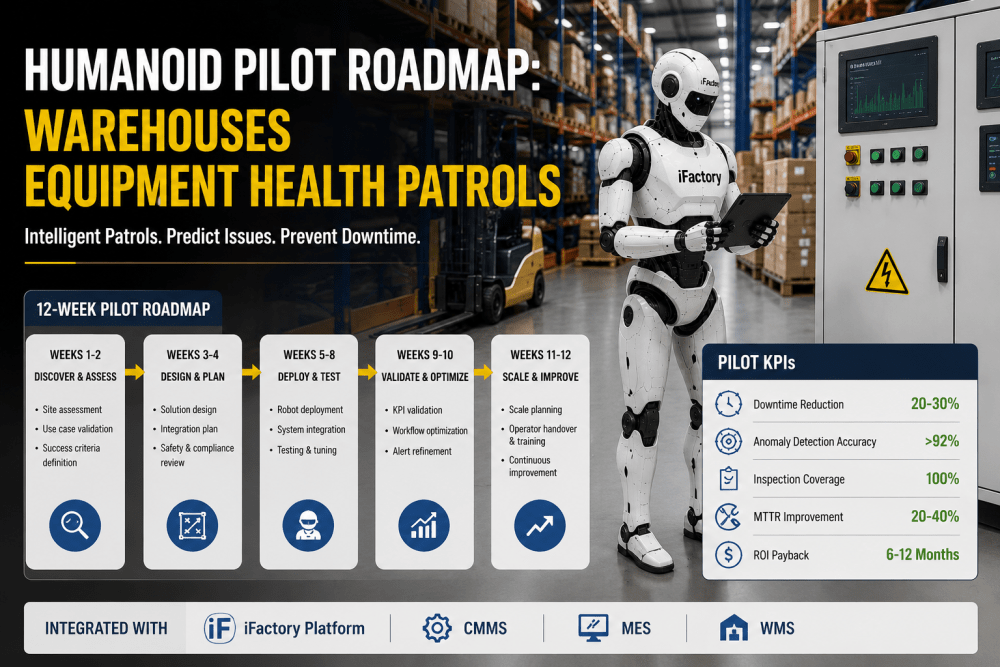
iFactory's ML models analyze telemetry across all your humanoid robots to predict component failures 48–72 hours in advance, reducing unplanned downtime by up to 40% and extending the operational life of your robot investments.
On-Premise Deployment, No Cloud Dependency
All data stays on your plant network via iFactory's NVIDIA appliance. No cloud data egress, no third-party data exposure, no latency from cloud round-trips. Your robot telemetry, safety logs, and throughput data never leave your facility.
What Unified Humanoid Fleet Management Delivers in Real Warehouses
Early adopters of iFactory's humanoid fleet operations platform have documented measurable improvements in safety, throughput, and operational efficiency — without adding headcount or replacing existing robot investments.
Everything You Need to Turn Your Humanoid Fleet Into a Unified Operations Asset
iFactory delivers a complete, turnkey operations management platform for your warehouse's humanoid robots — no custom integration projects, no vendor lock-in, no cloud dependency. Here's what's included in every deployment.
End-to-End Deployment in 6–12 Weeks
You hand over data-source access to your existing robot platforms and WMS; iFactory delivers a working pilot connecting Figure AI, Tesla Optimus, Unitree H1, Agility Digit, and any other humanoid fleet in 6–12 weeks. No custom development required.
On-Premise NVIDIA Appliance
All processing happens on your plant network. Zero cloud data egress, zero third-party data exposure. Your robot telemetry, safety logs, and throughput data never leave your facility.
Vendor-Agnostic Fleet Intelligence
iFactory's data normalization layer works with any industrial humanoid robot platform — Figure AI, Tesla Optimus, Unitree H1, Agility Digit, and emerging vendors — so you never have to rip and replace your operations stack when you add new robots.
24×7 Managed Operations Service
Your iFactory deployment includes 24×7 monitoring and support from our operations team. If a robot platform's telemetry feed drops or a safety threshold is breached, our team alerts your shift supervisor before it impacts throughput.
Pilot-to-ROI in One Quarter
We structure every deployment to demonstrate measurable ROI within the first quarter — throughput uplift, downtime reduction, or safety compliance improvement. No open-ended pilots with ambiguous outcomes.
Built for Warehouse Digital Transformation
iFactory's platform is designed to absorb the operations management role of legacy plant systems as you migrate toward a fully digital warehouse. Your humanoid robot fleet becomes a first-class data source in your transformation roadmap.
Questions Warehouse Leaders Ask About Unifying Humanoid Fleet Management
We've spoken with dozens of operations executives managing multi-vendor humanoid fleets. Here are the questions that come up most often — and the answers that matter.
Your Humanoid Fleet Is Already in the Building. Make It Work as One.
Stop managing Figure AI, Tesla Optimus, Unitree H1, and Agility Digit through separate dashboards. iFactory unifies your entire humanoid fleet — safety, throughput, maintenance, and ROI — in one on-premise platform. Deployed in 6–12 weeks. Zero cloud data egress. One operations view.