The mining operations superintendent reviews the morning material requisition log. Three underground stopes need ANFO delivery before the afternoon blasting shift, the primary crusher feed bin is running at 32% capacity with a haul truck queue forming, and the warehouse has flagged six low-stock items — including critical wear parts for the jumbo drill that is scheduled for maintenance tomorrow. Each material movement requires a haul truck, a LHD loader, or a service vehicle to navigate active mining zones with limited visibility, uneven road surfaces, and the ever-present risk of ground instability, equipment collision, or operator fatigue. On the surface, the concentrator thickener area needs flocculant replenishment, the reagent mixing area needs chemical drum delivery, and the maintenance bay needs a pallet of crusher liners moved from the laydown yard. Every shift, the same tension plays out across the mine: the need to keep material flowing to production areas versus the risk of exposing personnel to the hazards of mobile equipment operation in confined, dark, and geotechnically active environments. Humanoid robots equipped with material handling payloads, multi-sensor navigation stacks, and real-time integration with mine control systems are positioned to fundamentally change this equation — enabling autonomous material replenishment, intralogistics transport, and safety-critical supply delivery that reduces human exposure to mining hazards while improving operational efficiency and supply chain reliability.
Deploy Humanoid Robots for Mining Material Replenishment and Hazardous-Area Intralogistics
iFactory AI enables humanoid robot deployment for mining material replenishment, intralogistics transport, and hazardous-area supply delivery — connecting humanoid platforms to mine control systems, CMMS, and safety monitoring platforms through a unified integration architecture purpose-built for mining operations.
The Mining Material Replenishment Challenge — Why Humanoid Robots Address a Critical Safety and Productivity Gap
Mining operations move massive volumes of material every shift — ore, waste, consumables, reagents, spare parts, and fuel — but the material that keeps the mine producing (explosives, grinding media, flotation reagents, crusher wear parts, drill steel) is still transported primarily by human-operated service vehicles and manual handling. Each material movement into an active mining zone carries collision risk, operator fatigue exposure, and the opportunity cost of a skilled operator who could be performing higher-value work. A 2025 analysis by the International Council on Mining and Metals found that material transport and intralogistics account for 22–28% of fatal incidents in underground mining operations, with most incidents involving mobile equipment collisions, loss of control on uneven roadways, or pedestrian-vehicle interactions in confined spaces.
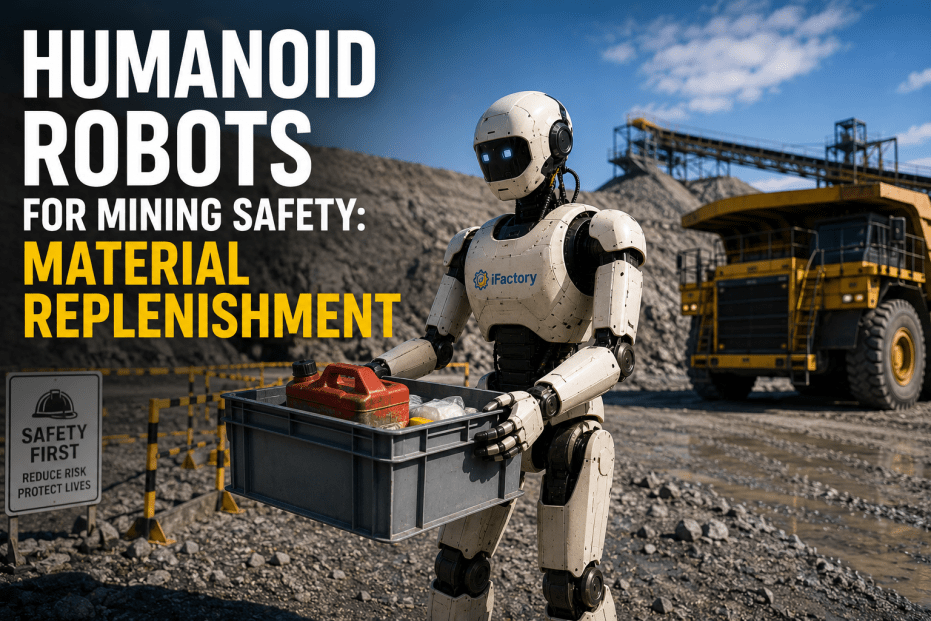
Humanoid robots address this risk profile directly: a bipedal platform with load-bearing capacity of 30–50 kg can navigate the same confined spaces, rough terrain, and vertical access ways that human miners use — stairs, ladders, narrow drifts, and raised platforms — without requiring the dedicated roadways, ventilation, and lighting that traditional mobile equipment demands. The humanoid carries a payload of consumables, reagents, or parts from the surface warehouse or underground supply station directly to the point of use, documents the delivery with time-stamped photographic evidence, and returns for the next load — all without exposing a human operator to the hazards of the travel path. Book a Demo to see iFactory's humanoid material replenishment integration applied to a mining operations simulation.
Core Capabilities for Humanoid Material Replenishment in Underground and Surface Mining
Deploying humanoid robots for mining material replenishment requires capabilities that extend beyond basic bipedal locomotion — the platform must navigate uneven and slippery surfaces, operate in low-light or zero-light conditions, communicate through the limited bandwidth of underground wireless networks, and integrate with mine-wide control systems that manage personnel tracking, equipment location, and hazard zone access. The table below compares the core capability requirements for mining material replenishment across the four primary operational domains.
| Capability Domain | Underground Stope Delivery | Surface Concentrator Supply | Warehouse-to-Point Intralogistics | Hazardous Zone Replenishment |
|---|---|---|---|---|
| Terrain Navigation | Uneven drift floors, 10–18% grade ramps, rail crossings, sump bypass | Paved roads, gravel paths, conveyor crossovers, building thresholds | Smooth warehouse floors, dock ramps, pallet staging areas | Rock debris, standing water, cable trays, ventilation ducting |
| Payload Type | Explosives (ANFO, emulsion), drill steel, ground support mesh and bolts | Flotation reagents, grinding media, crusher wear parts, screen decks | Consumables, PPE, maintenance parts, lubes and greases | Chemical reagents, sample containers, emergency response equipment |
| Navigation Sensors | LIDAR + thermal + inertial; path planning with geotechnical hazard overlay | GPS + LIDAR + vision; pre-mapped route with dynamic obstacle avoidance | LIDAR + vision + RFID waypoint; barcode/QR code station identification | Thermal + gas detection + LIDAR; real-time hazard zone boundary mapping |
| Communication Protocol | Underground MQTT over leaky feeder or 4.9 GHz private LTE | Wi-Fi 6 or private 5G; OPC UA to concentrator DCS | Wi-Fi 6; REST API to warehouse management system | Dual-path MQTT + OPC UA; failover to mesh radio network |
| Safety Integration | Collision avoidance with personnel tags; geofenced blast exclusion zones | Traffic management integration; pedestrian detection in shared zones | Automated door and gate interlock; elevator communication integration | Gas monitor interlock; ATEX zone compliance; emergency stop relay to mine control |
The capability requirements vary significantly by operational domain, which means a successful humanoid material replenishment program requires matching platform capabilities to specific delivery routes rather than deploying a one-size-fits-all solution. iFactory AI's integration platform supports multiple humanoid platforms with domain-specific sensor configurations and communication profiles — enabling mines to deploy the right platform for each material flow path. Book a Demo to review capability matching for your mine's specific material replenishment routes.
Humanoid Mining Intralogistics Workflow — From Supply Point to Hazardous Zone Delivery in Five Steps
Intralogistics material replenishment in mining operations follows a defined workflow from material requisition through delivery confirmation. The humanoid platform integrates into this workflow at the transport and delivery stages, replacing the human-operated service vehicle for defined material flows while maintaining compatibility with existing warehouse management, inventory tracking, and mine control systems. The workflow below illustrates a typical explosive consumables delivery to an underground production stope served by iFactory AI's humanoid integration platform.
Material Requisition and Pickup Assignment
The stope supervisor submits a material requisition through the mine's CMMS or warehouse management system — 250 kg of ANFO, 100 detonators, and 50 meters of shock tube for the afternoon blasting shift. The warehouse team stages the material at the underground supply station, and iFactory AI's platform assigns the delivery to the nearest available humanoid platform based on battery state, current location, and route priority. The requisition, staging confirmation, and delivery assignment are all captured in the digital material tracking record.
Payload Loading and Route Planning
The humanoid platform arrives at the supply station, where the warehouse team loads the material into its payload carrier (modular bin system with 40 kg capacity per trip; multiple trips may be required for larger quantities). The platform scans the material barcode to confirm pickup, verifies the delivery destination against the mine plan, and plans its route to the stope using the mine's georeferenced drift map with real-time hazard overlay — active blast zones, equipment movement, ground support status, and ventilation direction. Route planning is optimized for minimal travel time while avoiding identified hazards.
Autonomous Transport Through Active Mining Zones
The humanoid navigates autonomously from the supply station to the stope delivery point, traversing main drifts, ramp declines, and stope access ways at a walking pace of 3–5 km/h. The platform's LIDAR and vision sensors detect and avoid obstacles — haul trucks, LHDs, parked equipment, and personnel detected via RFID tag proximity. Communication with mine control is maintained through the underground MQTT network, with position updates published every 5 seconds to the personnel and equipment tracking system. The platform pauses at defined checkpoints for visual verification by the shift supervisor.
Hazard Zone Entry and Delivery Confirmation
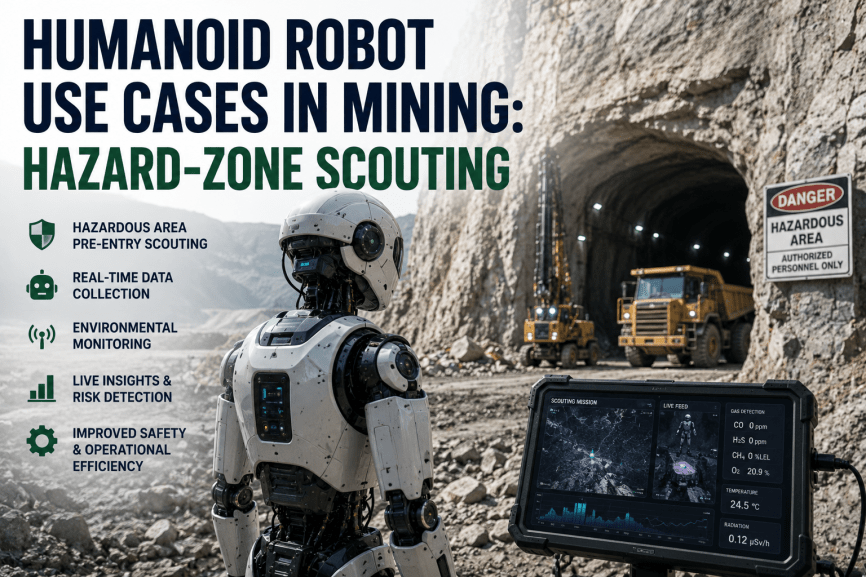
At the stope access point, the humanoid conducts a pre-entry hazard assessment — gas monitoring (NO2, CO, CH4, O2 deficiency), thermal scan for hot ground, and visual inspection for ground instability signs. If conditions are within safe thresholds, the platform enters the stope, navigates to the designated delivery point, and deposits the material. The platform captures photographic evidence of the delivery location, material condition, and surrounding ground conditions, and publishes the delivery confirmation to iFactory AI's platform with time-stamped GPS coordinates and sensor readings.
Return Transit and Mission Documentation
Following delivery, the humanoid returns to the supply station for the next assignment. The return transit may include additional tasks — inspecting ventilation curtains, checking ground support condition along the drift, or collecting environmental data (airflow, temperature, humidity) from sensor stations along the return path. Upon arrival at the supply station, the platform generates a complete mission report: delivery confirmation, route traveled, hazards encountered, sensor readings collected, and battery consumption. The report is automatically integrated into the mine's material tracking, equipment utilization, and safety documentation systems.
ROI Framework — What Humanoid Material Replenishment Delivers for Mining Operations
The business case for humanoid material replenishment in mining rests on five measurable value streams: personnel exposure reduction, mobile equipment utilization improvement, material delivery reliability, intralogistics labor productivity, and safety incident cost avoidance. Each value stream contributes to a combined ROI that substantially exceeds the platform investment within the first 18 months of deployment for a medium-size mine site operating 3–5 humanoid platforms on material replenishment routes. The table below summarizes documented ROI ranges from iFactory AI humanoid integration deployments in industrial environments with comparable operational profiles.
| Value Stream | Impact Mechanism | Documented Improvement Range | Annual Value (Medium Mine, 3–5 Platforms) |
|---|---|---|---|
| Personnel Exposure Reduction | Humanoid replaces human-operated service vehicle for 60–80% of routine material delivery routes; operator reassigned to higher-value work | 50–70% reduction in personnel-hours in active mining zones for material transport | $180K–$420K |
| Mobile Equipment Utilization | Service vehicles redeployed from material transport to production support; reduced vehicle hours reduce maintenance and fuel costs | 15–30% reduction in service vehicle hours for material delivery | $120K–$280K |
| Delivery Reliability | Humanoid operates on schedule regardless of shift staffing, operator availability, or fatigue management constraints; documented delivery confirmation every trip | 98–99.5% on-time delivery rate vs. 72–88% for human-operated service vehicles | $80K–$200K |
| Intralogistics Labor Productivity | Warehouse and supply chain personnel focus on materials management rather than transport; reduced non-productive travel time | 30–50% improvement in material moves per labor-hour | $100K–$250K |
| Safety Incident Avoidance | Elimination of high-risk material transport tasks; reduction in mobile equipment interactions with pedestrians in confined zones | Expected 40–60% reduction in material-transport-related near misses and incidents | $200K–$500K |
Combined annual value across all five streams typically reaches $680K–$1.65M for a medium-size mine site deploying 3–5 humanoid platforms on dedicated material replenishment routes — delivering an ROI that justifies full platform investment within 12–18 months of deployment. The most significant gains concentrate in personnel exposure reduction and safety incident avoidance, which together represent 55–65% of total quantified value.
Reduce Mining Hazard-Zone Exposure While Improving Material Delivery Reliability — iFactory Enables Humanoid Intralogistics Integration
iFactory AI's humanoid integration platform connects material replenishment robots to mine control systems, CMMS, and safety monitoring — enabling autonomous delivery of consumables, reagents, and parts to active mining zones without exposing personnel to transport hazards. Deploy 3–5 platforms on dedicated routes and achieve ROI within 12–18 months.
Expert Review: What Industry Research Reveals About Humanoid Material Replenishment in Mining
Industry research and practitioner experience converge on a consistent assessment: humanoid robots for material replenishment and intralogistics represent the highest-impact near-term use case for embodied AI in mining operations, building on the foundation of autonomous haulage and remote operations centers that leading mines have already established.
A 2025 analysis by the International Council on Mining and Metals examined incident data from 142 mine sites globally and found that material transport and intralogistics accounted for 22–28% of total fatal incidents — more than any other operational category including ground control (15–18%) and mobile equipment operation (18–22%). The analysis specifically identified pedestrian-vehicle interactions in confined underground spaces and loss-of-control events on decline ramps as the highest-consequence subcategories. Humanoid material replenishment directly addresses both subcategories by eliminating the need for pedestrian-vehicle interaction and replacing the articulated service vehicle with a smaller, slower, more maneuverable bipedal platform.
- 22–28% of mining fatalities linked to material transport and intralogistics
- Pedestrian-vehicle interactions and decline ramp incidents identified as highest-consequence subcategories
- Humanoid platforms address root causes without reducing material flow capacity
Research from the Australasian Institute of Mining and Metallurgy evaluated autonomous material transport deployments across six underground mine sites and documented a 15–25 percentage point improvement in on-time delivery rates compared to human-operated service vehicles. The primary mechanisms were elimination of shift-change delays, removal of fatigue-related operator breaks, and consistent route adherence without the detours and delays introduced by operator discretion. The 98–99.5% on-time delivery rate documented in autonomous deployments is directly relevant to humanoid material replenishment, which uses the same navigation and scheduling technology in a smaller, more flexible platform.
- 15–25 percentage point on-time delivery improvement over human-operated service vehicles
- Elimination of shift-change and fatigue-related delays as primary mechanisms
- Consistent route adherence eliminates operator-discretion detours
A 2024 study published in the Journal of Mining Science evaluated 18 mobile robotics deployments in underground and surface mining operations. The study found that platforms with direct integration to mine control systems — personnel tracking, equipment management, ventilation control, and hazard zone mapping — achieved 3.4 times higher operational uptime and 2.8 times higher user satisfaction scores than platforms operating as standalone systems. MQTT-based communication over underground networks and OPC UA integration with surface control systems were identified as the most reliable integration architectures — the same dual-protocol approach that iFactory AI uses as the foundation of its humanoid integration platform.
- 3.4x higher uptime for control-system-integrated vs. standalone mining robots
- MQTT and OPC UA identified as most reliable integration protocols
- iFactory's dual-protocol architecture directly addresses this success factor
Humanoid Material Replenishment for Mining — A High-Impact Pathway to Safer, More Reliable Intralogistics
Mining operations face a persistent intralogistics challenge that traditional automation approaches have not fully addressed: the need to move consumables, reagents, parts, and supplies from warehouse to point of use through active mining zones that are hazardous for both pedestrians and vehicles. Haul trucks and LHDs are optimized for ore and waste movement. Service vehicles require dedicated roadways and operator availability. Conveyors and pipelines are fixed infrastructure that cannot adapt to changing material flow patterns. Humanoid robots fill the gap that no existing technology addresses — providing flexible, autonomous material transport that can navigate the same confined, uneven, and hazardous spaces that human miners use, without exposing those humans to the risks of material transport through active mining zones.
iFactory AI's humanoid integration platform provides the technology layer that connects material replenishment robots to mine control systems, CMMS, and safety monitoring — enabling mines to deploy humanoid platforms on dedicated delivery routes with control-system integration that ensures safe operation, reliable delivery, and complete mission documentation. The platform supports multiple humanoid platforms with domain-specific sensor configurations and communication profiles, handles underground network connectivity through MQTT and OPC UA integration, and provides the analytics layer that tracks material delivery performance, platform utilization, and safety impact. Book a Demo to review iFactory's humanoid material replenishment integration architecture for your mine's specific delivery routes, hazard zones, and control system environment.
Frequently Asked Questions About Humanoid Material Replenishment in Mining Operations
What mining material types are best suited for humanoid delivery in initial deployment phases?
Consumables and small parts — drill steel, ground support mesh, bolts and plates, crusher wear liners, screen decks, PPE, and maintenance spares — are the highest-value initial deployment targets due to their manageable weight (5–30 kg per item), predictable delivery frequency, and defined storage locations at the point of use. Reagents and chemicals with proper packaging (flocculant bags, lubricant drums under 20 liters, sample containers) are also suitable. Bulk materials such as ANFO (typically delivered in 250–500 kg quantities per stope per shift) require multiple humanoid trips and are better suited for later deployment phases after the platform has demonstrated reliability on simpler delivery routes.
How does iFactory integrate humanoid material replenishment with existing mine control and personnel tracking systems?
iFactory's protocol bridge supports MQTT for underground communication over leaky feeder or private LTE networks, and OPC UA for integration with surface mine control systems and DCS environments. The platform publishes humanoid position, status, and sensor data to the mine's existing personnel and equipment tracking system, enabling the mine control room to see humanoid movements alongside haul trucks, LHDs, and personnel. The platform also integrates with the mine's CMMS for work order generation and material requisition management, and with the warehouse management system for inventory tracking.
What navigation and safety systems does the humanoid use to operate in underground mining environments?
The humanoid navigates underground using a combination of LIDAR-based SLAM for real-time localization and mapping, inertial measurement units for dead reckoning through GPS-denied zones, and pre-loaded mine plan data for route optimization. Safety systems include collision avoidance with personnel detected via RFID tag proximity, gas monitoring integration (NO2, CO, CH4, O2) for hazard zone entry assessment, emergency stop relay to mine control, and geofenced exclusion zones that prevent the platform from entering active blast areas or ground support-restricted zones. The platform operates at walking pace (3–5 km/h), which minimizes collision energy in the event of unexpected obstacle encounters.
What humanoid platforms are currently available for mining material replenishment deployment?
Currently available humanoid platforms with payload capacity (30–50 kg), ingress protection (IP54 or higher for dust and water resistance), and environmental tolerance suitable for mining environments include Agility Robotics Digit (40 kg payload, IP54, 32°F–104°F operating range, stair and ladder navigation capable) and Fourier GR-2 (30 kg payload, IP54, industrial-grade actuators, modular end-effector options for material handling). For mines requiring higher payload capacity or extended battery life, next-generation platforms from multiple OEMs are expected to reach commercial availability by 2027 with payload capacities of 60–100 kg and operating ranges of 8–12 hours per charge.
What is the expected timeline and investment for implementing a humanoid material replenishment program at a mine site?
A complete iFactory humanoid material replenishment deployment for 2–3 initial delivery routes — including edge gateway installation, humanoid platform integration with mine control systems, communication network assessment and configuration, route mapping and safety validation, CMMS and WMS integration, operator and mine control room training, and 90-day operational validation — typically ranges from $145,000 to $295,000 depending on the number of platforms, route complexity, and existing communication infrastructure. The deployment timeline from hardware installation to live autonomous material delivery operations is 10 to 16 weeks for the initial routes, with expansion to additional routes requiring 2 to 4 weeks per route. ROI is typically achieved within 12 to 18 months through a combination of personnel exposure reduction, mobile equipment utilization improvement, delivery reliability gains, and safety incident avoidance.
Deploy Humanoid Material Replenishment at Your Mine — Reducing Hazard-Zone Exposure While Improving Delivery Reliability
iFactory AI enables mining operations to deploy humanoid robots for autonomous material replenishment, intralogistics transport, and hazardous-area supply delivery — connected to mine control systems, CMMS, and safety monitoring through a single integration platform. The technology to reduce personnel exposure in material transport is available now. The question is when your mine will start building the autonomous intralogistics capability that the next generation of mining operations will require.