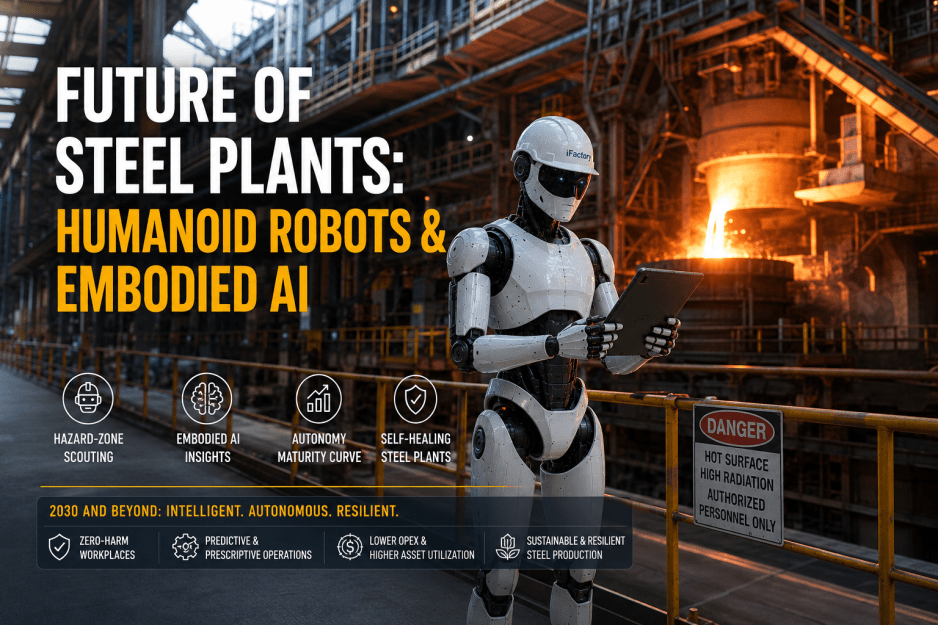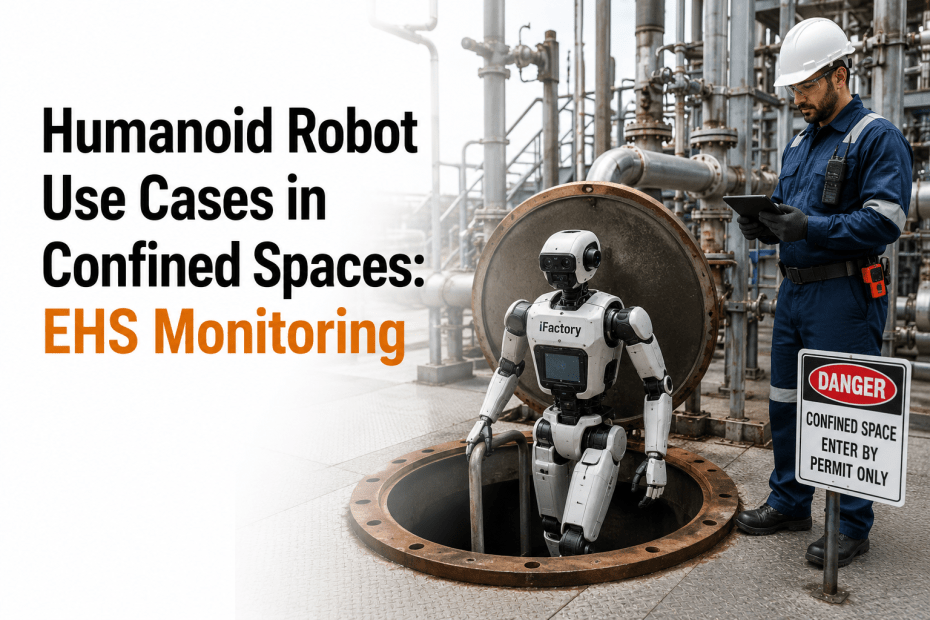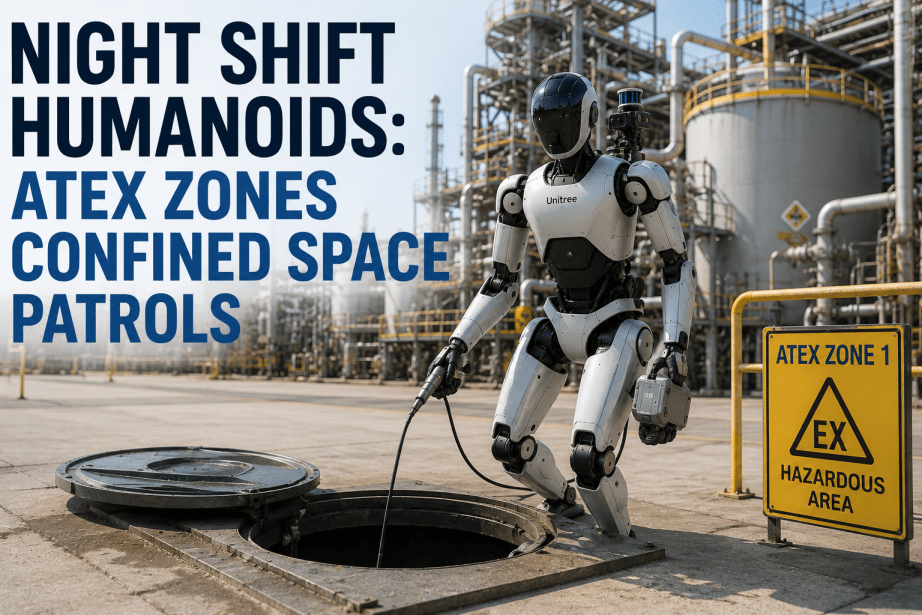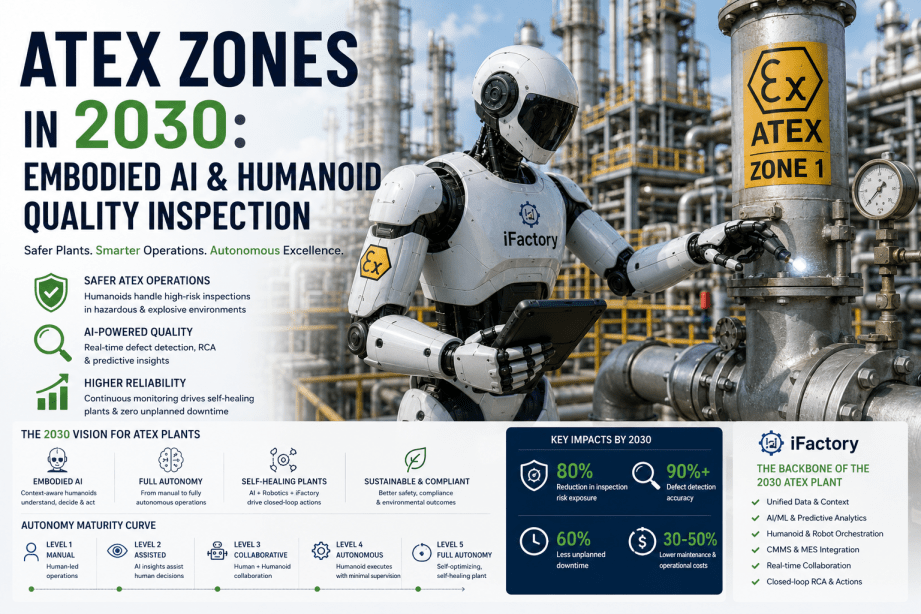
The automotive plant EHS manager reviews the morning hazard-zone entry log. Three paint booth entries are scheduled for nozzle cleaning and filter inspection, two weld cell entries for robotic arm maintenance and tip change, and one pit entry under the final assembly line for conveyor chain inspection. Each entry requires atmospheric monitoring, lockout/tagout verification, confined space permit documentation (for the pit and paint booths), standby attendant posting, and a rescue plan — and that is just the morning schedule. By the end of the week, the plant will log twenty-seven separate entries into zones classified as hazardous for atmospheric toxicity, oxygen deficiency, moving machinery proximity, or energy isolation risk. Every entry takes a skilled maintenance technician away from value-added work, exposes them to residual risk even with full PPE and permits, and consumes EHS team hours in documentation and supervision. Humanoid robots equipped with multi-sensor inspection payloads and integrated with plant safety systems are changing this equation, enabling automotive manufacturers to deploy autonomous or teleoperated humanoid platforms for hazardous-zone pre-entry scouting — eliminating unnecessary human exposure, improving EHS compliance documentation, and freeing skilled trades for work that requires human judgment and dexterity.
Automotive EHS: Humanoid Hazard-Zone Scouting Use Case
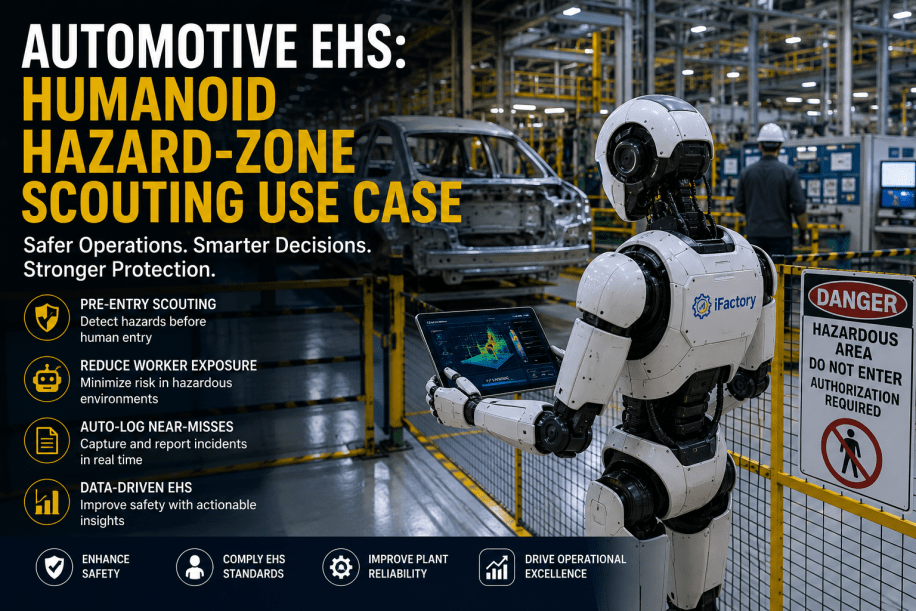
Deploy humanoid robots for automotive hazardous-zone pre-entry scouting — atmospheric monitoring, lockout/tagout verification, thermal imaging, and EHS compliance documentation — before any human enters the zone. iFactory AI integrates humanoid scouting data with plant CMMS, MES, and EHS systems for a unified safety and operations platform.
Six Core Humanoid Scouting Capabilities for Automotive EHS
iFactory's humanoid robot integration platform enables a comprehensive set of hazard-zone scouting capabilities purpose-built for automotive manufacturing environments. Each capability is production-ready, integrates with existing plant safety systems and EHS software, and delivers measurable reduction in worker exposure and compliance documentation burden.
Hazardous Zone Pre-Entry Assessment
Deploy the humanoid into paint booths, weld cells, conveyor pits, and chemical storage areas before any human entry. The platform conducts a full atmospheric scan (LEL, O2, H2S, CO, VOCs), thermal imaging survey for hot surfaces or electrical hazards, and structural integrity assessment using LIDAR and stereoscopic vision — all documented and timestamped in the EHS record before the entry permit is issued.
Multi-Sensor Gas and Air Quality Detection
Equip the humanoid with electrochemical and PID sensors that detect weld fumes (manganese, hexavalent chromium), paint booth solvent vapors (toluene, xylene, methyl ethyl ketone), and combustion byproducts from plant vehicles and ovens. The platform maps contaminant concentrations in 3D across the zone volume rather than relying on a single personal monitor location, identifying stratification pockets and dead zones that stationary sensors miss.
Lockout/Tagout Verification and Documentation
The humanoid's vision system captures photographic and video evidence of each lockout/tagout point — disconnects, valve positions, blinds, and lock application — with GPS-stamped location metadata and timestamp. The platform compares the as-found state against the written LOTO procedure for the specific equipment and flags discrepancies before the entry permit is approved, eliminating the most common cause of LOTO violations in automotive plants.
Weld Cell and Paint Booth Thermal Survey
Deploy the humanoid with a radiometric thermal camera to scan weld cell equipment, paint oven walls, conveyor bearings, and electrical panels for abnormal heat signatures. The platform identifies overheated bus bars, failing bearing assemblies, degraded insulation, and smoldering residues in paint booth exhaust ducts — hazards that would otherwise go undetected until they cause a fire or equipment failure during production.
Incident Scene Assessment and Documentation
When a safety incident occurs — chemical spill, equipment fire, or injury — the humanoid can be deployed to the scene before any human responder enters the hazard zone. The platform captures 360-degree visual documentation, atmospheric readings, thermal images, and structural condition data that becomes part of the OSHA incident record and root cause investigation package.
Automated EHS Compliance Documentation
iFactory automatically generates EHS compliance records from every humanoid scouting mission — atmospheric monitoring logs, pre-entry assessment checklists, LOTO verification evidence, confined space entry permits, and OSHA-required documentation — all timestamped, geo-tagged, and linked to the specific equipment and zone. The platform maintains a complete audit trail suitable for OSHA inspection, corporate EHS audit, and workers' compensation litigation defense.
From Deployment to Clear-to-Enter Decision in Four Steps
iFactory's humanoid scouting workflow integrates with existing plant EHS procedures and permit systems, replacing manual hazard assessment with automated multi-sensor inspection and real-time decision support.
Deploy Humanoid to Zone Boundary
The EHS technician or zone supervisor positions the humanoid at the hazard zone access point and initiates the scouting mission from the iFactory tablet interface. The platform verifies communication link quality, sensor calibration status, and battery state before authorizing entry. The humanoid enters the zone autonomously or via teleoperation depending on the complexity of the space and the specific hazards present.
Multi-Sensor Data Collection
The humanoid traverses a pre-defined or dynamically generated inspection path through the hazard zone, collecting atmospheric readings at multiple elevation planes, thermal images of all equipment surfaces, LIDAR scans for structural displacement or debris, and high-resolution visual imagery of LOTO points, equipment condition, and housekeeping status. Sensor data is streamed in real time to the iFactory platform via encrypted MQTT over the plant wireless network.
Real-Time Analysis and Alert Generation
The iFactory platform processes incoming sensor data against configurable threshold rules — OSHA PEL limits for airborne contaminants, NFPA 70E arc flash boundary conditions, LOTO procedure compliance verification, and thermal anomaly detection. If any reading exceeds its threshold, the platform generates an alert with the specific hazard, location, severity level, and recommended corrective action — displayed on the EHS command center dashboard and routed to the responsible supervisor's mobile device.
Clear-to-Enter or Remediation Directive
If all sensor readings are within acceptable limits and LOTO verification passes, iFactory generates the digital clear-to-enter certificate, updates the confined space entry permit system, and logs the scouting mission in the EHS compliance record. If hazards are detected, the platform issues a do-not-enter directive with specific hazard details and required remediation steps, and notifies the appropriate maintenance or EHS team for corrective action before a re-scout is authorized.
Why Automotive Hazard-Zone Entry Remains a Persistent EHS Risk
Despite decades of safety program evolution, automotive manufacturing facilities continue to log thousands of hazardous-zone entries per year — each carrying residual risk that safety systems reduce but do not eliminate. The following data points represent the highest-cost and highest-risk categories of hazard-zone entry in automotive assembly plants.
Weld Fume Exposure — Hexavalent Chromium and Manganese
Robotic weld cells require human entry for torch cleaning, nozzle replacement, and fixture adjustment. Each entry exposes maintenance technicians to weld fume particulates containing hexavalent chromium (OSHA PEL 5 mcg/m3) and manganese (OSHA PEL 5 mg/m3) that accumulate in the cell atmosphere between entries. Without pre-entry atmospheric monitoring, technicians enter blind to the actual contaminant concentration, which can exceed PELs by 2-5x after extended production runs without ventilation verification.
Paint Booth Solvent Vapor Accumulation
Paint booth entries for nozzle cleaning, filter change, and booth wall maintenance expose workers to solvent vapors — toluene, xylene, MEK, and ethyl acetate — that accumulate in the booth atmosphere during production. Booth ventilation systems reduce concentrations during operation but stratification can create localized pockets above the LEL or above OSHA STEL limits. Humanoid pre-entry scouting maps the actual vapor concentration across the booth volume, identifying zones that require additional purge time before human entry.
Confined Space Entry in Conveyor Pits and Utility Tunnels
Final assembly conveyor pits and plant utility tunnels meet the OSHA definition of permit-required confined spaces — limited egress, potential for atmospheric hazards, and risk of engulfment. Each entry requires a full permit program including atmospheric testing, ventilation, standby attendant, rescue plan, and entry supervisor authorization. Humanoid scouting eliminates the need for initial human entry to conduct atmospheric testing and visual inspection, reducing permit-required confined space entries by 60-80%.
Lockout/Tagout Verification Gaps
LOTO procedure compliance audits consistently find that 12-18% of energy-isolating devices are not properly verified before work begins — locks missing, tags illegible, or isolation points not clearly identified. These verification gaps are the leading root cause of LOTO-related injuries in automotive manufacturing. Humanoid scouting provides photographic verification of every isolation point before the entry permit is issued, eliminating the verification gap that manual processes cannot close.
Traditional Hazard-Zone Entry vs. iFactory Humanoid Pre-Entry Scouting
The table below compares how hazardous-zone entries are managed with traditional EHS processes versus iFactory's integrated humanoid scouting platform. The difference in worker exposure, documentation quality, and response time is measurable across every dimension of EHS performance.
| Process Area | Traditional EHS Process | iFactory Humanoid Scouting |
|---|---|---|
| Atmospheric Monitoring | Technician enters zone wearing personal monitor, single-point reading at breathing zone, manual log entry on paper permit | Humanoid conducts multi-elevation 3D atmospheric mapping across entire zone volume before any human entry, digital logging with automatic permit integration |
| LOTO Verification | Visual verification by authorized worker, manual check-off on paper procedure, no photographic evidence retained | Photographic and video verification of every isolation point with GPS-stamped location and timestamp, automatic comparison against written LOTO procedure |
| Entry Preparation Time | 45-90 minutes per entry including permit issuance, atmospheric testing, ventilation setup, and standby assignment | 8-12 minutes per scouting mission including deployment, multi-sensor inspection, and automated clear-to-enter certificate generation |
| Incident Documentation | Manual incident report completion, photos taken by responder, atmospheric data retrieved from personal monitor post-event | Automated incident documentation with 360-degree visual, atmospheric, and thermal data captured before any human responder enters the zone |
| Compliance Record Keeping | Paper permits filed in EHS office, scanned PDFs stored on shared drive, manual audit preparation requiring 1-2 weeks of document assembly | Digital EHS compliance database with all scouting missions, permits, and LOTO verifications linked to equipment and zone — audit-ready in minutes |
| Worker Exposure Reduction | Technicians enter hazard zones 15-30 times per week for inspection, maintenance, and troubleshooting | Humanoid performs initial entry and routine inspection for 70-80% of hazard-zone visits — human entry reserved for hands-on maintenance only |
Industry Expert Perspective on Humanoid Hazard-Zone Scouting in Automotive Manufacturing
"I have spent my entire career in automotive EHS — starting as a plant safety engineer at a Tier 1 stamping facility and eventually directing EHS programs across six North American assembly plants. The single most persistent safety challenge we faced was the tension between production throughput and safe entry into hazardous zones. Every paint booth entry, every weld cell access, every conveyor pit inspection required the same trade-off: stop production, isolate energy, test atmosphere, document everything, and send a person into a space that had just been filled with weld fume or solvent vapor. We spent millions on better ventilation, more sensitive personal monitors, and more detailed permit procedures — but we never solved the fundamental problem that a person had to go into the hazard zone to verify it was safe for people to go into the hazard zone. Humanoid pre-entry scouting changes that completely. The robot goes first, takes every reading the EHS team needs, documents everything digitally, and only if the zone passes every threshold does a human technician enter for the hands-on work. For any automotive plant running three or more assembly shifts, the reduction in worker exposure alone justifies the investment within 18 months. The improvement in LOTO compliance documentation and OSHA record quality is a secondary benefit that corporate EHS directors and plant managers alike will find immediately valuable during their next regulatory inspection."
Transform Automotive EHS with Humanoid Hazard-Zone Scouting
Automotive manufacturing facilities face a persistent EHS challenge that process improvements alone cannot solve: the need for skilled workers to enter hazardous zones — paint booths, weld cells, conveyor pits, and chemical storage areas — to verify conditions before other workers can safely enter. Every entry carries residual risk, consumes EHS team hours in documentation and supervision, and takes maintenance technicians away from value-added work. Humanoid robots equipped with multi-sensor inspection payloads and integrated with iFactory's EHS compliance platform eliminate the fundamental contradiction at the heart of automotive hazardous-zone entry by sending the robot first and keeping human workers out of harm's way until the zone has been comprehensively assessed and documented as safe.
iFactory's humanoid scouting platform delivers measurable EHS and operational results within 90 days of deployment: 60-80% reduction in human hazardous-zone entries, 8-12 minute scouting missions versus 45-90 minute entry protocols, complete digital EHS compliance documentation with zero manual data entry, and LOTO verification accuracy that eliminates the 12-18% verification gap that plagues manual processes.
You can have humanoid hazard-zone scouting operational in your automotive plant within six weeks. Book a Demo and see iFactory's EHS integration platform applied to your facility's highest-risk hazard zones.
Frequently Asked Questions About Humanoid Hazard-Zone Scouting in Automotive Manufacturing
EHS directors, plant managers, and automation engineers ask these questions when evaluating humanoid robot deployment for hazardous-zone scouting in automotive assembly facilities.
Stop Sending People into Hazardous Zones to Verify They Are Safe for People. Send the Humanoid Instead.
iFactory humanoid scouting integration delivers production-ready EHS automation in 6-10 weeks, connecting humanoid inspection platforms to your existing permit system, CMMS, and compliance documentation. You provide the hazard zone; we provide the integration architecture that eliminates unnecessary human exposure while improving EHS documentation quality and operational efficiency.