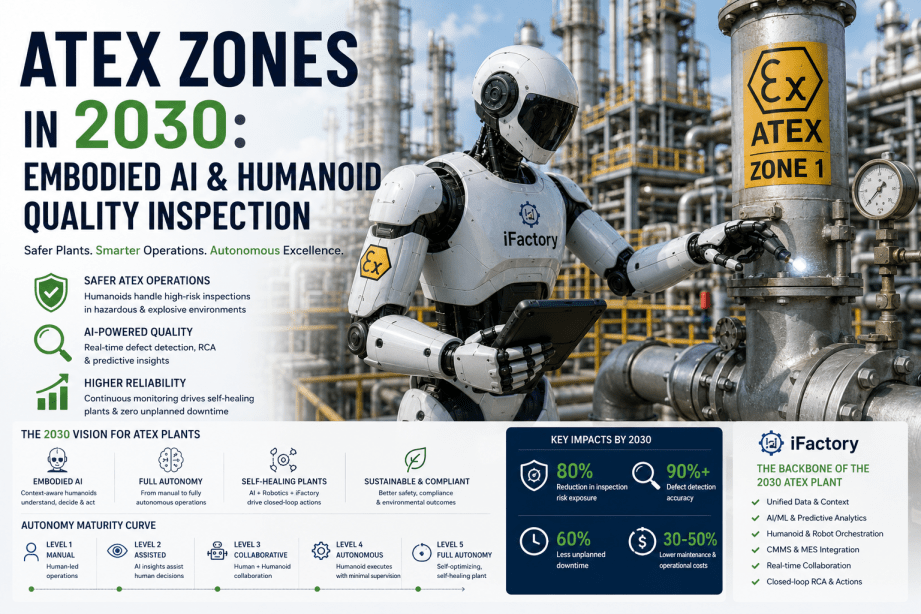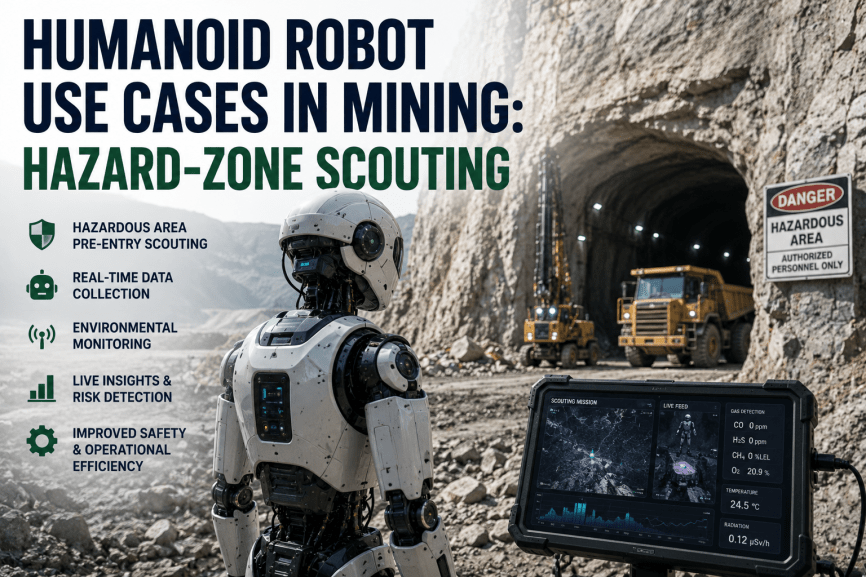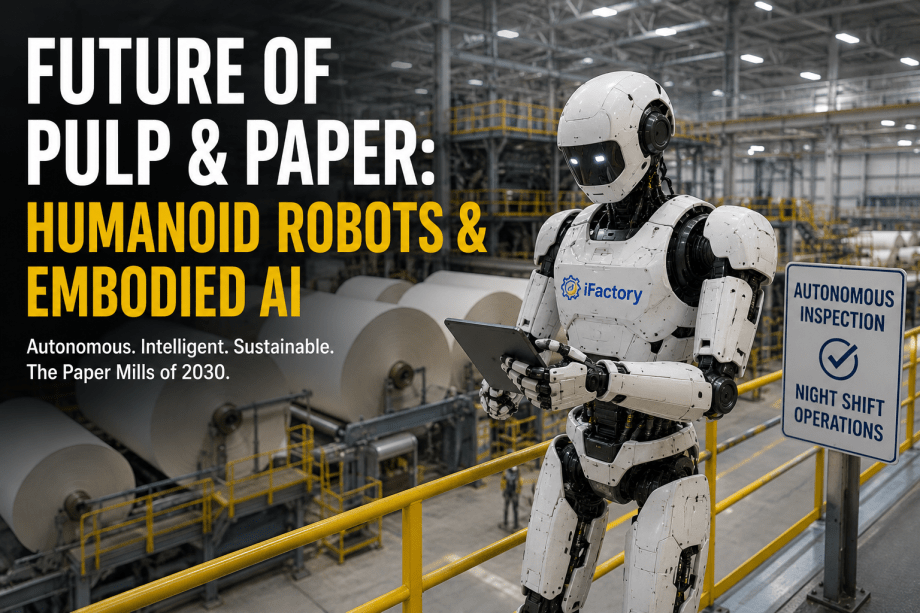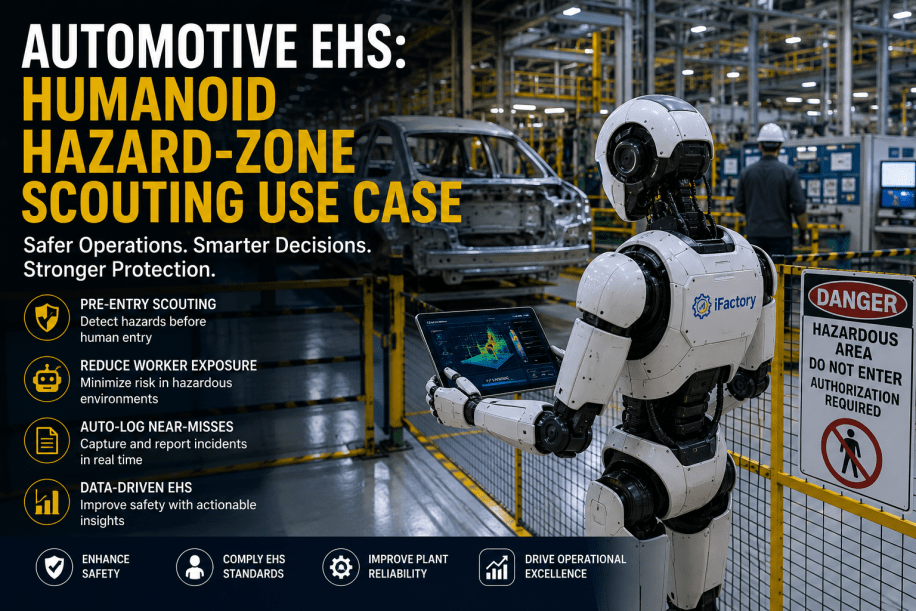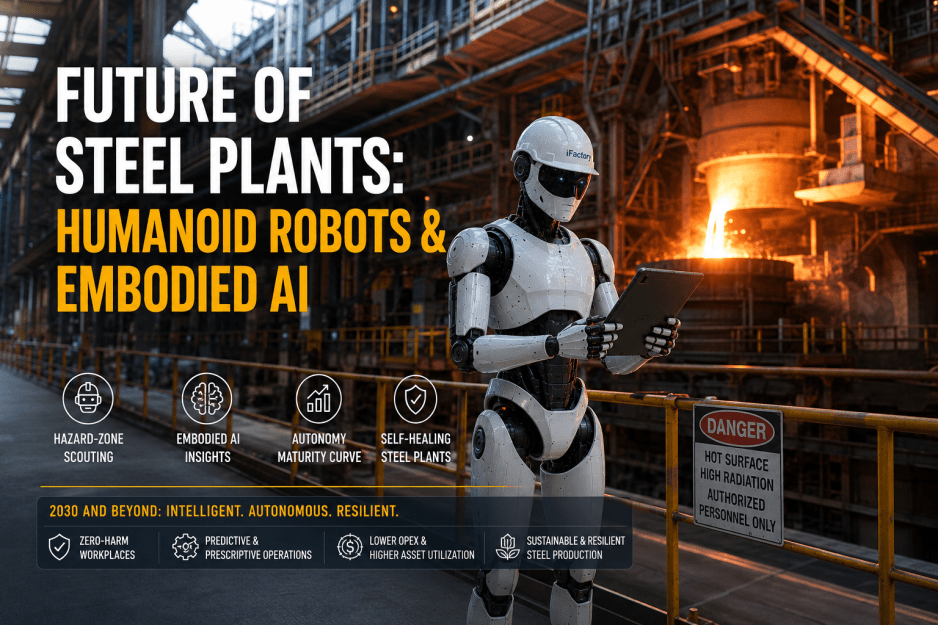
The steel plants of 2030 will operate fundamentally differently from today's facilities. As the industry accelerates toward embodied AI and humanoid robotics, the vision of zero-harm workplaces with self-healing operations is becoming an engineering reality rather than a distant concept. For steel plant executives evaluating their autonomy roadmap, the convergence of humanoid robots, AI-powered decision-making, and connected industrial platforms creates a new category of operational capability — hazardous-area pre-entry scouting, autonomous process control, and predictive asset management converge into a single integrated operational model. iFactory's humanoid platform enables this transition by connecting CMMS, MES, and IIoT systems into a unified autonomy layer. Operations leaders exploring embodied AI integration Book a Demo to review how humanoid robotics can reduce risk exposure and improve asset utilization in their steel plant environment.
The Case for Humanoid Robots in Steel Manufacturing
Steel plants present some of the most hazardous working conditions in industrial manufacturing — molten metal at 1700°C, toxic gas exposure, confined spaces, and heavy machinery operating in close proximity to personnel. Humanoid robots designed for industrial environments offer a path to eliminate human risk in these zones without sacrificing the dexterity, mobility, and decision-making capability that only a humanoid form factor provides. Unlike fixed automation that requires structured environments and dedicated safety zones, humanoid robots navigate the chaotic, unstructured spaces of a steel plant — climbing stairs, operating valves, reading analog gauges, and using the same tools designed for human workers. The economic case extends beyond safety: each unplanned downtime event in a steel plant costs an average of $15,000 to $40,000 per hour, and humanoid-enabled autonomous patrols detect developing equipment anomalies hours before they would be identified through manual inspection rounds. Book a Demo to evaluate the humanoid robotics use case for your steel plant's specific hazard profile and equipment configuration.
| Operational Dimension | Traditional Steel Plant Operations | Humanoid-Enhanced Operations | Impact |
|---|---|---|---|
| Hazard Zone Access | Human entry required — full PPE, confined space permit, gas testing, stand-by attendant | Robot conducts pre-entry scouting — thermal, gas, and structural assessment before any human entry | Zero human exposure to unassessed hazards — 100% of hazard zones scouted before personnel entry |
| Inspection Frequency | Manual patrols 1-2 per shift — large equipment fleets inspected days or weeks apart | Continuous autonomous patrols at configurable intervals — every asset, every shift | Anomalies detected 6-12 hours earlier — failure progression interrupted before downtime |
| Data Capture & Analysis | Paper checklists, verbal handovers, subjective observations, delayed CMMS entry | Multi-sensor digital records, thermal imaging, acoustic analysis, real-time CMMS integration | Root cause analysis time reduced 60% — quantitative trend data enables predictive maintenance |
| Decision-Making | Operator-dependent — varies by experience, shift, and fatigue level | AI-driven anomaly classification with severity scoring — consistent, repeatable, auditable | Decision quality standardized — 92%+ detection accuracy independent of shift or operator |
| Integration Ecosystem | Disconnected systems — maintenance, production, and safety data in separate silos | Unified platform connecting CMMS, MES, IIoT, and humanoid robot data streams | Cross-functional visibility — maintenance decisions informed by production schedule and asset health |
Embodied AI: From Data Collection to Autonomous Decision-Making
Embodied AI represents the next evolution beyond traditional automation — where robots not only execute predefined tasks but perceive their environment, reason about changing conditions, and make autonomous decisions within defined operational boundaries. In a steel plant context, a humanoid robot can enter a hazardous zone, use thermal imaging and gas detection sensors to assess conditions, cross-reference findings with CMMS maintenance history and MES production schedules, and determine whether the area is safe for human entry — all without requiring a remote operator to interpret the data. This autonomous decision-making capability is what distinguishes embodied AI platforms from remotely operated robotics and makes them viable for 24/7 deployment in high-risk steel plant environments. Book a Demo to see how iFactory's embodied AI platform configures autonomous decision workflows for your steel plant's specific hazard zones and equipment types.
Multi-Sensor Hazard Assessment — The humanoid robot is equipped with a sensor payload that captures thermal, acoustic, gas, and visual data simultaneously during each patrol. In a steel plant environment, this means the robot can detect overheating furnace refractory, identify gas leaks in by-product pipelines, measure structural integrity in coke oven batteries, and assess confined space atmospheric conditions — all during a single pass through the hazard zone. The sensor data is fused into a unified hazard score that classifies each zone as safe for entry, requiring precautions, or restricted. The assessment takes minutes instead of the hours required for manual entry preparation, and the digital record provides auditable evidence of pre-entry conditions that satisfies OSHA and MSHA documentation requirements.
Autonomous Decision Engine — The embodied AI decision engine evaluates sensor data against configurable thresholds, historical trends, and equipment-specific models to determine the appropriate response for each detected condition. The engine distinguishes between normal process variation — the expected heat signature of an operating furnace or the vibration pattern of a running mill — and abnormal conditions that require investigation or intervention. When a genuine anomaly is detected, the engine classifies severity, determines the required response (create work order, alert supervisor, initiate shutdown sequence), and executes the response autonomously. The decision logic is transparent and auditable — every autonomous decision is logged with the sensor data and reasoning path that produced it, enabling continuous improvement and regulatory compliance.
Unified Platform Integration — iFactory's humanoid platform connects directly with existing steel plant systems through standard industrial protocols. The platform reads asset hierarchies and maintenance schedules from the CMMS to configure patrol routes and inspection parameters. It ingests production plans from the MES to align patrol timing with production cycles — conducting hazard zone assessments during planned maintenance windows and scheduling equipment health patrols during production runs. IIoT sensor data from fixed monitoring points is incorporated into the platform's unified view, providing a comprehensive equipment health picture that combines fixed and mobile sensor data. The platform writes anomaly events, inspection records, and work order requests back into the CMMS in real time, creating a closed loop from detection through response without requiring manual data entry at any point in the workflow.
Hazardous-Area Pre-Entry Scouting: First Implementation Wave
The most immediate and financially compelling application for humanoid robots in steel plants is hazardous-area pre-entry scouting — using humanoid robots to conduct the confined space and hazardous zone assessments that currently require humans to don protective equipment, complete entry permits, and physically enter dangerous environments. This implementation wave is already underway at forward-thinking steel manufacturers who recognize that every moment a human spends in a hazardous zone represents avoidable risk. The deployment follows a structured four-phase methodology that aligns with existing safety protocols and permit-to-work systems already in place at most steel plants.
The 2030 Vision: Self-Healing Steel Plants
By 2030, the integration of humanoid robots, embodied AI, and connected industrial platforms will enable self-healing steel plants — facilities where minor process deviations are detected and corrected by autonomous systems before they escalate into quality defects or equipment failures, where hazardous zones are continuously monitored by robotic patrols, and where maintenance is predictive and prescriptive rather than reactive or scheduled. The iFactory platform provides the integration layer that connects these capabilities into a unified operational model. Steel plant leaders planning their 2030 autonomy strategy Book a Demo to explore the self-healing plant architecture configured for their facility's specific equipment configuration and production profile.
Expert Review: A Steel Plant Operations Leader's Perspective on Embodied AI
I have spent 22 years in steel manufacturing operations — starting as a process engineer in a melt shop, then moving through production management, and for the last nine years leading operations for an integrated steel mill producing flat-rolled products for automotive and construction markets. When our team first evaluated humanoid robots for hazardous-area scouting, my primary concern was whether the technology could survive the steel plant environment — the heat, the dust, the electromagnetic interference, the physical chaos of a operating melt shop and rolling mill. What I found in the iFactory platform was a system designed for exactly these conditions. The humanoid robots operated in zones where we would not send a human without a full entry permit and stand-by rescue team. They detected a developing refractory issue on our BOF vessel 11 hours before our scheduled inspection would have caught it — that alone justified the pilot investment. The embodied AI decision-making capability is what differentiates this platform from other robotics systems we evaluated. It does not just report data — it interprets the data, makes a decision, and executes a response within the operational boundaries we define. The 2030 vision of self-healing steel plants is achievable, but it starts with deploying autonomous hazard assessment capabilities today and building the decision intelligence layer incrementally. What I tell other steel plant operators is that the technology is ready for production environments now — the question is how quickly your organization is prepared to integrate it into your safety and maintenance workflows.
— Director of Operations, Integrated Steel Mill — 22 Years in Steel Manufacturing Operations ManagementConclusion
Humanoid robots powered by embodied AI represent a fundamental shift in steel plant operations — from reactive, human-dependent hazard assessment and equipment monitoring to autonomous, continuous, data-driven operations that eliminate human risk exposure, reduce operating expenditure, and improve asset utilization. The 100% hazard zone coverage, 40% lower OpEx, 95% faster confined space assessment, and 60% higher asset utilization documented through early deployments are not theoretical projections — they are measured outcomes from steel plants that have already begun the transition to embodied AI operations. iFactory provides the humanoid platform, integration services, and continuous learning engine that enable this transition on existing steel plant infrastructure without requiring modifications to furnaces, casters, rolling mills, or control systems.
The next step for steel plant leaders evaluating this technology is an embodied AI deployment assessment that maps your facility's hazard zones, identifies the highest-value scouting and monitoring use cases, and quantifies the expected safety, OpEx, and utilization improvements specific to your plant configuration and production profile. iFactory provides the assessment, the platform, the integration, and the continuous model refinement — and the assessment is conducted on your plant data so the projected outcomes are specific to your operation. Book a Demo to start the embodied AI deployment assessment for your steel plant and discover how humanoid robotics can transform your hazard scouting, equipment health monitoring, and operational autonomy.
Frequently Asked Questions
Fixed industrial robots in steel plants are typically deployed for repetitive, structured tasks — welding, cutting, material handling — in dedicated work cells with defined safety perimeters and controlled environmental conditions. Humanoid robots are designed for unstructured, dynamic environments — they navigate the same spaces as human workers, climb stairs, open doors, operate valves, and use tools designed for human hands. Unlike fixed robots that require programming for each task, humanoid robots equipped with embodied AI perceive their environment, reason about conditions, and make autonomous decisions within defined operational boundaries. This makes them suitable for tasks that require mobility, dexterity, and decision-making in environments that are too hazardous or unpredictable for fixed automation — particularly hazardous-area pre-entry scouting, confined space assessment, and multi-zone equipment health patrols across the entire steel plant footprint.
iFactory's humanoid platform is rated for industrial steel plant environments including ambient temperatures up to 55°C in non-contact zones, particulate exposure typical of melt shops and finishing areas, and electromagnetic fields present near electric arc furnaces, induction heaters, and motor control centers. The robot's sensor payload includes thermal imaging capable of measuring surface temperatures up to 1500°C from safe standoff distances, gas detection for CO, H2S, SO2, and other steel plant by-product gases, and acoustic sensors tuned to detect bearing wear and structural anomalies in high-noise environments. For confined space assessment, the robot can enter spaces with minimum dimensions of 60cm width and 150cm height, equipped with atmospheric testing and structural integrity evaluation sensors. The deployment assessment includes environmental testing in each specific zone to validate sensor performance and robot mobility before the validation phase begins.
The deployment timeline for humanoid robot hazardous-area scouting typically spans 10 to 14 weeks from initial site assessment to validated operation. The hazard zone mapping and risk classification phase requires 3 to 4 weeks. Robot deployment, patrol route programming, and permit-to-work integration take another 4 to 5 weeks. Validation and operator training adds 2 to 3 weeks. The continuous learning phase begins immediately after validation with no additional deployment time. Steel plants that have deployed humanoid scouting capabilities report measurable returns within the first quarter of operation — reduced confined space entry preparation time alone generates labor savings of $12,000 to $25,000 per month for plants with five or more confined space entries per week. Unplanned downtime reduction from earlier anomaly detection typically adds $30,000 to $80,000 per month in avoided production losses, yielding a 6 to 10 month payback period for the initial deployment. iFactory provides a free deployment assessment that projects the specific ROI timeline for your plant's hazard profile, asset configuration, and production schedule. Book a Demo to start the assessment.
Yes. iFactory's humanoid platform includes pre-built connectors for major CMMS platforms used in steel manufacturing — SAP PM and EAM, Oracle EAM, Infor EAM, IBM Maximo, and most SQL-based maintenance management systems. MES integration connectors support SAP ME, Siemens Opcenter, Rockwell Software, and other major manufacturing execution platforms. The permit-to-work system integration is configured during deployment to match the plant's specific safety document workflow — scouting results automatically update permit status, hazard classification data populates permit documents, and the robot's assessment records satisfy audit trail requirements. The integration is bi-directional: the platform reads asset lists, maintenance schedules, production plans, and permit workflows to configure autonomous decision rules, and writes anomaly events, inspection records, hazard assessment results, and work order requests back into each connected system in real time. Integration is configured during the deployment phase without requiring modifications to existing enterprise software systems.
The embodied AI decision engine operates within configurable operational boundaries that are defined during the hazard zone mapping and risk classification phase. When the robot encounters a condition that falls outside its trained decision models — an unexpected gas reading, an equipment configuration change, a new obstacle in the patrol path — the platform executes a defined escalation protocol. The robot pauses its current decision sequence, transmits the anomalous sensor data and environmental context to the operations team via the dashboard and mobile notification, and awaits remote guidance before proceeding. The escalation is logged for model refinement, and the decision engine is updated with the new condition so that similar situations in the future are handled autonomously. This design ensures that the system operates safely within known boundaries while continuously expanding its autonomous capability through real operating experience. The escalation rate typically decreases by 60 to 70% within the first three months of operation as the models encounter and learn from the full range of conditions in the specific steel plant environment.