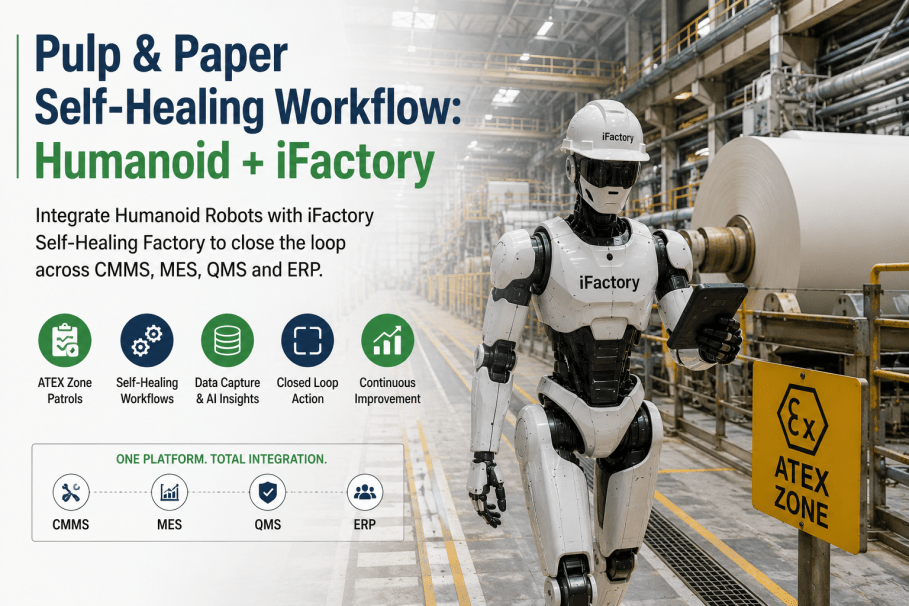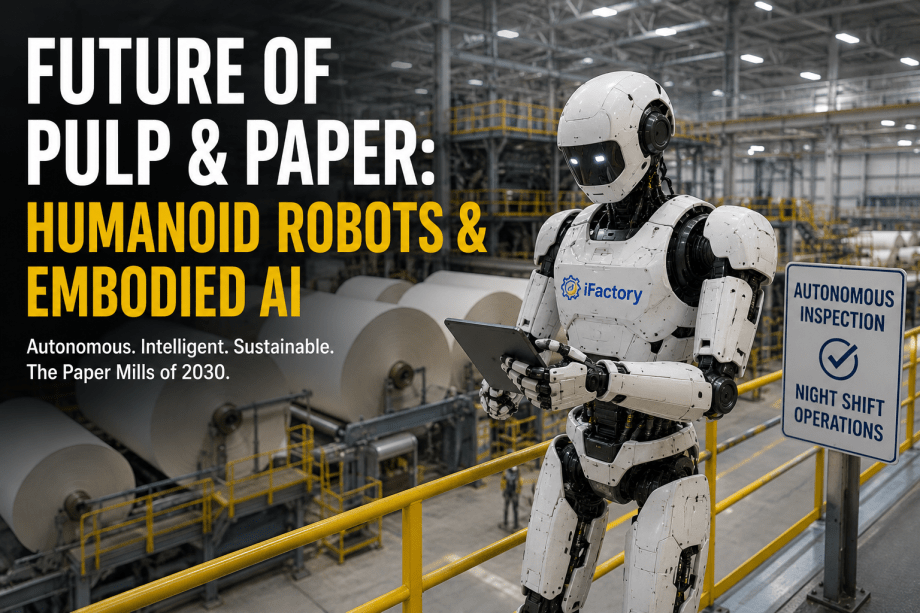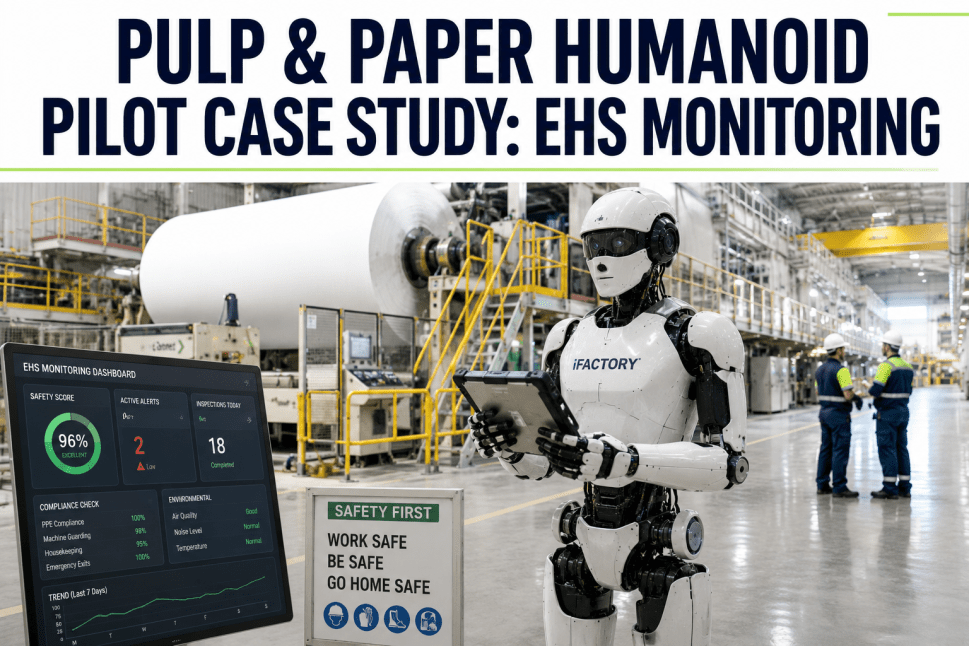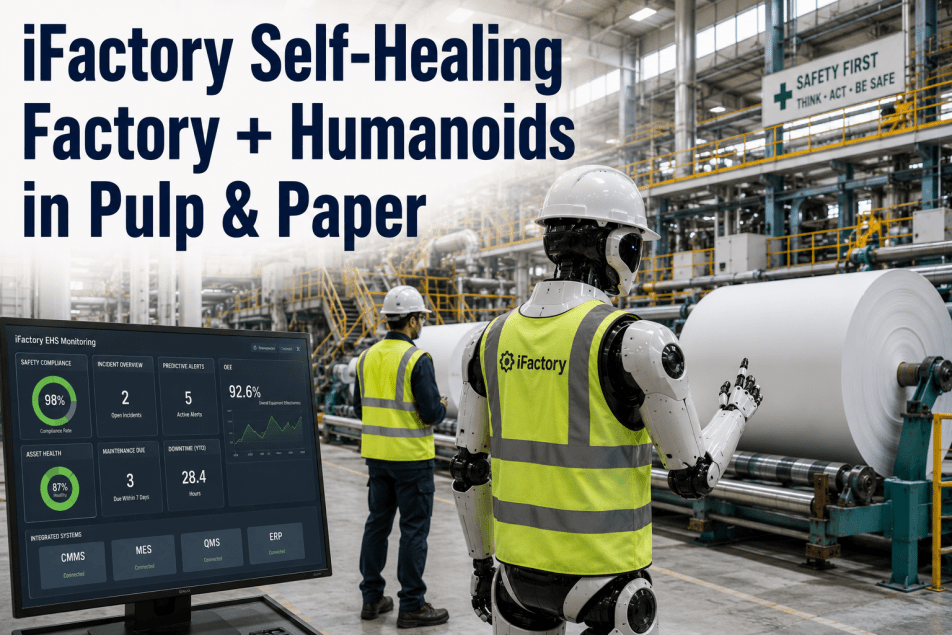
The pulp and paper mill operations director reviewed the weekly performance dashboard — two unplanned digester outages, three safety near-misses on the paper machine floor, and a maintenance backlog that had crept past sixty work orders. None of these were isolated events. They were symptoms of a plant running on disconnected systems: the CMMS didn't talk to the safety platform, the MES didn't feed equipment health data, and no one had real-time visibility into the conditions that preceded every failure and incident. This is the problem the self-healing factory was built to solve. By combining humanoid robots for physical patrol and intervention with iFactory's unified platform — spanning predictive maintenance, EHS monitoring, CMMS, MES, QMS, and ERP integration — pulp and paper mills can move from reactive, siloed operations to autonomous, self-correcting production environments.
Self-Healing Factory + Humanoid Robots for Pulp & Paper Mills
iFactory AI creates self-healing pulp and paper mills by integrating humanoid robot patrols with predictive maintenance, EHS safety monitoring, and unified CMMS, MES, QMS, and ERP platforms — all on-premise, all in one dashboard.
The Self-Healing Factory: From Reactive to Autonomous Operations
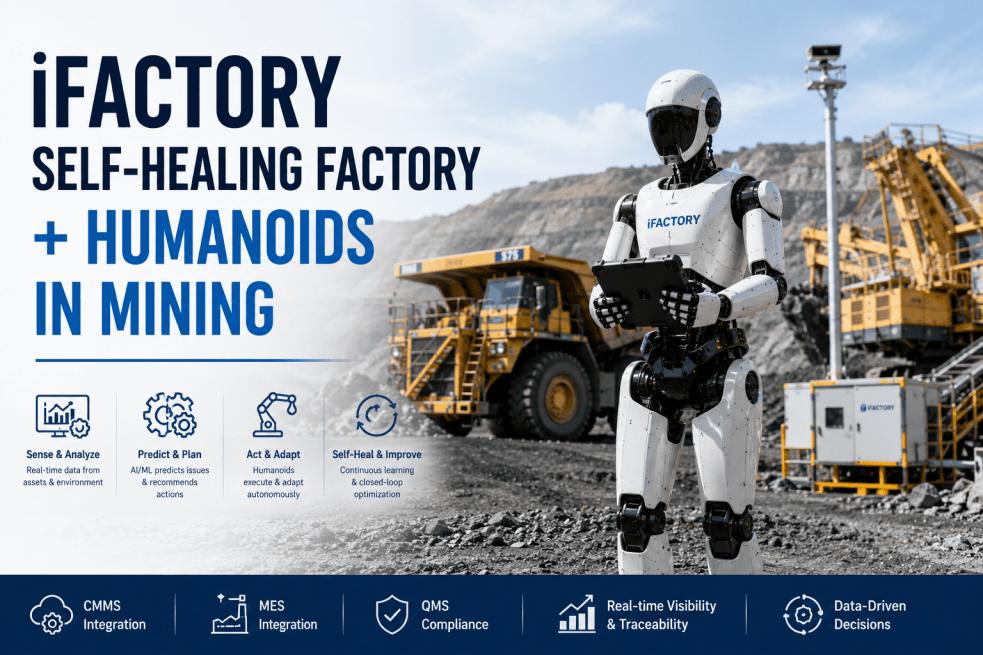
A self-healing factory detects anomalies, diagnoses root causes, and initiates corrective actions without human intervention — or escalates intelligently when human judgment is required. For pulp and paper mills, this concept transforms how every part of the operation responds to the unexpected.
When a digester experiences a pressure anomaly, the self-healing loop works like this: embedded sensors detect the deviation and feed data to iFactory's AI engine. The platform cross-references the reading against historical failure patterns, equipment specifications, and current production parameters. If the deviation falls within a corrected range, the system adjusts the control loop automatically. If it exceeds safe thresholds, a humanoid robot is dispatched to inspect the affected area visually and thermographically while the platform schedules a work order in the CMMS and alerts the shift supervisor through the EHS platform. The entire sequence — detect, diagnose, dispatch, document — takes minutes instead of hours.
| Operational Model | Incident Response | Data Flow | Workforce Role | Cost Structure |
|---|---|---|---|---|
| Traditional Mill | Operator discovers, reports, dispatches | Siloed — CMMS, MES, EHS separate | Reactive troubleshooting | High |
| Automated Mill | SCADA alerts, operator dispatches | Some integration, manual handoffs | Monitoring + response | Medium |
| Self-Healing Mill | AI detects, robot inspects, platform responds | Unified — CMMS, MES, QMS, ERP, EHS | Strategic oversight | Lowest |
Humanoid Robots in Pulp & Paper Operations
Humanoid robots bring mobility, dexterity, and sensing capability to environments that fixed automation cannot reach. In pulp and paper mills — where equipment spans acres, confined spaces are routine, and thermal/chemical hazards are constant — humanoids fill the gap between stationary sensors and human inspection. The iFactory platform ingests data from humanoid robot patrols and integrates it directly into CMMS work orders, MES production records, and EHS incident logs.
Equipment Patrol and Thermal Inspection
Humanoid robots patrol predefined routes through the pulp mill, paper machine hall, and finishing area, capturing thermal, vibration, and visual data at each asset. The robot's onboard sensors identify overheating bearings on dryer rolls, steam leaks at digester flanges, and misalignment on winder drives — conditions that typically develop over days or weeks before producing a failure. iFactory's AI engine compares each reading against the asset's baseline signature and, when a threshold is breached, automatically generates a work order in the CMMS with the robot's inspection data attached. The maintenance team receives a prioritized alert with a confidence score and recommended intervention window, not a raw temperature reading.
Confined Space and Hazmat Monitoring
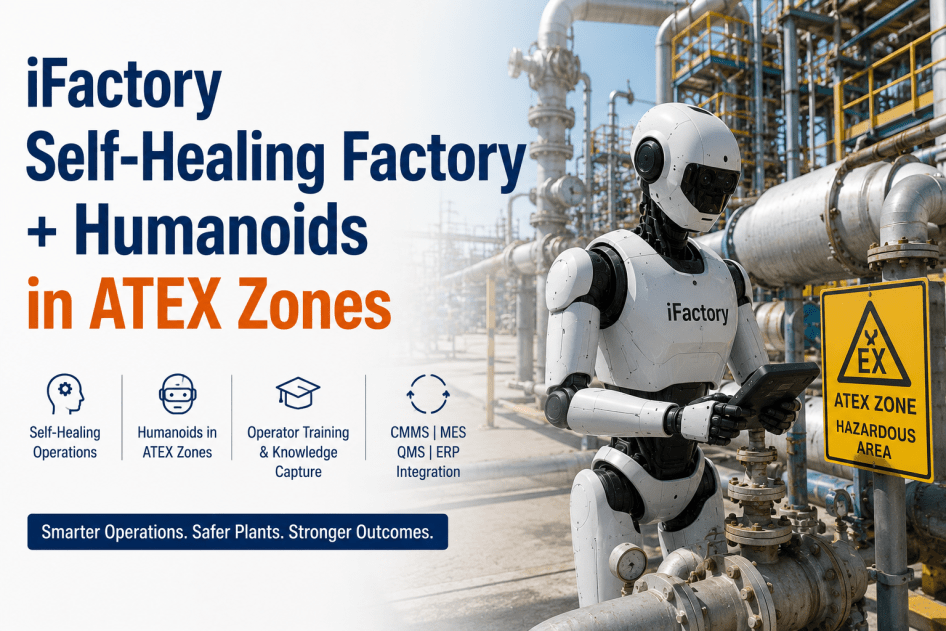
Confined space entry is one of the highest-risk activities in pulp and paper operations — digesters, chemical storage tanks, and effluent treatment vessels all require pre-entry testing and continuous atmospheric monitoring. Humanoid robots equipped with multi-gas sensors perform pre-entry atmosphere verification, relay real-time oxygen, LEL, and H₂S readings to the EHS platform, and maintain continuous monitoring while personnel are inside. If a gas level crosses the alarm threshold, the robot triggers an immediate evacuation alert through iFactory's EHS module and logs the event with timestamp, sensor data, and location. The platform automatically generates the required confined space entry permit documentation and incident report.
Material Movement and Logistics
Finished paper rolls weighing 2,000–8,000 pounds move from winder to warehouse to shipping dock in a continuous flow that strains both equipment and personnel. Humanoid robots manage roll staging, label verification, and warehouse slot assignment under iFactory's MES direction. When a roll completes the winder, the robot scans its barcode, confirms grade and weight against the production order, and directs the roll to the correct warehouse position. Inventory updates flow automatically to the ERP, eliminating the cycle-count variance that plagues manual tracking systems. Mills deploying this capability report 96%+ inventory accuracy within 90 days.
Maintenance Support and Documentation
When a work order requires physical intervention — replacing a corroded valve on a black liquor line or reseating a relief valve on a recovery boiler — humanoid robots support the maintenance team by retrieving tools, holding components, and documenting the repair with onboard cameras. The robot's visual record attaches directly to the work order in iFactory's CMMS, giving reliability engineers a permanent, timestamped record of every intervention. Over time, this visual documentation feeds the AI model's understanding of failure progression, improving the accuracy of future predictive alerts.
EHS Safety Monitoring: From Compliance to Continuous Protection
Pulp and paper mills operate under some of manufacturing's most stringent safety regulations — OSHA process safety management, combustible dust standards, confined space entry requirements, and chemical exposure limits that demand documented, auditable monitoring programs. Traditional EHS compliance relies on scheduled inspections, manual data entry, and after-the-fact incident reporting. The gap between inspections is where incidents happen. Humanoid robots running continuous EHS patrols close that gap.
iFactory's EHS module receives real-time data from every humanoid patrol — gas concentrations, temperature readings, noise levels, and visual evidence of housekeeping or guarding violations. When a patrol identifies a condition that requires corrective action, the platform generates a safety observation record, assigns it to the responsible supervisor, and tracks closure. Audit-ready documentation is produced automatically, eliminating the end-of-month scramble to reconcile inspection logs. The combination of humanoid robot EHS patrols and iFactory's unified platform creates a safety monitoring capability that operates 24/7 without adding headcount.
Unified Platform Integration: CMMS, MES, QMS, and ERP
The self-healing factory is only as effective as the systems it connects. Humanoid robots generate rich operational data, but that data must flow into the platforms that drive mill decision-making. iFactory provides native integration with each of the four core mill systems, creating a single source of truth for maintenance, production, quality, and business operations.
| Platform | Data From Humanoid Robots | System Action Triggered | Business Impact |
|---|---|---|---|
| CMMS | Vibration, thermal, visual inspection data | Auto-generate work orders with robot findings attached | 52% fewer emergency work orders, planned interventions only |
| MES | Roll barcode scans, production counts, cycle times | Update production records, adjust schedules | 96% inventory accuracy, real-time production visibility |
| QMS | Visual defect detection, dimensional measurements | Flag quality deviations, block nonconforming material | 31% reduction in customer quality complaints |
| ERP | Material movement confirmations, asset status updates | Update inventory, trigger procurement, reconcile costs | Cycle-count elimination, accurate cost-per-ton reporting |
Implementation Roadmap: From Assessment to Autonomous Operations
Moving from a traditional mill to a self-healing operation follows a structured, outcomes-based approach. iFactory's pilot methodology ensures that each phase delivers measurable results before the next phase begins.
Assess
Two-week on-site assessment mapping critical assets, existing sensor coverage, EHS compliance gaps, and integration points with current CMMS, MES, QMS, and ERP systems. Deliverable: prioritized deployment plan with ROI model.
Pilot
8–10 week pilot deploying humanoid robots on a single paper machine line or pulp processing area. iFactory platform connected read-only to existing systems. Baseline metrics established; first anomaly alerts within 2–4 weeks.
Integrate
Full integration with CMMS, MES, QMS, and ERP. Humanoid patrol routes expanded across the mill. Automated work order generation and EHS monitoring active. 12-week phase with weekly KPI reviews.
Scale
Mill-wide deployment covering all production lines, utility systems, and material handling. Self-healing loops active for highest-criticality assets. Continuous model improvement from accumulated operational data.
iFactory delivers the pilot phase on-premise in 8–10 weeks with no cloud dependency and no disruption to existing control systems. A mill-specific pilot plan can be structured around your highest-criticality production line. Book a Demo to discuss the pilot scope for your facility.
What Mill Leaders Say About Self-Healing Operations
"We deployed humanoid patrols on our paper machine line as a pilot. Within six weeks, the robots identified a developing bearing failure on a dryer roll that our vibration monitoring had flagged as marginal but not critical. The thermal data from the robot confirmed the trend was accelerating. We replaced the bearing on a planned weekend instead of losing 18 hours to an unplanned failure during a major order."
"Confined space entry was our highest-risk recurring task. Having a humanoid robot perform the pre-entry gas check and maintain continuous monitoring while our team was inside changed the risk profile completely. The iFactory integration means every entry is documented automatically — permits, gas readings, duration, and exit confirmation. Our auditors were impressed."
"The integration between humanoid patrol data and our CMMS was the feature that sold us. Every inspection run generates a work order if a threshold is breached — no human review bottleneck. Our maintenance planners went from spending 40% of their week triaging inspections to focusing on the interventions that actually matter. The predictive accuracy improved significantly once we had six months of robot-gathered baseline data."
Building the Self-Healing Pulp and Paper Mill
Pulp and paper manufacturing faces a convergence of challenges in 2026: aging infrastructure, tightening safety regulations, compressed delivery windows, and a workforce that cannot scale through hiring alone. The self-healing factory — combining humanoid robots for physical operations with iFactory's unified platform for data integration and decision automation — addresses each of these pressures directly. Autonomous EHS patrols reduce incident risk. Predictive maintenance eliminates unplanned downtime. Integrated CMMS, MES, QMS, and ERP systems replace manual data entry with automated, accurate information flow.
The path from a traditional mill to a self-healing operation is not a multi-year transformation. It begins with an 8–10 week pilot on a single production line, proving the data integration, the robot patrol model, and the ROI before scaling mill-wide. The technology exists today. The integration platform is proven. The question is whether your mill is ready to start the transition from reactive operations to autonomous, self-correcting production. Book a Demo to explore what a self-healing factory looks like in your pulp and paper mill.
Humanoid Robots and Self-Healing Factories: Common Questions
What makes pulp and paper mills good candidates for humanoid robot deployment?
How does iFactory integrate humanoid robot data with existing CMMS and EHS platforms?
What safety certifications and compliance standards do humanoid robots need for pulp and paper environments?
How long does it take to see measurable ROI from a humanoid robot and self-healing platform deployment?
Does iFactory require cloud connectivity or changes to existing control systems?
Transform Your Mill from Reactive to Self-Healing.
iFactory AI delivers a unified self-healing factory platform for pulp and paper mills — humanoid robot integration, predictive maintenance, EHS monitoring, and CMMS, MES, QMS, and ERP connectivity, all on-premise. See how an 8–10 week pilot can start delivering measurable results on your highest-criticality production line.