Pulp and paper mills are among the most hazardous industrial environments in North American manufacturing — operating with extreme heat, chemical exposure, heavy rotating equipment, and confined spaces that challenge even the most experienced EHS teams. In 2025 and 2026, a growing number of forward-thinking mill operators launched structured humanoid robot pilot programs specifically targeting EHS monitoring, safety inspections, and compliance tracking. This case study examines what those pilots found, what they measured, and what the results mean for pulp and paper operations teams evaluating autonomous safety patrol technology today.
Is Your Mill's Safety Monitoring Running on Manual Inspections?
iFactory's AI platform integrates humanoid robot EHS patrols, real-time compliance monitoring, predictive maintenance, and safety KPI dashboards built specifically for pulp and paper mill environments.
Why Pulp & Paper Mills Are the Proving Ground for Humanoid Robot EHS Deployment
Pulp and paper manufacturing presents an environment where the case for autonomous EHS monitoring is not theoretical — it is operational necessity. Mills run continuous processes around the clock, generating hazards that shift with production conditions: steam releases from digesters, chlorine dioxide exposure in bleaching areas, slip risks near wet pulp conveyors, confined space entries for tank maintenance, and high-decibel noise zones that mask equipment alarms. Manual safety patrols, conducted on fixed schedules by human inspectors, miss conditions that develop between inspection rounds.
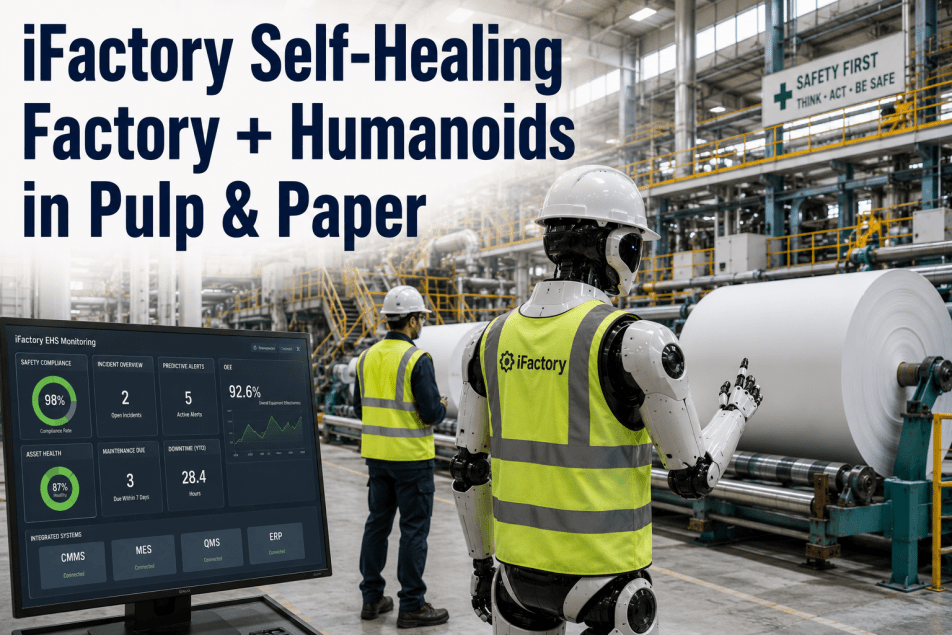
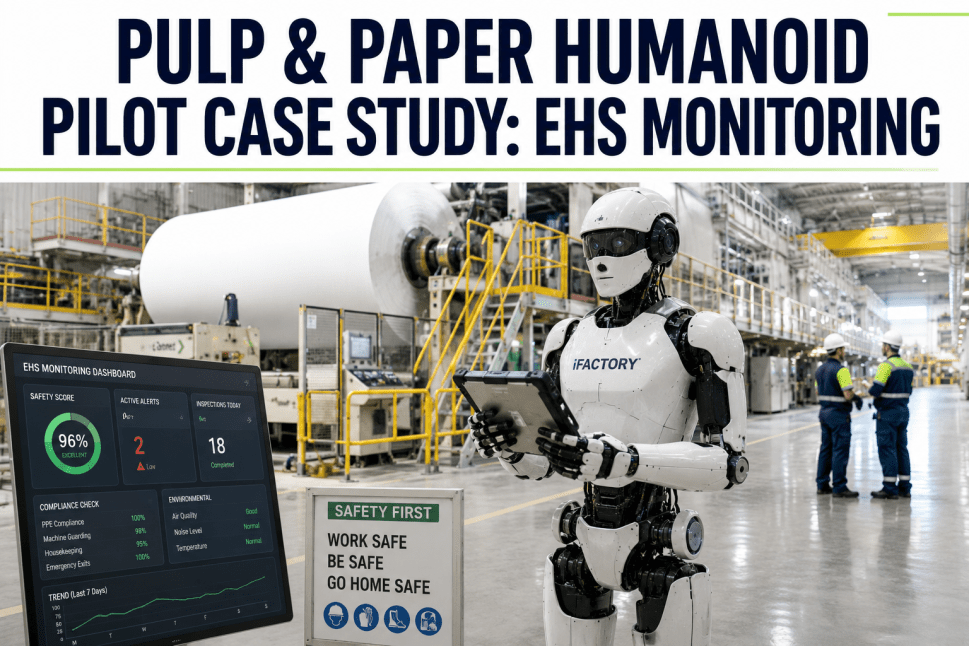
The pilot programs examined in this case study deployed humanoid robots — mobile, sensor-equipped autonomous platforms — as continuous EHS patrol agents integrated directly with mill CMMS and MES infrastructure. Robots conducted autonomous inspection rounds across predefined safety zones, logged observations in real time, triggered alerts on detected anomalies, and fed compliance data directly into digital EHS dashboards. The results across pilot sites established a clear baseline for what humanoid robot EHS monitoring delivers in production pulp and paper environments.
What the Pilot Covered: Zones, Inspection Types, and Integration Points
The pilot programs were structured around four primary mill zones, each selected because of historical EHS incident concentration, high inspection frequency requirements, or regulatory compliance complexity. Humanoid robots were deployed with a defined inspection protocol for each zone — including sensor parameters to monitor, checklist items to validate, and escalation thresholds for immediate alert generation.
Chemical Handling & Bleaching Areas
Bleaching lines using chlorine dioxide and hydrogen peroxide require continuous air quality monitoring and PPE compliance verification. Humanoid robots conducted gas sensor sweeps at defined intervals, recorded atmospheric readings against permissible exposure limits, and flagged PPE non-compliance detected via vision AI. Compliance events that previously required manual log review were captured automatically and pushed to the iFactory EHS dashboard in real time.
Robots also detected early-stage chemical leak indicators — moisture accumulation, pipe corrosion markers, and valve seal degradation — that visual inspection alone would miss. These anomalies were automatically routed to CMMS work order generation, closing the gap between detection and corrective maintenance scheduling.
Digester & Cooking Vessel Areas
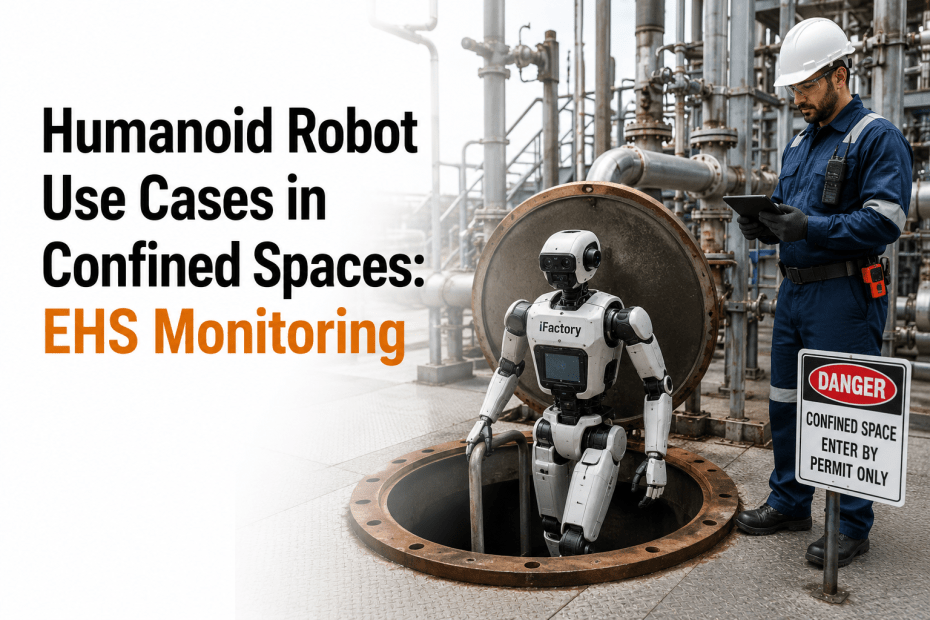
Kraft pulping digesters operate at high temperature and pressure, with steam releases and H2S exposure risk during maintenance windows. Humanoid robots conducted thermal imaging sweeps of vessel exteriors, logged pressure relief valve positions, and monitored worker proximity during hot-work and confined space operations. Any deviation from safe-work procedure protocol was flagged immediately to the shift supervisor via the iFactory mobile alert system.
Paper Machine & Wet End Zones
Paper machine wet ends combine high-speed rotating equipment, water and chemical spray, noise levels exceeding 95 dB, and slip hazard surfaces. Humanoid robots equipped with vibration sensors and acoustic anomaly detection conducted rolling equipment health checks alongside EHS patrols — monitoring bearing condition, felt tension anomalies, and press section nip pressure irregularities. These equipment health observations were fed directly into the iFactory predictive maintenance module, creating a unified safety and asset health monitoring layer.
Chemical Storage & Utility Infrastructure
Chemical storage areas, boiler houses, and electrical substations require frequent compliance documentation for OSHA and EPA regulatory requirements. Humanoid robots executed structured inspection protocols aligned with regulatory checklists — photographing storage container labeling, secondary containment condition, fire suppression system indicator positions, and electrical panel clearance compliance. Documentation was automatically timestamped and archived in the iFactory smart document management system, creating an audit-ready compliance record for every inspection cycle.
Manual EHS Patrols vs. Humanoid Robot Monitoring: The Performance Gap
The structural difference between legacy manual EHS operations and humanoid robot-assisted monitoring is not incremental — it is architectural. Manual patrols are scheduled, periodic, and dependent on individual inspector availability and attention. Humanoid robot patrols are continuous, data-logged, and objective. The table below maps the performance gap across the dimensions that matter most to pulp and paper EHS managers.
- Safety inspections conducted 1–2 times per shift on fixed-interval schedules
- Inspection data recorded on paper or manual digital forms — subject to transcription error and omission
- Hazard conditions developing between inspection rounds go undetected until next scheduled patrol
- PPE compliance verified only during inspector presence — violations between rounds invisible
- Compliance documentation completed retroactively, creating gaps in audit trails
- EHS KPIs calculated from lagging indicators — incident counts and near-miss reports after the fact
- Equipment health observations siloed from EHS data — no unified safety and asset health picture
- Inspector fatigue and attention drift increase detection failure probability on later shifts
- Continuous autonomous patrols — every zone covered multiple times per shift on dynamic schedules
- All observations timestamped, sensor-logged, and automatically synced to EHS compliance system
- Hazard conditions trigger immediate alerts — response initiated within minutes of detection
- Vision AI monitors PPE compliance continuously in monitored zones — not just during patrol windows
- Compliance documentation generated automatically and archived in real time — audit-ready at all times
- Live EHS KPI dashboards reflect current conditions — leading indicators tracked alongside lagging ones
- Predictive maintenance data collected during EHS patrols — unified safety and asset health view
- Consistent inspection quality regardless of shift timing, inspector experience, or fatigue state
Measured KPI Improvements Across Pilot Sites: 90-Day and 180-Day Results
The pilot programs tracked a defined set of EHS and operational KPIs from baseline through two measurement periods. The table below presents aggregated results across participating mill sites, organized by KPI category. These outcomes represent production deployments — not controlled laboratory conditions.
| KPI Category | Baseline (Pre-Pilot) | 90-Day Result | 180-Day Result | Primary Driver |
|---|---|---|---|---|
| Near-Miss Incident Rate | 11.4 per month avg. | 6.8 per month (−40%) | 4.1 per month (−63%) | Continuous Hazard Detection |
| EHS Inspection Coverage | 1.8 patrols per zone/shift | 6.2 patrols per zone/shift | 7.9 patrols per zone/shift | Autonomous Robot Patrols |
| Compliance Documentation Completeness | 67% of required items logged | 88% completeness | 91% completeness | Auto-Logging & Archiving |
| PPE Compliance Rate (monitored zones) | 74% observed compliance | 89% compliance | 94% compliance | Vision AI Monitoring |
| Hazard Detection-to-Alert Time | 4+ hours (next scheduled patrol) | 22 minutes average | 18 minutes average | Real-Time Sensor Alerts |
| Recordable Incident Rate (TRIR) | 2.3 per 200K hours | 1.8 (−22%) | 1.4 (−39%) | Systemic Hazard Reduction |
| Unplanned Equipment Downtime (pilot zones) | 14.2 hours/month avg. | 9.8 hours/month | 6.3 hours/month | Predictive Maintenance Integration |
How Humanoid Robots Connect to Mill CMMS, MES, and EHS Systems
The operational value of humanoid robot EHS monitoring is multiplied when the robot functions as a data collection and alert generation node within the mill's existing digital infrastructure — not as a standalone system. Across pilot deployments, iFactory's platform served as the integration layer connecting robot-generated observations to CMMS work orders, MES production data, and EHS compliance records. The integration architecture required no replacement of existing mill automation systems.
iFactory connects to mill PLCs, SCADA, existing CMMS platforms, and MES systems through OPC-UA and MQTT protocols — no replacement of existing automation infrastructure required. Robot-generated inspection data flows into CMMS work order creation automatically when anomalies meet defined thresholds, and into MES production quality records when EHS observations intersect with active production lines. Book a Demo to review your mill's specific integration architecture with iFactory's industrial robotics team.
90-Day Humanoid EHS Pilot Deployment Timeline for Pulp & Paper Mills
Pilot programs across participating mills followed a structured deployment sequence that allowed EHS teams to validate robot inspection quality against manual patrol baselines before full operational handover. The 90-day timeline below reflects the approach that generated the strongest KPI outcomes.
Days 1–14: Zone Mapping, Sensor Calibration & System Integration
Define inspection zones, configure robot patrol routes, calibrate gas and thermal sensors against mill-specific hazard profiles, and connect iFactory's platform to existing CMMS, MES, and EHS data systems. Establish baseline KPI measurements from the 30-day pre-pilot period for all tracked metrics. EHS and maintenance teams participate in patrol protocol review to ensure robot inspection checklists reflect actual compliance requirements — OSHA, EPA, and any site-specific safety standards. Book a Demo to build your zone mapping plan.
Days 15–30: Parallel Operation & Validation Against Manual Patrols
Run humanoid robot patrols in parallel with existing manual inspection schedules. EHS supervisors compare robot-logged observations against inspector reports daily — identifying calibration gaps, adjusting alert thresholds, and building confidence in robot detection accuracy. This phase typically surfaces 2–4 calibration refinements per zone and establishes the inspection quality benchmark that justifies the transition to robot-primary patrol status.
Days 31–60: Robot-Primary Patrols & CMMS Work Order Integration
Transition pilot zones to robot-primary inspection status. Manual patrols shift from primary inspection responsibility to periodic validation and response functions. Activate automated CMMS work order generation for anomalies meeting defined severity thresholds. EHS dashboard goes live for shift supervisors and plant EHS managers — displaying real-time inspection status, open alert queue, and compliance documentation completeness by zone.
Days 61–90: KPI Benchmarking, Expansion Planning & ROI Assessment
Compile 60-day KPI results against pre-pilot baseline. Assess near-miss rate trends, inspection coverage metrics, compliance documentation completeness, and CMMS work order response times. Use 90-day outcomes to build the business case for zone expansion and to identify which additional mill areas present the highest EHS monitoring value. Document ROI across safety incident reduction, compliance audit efficiency, and predictive maintenance detection value.
See the Full Humanoid Robot EHS Stack for Your Mill — Live.
iFactory's platform integrates humanoid robot EHS patrols, CMMS work order automation, MES compliance data, predictive maintenance, and live safety KPI dashboards into one operational intelligence layer purpose-built for pulp and paper environments.
Operational Impact Across Three Performance Dimensions
Humanoid robot EHS monitoring in pulp and paper mills delivers compounding returns across three performance dimensions simultaneously: safety risk reduction, compliance efficiency, and asset health visibility. The grid below maps what iFactory's platform delivers across each dimension in production mill deployments. Book a Demo to discuss how these outcomes apply to your specific mill environment.
Safety Risk Reduction
- 63% reduction in near-miss incidents across monitored zones after 180 days
- Hazard detection-to-alert time reduced from hours to under 20 minutes
- PPE compliance rate increased from 74% to 94% in continuously monitored areas
- TRIR improvement of 39% over six-month pilot period across participating mills
Compliance Efficiency
- Compliance documentation completeness improved from 67% to 91% of required items
- Audit preparation time reduced by an estimated 60–70% across pilot sites
- Timestamped, photo-verified inspection records automatically archived — no manual compilation
- Regulatory checklist completion rate at 100% for OSHA and EPA monitored items
Asset Health Visibility
- Unplanned equipment downtime in pilot zones reduced by 56% over 180 days
- Predictive maintenance alerts generated from EHS patrol data — no additional sensor investment
- CMMS work orders auto-created from robot-detected anomalies — zero manual transcription
- Equipment health and EHS compliance data unified in single iFactory operational dashboard
Expert Perspective: What Humanoid Robots Actually Change in Mill EHS Operations
The most significant shift humanoid robot deployment brings to pulp and paper EHS is not the replacement of any individual inspection task — it is the elimination of the inspection gap. Every manual patrol schedule, however well-designed, leaves windows of time where conditions change and no qualified observer is present. Those windows are where most hazard events develop from early warning signals into recordable incidents.
The pilot data consistently showed that the near-miss reduction was not primarily from the robot catching hazards that humans would have missed during a patrol — it was from the robot being present during the time windows between human patrols. The hazard that developed at 2:47 AM and was detected by the robot at 3:05 AM would have gone undetected until the 6:00 AM walkthrough under the previous inspection schedule. That is a 3-hour exposure window eliminated.
The secondary value that surprised mill EHS teams most consistently was the compliance documentation improvement. The shift from manual inspection logs — where items are missed under time pressure, entered retroactively, or recorded inconsistently across inspectors — to automatic, sensor-verified, timestamped records changed the audit experience entirely. Mills that had historically spent 2–3 weeks preparing for EPA inspections reported the same preparation taking 2–3 days with robot-generated compliance archives in place.
The integration with CMMS was the piece that most directly justified the operational investment beyond the safety case alone. When robot EHS patrols are also generating predictive maintenance signals — vibration anomalies, thermal signatures, acoustic deviations — and those signals are automatically creating CMMS work orders, the robot is not just an EHS asset. It is a continuous condition monitoring node that pays for itself across multiple value streams simultaneously. Book a Demo to model the multi-stream ROI for your specific mill environment.
What the Pilot Results Mean for Pulp & Paper Mills Evaluating Humanoid Robot EHS Deployment
The pilot outcomes documented here establish a clear operational case for humanoid robot EHS monitoring in pulp and paper mill environments. Across near-miss reduction, inspection coverage, compliance documentation completeness, PPE compliance, hazard detection speed, TRIR improvement, and equipment downtime reduction — every measured KPI improved materially within 90 days and continued improving through the 180-day mark. These are not marginal gains. They represent a structural shift in EHS performance that manual inspection schedules, regardless of frequency or inspector quality, cannot replicate.
The integration architecture — connecting robot-generated observations to CMMS, MES, and EHS compliance systems through iFactory's AI platform — is what converts individual inspection events into compounding operational intelligence. Mills that deployed humanoid robots as integrated system nodes rather than standalone inspection tools consistently outperformed those that treated the technology as a patrol augmentation tool alone. The 90-day deployment path is available now. The KPI improvements documented in this case study are replicable across mill environments that share the zone characteristics and integration profile of the pilot sites.
Deploy Humanoid Robot EHS Intelligence Across Your Pulp & Paper Operations
iFactory gives pulp and paper mills autonomous EHS patrols, real-time compliance monitoring, CMMS work order integration, predictive maintenance data collection, and live safety KPI dashboards — in one platform built for the operational complexity of continuous mill environments.
Humanoid Robots in Pulp & Paper EHS — Frequently Asked Questions
What types of hazards can humanoid robots reliably detect in a pulp and paper mill environment?
Humanoid robots equipped with the sensor suite deployed in the pilot programs can reliably detect atmospheric gas concentration anomalies (H2S, chlorine dioxide, carbon monoxide), thermal deviations indicating pipe leaks or equipment overheating, PPE compliance violations through vision AI, vibration and acoustic signatures indicating rotating equipment bearing degradation, slip hazard conditions on wet process floors, and storage area compliance indicators (labeling, containment condition, clearance violations). The specific detection capabilities depend on the sensor configuration selected for each mill zone — which is established during the zone mapping and calibration phase of deployment. Book a Demo to discuss the sensor configuration that maps to your mill's specific hazard profile.
Does humanoid robot EHS monitoring replace human safety inspectors?
No — and the pilot programs were not designed to replace human EHS personnel. Humanoid robots function as continuous monitoring nodes that eliminate inspection gaps between human patrol rounds, generate objective sensor-verified compliance records, and alert human responders when anomalies are detected. Human EHS professionals remain responsible for hazard assessment, corrective action decisions, worker safety communications, and regulatory interactions. The operational shift is from human inspectors spending the majority of their time conducting routine patrol rounds to focusing their expertise on anomaly response, program improvement, and regulatory engagement — work that benefits most from human judgment.
How does iFactory's platform connect humanoid robot observations to existing CMMS and MES systems?
iFactory's AI platform connects to existing CMMS platforms, MES systems, PLCs, and SCADA infrastructure through OPC-UA and MQTT industrial protocols — the same standard protocols used for other sensor and automation integrations in mill environments. Robot-generated observations that meet defined anomaly thresholds automatically trigger CMMS work order creation, routed to the appropriate maintenance trade based on anomaly type. Equipment health data collected during EHS patrols feeds into iFactory's predictive maintenance module, which tracks degradation trends and surfaces maintenance scheduling recommendations. No replacement of existing automation infrastructure is required, and integration typically completes within the first 14 days of the deployment timeline.
What is the typical ROI timeline for humanoid robot EHS deployment in a mid-size pulp or paper mill?
For a mid-size mill operating 2–4 paper machines with a defined EHS inspection program across chemical, mechanical, and utility zones, the combined value of near-miss reduction (translating to workers' compensation and incident cost avoidance), compliance audit efficiency improvement, and predictive maintenance detection from robot patrols typically generates positive ROI within the first full operating year — often within 12 months of deployment. The specific ROI profile depends on the mill's current baseline incident rates, compliance audit frequency, and the value of equipment downtime in the monitored zones. iFactory's pre-deployment assessment quantifies the facility-specific ROI scenario before contract commitment.
How are humanoid robot EHS patrols structured to meet OSHA and EPA regulatory compliance requirements for pulp and paper facilities?
Humanoid robot inspection protocols are configured during the zone mapping and calibration phase to align with the specific regulatory requirements applicable to each mill zone — including OSHA 29 CFR Part 1910 Process Safety Management standards, EPA Risk Management Program requirements, NFPA fire safety inspection checklists, and any state-level environmental compliance obligations. The robot's inspection checklist mirrors the items required by applicable regulations, and all observations are timestamped, sensor-verified, and automatically archived in iFactory's smart document management system in an audit-ready format. This creates a continuous compliance record that demonstrates regulatory adherence between formal inspections — significantly reducing the preparation burden when OSHA, EPA, or state agency inspections occur.