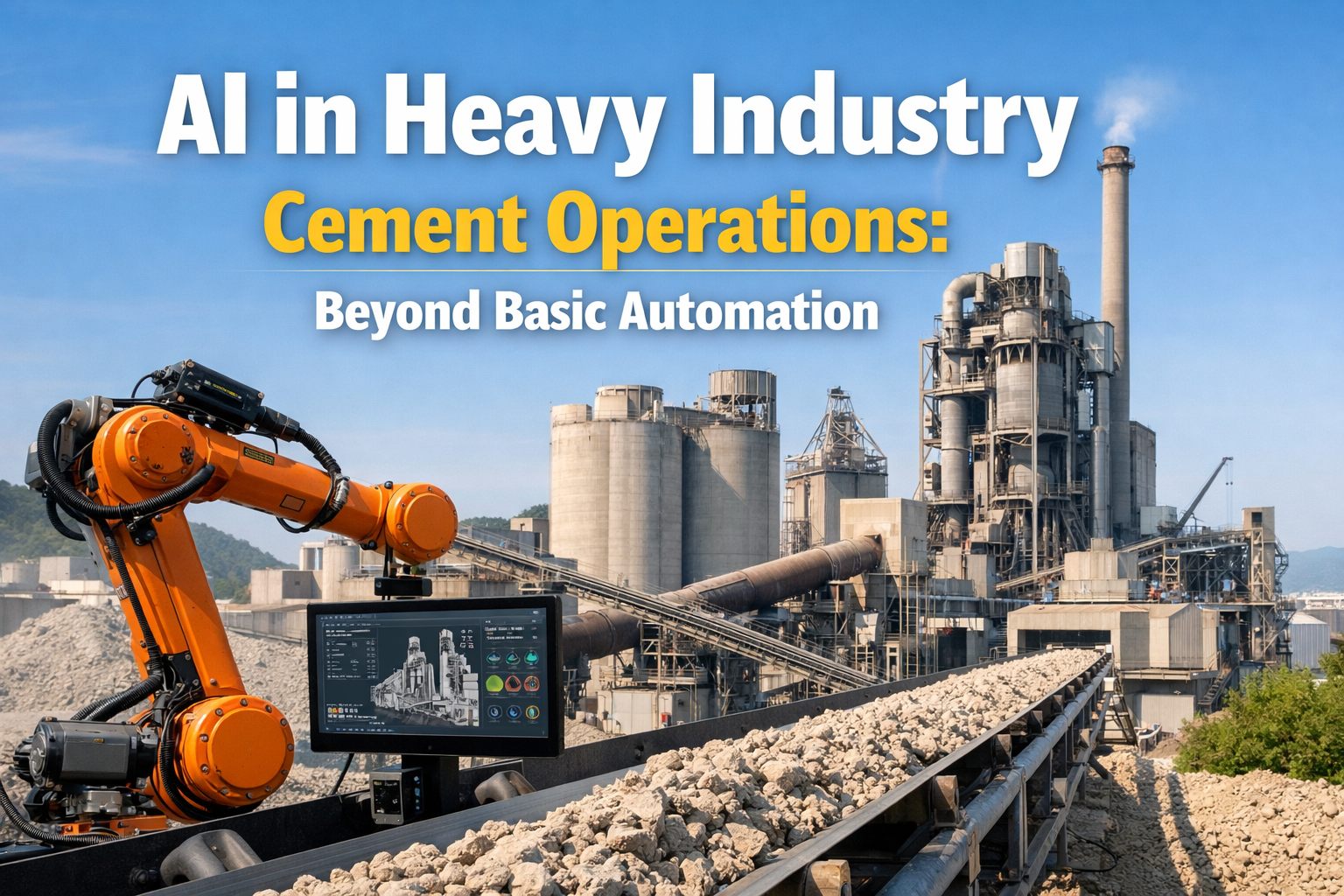
A cement kiln burning at 1,450°C doesn't care about your automation scripts. Traditional control systems react to what already happened—temperatures spiked, fuel efficiency droppedclinker quality degraded. By the time operators see the data, $8,000 in wasted energy and off-spec product has already gone up the stack. AI doesn't just automate cement operations—it predicts, adapts and optimizes across interdependent variables that no rule-based system can handle. Leading cement plants using AI-driven control report 18% energy cost reduction and 23% kiln uptime improvement within the first year. The question isn't whether AI works in heavy industry—it's whether you can afford to operate without it.
AI in Heavy Industry Cement Operations:
Beyond Basic Automation
How Artificial Intelligence Transforms Cement Manufacturing from Reactive Control to Predictive Optimization
Why Heavy Industry Cement Operations Defeat Traditional Automation
Cement manufacturing isn't assembly line work—it's managing chaos at 1,450°C with million-dollar consequences.
Energy: 60% of Operating Costs
A single degree celsius temperature variance in the kiln wastes $340/hour in fuel. Multiply across 24/7 operations and you're burning $3M annually in preventable energy waste.
Interdependent Variables
Kiln temperature affects clinker quality. Raw mill feed rate impacts preheater efficiency. Coal moisture changes flame characteristics. 47+ variables influence each other in real-time—impossible for operators to optimize manually.
Quality vs. Throughput Tradeoff
Push production too hard? Clinker quality drops and you're grinding rejects. Too conservative? Capacity sits idle while demand waits. AI finds the optimal balance every shift.
What AI Actually Does in Cement Operations
Moving from "what happened" to "what will happen" and "what should we do about it."
Real-Time Process Monitoring
What it does: AI analyzes 200+ sensor inputs every second—temperatures, pressures, flow rates, chemical composition, vibration patterns. Detects anomalies 14 minutes before human operators notice.
Business impact: Prevents kiln upsets that cost $120K–$180K per incident in lost production and refractory damage.
"Bearing temperature on kiln gear rising 0.3°C/hour—pattern matches lubrication failure in 4–6 hours. Maintenance alert created."
Predictive Combustion Optimization
What it does: Machine learning models predict optimal fuel mix (coal, pet coke, alternative fuels) and air-to-fuel ratios based on current raw material chemistry, ambient conditions, and clinker quality targets.
Business impact: 12–18% reduction in specific thermal energy consumption. For a 3,000 TPD plant, that's $2.1M annual fuel savings.
"Raw meal LSF increased 2 points—AI adjusts kiln temperature profile and reduces coal feed 4% to maintain clinker free lime at 1.2%."
Quality Prediction & Control
What it does: AI predicts clinker quality parameters (free lime, C3S, C2S) 45 minutes before lab results. Auto-adjusts process to hit compressive strength targets ±2 MPa.
Business impact: Reduces off-spec production from 8% to <2%. Each percentage point saved is worth $480K/year for mid-size plants.
"Predictive model shows 28-day strength trending toward 51 MPa (target: 53±2). System recommends raw mill adjustment 30 min before lab confirms."
Predictive Maintenance
What it does: Analyzes vibration signatures, thermal patterns, power consumption, and operational stress to predict equipment failures 2–4 weeks in advance. Schedules maintenance during planned shutdowns.
Business impact: 60% reduction in unplanned downtime. Emergency kiln shutdown costs $85K–$140K in lost production alone.
"Preheater cyclone showing abnormal vibration pattern + temperature delta—predicts refractory erosion. Schedule inspection in 18 days."
The Financial Math: AI ROI in Cement Operations
Real cost savings from plants that implemented AI-driven control systems.
Energy Optimization
How: AI optimizes kiln burner control, adjusts clinker cooler airflow in real-time, and maximizes alternative fuel usage while maintaining quality.
Production Uptime
How: Predictive maintenance prevents catastrophic failures. AI-driven process control reduces kiln upsets and emergency shutdowns by 70%.
Quality Consistency
How: Real-time quality prediction prevents grinding rejects and allows tighter specification targeting (less overproduction of strength).
Emissions Reduction
How: Lower specific energy consumption = less CO₂. AI optimizes combustion profiles to minimize NOx formation without sacrificing efficiency.
How AI Integration Actually Works in Cement Plants
Practical deployment without production disruption.
Data Infrastructure Audit
Duration: 2–3 weeks
Assessment of existing DCS/SCADA systems, sensor coverage, data quality, and network infrastructure. Identify gaps and plan integration points.
Baseline & Model Training
Duration: 4–6 weeks (runs in parallel with production)
AI models learn from 90 days of historical data—correlating process inputs to outputs, building digital twin of kiln behavior, training predictive algorithms.
Shadow Mode Testing
Duration: 3–4 weeks
AI runs in "advisory" mode—making recommendations that operators can choose to follow or ignore. Validates model accuracy, builds operator trust, fine-tunes parameters.
Phased Autonomous Control
Duration: 6–8 weeks
Gradual handoff to AI control. Week 1–2: Raw mill optimization. Week 3–4: Kiln burner control. Week 5–6: Full kiln system. Week 7–8: Quality prediction active. Operators retain override authority.
No production shutdowns required. Schedule a technical assessment to understand integration with your existing systems.
Specific AI Applications Across Cement Operations
Raw Material Blending
AI analyzes incoming limestone, clay, and additives chemistry via XRF—auto-adjusts stacker/reclaimer to hit LSF, SM, and AM targets ±0.2 points. Handles variability in quarry zones that manual blending can't accommodate.
Alternative Fuel Optimization
Machine learning predicts optimal mix of coal, RDF, tire-derived fuel, and biomass based on calorific value, ash content, and moisture—maximizing substitution rate while maintaining flame stability and clinker quality.
Kiln Coating Management
AI monitors refractory coating thickness via thermal imaging and kiln shell temperature patterns. Predicts coating loss and automatically adjusts kiln operation to rebuild coating—preventing catastrophic refractory failure.
Grinding Circuit Optimization
AI controls ball mill load, separator speed, and clinker feed rate to hit Blaine fineness and PSD targets while minimizing specific power consumption. Adapts to clinker grindability changes in real-time.
Common Questions About AI in Cement Manufacturing
Does AI replace our kiln operators?
No. AI handles the impossible—optimizing 47+ interdependent variables simultaneously. Operators shift from manual setpoint adjustment to monitoring AI recommendations, handling exceptions, and focusing on maintenance coordination. Most plants report operators prefer AI assistance because it eliminates the frustration of fighting process variability.
What if our plant uses alternative fuels with high variability?
That's exactly where AI excels. Traditional control systems fail with variable fuel quality—operators can't react fast enough. AI predicts combustion behavior based on fuel analysis, adjusts air distribution preemptively, and has increased alternative fuel substitution rates from 25% to 45–50% at plants burning RDF, tires, and biomass.
Can AI work with our existing DCS/SCADA system?
Yes. AI systems integrate via standard protocols (OPC UA, Modbus, etc.) with all major DCS platforms—Siemens, ABB, Schneider, Honeywell, Yokogawa. No rip-and-replace. The AI layer sits above existing control systems and sends optimized setpoints.Integration assessment takes 1–2 weeks.
How much historical data do you need to train AI models?
Minimum 60 days of continuous operation data at 1-minute intervals. Ideal is 90–120 days including different operating modes, seasonal variations, and raw material changes. The more variability in training data, the better AI handles edge cases. Plants without adequate historical data can start collecting during the contract/planning phase.
What happens if AI makes a bad recommendation?
Multiple safety layers: (1) AI recommendations are constrained within safe operating limits defined during commissioning. (2) Operators retain override authority 24/7. (3) Automatic rollback if process moves outside acceptable ranges. (4) Human-in-the-loop for major process changes. After 6+ months, AI rarely makes recommendations operators disagree with—the AI learns plant-specific behavior that outperforms manual control.
Is the ROI really 6–9 months? That seems aggressive.
Energy savings alone typically justify the investment. A 3,000 TPD plant burning 750 kcal/kg clinker at $4.20/GCal saves $2.1M/year with 15% thermal energy reduction. Add uptime improvements ($1.8M) and quality savings ($620K), and you're at $4.5M+ annual impact. Against $1M implementation cost, that's 2.7 months payback. Conservative estimate is 6–9 months accounting for ramp-up time.
From $8K Daily Energy Waste to AI-Optimized Efficiency
See exactly how AI will reduce your specific energy consumption, increase kiln availability, and improve clinker quality based on your plant configuration.


.jpeg)
.jpeg)


