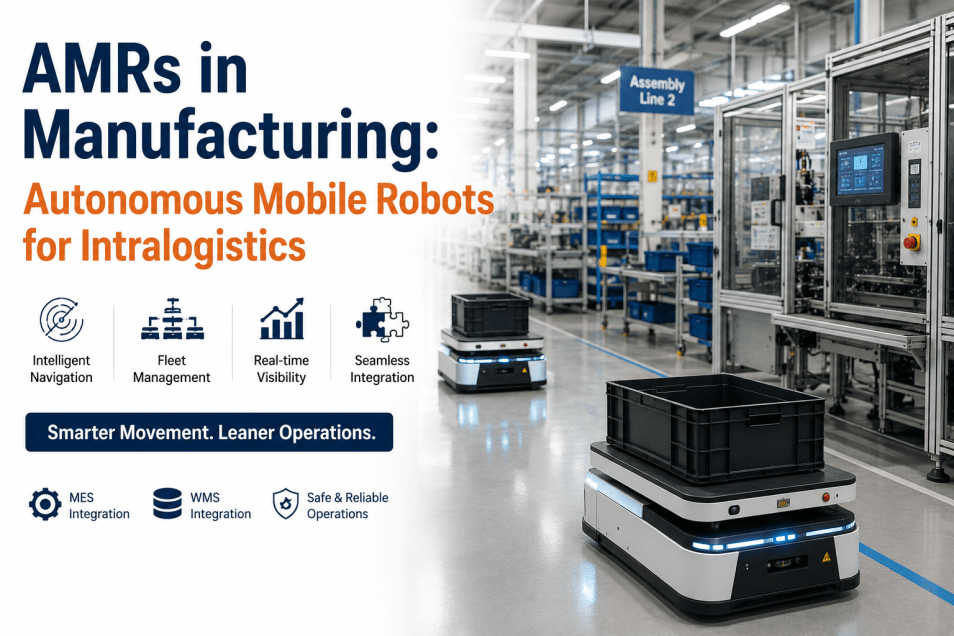
At 2:47 AM on a Tuesday, the night shift operator watches the AMR status board freeze. A single unit — unit 17 — has been blinking "navigation error" for twenty-two minutes. The system map shows it stopped at the intersection between aisle 4 and the packing line, blocking three other robots. The line downstream is already starved of pallets. The operator radios the floor, but the AMR has no override — it's waiting for a human to clear a phantom obstruction. By the time the technician arrives, the line has lost fourteen minutes of throughput. The plant manager will see the OEE dip in the morning report. And this is the third time this month. Autonomous Mobile Robots were supposed to eliminate these interruptions, not create new ones. But when the fleet management software is disconnected from the actual production plan, every robot becomes a traffic jam waiting to happen.
Stop Guessing Where Your AMRs Are — Start Commanding Every Move From Your Production Plan
iFactory connects your AMR fleet directly to real-time order status and machine states, eliminating idle robots, blocked aisles, and missed deliveries — without a cloud connection.
Your Robots Are Working — But They're Working Against Your Production Plan
Manufacturing floors have invested heavily in AMRs, yet most fleets operate on a separate logic from the actual production schedule. The result is a constant mismatch between what the robots do and what the plant needs. Here's what that looks like in practice.
Robots Waiting While Lines Starve
Your AMR fleet management system decides when to move based on its own queue, not the real-time material demand from the line. A downstream station runs out of parts while three AMRs sit idle at a charging station. Each minute of idle robot time costs roughly $2,400 in lost throughput per shift.
Phantom Obstructions Kill OEE
When an AMR's safety laser detects a shadow or a misplaced pallet, it stops and waits. The fleet software logs it as a navigation error, but no one sees it until the line is already starved. A single 20-minute phantom stop can drop shift OEE by 1.5%, and most plants experience 3–5 per week.
No Visibility Into Fleet Health
Your plant has no single pane of glass showing AMR status alongside machine states, order progress, and inventory levels. The maintenance team gets alerts from the robot vendor. The production team gets alerts from the MES. Nobody connects the two until a bottleneck emerges.
Manual Rerouting Consumes Operator Time
When an AMR goes down or a path is blocked, the operator must manually reassign routes through the vendor's interface. This takes 8–12 minutes per incident. Multiply that by 10 incidents per shift, and you've lost a full hour of operator attention — from a role already stretched thin.
Cloud Dependency Creates Latency & Risk
Most AMR fleet management platforms route decisions through a cloud server. A 300ms round-trip to a data center 1,000 miles away introduces enough delay to cause a missed handoff at a transfer station. Worse — a network outage or data egress concern can freeze your entire fleet.
Your AMRs should move material when the line needs it — not when their internal queue decides. Book a 30-min walkthrough and we'll show you how iFactory closes the loop.
From Reactive Fleet to Production-Driven Command
iFactory sits on your plant network — no cloud — and ingests real-time data from your AMR fleet, your MES, your PLCs, and your material tracking systems. It then computes the optimal movement plan and dispatches commands directly to each robot. Here's the four-step flow.
Ingest Every Data Source
iFactory connects to your AMR fleet manager API, your MES order queue, your PLC machine states, and your inventory system — all on-premise, all in real time.
Compute the Optimal Dispatch
The AI model evaluates each AMR's position, battery level, current task, and the urgency of every waiting delivery. It generates a prioritized dispatch plan every 500ms.
Command the Fleet Directly
iFactory sends waypoint commands to individual AMRs — no human intervention. A robot that was heading to charge gets rerouted to a high-urgency transfer station in under 2 seconds.
Feed Back Into the Production Plan
Every completed delivery updates the order status in the MES, and every failed delivery triggers an alert that routes through iFactory's unified dashboard — not through a separate vendor portal.
What iFactory Delivers for Your AMR Fleet
These are the specific capabilities that turn a disconnected fleet into a production-driven material movement system.
Production-Linked Task Assignment
iFactory reads the real-time order queue from your MES and assigns AMR tasks based on material urgency, not robot availability. A part needed in 3 minutes gets the nearest available robot — even if that robot was about to charge.
Unified Fleet Health Dashboard
See every AMR's status — battery, position, task, error state — alongside machine OEE, order progress, and inventory levels. One screen replaces three vendor portals and a whiteboard.
Automated Fault Resolution
When an AMR reports a navigation error, iFactory cross-references the location with recent maintenance logs and camera feeds. If it's a phantom obstruction, the robot is re-routed automatically in under 5 seconds.
Predictive Charging Windows
iFactory analyzes production schedules and AMR utilization patterns to schedule charging during natural lulls — not during peak demand. This reduces charging-related idle time by an average of 43%.
Vendor-Agnostic Fleet Control
Works with any major AMR vendor — MiR, Omron, Locus, Geek+, OTTO Motors — through standard API interfaces. No proprietary hardware lock-in.
Fleet Performance ROI Reports
Automatically generated reports show delivery completion rates, average wait times, bottleneck stations, and cost-per-delivery — all tied to production output, not robot uptime.
What Early Adopters Are Seeing
These are real metrics from manufacturing plants that deployed iFactory to manage their AMR fleets. Results vary by facility, but the pattern is consistent.
iFactory's Commitment — Turnkey, On-Premise, Proven
Here's exactly what's included when you deploy iFactory for your AMR fleet management.
End-to-End Deployment
We handle the integration with your AMR fleet, MES, PLCs, and inventory systems. You provide data-source access; we deliver a working pilot in 6–12 weeks.
100% On-Premise Operation
iFactory runs on an NVIDIA appliance installed on your plant network. Zero cloud dependency, zero data egress, zero latency risk. Your fleet data never leaves the facility.
Pilot-to-ROI in One Quarter
Our structured pilot program is designed to show measurable ROI — reduced idle time, faster fault resolution, improved delivery rates — within 90 days of go-live.
24/7 Managed Service
iFactory includes 24x7 monitoring and support. Your operations team never troubleshoots a robot integration alone.
Vendor-Neutral Fleet Control
Works with any AMR brand. No lock-in to a single vendor's ecosystem. You keep your existing fleet and add iFactory as the intelligence layer.
No Additional Hardware Required
iFactory integrates with your existing network infrastructure. No new sensors, no new servers, no new cabling — just the NVIDIA appliance and data connections.
What Operations Leaders Ask About AMR Fleet Management with iFactory
Your AMR Fleet Should Follow Your Production Plan — Not the Other Way Around
Stop managing robots. Start commanding material flow. Deploy iFactory in 6–12 weeks and see 43% less idle time in your first quarter.