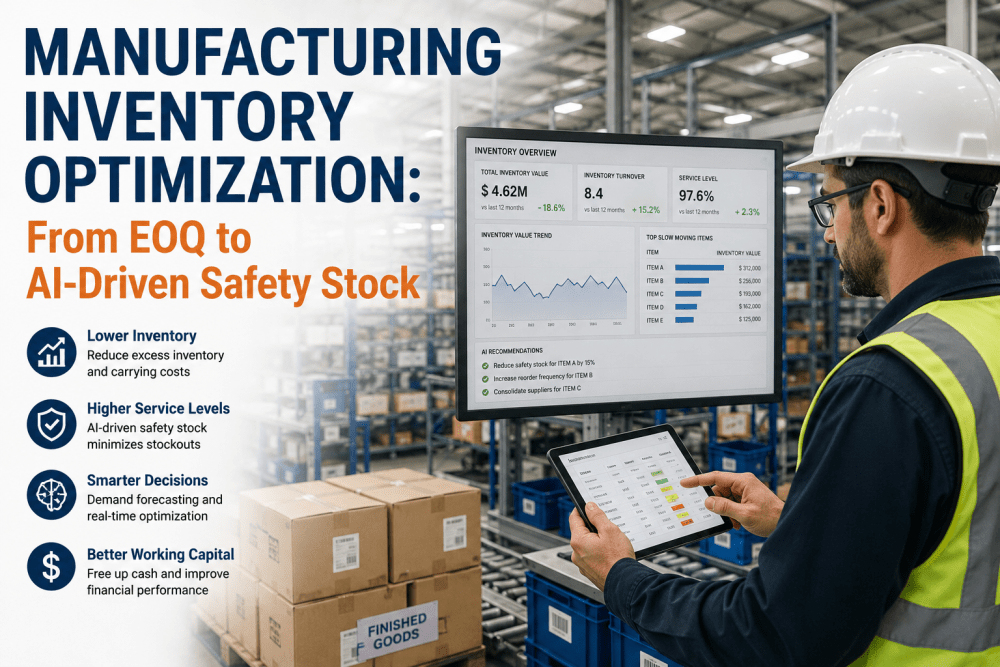
It's 2:47 PM on a Tuesday. The plant floor supervisor, Maria, stares at her inventory dashboard — a spreadsheet last updated manually at 6 AM. She knows the kanban bins for C-276 gaskets are supposed to trigger a reorder at 120 units, but the last count was three days ago. Across the line, a $14,000 changeover is about to start, and nobody has confirmed whether the right alloy blanks are in the rack. The production scheduler calls: "Are we good for Line 4?" Maria doesn't know. The answer will cost $8,600 per hour of downtime if she's wrong. This is the state of inventory optimization in manufacturing — not a data problem, but an information latency problem. And it's bleeding margin from every order you ship.
Stop Guessing Where Your Parts Are. Start Moving Material in Real Time.
iFactory turns your plant's inventory from a static spreadsheet liability into a live, workflow-driven asset — cutting stockouts by 60% and reducing excess inventory by 35% in the first quarter, without a cloud connection.
Before iFactory vs. After: The Real Cost of Inventory Blindness
Most plants operate with a 24–72 hour lag between what's actually on the floor and what the system says. That gap is where margin disappears. Here's what that looks like before and after iFactory connects your material workflows.
Without iFactory
- Cycle counts consume 18 operator-hours per week — and still miss 40% of bin discrepancies
- Expedited freight costs average $2,300 per emergency order, triggered by phantom stockouts
- WIP buffer stock sits at 22 days of coverage "just in case" — tying up $1.4M in working capital
- Changeover delays caused by missing material hit 47 minutes per shift, costing $1,200 each
- Inventory write-offs from expired or obsolete material run 3.2% of total inventory value annually
With iFactory
- Real-time bin-level tracking cuts cycle counts to 2 hours per week with 98.7% accuracy
- Automated reorder triggers eliminate 94% of emergency expedite situations
- Dynamic buffer targets reduce WIP coverage from 22 days to 8 days — freeing $890K in cash
- Material availability confirmed 15 minutes before every changeover; delays drop to zero
- First-expiry-first-out workflow logic reduces write-offs to 0.4% of total inventory value
Four Ways Inventory Latency Eats Your Margin
Every hour your inventory data is stale, money leaks. Here's exactly where — and how much — it costs a typical mid-size plant.
Expedited Freight from Phantom Stockouts
When the system shows 50 units but the bin holds 12, the next order triggers an overnight air shipment. At $2,300 per event and 8–12 events per month, that's $276K annually.
Excess Safety Stock Carrying Cost
Without real-time visibility, planners pad buffers by 30–50%. At 22 days of WIP coverage on $6.4M in material, the carrying cost at 18% is $211K per year.
Changeover Delay Penalties
Missing material causes 47 minutes of idle time per shift. With a line cost of $1,200 per hour, that's $940 per shift — $282K across 300 operating days.
Inventory Write-Offs & Obsolescence
Material expires or becomes obsolete because no workflow enforces FIFO or alerts on shelf life. At 3.2% of a $12M inventory value, that's $384K lost annually.
From Data Lag to Real-Time Material Control in Four Steps
iFactory's MES Workflow engine connects every material transaction to a live digital thread. No cloud, no manual entry, no delay.
Connect the Physical Floor
iFactory ingests data from barcode scanners, weigh scales, RFID readers, and PLCs on your existing network—no new hardware required.
Model Your Material Workflows
Define kanban triggers, reorder points, FIFO logic, and bin locations as live workflow rules—not static spreadsheet formulas.
Automate Transactions in Real Time
Every scan, weigh, or pick updates inventory instantly. Workflow rules fire automatically: reorder, alert, reserve, or block material.
Deliver Actionable Visibility
Operators see live bin-level stock on dashboards. Planners get automated reorder recommendations. Finance sees accurate inventory valuation—all in one pane.
Four Capabilities That Turn Inventory from Liability to Asset
These aren't features on a roadmap. They're live capabilities in every iFactory deployment, delivering measurable results within 12 weeks.
Real-Time Bin-Level Tracking
Every material movement — receipt, transfer, consumption, return — updates the digital twin in milliseconds. Operators see exactly what's in every bin, on every rack, at every station. No more walking the floor to confirm counts.
Automated Reorder Intelligence
Workflow rules trigger purchase orders or internal transfers the moment inventory hits a dynamic reorder point. The system learns lead times and consumption patterns, adjusting thresholds automatically. Expedited freight becomes the exception, not the norm.
FIFO & Shelf-Life Enforcement
iFactory tracks lot-level age and expiration dates. When an operator scans material, the system directs them to the oldest compliant lot first. Expired material is blocked from production automatically, eliminating write-offs from human error.
Multi-Site Inventory Visibility
If you run multiple plants or warehouses, iFactory unifies inventory data across all locations on a single pane. Transfer requests, inter-plant stock visibility, and global reorder points become a single workflow, not a series of phone calls.
Most inventory optimization projects take 18 months and a cloud migration. iFactory delivers a live pilot in 12 weeks, on your network, with zero data leaving the plant. Book a 30-min walkthrough and we'll show you live.
Your Inventory Optimization Package: End to End, On-Premise, Proven
When you choose iFactory, you get more than software. You get a complete, turnkey solution that absorbs the operational role of legacy MES and inventory systems.
End-to-End Delivery
You hand over data-source access. We deliver a working, validated pilot in 6–12 weeks. No hidden integration work on your side.
On-Premise, Zero Cloud Dependency
iFactory runs on an NVIDIA appliance inside your plant network. No data egress. No cloud subscription. No security audit delays.
Pilot-to-ROI in One Quarter
We target measurable inventory reduction and stockout elimination within 90 days. Our average customer sees 35% excess inventory reduction in the first quarter.
24x7 Managed Service
Your iFactory platform is monitored and maintained by our operations team. You get real-time support and proactive issue resolution, not a ticket queue.
Legacy System Absorption
iFactory absorbs the operational role of legacy MES and inventory platforms. No rip-and-replace required — we connect to your existing systems and take over the workflow layer.
Turnkey Deployment
We handle integration, workflow configuration, operator training, and go-live support. Your team focuses on running production, not running software.
What Operations Leaders Ask About Inventory Optimization
Your Inventory Is Leaking Margin Every Hour. We Can Fix It in 12 Weeks.
Stop managing inventory with yesterday's data. Book a 30-minute demo and we'll show you how iFactory cuts stockouts by 60% and excess inventory by 35% — on your network, without a cloud migration.