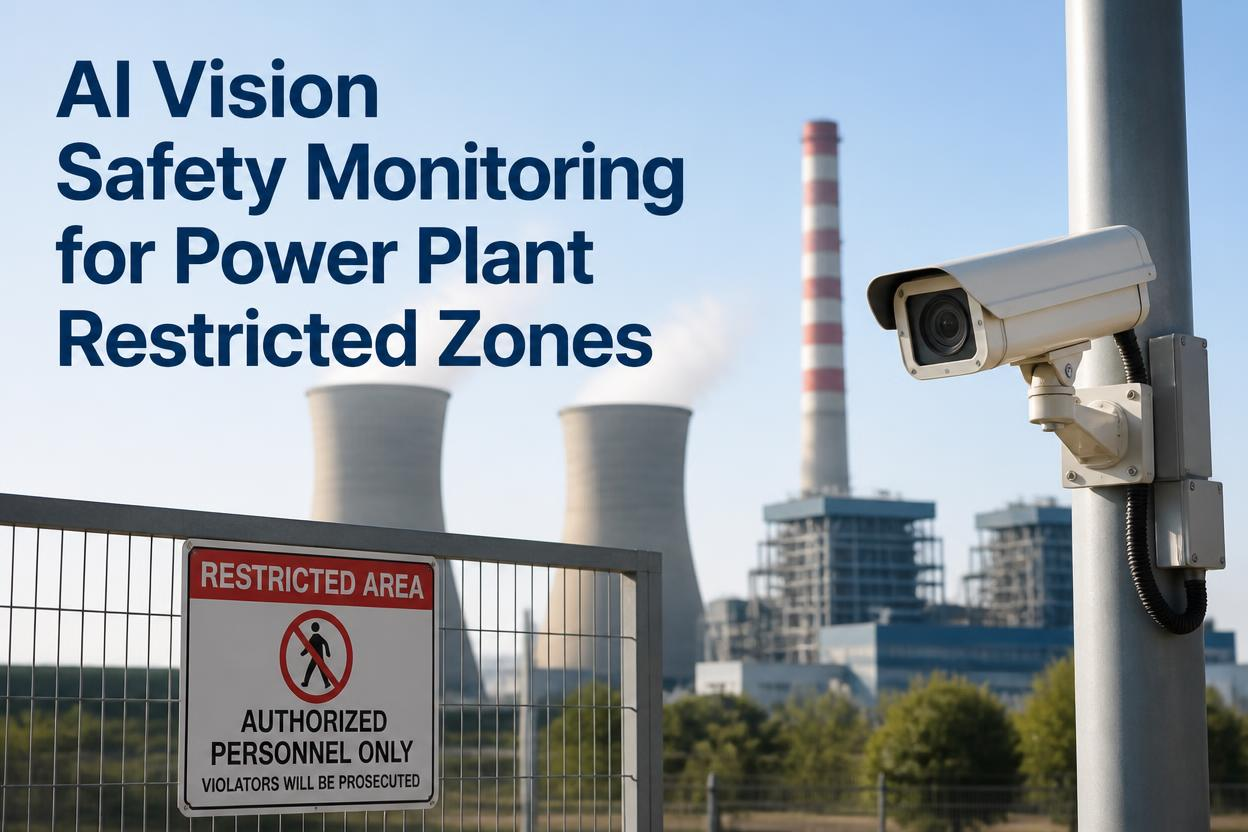
A restricted zone violation at a power plant rarely looks dramatic in the moment — someone ducks under a barrier tape to save two minutes, a contractor walks past a boiler front without a hard hat, a technician lingers near a live switchyard bay a little too long. None of it trips an alarm, and by the time a safety officer reviews CCTV footage after an incident, the moment that mattered is long gone. iFactory's AI vision safety monitoring watches every restricted zone continuously and flags the violation the instant it happens, not during a weekly footage review. You can book a demo to see it running against your own plant's camera feeds.
Your Cameras Already Watch the Restricted Zones. They Just Don't Say Anything When Someone Walks In.
iFactory's AI vision layer turns existing plant cameras into a continuous restricted-zone monitor, detecting unauthorized entry, missing PPE, and unsafe proximity to live equipment the instant it happens.
Weekly Footage Review Catches the Violation After the Risk Has Already Passed
Most power plants still rely on a safety officer scrubbing through hours of CCTV footage after an incident or during a scheduled audit, which means the system only ever confirms what already happened. The numbers below describe how much that delay actually costs a plant in unaddressed risk.
Four Restricted-Zone Risk Patterns iFactory's AI Vision Camera Flags in Real Time
Not every safety risk around a power plant's high-voltage and high-temperature equipment looks the same, so the AI model is trained on distinct visual patterns rather than a single generic motion trigger. Each pattern below is scored by severity and routed to the right responder automatically.
Unauthorized Entry Into Switchyard or Boiler Front
The AI identifies a person crossing a defined restricted boundary around live switchyard bays, boiler fronts, or turbine decks without an authorized badge event logged for that zone, and pushes an immediate alert to the control room and site safety officer.
Missing PPE in a Designated Zone
Hard hats, high-visibility vests, and face shields are detected against zone-specific requirements, so a contractor missing required PPE inside a hot work or confined space area is flagged before an incident, not after one.
Unsafe Proximity to Rotating or Live Equipment
The AI tracks the distance between a detected person and equipment classified as rotating, high-voltage, or high-temperature, flagging sustained proximity that exceeds the site's defined safe working distance.
Lone Worker in a High-Risk Zone After Hours
A single person detected in a designated high-risk zone during off-shift hours without a corresponding work permit logged is flagged for a wellness check, reducing lone-worker risk without requiring a manual patrol.
Every Restricted-Zone Violation Your Cameras Miss Today Is a Report Waiting to Be Written After an Incident
iFactory's AI vision camera turns your existing CCTV infrastructure into a continuous safety monitor with zone-specific rules for your plant's actual layout. Book a demo and see it flagging violations on your own camera feeds.
From Existing Camera Feed to a Routed Safety Alert
iFactory's AI vision safety monitoring is built to run on the camera infrastructure already installed at most power plants, so deployment does not require a new CCTV network.
Camera Feed Connection
Existing IP cameras covering switchyards, boiler fronts, turbine decks, and coal handling areas are connected to iFactory's vision pipeline without new hardware in most cases.
Zone and Rule Configuration
Restricted boundaries, required PPE per zone, and safe proximity distances are configured against your plant's actual layout and permit-to-work rules.
Continuous Detection
The AI model runs continuously against every connected feed, classifying entries, PPE compliance, and proximity events in real time, day and night.
Severity-Routed Alerting
Each detected event is scored by severity and routed to the control room, site safety officer, or shift supervisor depending on the zone and risk level.
Manual Patrols and Footage Review vs Continuous AI Vision Monitoring
The comparison below shows what changes operationally when restricted-zone monitoring shifts from scheduled patrols and post-incident review to always-on AI detection.
| Capability | Manual Patrols / Footage Review | iFactory AI Vision Monitoring |
|---|---|---|
| Coverage Window | Scheduled patrols, gaps between rounds | Continuous, 24 hours a day |
| Detection Speed | Hours to days after the event | Within seconds of the violation |
| PPE Compliance Checks | Spot-checked during rounds | Verified on every detected entry |
| Lone Worker Risk | Relies on check-in calls | Automatic after-hours detection |
| Incident Investigation | Manual footage search after the fact | Tagged, searchable event log |
Getting From Camera Access to Live Zone Monitoring
Most power plants move from initial camera access to live restricted-zone alerts within a few weeks, since the deployment leverages infrastructure already in place.
Common Questions About AI Vision Safety Monitoring at Power Plants
Your Cameras Are Already Recording the Risk. They Just Need to Speak Up.
Restricted-zone violations at a power plant rarely announce themselves loudly, and a monitoring approach built around scheduled patrols and post-incident footage review only ever confirms risk after it has already passed. The gap between what your cameras capture and what your safety team actually reviews is where preventable incidents live.
iFactory's AI vision camera closes that gap by watching every restricted zone continuously and routing the exact violation, with severity and location, to the right responder in seconds rather than days. Book a demo to see it running against your own plant's camera feeds.
Turn Your Existing Cameras Into a 24-Hour Safety Officer
iFactory's AI vision monitoring detects unauthorized entry, missing PPE, and unsafe equipment proximity the moment it happens, across every restricted zone in your plant. Book a demo and see the detection running live.