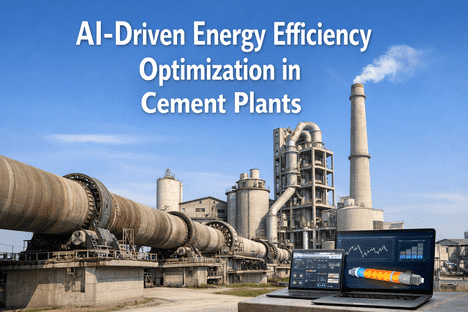
Energy costs account for 60–65% of cement production expenses in India, with rotary kilns consuming 70% of that energy. For a typical 3000 TPD plant burning through ₹200+ crores in fuel annually, even a 2–3% inefficiency translates to ₹4–6 crore in preventable losses each year. This is where artificial intelligence is revolutionizing kiln operations.
Cement Kiln Optimization
AI-Powered Kiln Optimization: How Indian Cement Plants Are Cutting Energy Costs by 15%
Real, documented results from utility-scale cement plants across India
15%
Average energy savings
₹12Cr+
Annual cost reduction
4 Months
Typical ROI payback
Why Indian Cement Manufacturers Are Switching to AI
Instant Optimization
AI adjusts kiln parameters every 60 seconds vs. 10+ minutes with manual control.
Massive Savings
3000 TPD plants save ₹10–14 crores annually on fuel costs alone.
Better Quality
70% reduction in clinker quality variation, fewer production rejects.
The ₹1000 Crore Problem in Indian Cement Manufacturing
Energy costs account for 60–65% of cement production expenses, with kilns consuming 70% of that energy. A typical 3000 TPD plant burns through ₹200+ crores in fuel annually. Even a 2–3% inefficiency means ₹4–6 crore losses every year.
Manual kiln control can't keep pace with modern demands. Operators manage 50+ parameters simultaneously, coal quality fluctuates daily, and raw material chemistry changes hourly. Human response delays of just 5–10 minutes waste massive thermal energy — energy that AI can recover.
Stop Wasting Fuel Costs Today
See how AI can reduce your plant's energy consumption by 15%. Get a customized analysis for your specific operations.
How AI Kiln Optimization Actually Works
No magic, just intelligent automation that learns and adapts 24/7:
1
Sense
150+ sensors capture temperature, pressure, gas composition, and material flow in real time.
2
Predict
AI models forecast kiln behavior 15–30 minutes ahead based on current conditions.
3
Optimize
Machine learning calculates ideal fuel, air, and feed rates for maximum efficiency.
4
Control
The system automatically adjusts parameters every 60 seconds, learning continuously.
Want to see this technology in action at your plant? Schedule a live demonstration and watch AI optimize a kiln in real time, or contact our technical team to discuss your specific requirements.
Proven Benefits: What You Actually Get
12–18% Lower Fuel Costs
₹8–15 Cr
Reduced specific heat consumption from 820 to 720 kcal/kg through optimal combustion control. Savings visible within the first month of deployment.
3–5% Production Increase
+Revenue
Higher throughput without additional capital investment. AI optimizes kiln loading, residence time, and heat transfer for maximum output.
70% Better Quality Consistency
Less Variation
Free lime content stays within ±0.3% vs ±1.2% with manual control. Fewer rejects, less corrective blending, stronger cement.
10% CO₂ Reduction
Greener
Lower emissions through efficient combustion. Meet environmental compliance while reducing carbon credit costs.
Ready to Achieve These Results?
Dozens of cement plants across India have already implemented AI optimization. Join them and start saving within 60 days.
ROI Calculator: Your Potential Savings
Savings scale with plant size. The ranges below are drawn from real deployment data across a variety of Indian cement plants.
2000 TPD Plant
₹6–9 Cr
Annual savings · 4–6 month payback
3000 TPD Plant
₹10–14 Cr
Annual savings · 3–4 month payback
5000 TPD Plant
₹16–22 Cr
Annual savings · 2–3 month payback
Case Study: A 4000 TPD Kiln in North India
Challenge: high fuel consumption variability (±8%) due to inconsistent raw material quality from multiple quarries. Manual operators couldn't adapt fast enough to feedstock changes, resulting in energy waste and quality issues.
Results after 8 months:
15.2%
Energy cost reduction
Implementation: A 6-Month Journey to Results
Assessment & Baseline
Audit current performance, install missing sensors, collect 3–6 months of historical data, and establish baseline KPIs for comparison.
Infrastructure & Training
Set up data pipelines and edge computing, develop AI models on your historical data, and train operators on the new system interface.
Advisory Testing
AI provides recommendations, operators manually implement. Validate performance, refine models, and build confidence before automation.
Automated Operation
Enable closed-loop control, monitor results, and fine-tune. Full energy savings are typically achieved within 6 months of deployment.
Questions about the implementation process? Our team has deployed AI optimization across dozens of cement plants in India. Get expert guidance on planning your project, or schedule a detailed implementation review for your facility.
Start Your Implementation Journey
We handle everything from assessment to deployment. Your team focuses on running the plant — we deliver the energy savings.
Key Takeaways for Indian Cement Plants
- 15% energy savings is the industry average — some plants achieve 18%+.
- 3–4 month payback for a typical 3000 TPD plant (₹3 Cr investment, ₹12 Cr+ annual savings).
- No DCS replacement needed — AI works as an optimization layer above existing controls.
- Operators augmented, not replaced — they transition to supervisory roles with better tools.
- Proven technology — utility-scale cement producers across India already see results.
Common Questions Answered
How much does AI kiln optimization cost?
₹2.5–4 crores depending on plant size and complexity. For a 3000 TPD plant, typical investment is ₹3 crores with ₹10–14 crore annual savings — a 3–4 month payback period. This includes sensors, software, integration, and training.
Will AI replace our experienced operators?
No. Operators transition from manual parameter adjustment to supervisory roles. They monitor AI recommendations, handle exceptions, and focus on higher-value activities. Their expertise remains critical for startups, shutdowns, and emergency situations.
How long until we see results?
Initial energy savings appear within 3–4 months during advisory-mode testing. Full 12–15% optimization is typically achieved within 6 months of deployment. Implementation takes 6–8 months total from start to autonomous operation.
What if our raw material quality varies significantly?
That's where AI excels. Machine learning models automatically adapt to feedstock changes within minutes vs hours with manual control. Plants with high raw material variability often see the biggest improvements.
Do we need to replace our existing DCS/PLC systems?
No. AI works as an optimization layer above your current control systems using standard industrial protocols (OPC-UA, Modbus). Only additional sensors and edge computing hardware are needed — your control infrastructure stays in place.
Have more questions? Our support team is here to help you understand every aspect of AI kiln optimization for your plant.
Ready to Cut Your Energy Costs by 15%?
Join utility-scale cement producers across India in achieving major fuel savings through AI optimization. Get a customized ROI analysis for your plant — see your potential savings in 30 minutes.