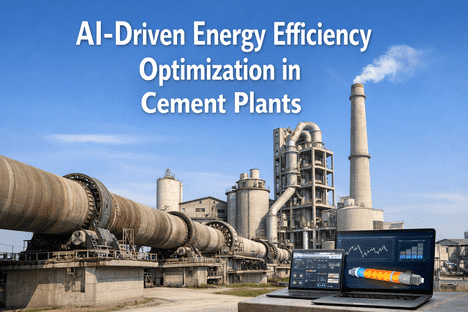
A Maharashtra cement plant faced ₹8 lakh penalty in 2023 for exceeding BIS thermal energy consumption limits (775 kcal/kg vs 735 kcal/kg target). Their kiln operators were running conservative setpoints to avoid clinker quality issues—safe but inefficient. The penalty plus excess fuel costs added ₹4.2 crores to annual OPEX. Their AI energy management system, deployed 6 months later, simultaneously reduced thermal energy to 718 kcal/kg (exceeding BIS targets) while improving clinker quality consistency by 18%. Annual fuel savings: ₹3.8 crores. Zero penalties.
Indian cement plants face dual pressure: meet increasingly strict BIS energy standards while cutting costs to stay competitive. Traditional approaches force trade-offs—conservative operations ensure compliance but waste energy; aggressive optimization risks penalties. AI energy management breaks this trade-off, delivering 10-15% thermal efficiency gains while maintaining BIS compliance. Here's how leading plants are achieving both simultaneously.
Energy Management AI for Indian Cement Plants: Meeting BIS Standards While Cutting Costs
Achieve 10-15% Efficiency Gains + Zero Compliance Penalties
BIS Energy Standards: What Indian Cement Plants Must Achieve
BIS 4032 & PAT Scheme Requirements
Specific Thermal Energy Consumption (STEC)
Total thermal energy (fuel) consumed per tonne of clinker produced
Specific Electrical Energy Consumption (SEEC)
Total electrical energy consumed per tonne of cement produced
Cement plants exceeding 30,000 tonnes annual clinker capacity must meet energy reduction targets. Exceeding targets earns ESCerts (Energy Saving Certificates) tradeable on power exchanges. Missing targets = financial penalties + mandatory compliance plans.
Energy Consumption Breakdown: Where to Optimize
Typical 5000 TPD Plant Energy Distribution
Kiln System (Pyroprocessing)
65%Thermal energy for clinkerization—biggest savings opportunity
AI Optimization Potential: 10-15% reduction (₹2.8-4.2 Cr/yr)
Grinding Operations (Raw Mill + Cement Mill)
25%Electrical energy for size reduction—grinding efficiency critical
AI Optimization Potential: 8-12% reduction (₹60-90 L/yr)
Auxiliary Equipment (Cooler, Fans, Conveyors)
10%Support systems—heat recovery and load optimization
AI Optimization Potential: 5-8% reduction (₹25-40 L/yr)
Get Free Energy Audit & BIS Compliance Check
We'll analyze your last 12 months of energy consumption, identify BIS compliance gaps, and calculate exact AI optimization potential. See where you're wasting energy and how much you could save.
- STEC & SEEC benchmarking
- BIS compliance assessment
- Energy waste identification
- AI optimization roadmap
- Savings projection (₹)
- PAT scheme analysis
Struggling with BIS compliance or high energy costs? Talk to our energy management specialists — We've optimized 20+ Indian cement plants.
AI Energy Optimization: Three Critical Areas
How AI Delivers 12-15% Thermal Energy Reduction
Kiln Temperature Control
10-12%AI finds optimal temperature profiles that minimize fuel while maintaining clinker quality. Adjusts for raw mix variations in real-time.
Air/Fuel Ratio Optimization
3-5%Precise combustion control reduces excess air—every 1% excess air wastes 0.3% fuel. AI maintains ideal stoichiometry.
Heat Recovery Maximization
2-3%Optimizes preheater, cooler efficiency. AI balances clinker cooling with waste heat recovery for maximum energy capture.
Traditional operators run conservative setpoints (higher temps, longer residence time) to guarantee quality. AI learns exact minimum energy required for proper clinkerization based on current raw mix, eliminating this safety buffer. Result: Same quality at 10-15% lower fuel consumption.
Real Results: Karnataka Cement Plant Case Study
4200 TPD Integrated Cement Plant - 12-Month Deployment
AI Energy Management System | Kiln + Mills + Auxiliary
Baseline: STEC 748 kcal/kg (above PAT target) | SEEC 83.5 kWh/t | Annual energy cost ₹28 Cr
- ESCerts earned: ₹42 lakhs from PAT scheme for exceeding targets
- Quality improvement: 18% reduction in LSF variation, 22% reduction in free lime
- CO₂ reduction: 12,800 tonnes/year (supports net-zero commitments)
- Refractory life: 15% longer kiln campaign due to stable thermal profiles
Dual Benefits: Compliance + Cost Savings
Why AI Energy Management Delivers Both
BIS Compliance Assurance
AI continuously monitors STEC and SEEC against BIS targets. Automatic alerts if approaching limits. Predictive adjustments prevent violations before they occur. Zero penalties, guaranteed compliance.
PAT Scheme Optimization
AI maximizes energy savings to exceed PAT targets, earning tradeable ESCerts worth ₹30-60L annually. System tracks progress toward targets in real-time, adjusting strategies quarterly.
Quality-Energy Balance
Unlike manual optimization, AI finds exact sweet spot where quality meets spec at minimum energy. No trade-offs—achieve both simultaneously through multivariate optimization.
Net-Zero Progress
12-15% energy reduction = 15,000+ tonnes CO₂/year for 5000 TPD plant. Critical for meeting 2030 net-zero commitments. AI provides carbon accounting dashboards for ESG reporting.
See Live Energy Optimization Demo
Watch AI optimize kiln parameters in real-time: temperature profiles, fuel/air ratios, heat recovery. See STEC reduction while maintaining clinker quality specifications.
Implementation Timeline: 90 Days to Energy Savings
Phased Deployment for Cement Plants
Month 1: Energy Baseline & Sensor Deployment
Install additional temperature, flow, and O₂ sensors. Connect to DCS/SCADA. Collect 4 weeks baseline data on STEC, SEEC, quality parameters. Identify current waste areas.
Month 2: AI Model Training & Validation
Train ML models on 12+ months historical data. Learn correlations between fuel consumption, temperatures, and clinker quality. Validate models achieve 92%+ accuracy before deployment.
Month 3: Advisory Mode + Operator Training
Deploy AI in "advisory" mode—recommendations only. Operators manually implement suggested setpoints for 4 weeks. Verify energy savings + quality maintenance. Build confidence.
Month 4+: Autonomous Optimization
Enable closed-loop control. AI automatically adjusts kiln speed, fuel flow, air dampers within safe limits. Continuous learning improves performance over time. Typical ramp-up: 5% savings Month 1 → 12-15% by Month 6.
ROI Breakdown: Investment vs Annual Returns
Financial Case (4000 TPD Plant)
Total Investment
₹85 LakhsHardware (₹30L) + Software (₹35L) + Installation (₹12L) + Training (₹8L)
Annual Energy Savings
₹3.2 CroresThermal (₹2.7Cr) + Electrical (₹50L) at 12% reduction
Net ROI (Year 1)
276%Payback in 3.2 months. ₹2.35 Cr net profit Year 1.
- PAT ESCerts: ₹30-50L annually from exceeding energy targets
- Penalty avoidance: ₹8-15L saved by maintaining BIS compliance
- Refractory savings: Longer kiln life = ₹20-30L deferred CAPEX
- Quality consistency: Reduced rejects = ₹15-25L value
Want customized ROI for your plant? Get free calculation — We'll show exact investment and savings based on your TPD and energy costs.
Energy Management AI: Key Takeaways
- 12-15% thermal energy reduction is typical for AI-optimized kilns while maintaining BIS compliance
- ₹3-5 Cr annual savings for 4000-5000 TPD plants from fuel + electricity optimization
- BIS compliance guaranteed—AI monitors STEC/SEEC continuously, prevents violations automatically
- PAT scheme benefits—exceed targets to earn ESCerts worth ₹30-60L annually
- 3-4 month payback typical for energy AI investment (276% Year 1 ROI)
- Quality improves—AI finds optimal setpoints that reduce energy AND variation simultaneously
Achieve BIS Compliance + Cut Energy Costs 12-15%
Free energy audit: We'll benchmark your STEC/SEEC against BIS targets and calculate exact AI optimization savings.
See how much you could save while exceeding compliance requirements.