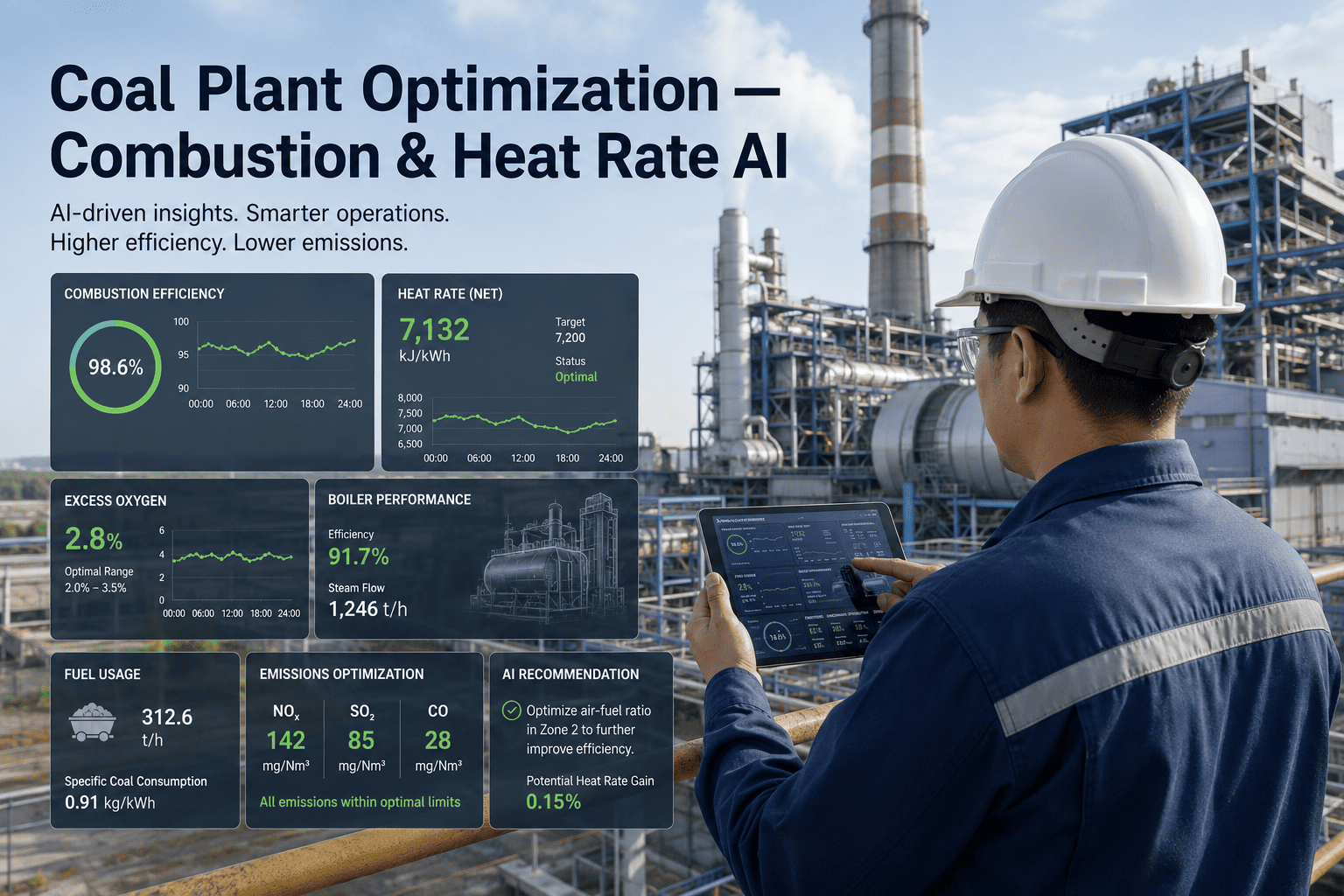
August 2023. A 500MW coal-fired unit in Gujarat operates at 2,550 kcal/kWh heat rate—exactly at design specification. The operations team is satisfied. But here's what the data reveals: At 85% load, best heat rate achieved historically was 2,480 kcal/kWh (during favorable coal quality + optimal settings). At current 75% load with today's coal (GCV 3,400 kcal/kg), optimal heat rate should be 2,485 kcal/kWh. Actual: 2,550 kcal/kWh. That 65 kcal/kWh gap = ₹8.2 lakhs per day in excess fuel cost. ₹30 crores annually. The unit meets design spec, so no alarm bells. But AI analysis shows 2.5% efficiency sitting on the table—lost because operators can't find optimal settings across 400+ parameters with variable coal quality.
Indian thermal power plants face brutal efficiency realities: High-ash coal (30-45% ash), frequent load cycling (50-100% swings), aging equipment (60% of fleet >20 years), and operator dependency on thumb rules. Design heat rate: 2,400-2,550 kcal/kWh. Actual average: 2,600-2,800 kcal/kWh. That 200-300 kcal/kWh gap costs a 500MW unit ₹25-40 crores annually in excess fuel. Manual optimization can't handle the complexity—12+ variables affecting heat rate simultaneously (coal quality, excess air, mill performance, condenser vacuum, steam temperatures). AI closes this gap through continuous real-time optimization. Want to assess heat rate improvement potential?
Heat Rate Optimization AI: Improving Efficiency at Indian Thermal Power Plants
0.8-2.5% Efficiency Gains | ₹18-45Cr Annual Fuel Savings (500MW) | Real-Time Optimization | Variable Coal Handling
Why Heat Rate Optimization is So Hard (and So Valuable)
Heat rate = thermal efficiency inverse. Lower heat rate = higher efficiency = less fuel per kWh. Every 1% heat rate improvement = ₹18-25 crores annual savings for 500MW unit. But achieving this is brutally complex:
Multi-Variable Complexity
12+ parameters affect heat rate simultaneously:
- Coal quality: GCV (3,000-4,500 kcal/kg), ash (30-45%), moisture (5-12%) vary batch-to-batch
- Combustion: Excess O₂ (3-5% optimal), flue gas temp, coal fineness, air-fuel ratio
- Steam cycle: Main steam temp/pressure, reheat temp, condenser vacuum, feedwater heater performance
- Auxiliary load: Mill power, fan power, pump power (5-8% of gross generation)
- Load factor: Heat rate varies 50-100% load (U-shaped curve, optimal at 75-85%)
The Operator Dilemma: Adjusting one parameter affects 5 others. Operators optimize locally (e.g., reduce excess air) but miss global optimum requiring 8-parameter adjustment. Struggling with multi-variable optimization? Chat about AI solutions.
Indian Coal Variability
Reality check: Indian coal isn't consistent like imported coal. GCV varies 3,200-3,800 kcal/kg within same rake. Ash content 30-45%. Moisture 5-12%.
Impact on heat rate:
- High ash (40%+) → Mill power increases 15-20% → Auxiliary load up → Net heat rate degrades
- Low GCV (3,000 kcal/kg) → Need more coal flow → Combustion less efficient → Heat rate penalty 3-5%
- High moisture → Reduces flame temperature → Incomplete combustion → Unburnt carbon loss
Manual Response: Operators adjust for average coal quality. Can't optimize for actual real-time coal properties changing every 2-3 hours.
Variable coal quality hurting efficiency? Request coal-adaptive optimization demo.
Load Cycling Penalties
Grid reality: Renewable integration forces thermal plants to cycle 50-100% load daily. Each load change affects optimal heat rate settings.
Heat rate vs load relationship:
- 100% load: 2,450 kcal/kWh (design optimal)
- 75% load: 2,520 kcal/kWh (+2.9% heat rate penalty)
- 55% load: 2,680 kcal/kWh (+9.4% penalty—U-curve bottom)
Manual Problem: Operators use fixed settings. Don't re-optimize excess air, feedwater heaters, mill distribution for each load level.
Frequent load cycling? Learn about dynamic optimization.
Real-Time Optimization Gap
Best-case manual optimization: Performance engineer analyzes data monthly, recommends settings adjustment. 30-day lag between problem and correction.
Missed opportunities:
- Condenser vacuum drops 5 mmHg (monsoon cooling tower performance) → Heat rate +0.5% → Takes 2 weeks to notice
- Mill A coal fineness degrades (classifier wear) → Unburnt carbon +0.3% → Detected in quarterly analysis
- Feedwater heater 6 tube leak (partial bypass) → Heat rate +0.4% → Found during annual shutdown
AI Difference: Detects and corrects these issues within minutes, not weeks. Continuous optimization vs periodic adjustments.
AI-Powered Heat Rate Optimization: How It Works
Heat rate optimization AI ingests real-time DCS data (400+ parameters at 1-second resolution), learns optimal settings for current conditions (load, coal quality, ambient), and recommends adjustments every 5-10 minutes to minimize heat rate.
Data Integration & Real-Time Monitoring
- DCS integration: 400+ parameters (temperatures, pressures, flows, emissions, power)
- Coal quality input: GCV, ash, moisture from lab (updated 2-4 times/day) + proxies from combustion data
- Heat rate calculation: Real-time using fuel flow, steam flow, gross/auxiliary power
- Performance tracking: Compare actual vs optimal heat rate for current conditions
AI Optimization Engine
- Physical models: Thermodynamic cycle simulation (boiler, turbine, condenser, feedwater heaters)
- Machine learning: Neural networks trained on 12-24 months historical data (what settings produced best heat rate)
- Reinforcement learning: AI experiments with settings (within safe bounds), learns what works for this specific unit
- Multi-objective optimization: Minimize heat rate while maintaining emissions limits (NOx <300 mg/Nm³), equipment safety
Operator Guidance & Closed-Loop Control
- Advisory mode (initial): AI recommends adjustments, operators execute manually, verify results
- Closed-loop (advanced): AI directly adjusts setpoints (dampers, feedwater, attemperators) within approved limits
- What AI optimizes: Excess O₂, mill biasing, feedwater heater extraction, spray attemperator, condenser cooling water flow
- Operator override: Always available—AI suggestions, not mandates
Questions about implementation or integration? Schedule technical consultation — We'll explain how AI integrates with your specific DCS platform.
Real Results: Karnataka 500MW Coal Unit
12-Month Heat Rate Optimization Deployment
Unit Profile: 500MW subcritical coal unit | 18 years old | Indian coal (3,200-3,800 kcal/kg, 35-42% ash)
Baseline (2022): 2,620 kcal/kWh average heat rate | 75% plant load factor | ₹2,850/ton coal cost
Results After 12 Months:
- Combustion optimization (0.7%): Reduced excess O₂ from 4.8% to 3.2% while maintaining CO <50 ppm
- Condenser vacuum (0.3%): Optimized cooling water flow based on ambient, improved vacuum 720→735 mmHg
- Feedwater heater (0.4%): Optimized extraction steam distribution, improved terminal temp difference
- Mill optimization (0.2%): Balanced coal feed across mills, improved fineness control
Want similar results in your TPP? Request ROI Calculation or Discuss Your Unit
Get Free Heat Rate Assessment
We'll analyze 3 months of your DCS data to identify efficiency gaps, calculate achievable heat rate improvement, and estimate fuel savings. See exactly how much you can save BEFORE committing to AI deployment.
- Current vs optimal heat rate analysis (by load level)
- Root cause identification (combustion, steam cycle, auxiliaries)
- Achievable improvement calculation (conservative estimate)
- Annual fuel savings projection (₹ based on your coal cost)
- Quick wins (no AI needed) vs AI-required optimization
- ROI calculation with implementation timeline
Assessment takes 10-14 days. We'll need 3 months DCS data export (CSV/PI historian), coal quality logs, and unit design specs. No cost, no obligation.
Heat Rate Optimization AI - Key Takeaways
- 0.8-2.5% heat rate improvement achievable with AI optimization—for 500MW unit, that's ₹18-45 Cr annual fuel savings
- 42 kcal/kWh improvement in Karnataka case study (2,620→2,578)—1.6% efficiency gain, 11-month ROI payback
- Real-time optimization essential for variable Indian coal (3,000-4,500 kcal/kg GCV)—AI adjusts settings every 5-10 minutes vs monthly manual tuning
- Multi-parameter coordination is key—AI optimizes 12+ variables simultaneously (combustion, steam cycle, auxiliaries) for global optimum
- Load cycling demands dynamic settings—heat rate varies 50-100% load, AI re-optimizes for each load level automatically
- Advisory → Closed-loop progression de-risks deployment—start with operator guidance, graduate to automated control after validation
Ready to optimize your heat rate with AI? Start with data-driven assessment to quantify potential.
Schedule Assessment Ask Technical QuestionsStop Leaving Efficiency on the Table. Optimize Heat Rate with AI.
Free heat rate assessment: We'll analyze your DCS data, identify efficiency gaps, calculate fuel savings potential, and show you exactly how AI delivers ROI for your specific unit and coal conditions.
See the savings opportunity before investing a rupee in AI.
Our team has deployed heat rate optimization AI across 15+ thermal power plants in India (NTPC, Adani, Tata, independent IPPs). We understand subcritical/supercritical units, Indian coal challenges, and DCS integration (ABB, Yokogawa, Honeywell, Emerson).