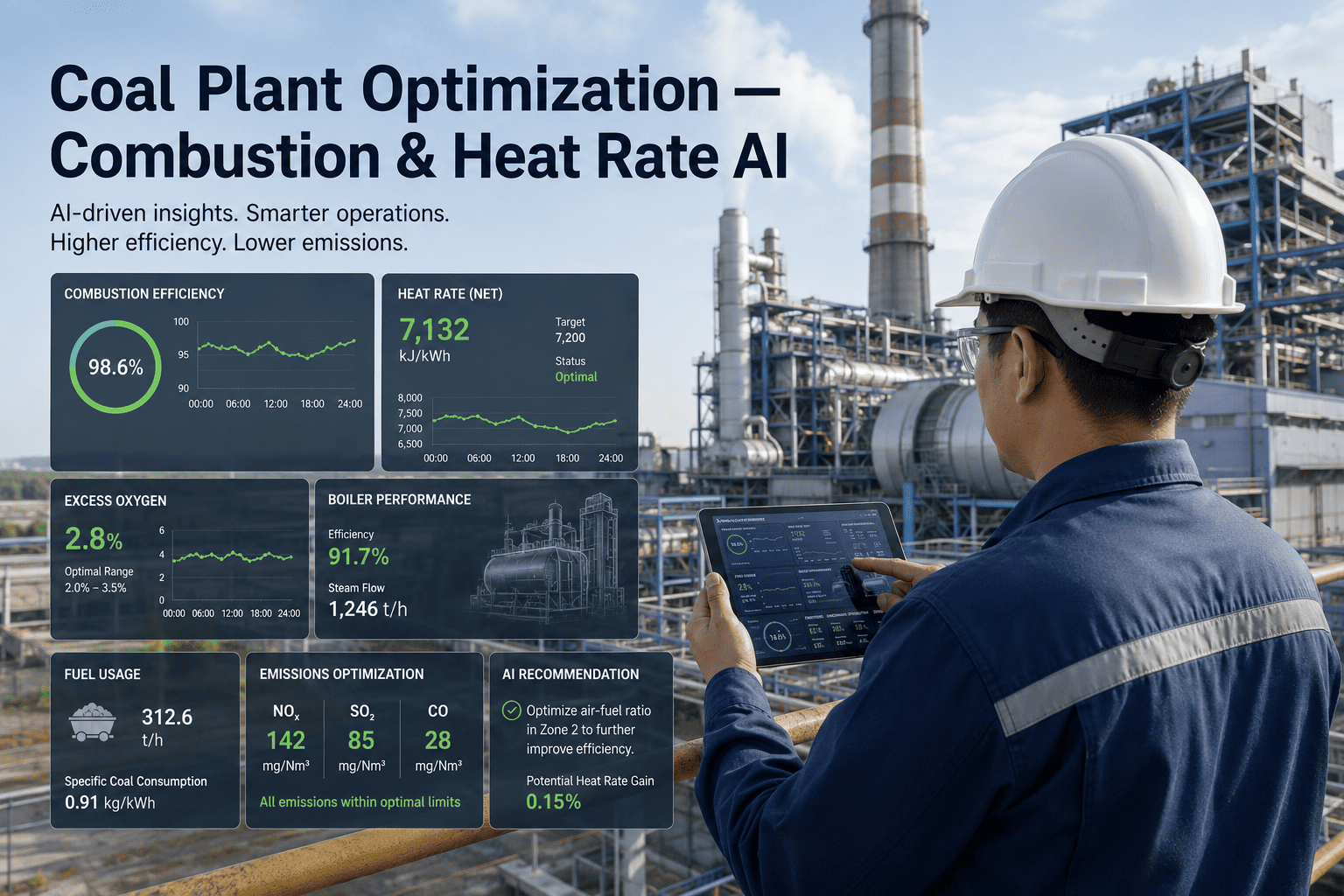
Most coal-fired units are running two to four percent below their design heat rate right now, and it usually has nothing to do with equipment failure. It comes from hundreds of interdependent combustion variables — excess air, mill balance, steam temperature, burner tilt — drifting slightly out of their optimal range faster than any control room team can track manually. On a 500 MW unit, a single percentage point of heat rate recovery is worth well over a million dollars a year in fuel alone. AI combustion optimization finds that percentage point continuously, without touching a single piece of hardware. This page breaks down where the savings actually come from and what a realistic combustion optimization program looks like. Reach out through iFactory support to review it against your unit's own data.
Power Plant · Combustion & Emissions AI
Recover the Heat Rate Your Coal Unit Already Has, Without Touching the Boiler
AI continuously tunes combustion, air balance, and sootblowing timing across hundreds of interacting variables — cutting fuel consumption 8–15% and NOx/SOx emissions without capital investment.
Max heat rate reduction from combustion tuning alone
Reduction in NOx emissions from AI-optimized combustion settings
Annual fuel consumption reduction achieved in a documented 500 MW case study
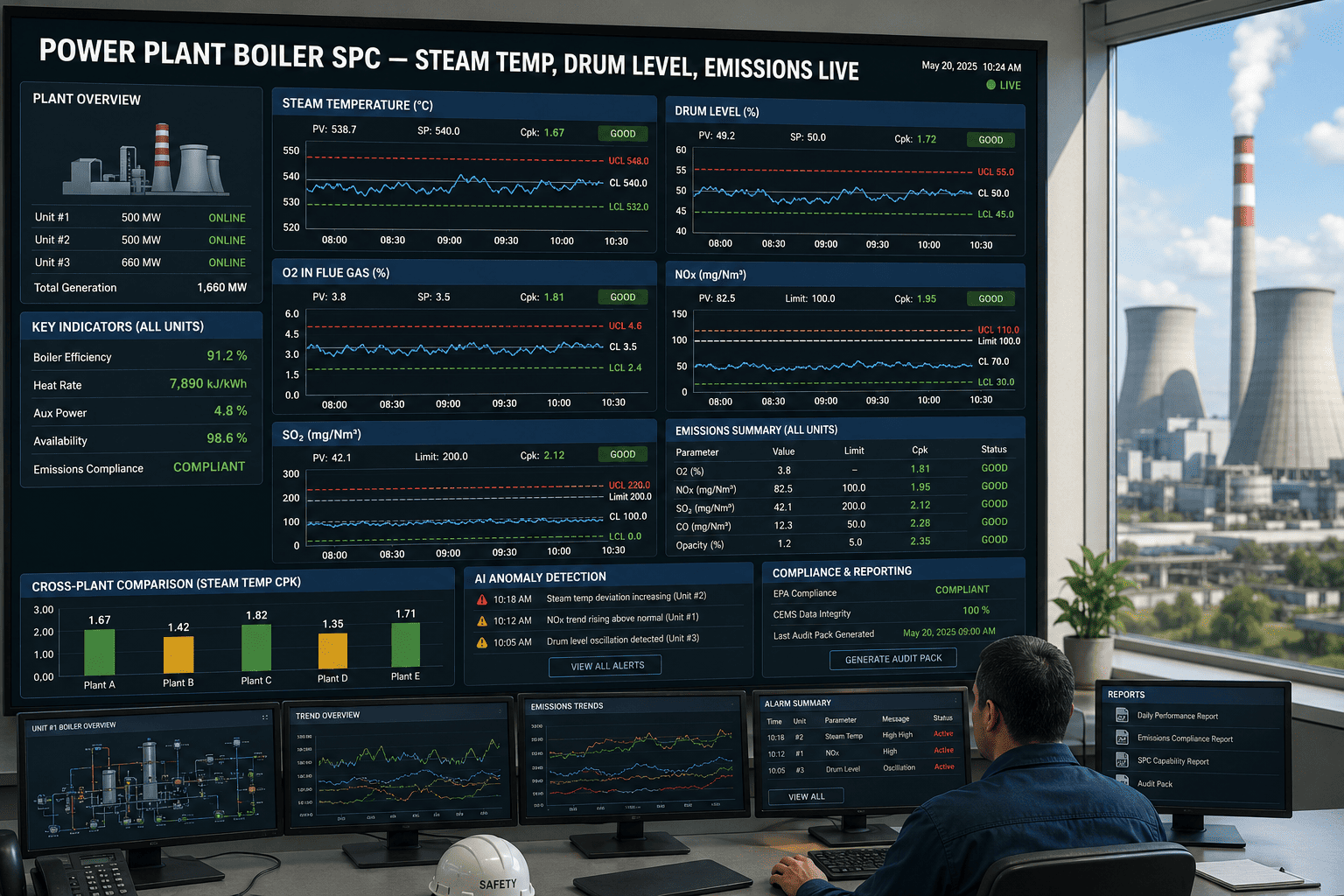
Live Combustion Signals
The Parameters an AI Model Watches That a Control Room Can't Track Continuously
Every one of these signals interacts with the others. A control room operator adjusts one at a time; the model adjusts all of them together, every few seconds.
Excess Air Ratio
Held within optimal band continuously
Pulverizer Balance
Coal flow evened across mills in real time
Flame Scanner Data
Cross-referenced against O2 and CO trends
Soot Blower Timing
Triggered by heat transfer decline, not a fixed clock
Superheater Metal Temp
Monitored against tube life limits during tuning
Furnace Exit Gas Temp
Used to catch slagging before efficiency drops
iFactory Tunes Combustion Continuously, Across Every Load Point.
From 40% load to full capacity, the model finds the setpoints a static control strategy misses.
Before and After
What a Combustion Optimization Rollout Actually Changes
Metric
Before AI Tuning
After AI Tuning
Heat rate deviation
2–4% above design
Within 0.5–1.5% of design
NOx emissions
Baseline compliance, minimal margin
Up to 15% reduction with margin to spare
Setpoint adjustment
Manual, reactive, once per shift or less
Continuous, automatic, every few seconds
Sootblower scheduling
Fixed time interval regardless of fouling
Triggered by actual heat transfer decline
Documented Case
$2 Million a Year From Settings the Plant Already Had Access To
A North American utility applied AI-recommended control settings across its coal fleet without any capital investment. The model analyzed operational data and identified adjustments to steam temperature and air balance that plant staff had never been able to hold consistently across shifts. One unit alone realized more than two million dollars in annual fuel savings once the recommendations were implemented as standing control targets.
— Digital Transformation Case Study, North American Utility Fleet
Frequently Asked Questions
Coal Plant Combustion Optimization — What Plant Managers Ask
Does combustion optimization require new hardware on the boiler?
No. Combustion optimization works by analyzing existing plant instrumentation — flame scanners, O2 analyzers, thermocouples, and DCS data — and recommending or automatically applying setpoint adjustments within the plant's existing control constraints. This is why it consistently delivers the highest return of any efficiency program: no capital outlay, and payback measured in months rather than years.
Book a demo to see it against your unit's DCS tags.
How much heat rate improvement is realistic for an existing coal unit?
Documented results across multiple coal-fired case studies show heat rate reductions in the 1.5% to 2.5% range from combustion tuning alone, with some units achieving up to 4% fuel consumption reduction when soot blower optimization and auxiliary load reduction are included. The exact figure depends on how far the unit's current operation sits below its design heat rate before optimization begins.
Will optimizing for heat rate compromise emissions compliance?
Properly configured combustion optimization treats emissions limits as hard constraints the model cannot violate, not as a secondary consideration. In practice, most deployments improve both heat rate and NOx or SOx output simultaneously, because the same excess-air and temperature control that wastes fuel also tends to drive higher emissions.
How does the AI model handle load cycling and part-load operation?
Static setpoint strategies are typically tuned for one operating point and applied everywhere else as an approximation. AI combustion models are trained across the full operating range, so they continuously find near-optimal settings at 40% load, 70% load, and full load rather than defaulting to design-point assumptions during cycling.
How long does it take to see measurable fuel savings after deployment?
Most combustion optimization programs show measurable heat rate improvement within the first few weeks of live operation, since the model begins recommending setpoint adjustments as soon as it has enough operating data to establish a reliable baseline. Full savings realization typically stabilizes within two to three months.
Contact support to scope a baseline assessment for your unit.
Find the Heat Rate Your Unit Is Already Leaving on the Table
Continuous combustion tuning, emissions-aware optimization, and condition-triggered sootblowing — built from your plant's own operating data.