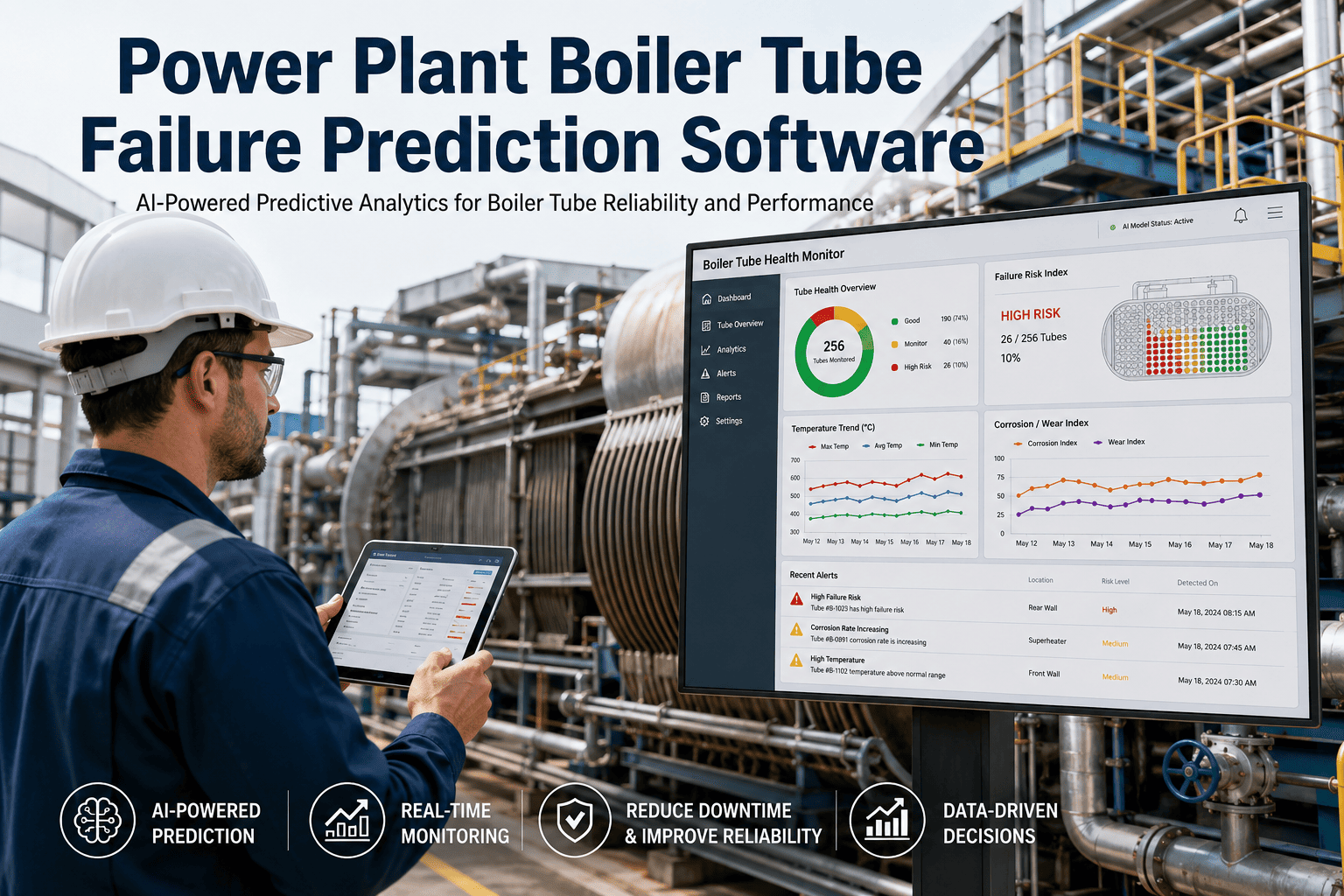
Boiler tube failures are the single largest cause of unplanned outages at thermal power plants worldwide, and they remain stubbornly difficult to predict using traditional inspection methods alone. A single tube leak can force an entire unit offline for days while the failed section is located, isolated, and repaired, and by the time operators notice a pressure or temperature anomaly on the control room screen, the tube has often already failed. Plant reliability teams have spent decades refining inspection schedules and metallurgical sampling programs to catch tube degradation early, but these methods only capture a snapshot of a boiler's condition at the moment of inspection. AI failure prediction software closes that gap by continuously analyzing thermal, pressure, and flow data across the boiler, identifying the wall-thinning, creep, and fatigue patterns that precede a tube failure weeks before it happens. Plant managers ready to see this applied to their own unit can book a demo and review a live prediction dashboard.
PREDICTIVE MAINTENANCE · POWER PLANTS · 2026
Predict Boiler Tube Failures Before They Force an Outage
AI failure prediction software monitors boiler tube health continuously, giving reliability teams weeks of advance warning before the leading cause of unplanned power plant outages strikes.
#1 Cause
Boiler tube failures remain the leading cause of unplanned outages across thermal power plants
3-5 Days
Typical unit downtime caused by a single unplanned boiler tube leak, including locate, isolate, and repair time
2-6 Weeks
Advance warning AI wall-thinning and creep models can provide before a tube reaches critical failure risk
30-40%
Reduction in boiler-related forced outages reported by plants running continuous tube health monitoring
The Four Failure Mechanisms Behind Most Tube Leaks
Boiler tube failures rarely happen without warning, but the warning signs differ depending on the underlying mechanism, which is why a single inspection method has never been enough on its own to catch every developing failure across a boiler's thousands of feet of tubing.
| Failure Mechanism |
Root Cause |
Early Warning Signal |
| Wall Thinning |
Fly ash erosion or fireside corrosion over time |
Gradual wall thickness decline at fixed inspection points |
| Creep Damage |
Prolonged exposure to high temperature and stress |
Localized temperature excursions above design limits |
| Fatigue Cracking |
Repeated thermal cycling from frequent starts and stops |
Stress pattern changes correlated with cycling frequency |
| Corrosion Fatigue |
Combined chemical attack and cyclic mechanical stress |
Water chemistry deviation paired with thermal cycling |
Where Traditional Inspection Programs Fall Short
Scheduled ultrasonic thickness testing and periodic tube sampling remain valuable tools, but they share a fundamental limitation: they only capture the condition of a tube at the exact moment of inspection, at a limited number of measurement points across a boiler that may contain tens of thousands of feet of tubing. Between inspections, wall thinning and creep damage continue to progress unmonitored, and a section of tubing that tested within acceptable limits during the last outage can reach critical thinning well before the next scheduled inspection window. AI failure prediction software does not replace these inspection programs, it fills the gap between them by continuously modeling tube condition using the operating data the plant is already generating, extending visibility into every hour the unit runs rather than just the moments an inspector is physically present.
How Continuous Tube Health Monitoring Works
The monitoring approach layers analytics on top of existing plant instrumentation, turning data your control system already collects into an early warning system.
1
Operating Data Ingestion
Temperature, pressure, flow, and water chemistry data from the DCS and historian feeds continuously into the prediction platform.
2
Degradation Modeling
Physics-informed models track wall thinning, creep accumulation, and fatigue cycling against each tube section's design limits.
3
Risk-Ranked Zones
Boiler zones are ranked by failure risk and estimated time-to-critical, directing inspection resources where they matter most.
4
Planned Outage Integration
High-risk zones are flagged for targeted inspection or replacement during the next planned outage, avoiding forced shutdowns.
PREDICTIVE MAINTENANCE · POWER PLANTS · 2026
See Your Boiler's Risk Profile in Real Time
Get a personalized walkthrough of how continuous tube health monitoring would apply to your specific boiler design and operating history.
Rolling Out Monitoring Without Disrupting Operations
Plant reliability teams cannot take a unit offline just to install monitoring software. A phased approach builds confidence in the predictions before they influence outage planning decisions.
Weeks 1-3
Data and History Review
Existing DCS data points, historian coverage, and past inspection and failure records are gathered to establish the modeling baseline.
Weeks 4-8
Model Calibration
Degradation models are calibrated to your specific boiler design, fuel type, and historical failure locations before going live.
Weeks 9-16
Validation Against Inspection
Predictions are checked against the next scheduled outage inspection to confirm accuracy before decisions rely on the models.
Month 5+
Outage Planning Integration
Risk-ranked zones feed directly into outage scope planning, with continuous retraining improving accuracy over successive cycles.
What Plant Reliability Managers Are Saying
Boiler tube leaks were the outage cause we dreaded most because they never gave us any real warning until the unit was already tripping. After a year of continuous monitoring, we identified a high-risk superheater zone during a planned outage inspection based on the model's ranking, well before it would have failed in service. That single catch alone paid for the monitoring program, and we have avoided two more forced outages since.
Plant Reliability Manager, Coal-Fired Generation Unit
Frequently Asked Questions
PREDICTIVE MAINTENANCE · POWER PLANTS · 2026
Ready to Get Ahead of Your Next Tube Failure?
Join power plants already using AI failure prediction software to catch boiler tube risk weeks in advance and cut forced outages tied to tube leaks.