3:24 AM, February 2023. A 500MW coal-fired unit at a Gujarat thermal power plant trips unexpectedly. Boiler tube leak in the superheater section—high-pressure steam (540°C, 180 bar) blasting through a pinhole rupture in the tube wall. Emergency shutdown protocol initiated. By 3:40 AM, the unit is offline. Damage assessment reveals the tube had been thinning for 6-8 weeks due to localized overheating from slag buildup. Total cost: ₹6.8 crores (emergency repairs + lost generation revenue) + 18 days forced outage. The brutal truth? Sensors showed temperature anomalies 4 weeks earlier. But buried in 50,000+ data points per hour across 400+ boiler parameters, the warning was invisible to human operators.
Indian thermal power plants lose an estimated ₹2,400-3,200 crores annually from unplanned boiler tube failures. Each major tube leak costs ₹4-8 crores in direct losses plus weeks of forced outage. Meanwhile, sub-optimal combustion burns through extra coal (2-5% fuel waste) while violating NOx emission limits (₹2-6 lakhs per day penalties from CPCB). The data to prevent these problems exists—your DCS collects temperature, pressure, flow, flue gas composition every second. What's missing is intelligence to predict failures before they happen and optimize combustion in real-time. That's where boiler analytics AI delivers transformative impact. Want to assess AI potential for your TPP?
Boiler Analytics AI: Preventing Tube Leaks and Optimizing Combustion in Indian TPPs
97% Fault Detection Accuracy | 4-6 Week Tube Leak Prediction | 2-4% Coal Savings | 30-40% NOx Reduction
The Twin Crises: Tube Failures & Combustion Inefficiency
Indian TPPs face a brutal operational reality: Aging boilers (60% of fleet >20 years old), high-ash Indian coal (30-45% ash content), and aggressive operational cycling create perfect conditions for failures. Here's why AI is no longer optional:
Boiler Tube Leak Epidemic
- Short-term overheating (42%): Slag buildup blocks heat transfer → tube wall overheats → ruptures. Happens within 2-4 weeks.
- Long-term overheating (23%): Chronic high flue gas temperature → gradual tube thinning → creep failure. Takes 6-12 months.
- Corrosion/erosion (18%): High-ash coal abrasion + sulfur corrosion. Outer diameter wastage accelerates in superheater zones.
- Steam-side oxidation (11%): High steam temperature (540°C+) causes internal oxide scale → reduced heat transfer → overheating.
- Thermal fatigue (6%): Frequent startups/shutdowns → thermal stress cycling → crack propagation → failure.
The Detection Problem: Traditional monitoring tracks individual sensor readings. But tube failures result from complex interactions between 10-15 parameters (flue gas temp, steam flow, furnace draft, coal fineness, excess air). Humans can't spot these multi-variable patterns until failure is imminent. Experiencing frequent tube leaks? Request tube leak analysis to identify root causes.
Combustion Optimization Failure
- Coal variability: Indian coal GCV varies 3,000-4,500 kcal/kg batch-to-batch. Operators can't adjust fast enough.
- Air-fuel balance complexity: Optimal excess O₂ is 3-5%. Too low → unburnt carbon loss + CO emissions. Too high → heat loss up stack + NOx spike.
- Load-dependent optimization: Optimal combustion settings at 100% load ≠ 70% load. Operators use fixed recipes.
- Multi-variable interactions: 15+ parameters affect combustion efficiency (coal fineness, air distribution, furnace draft, burner tilt). Human operators adjust 1-2 at a time—miss the optimal combination.
The Efficiency Gap: Best-in-class TPPs achieve 88-90% boiler efficiency. Indian average: 82-85%. That 4-6% gap = ₹15-22 crores annual fuel waste for 500MW unit. AI closes this gap by optimizing combustion every 5-10 minutes based on real-time conditions. Struggling with efficiency? Chat about combustion optimization.
AI-Powered Boiler Analytics: How It Works
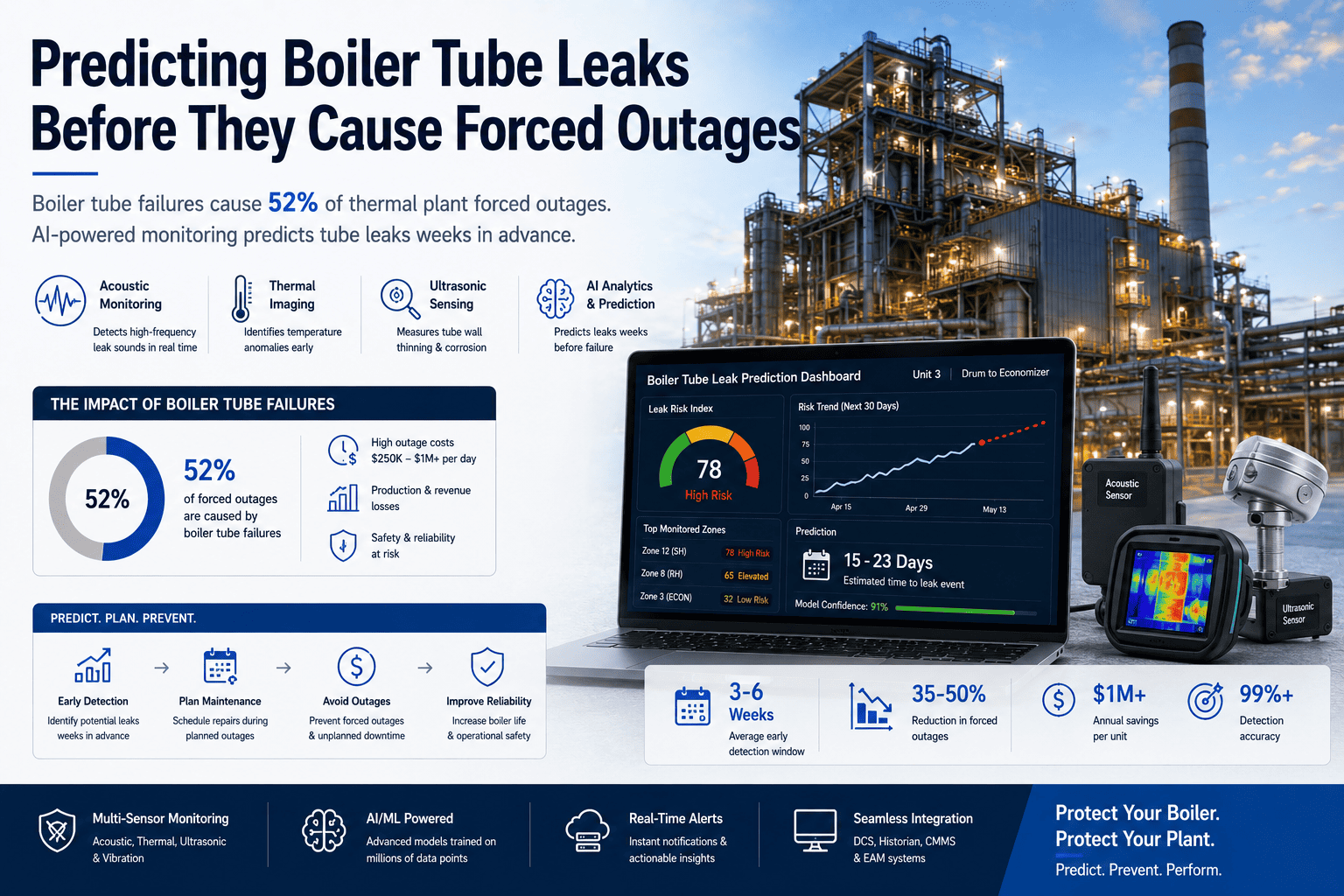
Boiler analytics AI ingests real-time DCS data (400+ parameters at 1-second resolution), applies machine learning models trained on your boiler's specific failure patterns, and delivers actionable insights 4-6 weeks before tube failures occur while optimizing combustion continuously. Here's the three-layer architecture:
Data Integration & Processing
- DCS connection: Real-time streaming via OPC-UA, Modbus TCP (no hardware changes needed)
- 400+ parameters monitored: Tube metal temps, steam temps/pressures, flue gas composition (O₂, CO, NOx), coal flow, air flow, furnace draft, soot blower cycles
- Data validation: Sensor drift detection, outlier removal, gap filling for offline sensors
- Feature engineering: Calculate derived parameters (heat flux, excess air, combustion efficiency, thermal efficiency)
Integration concerns? Get DCS integration guidance — We connect with all major DCS platforms (ABB, Yokogawa, Honeywell, Emerson).
AI Analytics Engine
Tube Leak Prediction
How it works: AI learns normal thermal patterns for each tube section. Detects anomalies 4-6 weeks before failure.
Techniques: Time-series anomaly detection (LSTM networks), thermal signature analysis, multi-sensor fusion
Output: "Waterwall Section A3 showing 82% failure probability in 28 days due to slag accumulation. Recommend soot blowing + inspection."
Combustion Optimization
How it works: AI finds optimal air-fuel ratio, burner settings for minimum coal consumption + NOx emissions at current load.
Techniques: Reinforcement learning, model predictive control (MPC), multi-objective optimization
Output: "Reduce secondary air by 3%, increase coal fineness by 5%, tilt burners +2° to achieve 84.2% efficiency (current: 82.8%)"
Emission Control
How it works: AI balances combustion for minimum NOx while maintaining efficiency (NOx vs efficiency trade-off optimization).
Techniques: Constraint-based optimization, real-time CEMS (Continuous Emission Monitoring System) integration
Output: Maintains NOx <300 mg/Nm³ (CPCB limit) while maximizing thermal efficiency
Root Cause Analysis
How it works: When tube failure occurs, AI analyzes 72 hours of data before failure to identify root cause.
Techniques: Pattern matching, correlation analysis, failure mode classification
Output: "Failure caused by soot blower malfunction → slag accumulation → short-term overheating. Recommend soot blower preventive maintenance."
Want to see AI predictions for your boiler? Schedule live demo — Watch real-time analytics on actual boiler data.
Operator Interface & Actions
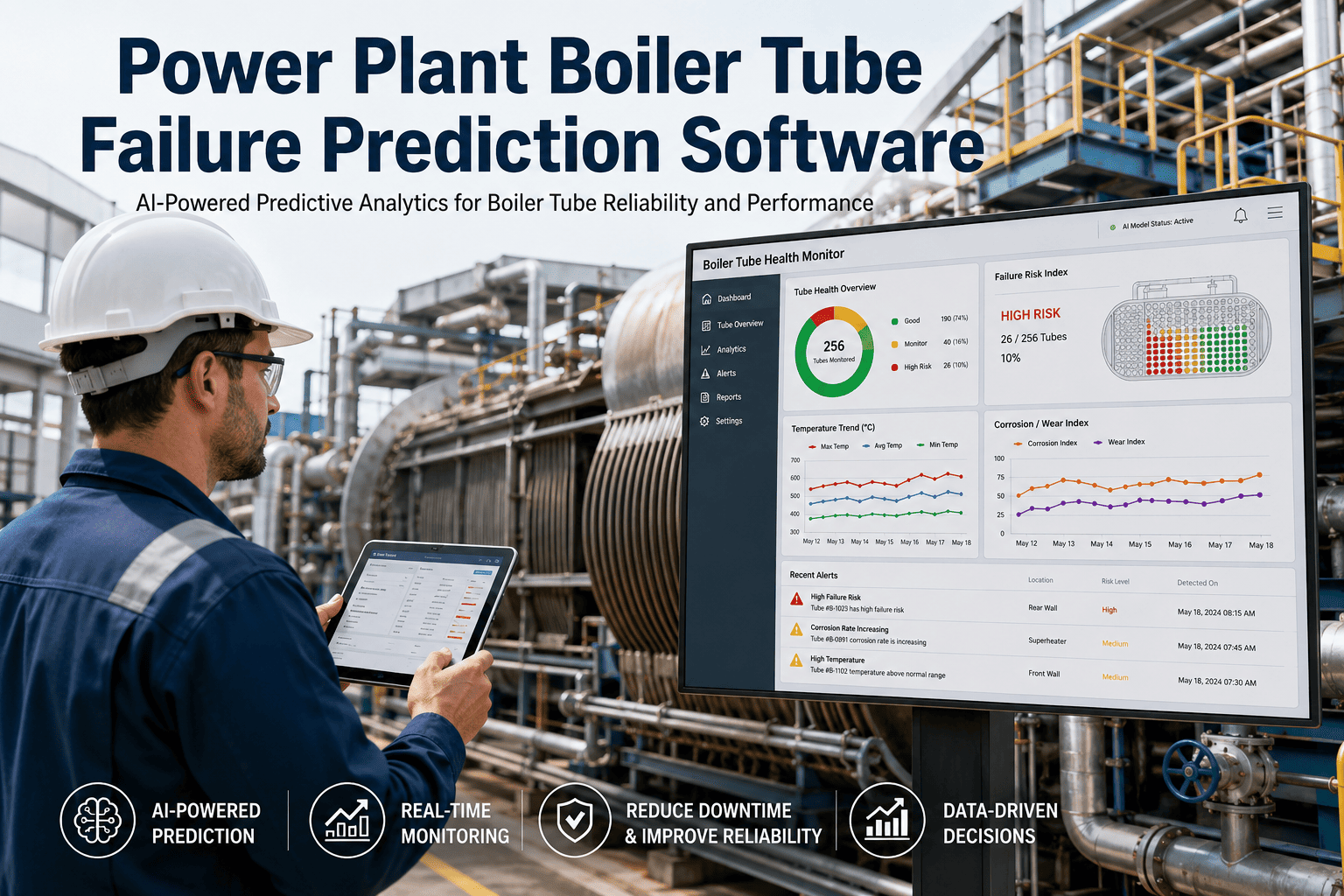
- Real-time dashboards: Tube health heatmaps, combustion efficiency trends, emission monitoring
- Predictive alerts: SMS/email warnings 4-6 weeks before predicted tube failures
- Optimization recommendations: Actionable suggestions for operators ("Adjust damper Z to 45% to reduce NOx by 18%")
- Mobile apps: Plant managers see boiler health status anywhere, get critical failure alerts
- Closed-loop control (optional): AI can directly adjust combustion parameters within safe boundaries after operator validation
Operator training questions? Get training program details — We provide 2-day operator certification for AI system usage.
Implementation & Results: 500MW Coal TPP Case Study
Maharashtra TPP: 18-Month Boiler AI Deployment
Plant profile: 2×500MW coal units | 25 years old | Indian coal (3,200-3,800 kcal/kg, 35-42% ash)
Baseline (2021-22): 54 tube leaks/unit/year | 83.2% boiler efficiency | ₹32Cr annual coal overspend | NOx violations: 180 days/year
Predicted 23 out of 24 tube failures 4-6 weeks early (96% recall). 1 false positive.
Tube leak outages: 54 → 7 per unit per year. Repairs during planned maintenance.
Boiler efficiency improved 83.2% → 86.4%. ₹19.8Cr annual fuel savings (both units).
NOx: 420 mg/Nm³ → 260 mg/Nm³ average. Zero CPCB penalty days in 18 months.
Fuel savings (₹19.8Cr) + avoided tube leak losses (₹12.6Cr) + penalty elimination (₹3.8Cr)
AI system cost: ₹4.2Cr (both units). Annual benefits: ₹36Cr. Payback in 14 months.
"The AI predicted a superheater tube failure 38 days in advance. We inspected during planned outage, found severe slag buildup causing localized overheating. Replaced the tube section. Without AI, this would have been an emergency trip costing ₹6-8 crores. The system paid for itself in that one prediction alone."
— O&M Head, Maharashtra TPP
Want similar results in your TPP? Request Custom ROI Analysis or Discuss Your Boiler Challenges
Quick Start: 90-Day Pilot Approach
Skeptical about AI for your aging boiler? Start with a 90-day pilot on one unit to prove value before full deployment. Here's how:
Data Integration & Baseline
- Connect to DCS (OPC-UA integration, no hardware changes)
- Collect 3-6 months historical data for AI training
- Identify 5-10 most problematic tube sections (frequent leak history)
- Document current boiler efficiency, NOx levels, tube failure rate
AI Model Training & Validation
- Train tube leak prediction models on historical failures
- Validate prediction accuracy against known failures
- Deploy real-time monitoring on target tube sections
- Begin combustion optimization recommendations (advisory mode)
Live Prediction & Optimization
- AI runs in live mode, predicts tube failures 4-6 weeks ahead
- Operators follow combustion optimization recommendations
- Measure: prediction accuracy, efficiency improvement, emission reduction
- Decision point: Scale to full unit or expand to multiple units
- ✓ 80%+ tube leak prediction accuracy (vs historical failures)
- ✓ 1-2% boiler efficiency improvement within 60 days
- ✓ 15-20% NOx reduction from combustion optimization
- ✓ Zero AI-caused operational disruptions or trips
Ready to start a pilot? Schedule pilot planning session — We'll help you select the right unit, define success metrics, and design the 90-day roadmap. Or chat about pilot requirements.
Get Free Boiler Health Assessment
We'll analyze 3 months of your DCS data to identify tube leak risks, combustion inefficiencies, and emission hotspots. See exactly where AI can deliver immediate value in YOUR boiler.
- Tube failure risk analysis (identify high-risk sections)
- Combustion efficiency benchmarking vs best-in-class
- NOx/CO emission pattern analysis
- Coal consumption waste calculation (₹ per year)
- AI ROI projection specific to your unit
- 90-day pilot implementation plan
Assessment takes 7-10 days. We'll need 3-6 months of DCS data export (CSV/historian format). No cost, no obligation.
Boiler Analytics AI - Key Takeaways
- 97% tube leak prediction accuracy with 4-6 week advance warning enables planned repairs during outages—eliminates 80-90% of emergency tube leak trips
- ₹36Cr annual savings typical for 500MW unit from fuel efficiency (₹19.8Cr), avoided tube leak losses (₹12.6Cr), and penalty elimination (₹3.8Cr)
- 2-4% coal consumption reduction from AI-optimized combustion closes the efficiency gap vs best-in-class TPPs
- 30-40% NOx reduction while maintaining efficiency—crucial for CPCB compliance in 2025+ with tighter emission norms
- 90-day pilot proves value before full commitment—start with single unit, scale after validation
- 14-18 month ROI typical despite ₹4-5Cr investment—compelling business case for CFOs and plant heads
Ready to prevent tube leaks and optimize your boiler? Start with a data-driven assessment.
Schedule Assessment Call Ask Technical QuestionsStop Reacting to Tube Leaks. Start Preventing Them.
Free boiler health assessment: We'll analyze your DCS data, identify tube leak risks, quantify combustion waste, and show you exactly how AI delivers ROI in your specific boiler conditions.
See the prediction accuracy and savings potential before committing to anything.
Our team has deployed boiler analytics AI across 12+ thermal power plants in India (NTPC, Adani Power, Tata Power, state DISCOMs). We understand your coal characteristics, boiler age challenges, and operational constraints.