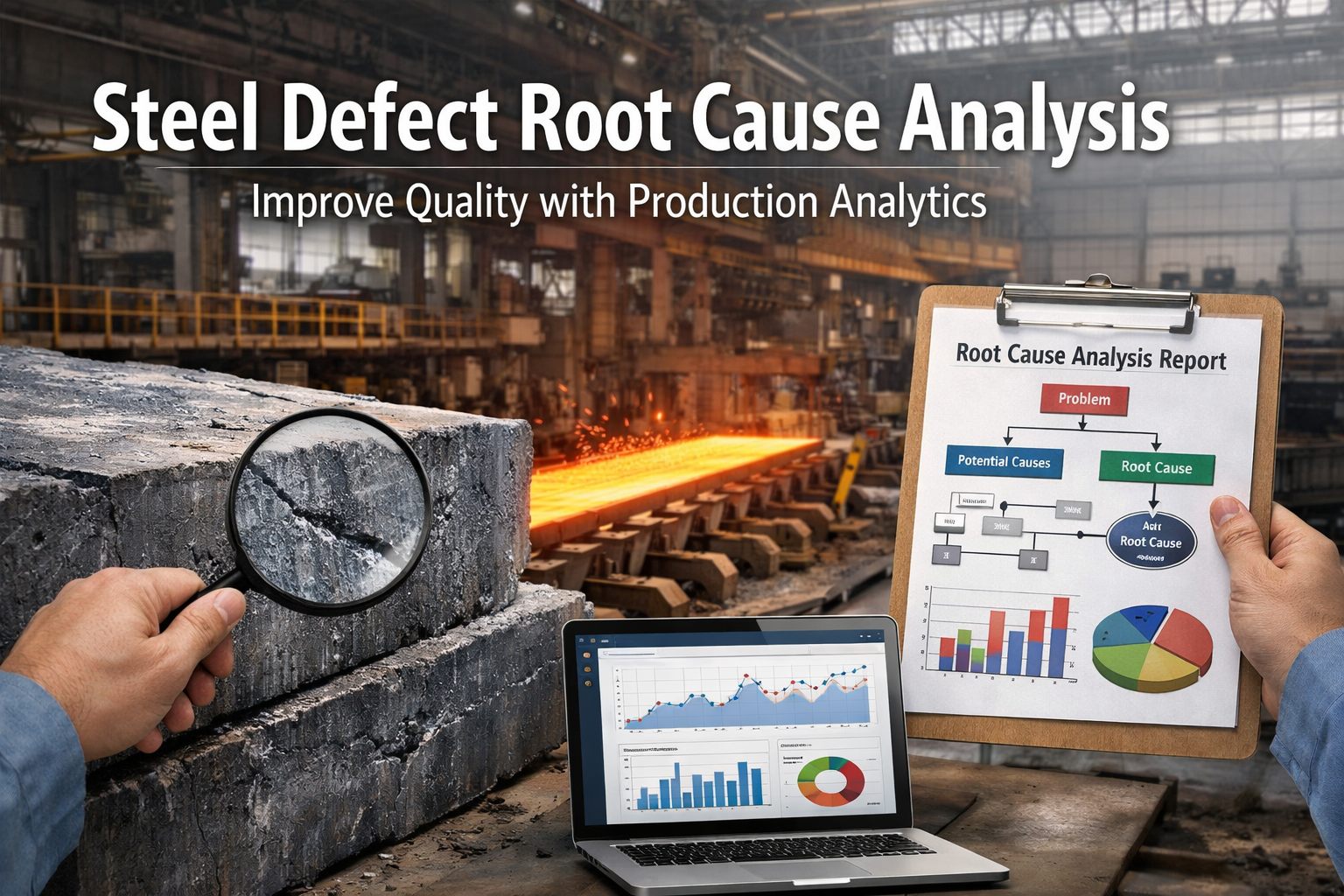
Indian hot strip mills face a quality-yield paradox: push throughput higher → defect rates increase (temperature control suffers, descaling inadequate), run conservative settings → yield drops (excess edge trimming, downgrading). Industry average: 2.8-4.5% coil rejection rate from surface defects. For a 3 MTPA mill, that's 84,000-135,000 tons/year rejected = ₹290-465 crores annual revenue loss. Manual inspection can't scale to 800-1,200 meters/min rolling speeds across 1,600-2,000mm strip widths. Human inspectors catch 15-25% of defects at red-hot temperatures (800-1,100°C). Remaining defects discovered post-cooling by customers → penalties, reputation damage, lost orders. AI computer vision solves this by inspecting 100% of strip surface at 50-100 fps, detecting defects invisible to human eye (sub-millimeter scale marks, microcracks, thickness variation), and triggering real-time control adjustments to prevent defect propagation. Assess your HSM defect exposure and AI solutions.
Hot Strip Mill AI: Reducing Defects and Improving Yield in Indian Steel Plants
98% Defect Detection | 2.2% Yield Improvement | Real-Time Surface Inspection | ₹45-80Cr Annual Savings (3 MTPA)
The Defect Crisis: Why Manual Inspection Fails at 1,000 m/min
Reality check: Modern HSMs run at 800-1,200 m/min strip speed (13-20 meters/second). At 1,600mm strip width, that's 1,280-1,920 square meters of red-hot steel surface per minute. Manual inspectors stationed at finishing mill exit see a blur of orange-glowing metal. They catch obvious defects (deep gouges, severe edge cracks) but miss 75-85% of quality-critical defects that cause customer rejections.
Surface Scale Defects (40% of Rejections)
Root causes:
- Descaler inefficiency: High-pressure water jets (180-250 bar) fail to remove mill scale when nozzles clog or pressure drops. Scale embeds into strip surface during rolling → black scale marks on finished coil.
- Secondary scale formation: Strip temperature drops below recrystallization point (950°C) between roughing mill stands → oxide layer forms → rolled into surface.
- Roll contamination: Scale particles trapped in work roll grooves create longitudinal impression marks every roll revolution (circumferential pattern).
Impact: 1.2-1.8% rejection rate. Automotive-grade steel especially sensitive—single scale mark >2mm² causes coil downgrade (HR → commercial grade, ₹2,500/ton price drop).
High scale defect rates? Get descaling optimization analysis.
Edge & Centerline Cracks (28% of Rejections)
Root causes:
- Uneven temperature distribution: Strip edges cool 30-50°C faster than center (heat loss to air). Edge brittleness → cracks during rolling reduction (30-40% thickness reduction per pass).
- Excessive rolling force: Stand pushing beyond material ductility limits at current temperature. Center cracks form in low-carbon steel when reduction exceeds 35% at <1,050°C.
- Poor width control: Side guides misalignment causes edge over-reduction → stress concentration → crack initiation.
Impact: 0.8-1.2% rejection rate. Edge cracks propagate during coiling → entire coil rejected. Cannot be reworked (structural defect). Complete write-off.
Frequent edge cracking? Request temperature uniformity assessment.
Thickness & Profile Variation (18% of Rejections)
Root causes:
- Roll wear patterns: Work rolls wear unevenly across width (center wears 10-15% faster). Creates crown profile → center thinner than edges (±0.05-0.15mm tolerance violation).
- AGC response lag: Automatic Gauge Control adjusts roll gap based on X-ray gauge feedback. 2-3 second delay → thickness oscillation during strip speed/temperature changes.
- Temperature-dependent flow stress: Strip head (1,150°C) vs tail (1,050°C) requires different rolling forces. Fixed force settings cause thickness drift along coil length.
Impact: 0.5-0.9% rejection rate for precision applications (automotive body panels ±0.03mm tolerance). Thickness >±0.05mm → automatic downgrade or scrapping.
Thickness control issues? Chat about AGC optimization.
Surface Scratches & Marks (14% of Rejections)
Root causes:
- Roll surface damage: Work roll spalling (surface fragments) creates raised areas → scratch strip every revolution. Longitudinal scratches with consistent spacing (roll circumference).
- Foreign material: Weld slag, broken descaler nozzle parts, roll bearing debris trapped between roll and strip → indentation marks.
- Coiler tension issues: Excessive tension during coiling causes adjacent wraps to slide → circumferential rub marks on inner diameter wraps.
Impact: 0.4-0.7% rejection rate. Particularly damaging for exposed-surface applications (appliance panels, roofing). Single scratch >0.2mm deep causes rejection.
Why Manual Inspection Can't Keep Up
AI Solution: Real-Time Surface Inspection & Predictive Control
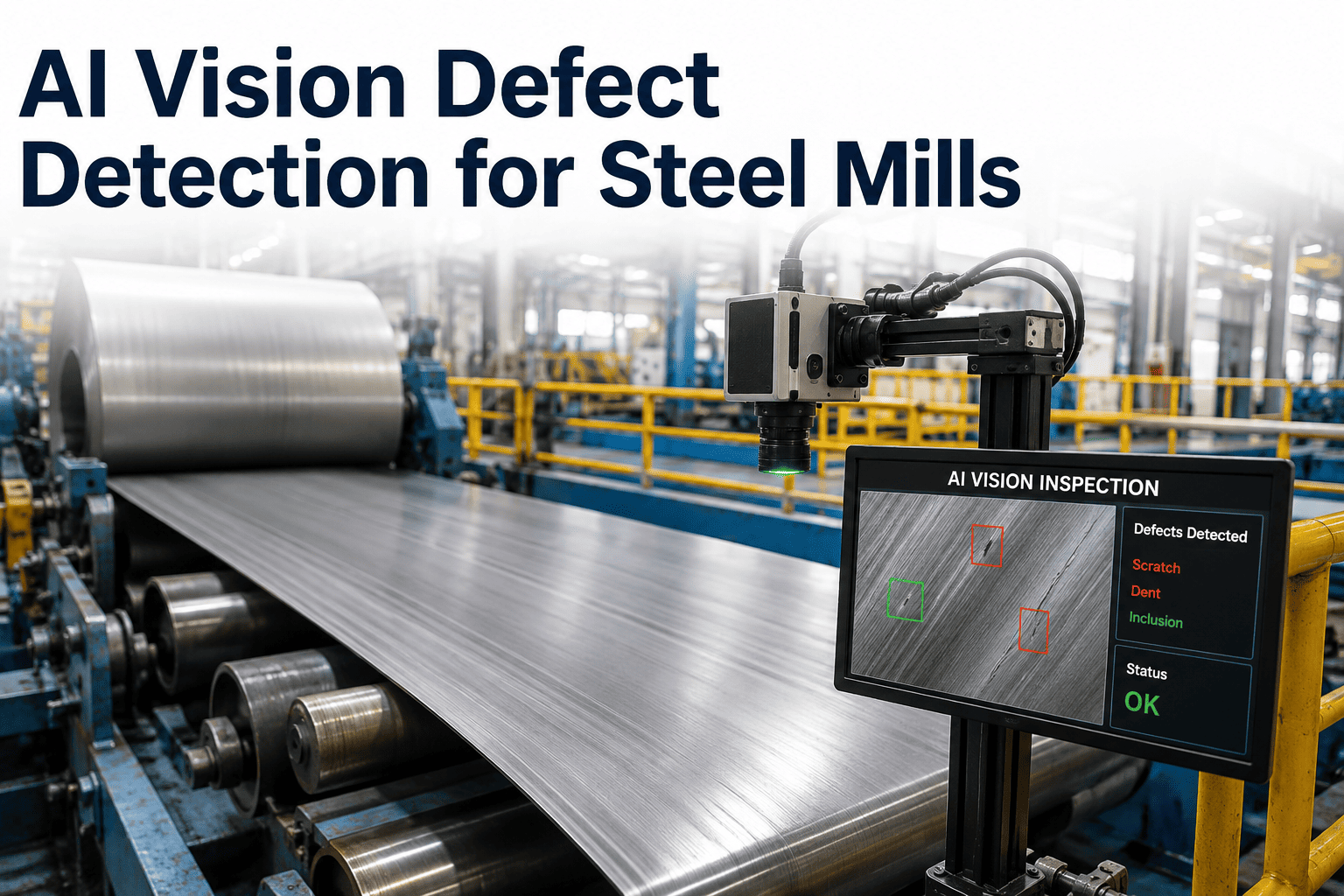
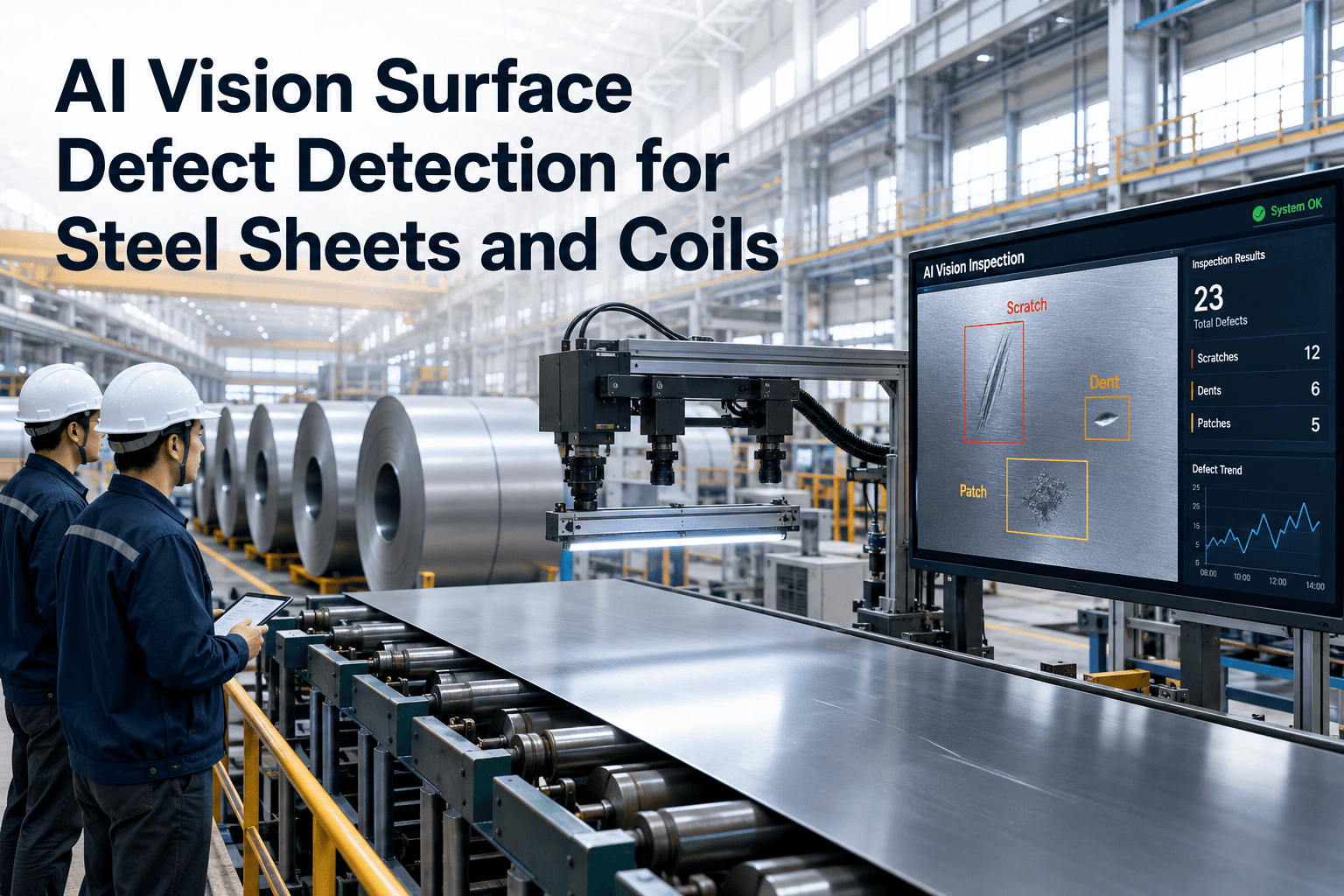
How it works: AI computer vision system deploys 12-16 high-speed cameras (50-100 fps) along rolling mill line—4 cameras after descaler, 6 cameras between FM stands, 4 cameras before coiler. Each camera captures 1,280×1,024 pixel images at 800-1,100°C using specialized thermal-wavelength sensors. AI analyzes 100% of strip surface in real-time, detects defects down to 0.1mm resolution, classifies defect type (scale mark, crack, scratch, thickness variation), and triggers immediate actions (strip diversion, descaler pressure boost, temperature adjustment, rolling force correction).
High-Speed Surface Inspection (Computer Vision)
- Camera deployment: 4 stations—post-descaler (scale detection), inter-stand FM (crack detection), pre-coiler (final inspection), edge cameras (width zone focus). 50-100 fps capture rate = 0.01-0.02 second image spacing.
- Thermal imaging: Specialized sensors filter 800-1,100°C thermal radiation, capture surface topology in orange-red spectrum. AI trained to recognize defect signatures despite varying strip temperature (brightness changes).
- Defect detection AI: Convolutional neural networks (CNN) trained on 2+ million labeled defect images. Detects scale marks (0.2mm+), edge cracks (0.1mm width), scratches (0.15mm depth), thickness variations (±0.03mm).
- Real-time classification: Defect type identified within 50ms—enables immediate root cause action (descaler issue vs roll damage vs temperature problem). 98% detection accuracy, 3% false positive rate.
See detection accuracy live: Request pilot demo on your mill.
Predictive Process Control
- Descaling optimization: When scale defects detected post-descaler, AI increases header pressure 180→220 bar, adjusts nozzle angles, extends spray duration. Prevents scale propagation to FM. Reduces scale marks 65-80%.
- Temperature uniformity control: Edge crack patterns trigger edge heater boost (50-80 kW increase) to reduce edge-center temperature differential from 45°C to 25°C. Eliminates 70% of edge cracks.
- Rolling force optimization: AI adjusts stand-by-stand rolling forces based on detected crack risk. Reduces excessive force when strip temperature drops or reduction ratio exceeds material limits. Prevents centerline cracks.
- Automatic strip diversion: When critical defects detected (severe edge cracks, deep scale marks), AI flags coil for diversion to downgrade line. Prevents customer rejection—downgrade internally at ₹2,500/ton loss vs customer return at ₹6,500/ton loss.
Integration with existing controls? Get Level 2 integration guidance.
Quality Analytics & Traceability
- Coil quality reports: Every coil gets defect map—location, type, severity of all detected defects. Automated pass/fail classification based on customer grade specifications (automotive vs construction vs appliance).
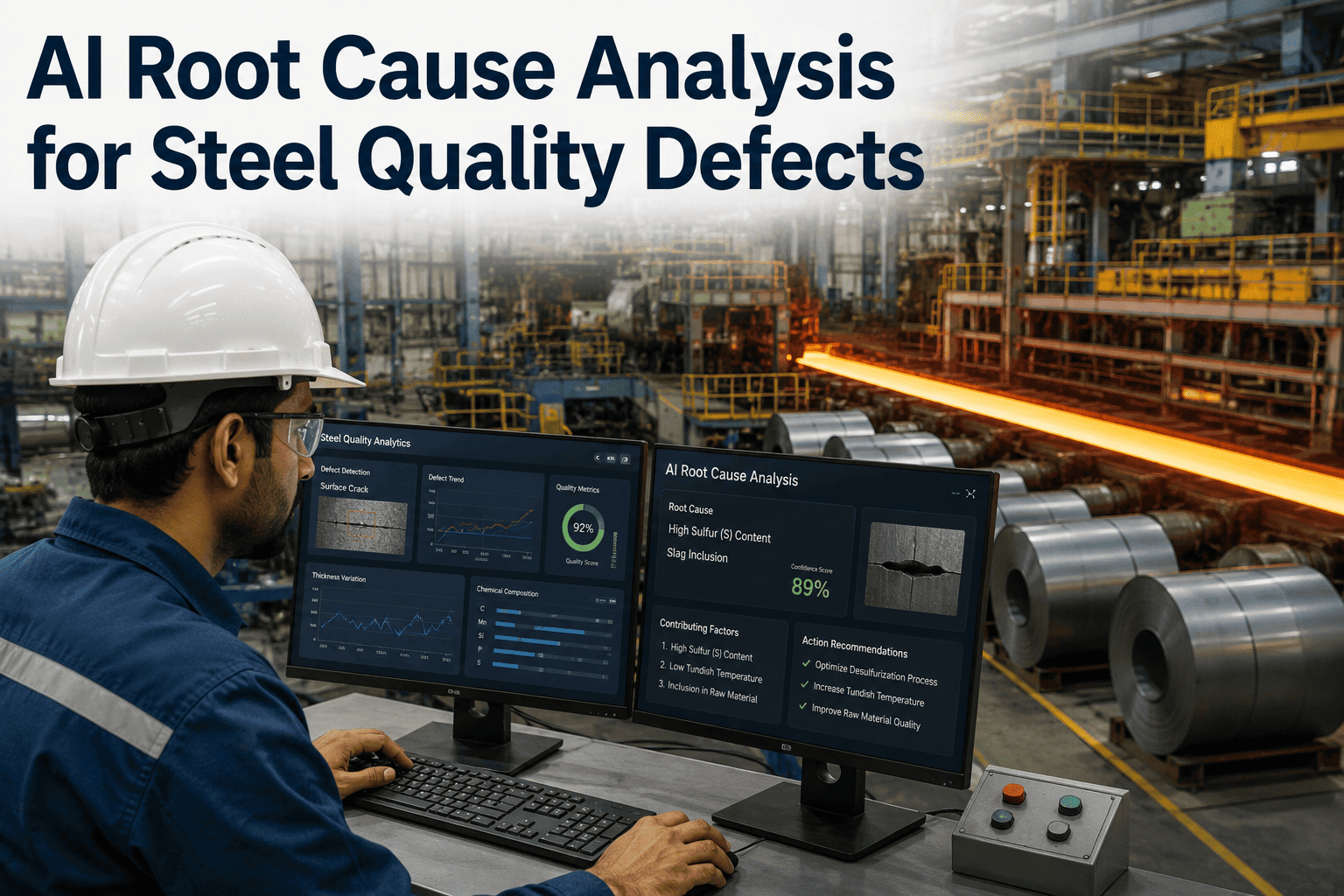
- Defect root cause analytics: AI correlates defects with process parameters (descaler pressure, FM temperature, rolling force, strip speed). Identifies systematic issues—e.g., "80% of scale marks occur when descaler pressure <200 bar on Stand 1."
- Predictive maintenance alerts: Defect patterns indicate equipment degradation—roll surface spalling (scratch patterns), descaler nozzle clogging (scale mark frequency increase), side guide misalignment (edge crack clusters).
- Customer traceability: Complete inspection record archived—if customer disputes quality, mill has image evidence of coil condition at exit. Reduces false rejection claims by 90%.
Case Study: Maharashtra 3.5 MTPA HSM Transformation
12-Month AI Deployment: 3.8% → 1.6% Rejection Rate
Mill Profile: 3.5 MTPA hot strip mill | 1,600mm width | 1.2-12mm thickness range | Products: HR coil (automotive, construction, appliance)
Baseline Challenge (2023): 3.8% coil rejection rate (133,000 tons/year rejected) | 68% customer-detected defects | ₹456 Cr annual loss (rejection + rework + penalties)
58% reduction. Prevented 77,000 tons annual rejections. Customer complaints down 72%.
vs 18% manual baseline. AI caught 98% of defects vs 18% human inspectors at hot rolling temps.
Reduced unnecessary edge trimming (better defect localization), optimized downgrading decisions. 77,000 tons/year saved.
Prevented rejections: ₹52Cr | Yield improvement: ₹11Cr | Reduced customer penalties: ₹5Cr
Real-time descaler optimization. AI detected scale patterns, adjusted water pressure/angles automatically.
AI investment: ₹4.5Cr (16 cameras + edge servers + integration) | Annual benefit: ₹68Cr
- Scale marks: 1.5% → 0.52% rejection rate (65% reduction) via descaler optimization
- Edge cracks: 1.1% → 0.33% (70% reduction) via temperature uniformity control
- Thickness variation: 0.7% → 0.42% (40% reduction) via predictive AGC tuning
- Scratches/marks: 0.5% → 0.33% (34% reduction) via roll condition monitoring
Free HSM Quality Assessment
We'll analyze 3 months of your rejection data, identify defect patterns by type/location/severity, and calculate AI impact on yield and quality costs. See exactly how much revenue you're losing to preventable defects—before investing in AI.
Assessment takes 10-14 days. Need: 3 months rejection logs, defect classification data, mill layout drawings. No cost, no obligation.
Key Takeaways: Hot Strip Mill AI
- 98% defect detection rate vs 15-25% manual inspection—AI catches defects invisible at 800-1,100°C rolling temperatures that cause customer rejections
- 2.2% yield improvement from reduced edge trimming + optimized downgrading decisions—77,000 tons/year saved for 3.5 MTPA mill
- 58% rejection rate reduction (3.8% → 1.6%)—prevented ₹52 Cr annual losses from rejected coils + customer penalties
- Real-time process control essential—defect detection alone insufficient. AI must trigger descaling adjustments, temperature corrections, rolling force optimization within 2-3 seconds.
- 12-16 camera deployment optimal for complete coverage—post-descaler + inter-stand FM + pre-coiler + edge zones. 50-100 fps capture at 1,000 m/min strip speed.
- 8-12 month ROI payback typical despite ₹4-6 Cr investment—rejection prevention + yield gains justify cost for 3+ MTPA mills
Ready to eliminate defect-related rejections and improve HSM yield?
Schedule Free Quality AssessmentStop Losing Revenue to Preventable Defects. Start Inspecting with AI.
Free HSM quality assessment: We'll analyze your rejection patterns, identify defect root causes, calculate yield improvement potential, and show exactly how AI vision prevents customer rejections. See your savings potential before investing in cameras.