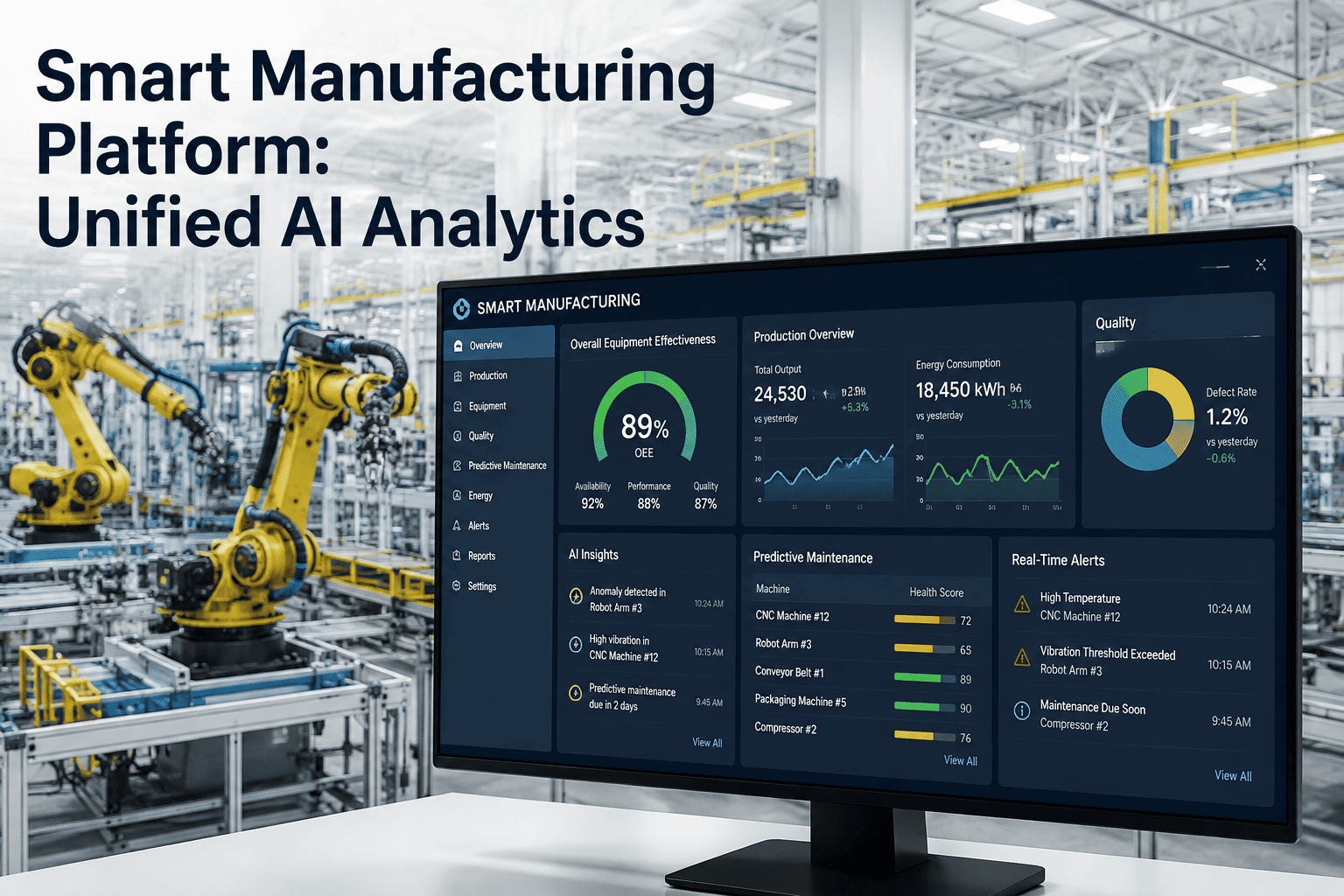
Most FMCG plants run at just 60% OEE — meaning 40% of production capacity is lost to unplanned stops, slow cycles, and quality rejects that manual tracking simply cannot catch in real time. AI-powered OEE optimization uses computer vision, machine learning, and automated data capture to monitor every machine state, count every part, and time every cycle — transforming OEE from a lagging report into a live operational compass. Book a Free OEE Assessment to discover how much hidden capacity your FMCG lines are leaving on the table.
AI OEE Optimization for FMCG Manufacturing
Automate Data Capture, Eliminate Hidden Losses, and Push Every Production Line Toward World-Class Performance with AI-Powered Vision and Analytics
The Three Pillars of OEE — and Where FMCG Plants Lose
OEE multiplies Availability, Performance, and Quality. Even small losses in each compound into massive hidden waste.
Availability
Target: 90%Top Losses
Changeovers between SKUs (15–20% of available time in food lines), unplanned breakdowns, sanitary cleaning cycles, and material shortages on high-speed packaging lines.
AI Solution
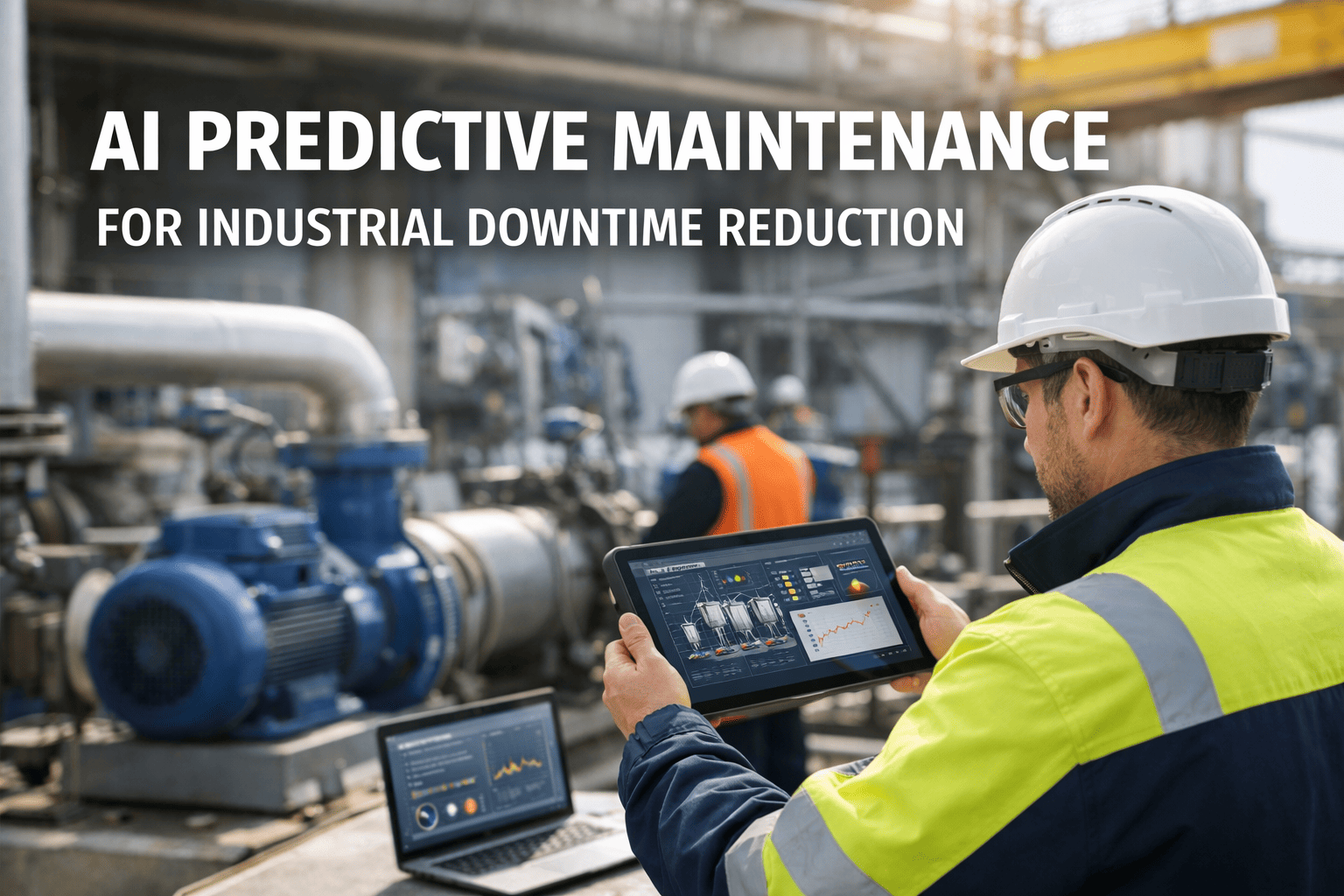
Predictive maintenance prevents breakdowns. AI scheduling sequences SKU runs to minimize changeover time. Vision systems detect material jams before they cause full stops.
Performance
Target: 95%Top Losses
Micro-stops on filling, capping, and labeling machines, speed reductions due to material variability, conveyor jams, and operators running lines below rated speed due to lack of real-time cycle data.
AI Solution
Real-time cycle time monitoring flags speed losses instantly. AI identifies micro-stop patterns and root causes. Automated part counting replaces manual tallies with exact data.
Quality
Target: 99%Top Losses
Fill-level inaccuracies, label misalignment, packaging seal failures, and product contamination from temperature excursions — often detected only at end-of-line QC or after customer complaints.
AI Solution
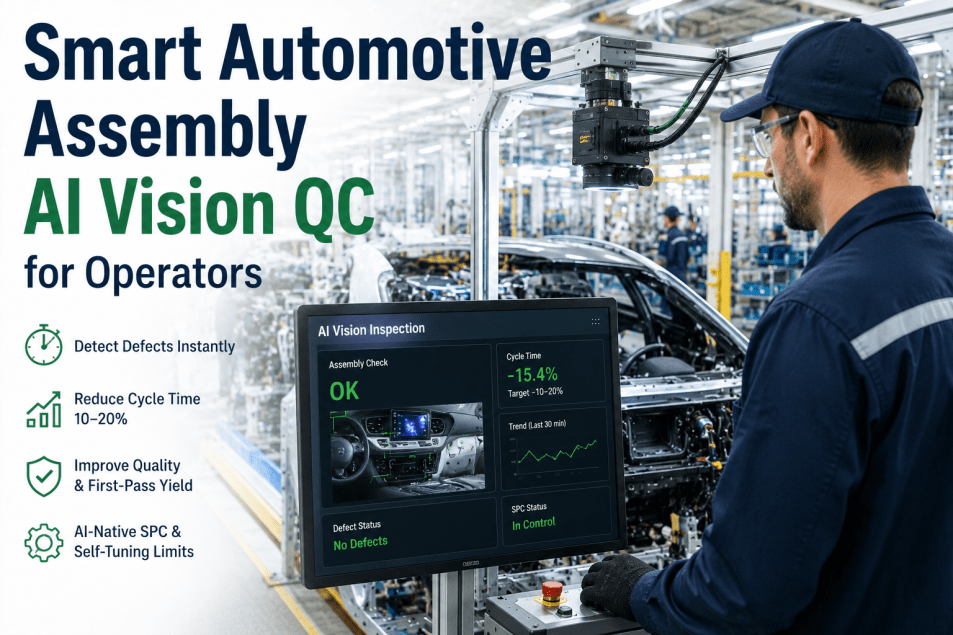
Computer vision inspects every unit at line speed — fill levels, label placement, seal integrity, and print quality. Defects are caught at source, not at final inspection.
AI Data Capture: From Blind Spots to Full Visibility
Traditional OEE relies on manual logs and operator estimates. AI captures everything automatically.
Machine State Detection
AI vision systems and PLC integration detect running, idle, stopped, and changeover states automatically — no operator input required. Every second of machine time is classified and logged in real time across all lines simultaneously.
Cycle Time Monitoring
Sensors and vision systems measure actual cycle times per unit with millisecond accuracy. AI compares actual vs. ideal cycle times continuously, flagging speed losses the moment they begin — not hours later in a shift report.
Automated Part Counting
Computer vision counts every unit produced, rejected, and reworked at each station. No manual tally sheets, no estimation, no end-of-shift reconciliation errors. Good count, reject count, and scrap count are always accurate.
Downtime Reason Classification
AI automatically categorizes every stop event — mechanical failure, changeover, material shortage, operator break, or cleaning cycle. Pareto analysis updates in real time so supervisors always know the biggest loss driver on every line.
Quality Inspection at Line Speed
Deep learning vision models inspect fill levels, label position, seal integrity, print quality, and packaging completeness on every single unit at full production speed — replacing statistical sampling with 100% inline inspection.
Live OEE Dashboard
Availability, Performance, and Quality scores update every minute on shop floor displays, supervisor tablets, and executive dashboards. Shift targets, trend lines, and loss breakdowns are always one glance away.
Your OEE Score Is a Symptom. AI Finds the Disease.
iFactory captures machine states, cycle times, part counts, and quality data automatically — then connects it to your CMMS for instant work orders when something goes wrong. No clipboards. No guesswork.
Where AI OEE Optimization Hits Hardest in FMCG
High-speed, high-volume FMCG lines have unique challenges — and unique AI opportunities.
AI vision monitors fill levels on every bottle at full speed. Cycle time tracking detects filler valve degradation before output drops. Predictive maintenance on rotary fillers prevents catastrophic seal failures that halt entire lines.
Automated changeover tracking measures actual vs. target changeover time for every SKU switch. Vision systems verify label placement, barcode readability, and case count accuracy. AI flags cartoner jams within seconds.
AI optimizes batch sequencing to minimize cleaning time between product changeovers. Sensor fusion monitors mixing consistency in real time. Predictive models anticipate ingredient quality variations and adjust parameters proactively.
Vision-based pallet pattern verification ensures correct stacking. AI detects palletizer jams and misfeeds instantly. Throughput tracking across the entire line identifies the true bottleneck — often the palletizer constrains upstream speed.
AI vs. The Six Big Losses of OEE
Every percentage point of OEE lost traces back to one of six root causes. Here is how AI attacks each one.
How iFactory Turns OEE Data into Action
Capturing OEE is step one. Converting insights into work orders and improvements is where the value lives.
Sensor and Vision Data Capture
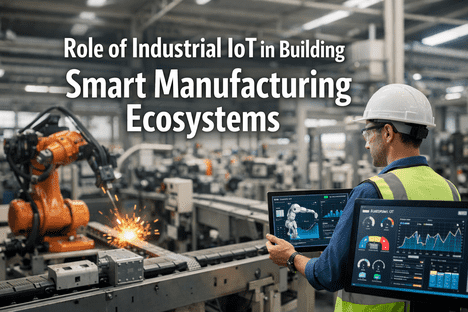
AI vision systems and IoT sensors connect to every production line via PLC integration, edge gateways, and camera networks. Machine states, cycle times, part counts, and quality data flow into iFactory in real time.
Live OEE Calculation Engine
iFactory computes Availability, Performance, and Quality per line, per shift, per SKU — updated every 60 seconds. Automatic Pareto analysis ranks loss drivers and spots degradation before crises.
Automatic CMMS Work Orders
When AI detects a predictive maintenance alert, chronic micro-stop pattern, or quality threshold breach, iFactory CMMS generates a prioritized work order with machine, location, severity, and recommended action.
ERP and MES Sync
OEE data, production counts, and quality metrics sync directly to your ERP and MES systems. Actual vs. planned production, scrap costs, and maintenance expenses update automatically for leadership visibility.
The Business Case for AI OEE Optimization
Conservative estimates based on published industry benchmarks and real-world FMCG deployments.
OEE Score Improvement
Digitized factories gain 5–15 OEE points after AI implementation. Each point recovered on a $10M line equals $100K+ in additional output.
Downtime Reduction
Predictive maintenance cuts unplanned downtime by 35–55%. Every avoided hour saves $5K–$50K on high-speed FMCG lines.
Waste and Scrap Reduction
AI vision catches defects at the source. Plants report up to 30% waste reduction — recovering raw materials previously discarded.
3-Year ROI
Industry benchmarks show 300% ROI over 3 years for AI-driven OEE — from compounding gains in uptime, throughput, and quality.
Frequently Asked Questions
Q1What OEE score should our FMCG plant target?
World-class OEE is 85% for discrete manufacturing. For FMCG food and beverage lines, 70–80% is a strong target due to sanitary cleaning and changeover requirements. The key is continuous improvement — focus on gaining 5+ points per year rather than chasing an absolute number. Only about 6% of manufacturing organizations globally achieve 85%+.
Q2Do we need to replace our existing PLCs or machines?
No. iFactory AI layers on top of your existing equipment via OPC-UA, MQTT, and edge camera systems. Older machines without PLC connectivity can be monitored with external IoT sensors and vision systems — no retrofit required. Your current infrastructure stays intact while AI adds the intelligence layer.
Q3How does AI vision count parts and detect defects?
Deep learning models trained on your specific products process camera feeds at line speed. The system counts every unit, classifies good vs. reject, and identifies specific defect types — fill level errors, label misalignment, seal failures, and print defects — all without slowing the line or requiring manual sampling.
Q4How quickly will we see OEE improvement?
Most plants see immediate gains from accurate data capture alone — eliminating the estimation errors that hide true performance. Measurable OEE improvement from AI-driven optimization typically appears within 8–12 weeks. Plants tracking OEE for the first time often discover 10–15% of hidden losses they never knew existed.
Q5Can iFactory track OEE across multiple plants?
Yes. iFactory provides enterprise-level OEE dashboards that compare performance across lines, shifts, plants, and regions. Standardized data capture enables meaningful benchmarking and best-practice sharing across your entire FMCG operation — whether you run 2 plants or 200.
Q6How does OEE data connect to our CMMS?
iFactory CMMS automatically generates maintenance work orders when AI detects equipment degradation, chronic micro-stops, or quality threshold breaches. OEE data and maintenance actions are linked in one platform — the diagnosis and the cure live in one system, creating a closed loop between data and action.
Stop Guessing. Start Measuring. Start Improving.
See how iFactory connects AI vision systems, automated OEE tracking, and CMMS work orders into one intelligent platform purpose-built for FMCG manufacturing excellence.