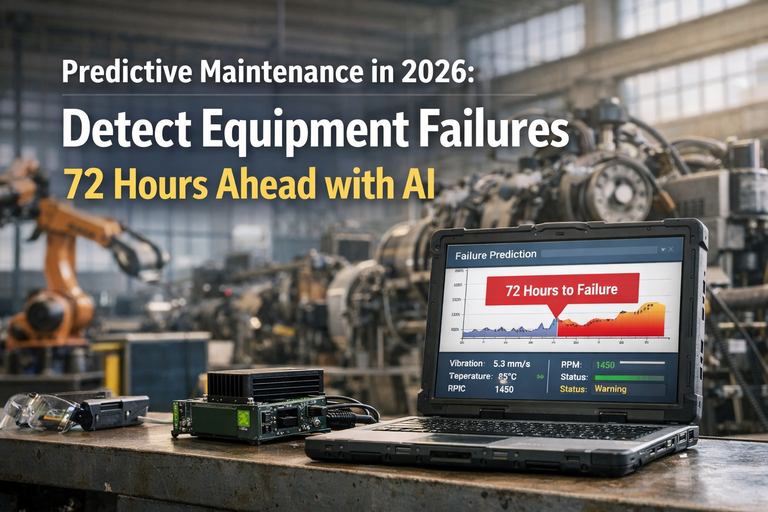
It's 2:47 AM. Your automated night shift just stopped. The spindle on your most profitable CNC machine seized mid-cut—no warning, no advance notice, just silence where there should be production. Now you are facing a $22,000 replacement, a 2-week wait for parts, and $8,000+ per day in lost output. Here's what hurts most: the warning signs were there for six weeks. You just couldn't see them. Predictive maintenance changes everything—detecting spindle failures weeks before they happen and turning $150,000 disasters into $3,500 scheduled repairs.
$2.3 MillionPer Hour
Average downtime cost in automotive manufacturing
— Siemens True Cost of Downtime 2024
26%
of CNC downtime caused by spindle failures
50%
downtime reduction with predictive maintenance
5x
more expensive: reactive vs. planned repairs
The 5 Warning Signs Your Spindle Is About to Fail
Spindle failure doesn't happen overnight. The bearings—the most critical component—degrade over weeks, sending signals that sensors can detect long before humans notice anything wrong. Here is what to watch for:
01
Unusual Noise
Grinding / Rattling
Bearing contamination or failure
Whining / Screeching
Lubrication issues, preload problems
Clunking / Knocking
Severe damage, crash impact
Predictive Detection: Vibration sensors capture frequency changes weeks before sounds become audible to humans
02
Excessive Heat
Spindle bearings normally reach 113°F+ during operation. But when they degrade, friction increases and temperatures soar—eventually destroying the bearing cage.
<120°FNormal
120-140°FWarning
>140°FCritical
03
Increased Vibration
As bearings wear, balls and races pit and degrade—creating uneven surfaces that cause vibration. This accelerates wear and directly impacts part quality.
Bearing damageImbalanceMisalignmentWorn holders
04
Loss of Accuracy
When internal components wear, they introduce runout. Even tiny inaccuracies make it impossible to hold tolerances—increasing scrap and rework.
Parts out of tolerance
Poor surface finish
Inconsistent dimensions
05
Abnormal Power Draw
Increased power consumption signals underlying issues. Spindle misalignment, bearing deterioration, or drive faults create additional resistance.
iFactory's AI-powered monitoring detects spindle problems 4-8 weeks before failure—turning emergencies into scheduled maintenance and saving $100K+ per prevented failure.
Modern CNC monitoring uses multiple sensor types working together to build a complete picture of spindle health. Each method catches different failure modes at different stages:
Vibration Analysis
4-8 Weeks Early
Accelerometers mounted on spindle housing capture vibration frequency signatures. AI analyzes patterns to detect:
"AI-powered equipment maintenance systems can decrease costs by up to 25% and reduce unplanned downtime by 30-40%. Solutions leverage both historical performance data and real-time sensors to predict machinery malfunctions before they occur. Vibration analysis has become one of the most accepted and used techniques for rotary equipment. Bearings in machine tool spindles are the most sensitive component—any major issues are usually reflected and detected through the bearings first."
— McKinsey Research on AI in Manufacturing— Sensemore, Condition Monitoring in CNC Machines
iFactory brings enterprise-grade predictive maintenance to manufacturing plants of all sizes—with wireless sensors, AI analytics, and CMMS integration that fits your operation and your budget.
The earliest detectable signs are subtle changes in vibration frequency—undetectable by humans but visible to sensors. As failure progresses, you'll notice unusual noise (grinding, whining, rattling), excessive heat, increased vibration, loss of part accuracy, and abnormal power consumption. By the time noise is audible, you typically have only 2-4 weeks before catastrophic failure. Predictive maintenance catches issues 4-8 weeks earlier.
How much does CNC spindle replacement cost?
A new CNC spindle costs $14,000-$24,000 depending on the machine and spindle type. However, the total cost of unplanned failure is much higher: add $80,000-$120,000 in downtime (2 weeks at $8,000/day), $5,000-$10,000 in rush shipping and overtime, and $2,000-$8,000 in scrapped parts. Total impact: $101,000-$162,000. A scheduled rebuild caught by predictive maintenance costs only $2,500-$3,500.
How far in advance can predictive maintenance detect spindle problems?
Vibration analysis can detect bearing wear 4-8 weeks before failure. Temperature monitoring catches issues 2-4 weeks early. Ultrasonic analysis provides the earliest possible detection by identifying lubrication problems before any damage occurs. This advance warning gives you time to order parts, schedule repairs during planned downtime, and avoid the massive costs of unplanned failure.
What sensors are needed for CNC spindle monitoring?
Start with wireless vibration sensors mounted on spindles—these catch 60-70% of failures. Add temperature sensors for bearing and motor monitoring. Modern wireless sensors (IP67/IP68 rated) install in minutes without complex wiring. The monitoring system costs $2,000-$5,000 per spindle, but one prevented failure saves $100,000+, paying for your entire fleet's monitoring for years.
Can predictive maintenance integrate with our existing CMMS?
Yes. Modern predictive maintenance platforms connect to popular CMMS systems via API. When the system detects an issue, it automatically creates a work order with diagnostic data, recommended actions, and priority level. This eliminates manual data entry and ensures nothing falls through the cracks. iFactory integrates seamlessly with your existing maintenance workflows.