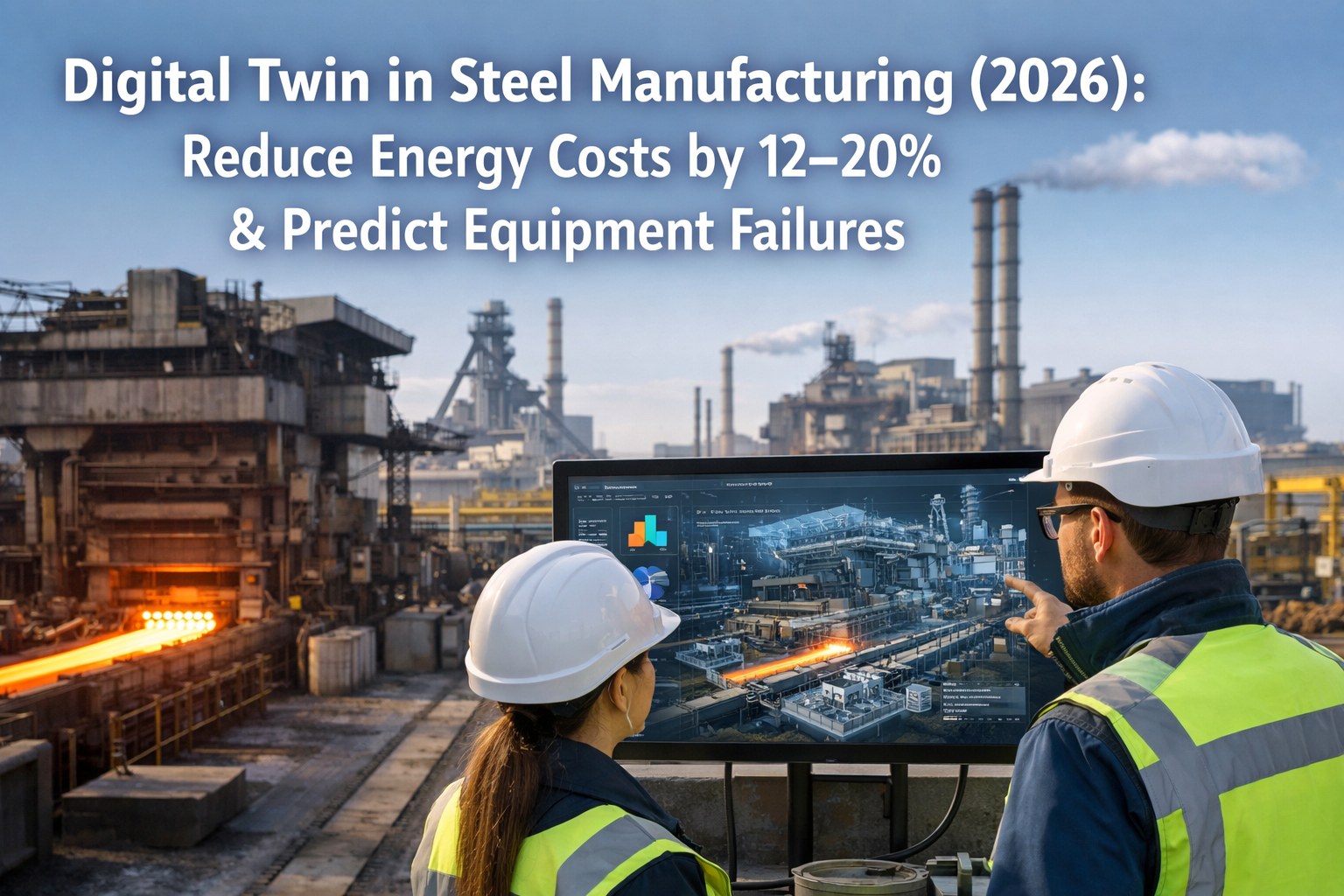
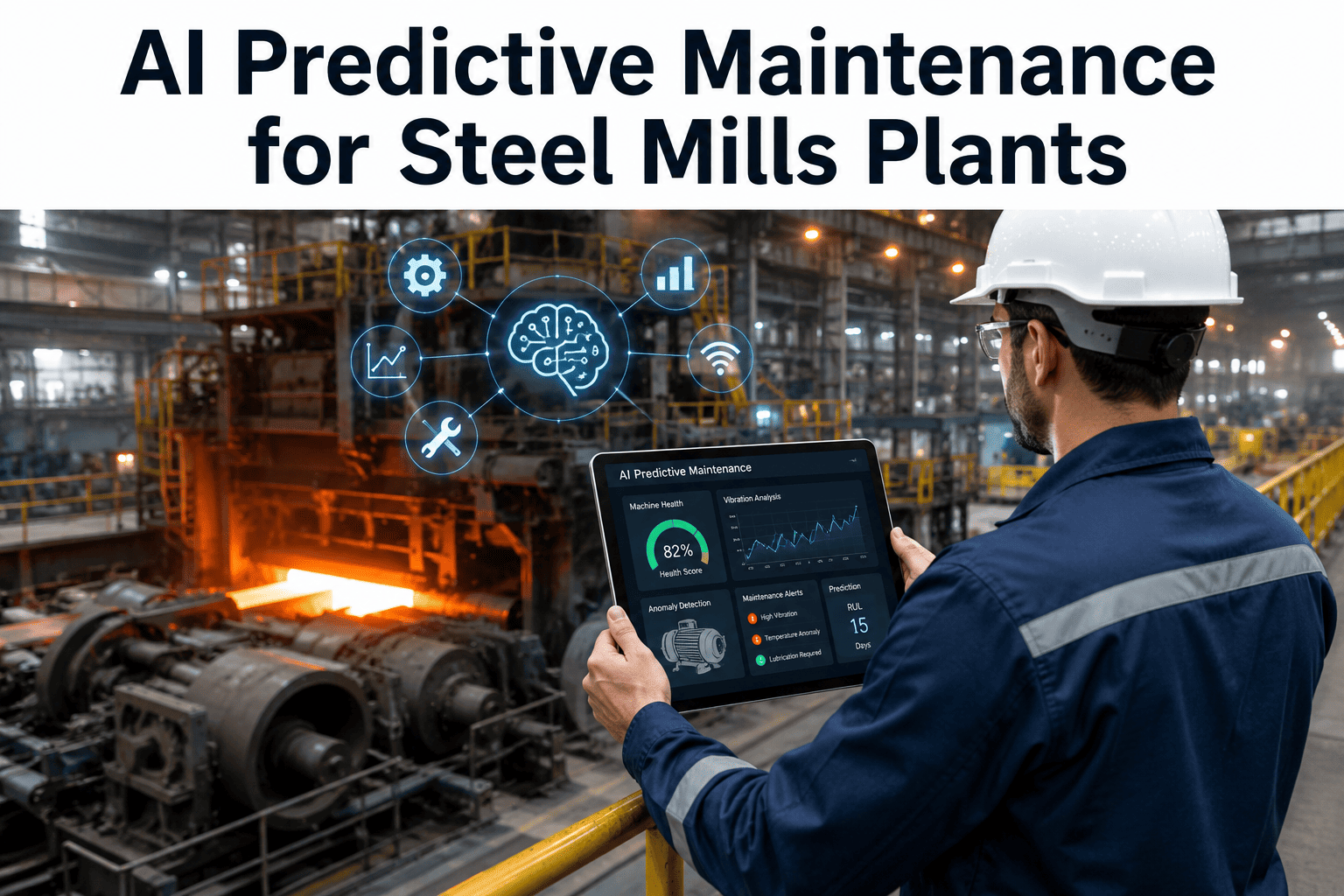
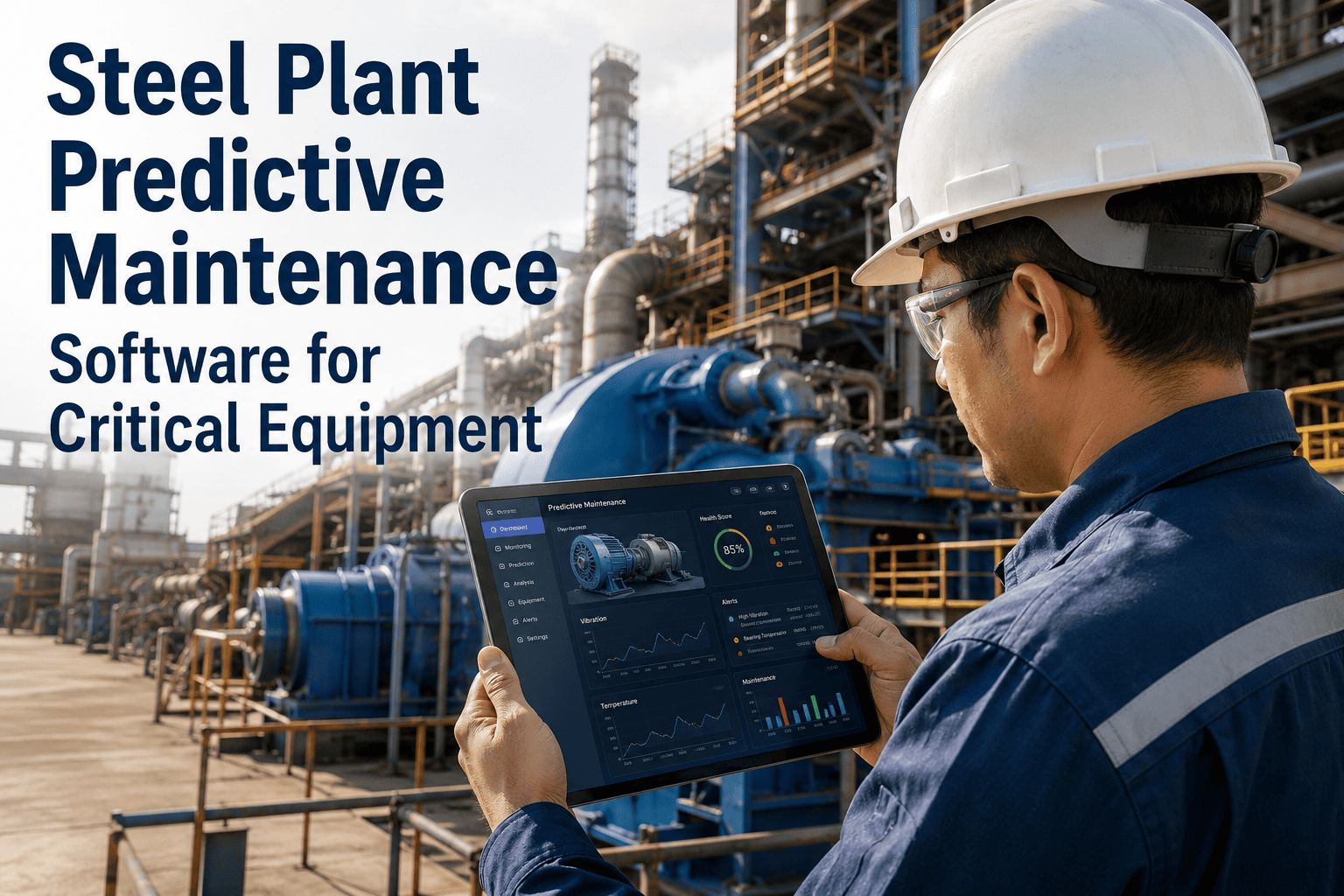
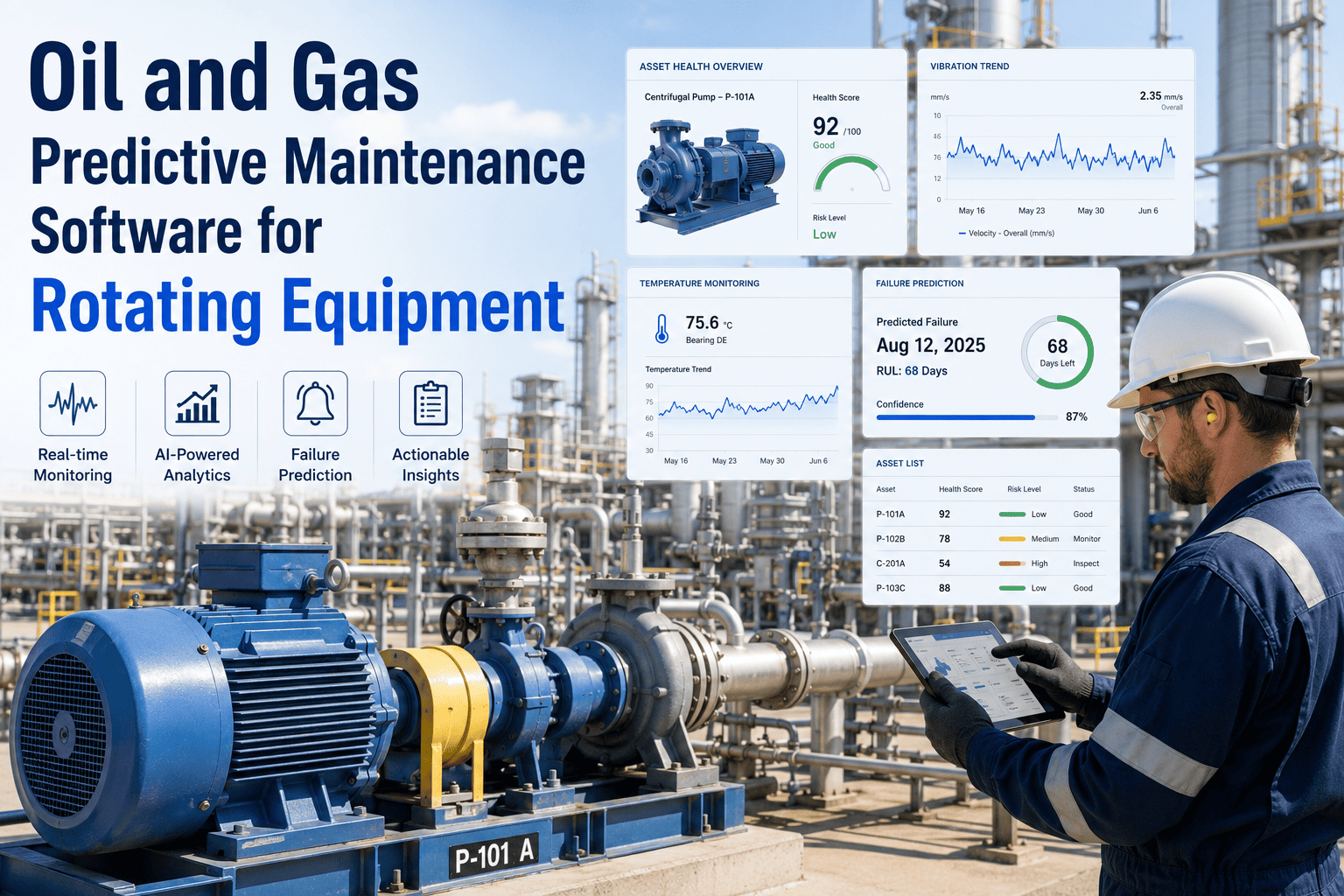
Steel manufacturing consumes up to 10% of global industrial electricity. Unplanned downtime at a single integrated steel plant costs $2–8 million per year. Yet less than 20% of the massive data generated by steel plants is used for decision-making. Digital twin technology is changing that equation. Tata Steel deployed 250+ digital twin models across 15 plants and saved $1.4 billion. McKinsey documents 30–50% reductions in unplanned downtime and 10–25% lower maintenance costs in capital-intensive process industries. In 2026, digital twins have moved from aerospace experiments into the blast furnaces, rolling mills, and converter shops where they deliver the highest ROI in all of heavy manufacturing. Here's how they work in steel — and how to implement one without a $10 million IoT project.
Steel Industry Digital Transformation
Digital Twins in Steel Manufacturing
Reduce energy costs by 12–20%, predict equipment failures weeks in advance, and optimize every ton of steel from furnace to finished coil.
$1.4B
Cumulative savings at Tata Steel from 250+ digital twin models
775%
ROI on digital investment over 5 years
30–50%
Reduction in unplanned downtime via digital twins
90%+
First-time success rate on process changes with virtual testing
What Is a Digital Twin for Steel Plants?
A digital twin is a real-time virtual replica of your physical steel plant — every blast furnace, converter, rolling mill, crane, and compressor mirrored in software with live data flowing from sensors, maintenance records, and production systems. Unlike static 3D models, a production-grade digital twin continuously ingests data, predicts outcomes, and recommends actions. Think of it as a living, breathing nervous system for your entire operation. Tata Steel calls theirs the Integrated Remote Operations Center (iROC) — a mission-control hub in Jamshedpur that monitors 15+ plants globally through digital twins with 10,000+ real-time data streams.
The 5 Layers of a Steel Plant Digital Twin
5
Decision Intelligence
Scenario modeling, what-if analysis, capital planning optimization, and autonomous scheduling based on predicted outcomes
4
Predictive Analytics
Failure probability scoring, remaining useful life estimation, energy consumption forecasting, and anomaly detection
3
Behavioral Baselines
Complete work order history, PM compliance, failure mode analysis, MTBF/MTTR calculations, and cost-per-asset lifecycle views
2
Real-Time Status
Current operating condition, sensor integration, inspection results, active work orders, and alarm states for every monitored asset
1
Asset Registry
Complete hierarchy of every plant asset — furnaces, cranes, mills, compressors — with criticality ratings and connected system maps
Where Digital Twins Deliver ROI in Steel: 5 Critical Applications
Every section of a steel plant — from raw material handling to finished product dispatch — generates optimization opportunities. Here are the five areas where digital twins deliver the fastest, most measurable returns in 2026.
The blast furnace is the heart — and the biggest energy consumer — of an integrated steel plant. Digital twins model the complex thermodynamic interactions between burden materials, hot blast, and slag chemistry in real time. Tata Steel's first digital twin pilot found an optimal strategy that cut coke rate by 2.5%, saving approximately ₹45 crore annually on a single furnace. Across their global operations, blast furnace optimization was the single largest contributor to their $1.4 billion savings, accounting for roughly $550 million through coke rate reduction alone.
2.5%
Coke Rate Reduction
$550M
Savings from BF Optimization
4–6%
Typical AI-Optimized Reduction
Rolling mills consume enormous energy and every parameter — rolling speed, reduction ratio, initial temperature, pass schedule — affects both product quality and energy consumption. Digital twins simulate different rolling configurations virtually, identifying the exact combination that minimizes energy per ton while maintaining metallurgical specifications. Steel plants using digital twins for rolling optimization report 12–20% energy cost reductions by eliminating "ghost energy" — power consumed when machines run at constant baselines instead of adapting to actual load conditions.
12–20%
Energy Cost Reduction
8–10%
Ghost Energy Eliminated
Real-time
Parameter Adaptation
Unplanned downtime in discrete manufacturing costs an average of $260,000 per hour, with heavy industrial sectors facing costs upward of $2 million per hour. Digital twins integrate vibration, temperature, pressure, and condition data from sensors across furnaces, cranes, mills, and compressors to predict equipment failures 2–4 weeks in advance. At Tata Steel, AI models within the digital twin predict failures early enough to schedule maintenance during planned downtimes, eliminating costly emergency shutdowns entirely.
2–4 wk
Early Failure Warning
22%
Downtime Reduction
10–25%
Maintenance Cost Cut
Converter (BOF) steelmaking involves ultra-high temperatures and harsh environments where personnel cannot directly monitor conditions. Digital twins model the smelting process in real time, predicting endpoint temperature and steel composition with high accuracy. This eliminates trial-and-error adjustments, reduces smelting costs, prevents material waste, and achieves over 90% first-time success rates on process changes. ArcelorMittal's AI-driven process optimization at their Eisenhüttenstadt plant improved the surface quality of automotive-grade steel by minimizing defects in real time.
90%+
First-Time Success Rate
20%
Trim Scrap Reduction
Virtual
Process Testing
Steel production accounts for roughly 7% of global CO2 emissions. Digital twins enable real-time energy monitoring across every process stage, identifying where energy is lost during liquid iron transport, where cooling systems waste power on non-hotspot areas, and where process gas recovery can be optimized. Tata Steel Nederland is using simulation-based digital twins to pursue CO2 reduction targets of 30–40% by 2030 and carbon neutrality by 2045. Their digital twin optimizes thermal process management across iron and steelmaking plants, reducing both energy costs and environmental impact simultaneously.
30–40%
CO2 Reduction Target
15–25%
Energy Savings
ESG
Compliance Enabled
Which Area of Your Steel Plant Has the Highest Digital Twin ROI?
Our steel industry specialists analyze your plant data, identify the highest-impact starting point, and map a phased digital twin roadmap — from blast furnace to rolling mill.
Case Study Snapshot: How Tata Steel Built a $1.4 Billion Digital Twin Program
Tata Steel's digital transformation is the most documented case of digital twin ROI in heavy industry. Their journey proves that you don't need to digitalize everything on day one — you start small, prove value, and scale fast.
2016
Single Blast Furnace Pilot
First digital twin deployed on one blast furnace at Jamshedpur. Found optimal coke rate strategy saving ₹45 crore annually. Proof of concept funded the entire scale-up.
2017
Plant-Wide Expansion
Extended digital twins across the Jamshedpur plant. AI models deployed for predictive maintenance, quality optimization, and energy management. iROC established as centralized command center.
2018–19
Global Rollout
Extended to UK (Port Talbot), Netherlands (IJmuiden), and Thailand operations. 150+ models deployed. Predictive maintenance reduced downtime 22%. Energy optimization saved $180 million. Cumulative savings: $500 million.
2020
Enterprise Scale
250+ digital twin models live across 15 plants globally. iROC evolved into 24/7 command center. 90%+ first-time success rate. Cumulative savings crossed $1 billion. Maintained production through COVID-19 via remote optimization.
2020+
$1.4B Total Savings Announced
775% ROI on ₹1,200 crore digital investment. Recognized as World Economic Forum "Global Lighthouse" for smart manufacturing. Became the global benchmark for Industry 4.0 in steel.
Key Takeaway
Tata Steel's technology deployed in 12–18 months. But culture transformation took 3–4 years. Operators initially distrusted AI recommendations. The solution: always show the reasoning behind every recommendation, allow human override, and prove accuracy over months. The trust was earned, not imposed.
Implementation Roadmap: Your Steel Plant Digital Twin in 4 Phases
You don't need $10 million and thousands of new sensors. Most steel plants achieve 60–70% of total digital twin benefits from existing CMMS data alone. Here's how to start.
Digital Asset Registry
Catalog every asset: furnaces, cranes, mills, compressors, electrical systems, safety devices. Build a complete hierarchy with parent-child relationships, criticality ratings, and connected system maps. Import existing maintenance records and documentation. Deliverable: searchable digital registry of 100% of plant assets.
Behavioral Baselines & Trending
Connect every work order, PM task, inspection, and failure event to its corresponding asset twin. Establish measurable baselines for critical assets: energy consumption, temperature profiles, vibration signatures, thickness measurements. Begin trending parameters against maintenance events. Deliverable: trending dashboards for top 50 critical assets.
Predictive Analytics Activation
With 6+ months of structured data, activate failure probability scoring and remaining useful life estimation. Pattern recognition across maintenance history predicts which assets are approaching failure, enabling proactive scheduling. Deliverable: risk-ranked asset priority dashboard with 60–90 day failure warnings.
Decision Intelligence & Optimization
Use accumulated digital twin data for strategic decisions: optimal replacement timing, capital project justification, energy optimization prioritization, and staffing optimization. Run what-if scenarios before committing resources. Add IoT sensors selectively to enhance the twin for highest-value assets. Deliverable: full decision-support platform with scenario modeling.
Documented ROI: The Numbers Behind Steel Digital Twins
30–50%
Reduction in unplanned downtime — worth $2–8M/year for a mid-sized steel plant
McKinsey
10–25%
Lower maintenance costs through optimized scheduling and reduced emergency repairs
McKinsey
20–40%
Extended asset life through condition-based replacement timing
McKinsey
15–25%
Energy savings from maintenance-performance correlation analysis
Industry Benchmarks
233%
ROI over 5 years from digital twin deployment in metalworking operations
Frontiers Research, 2025
64%
Of industrial organizations report positive ROI from AI investments within 12 months
Industry Surveys 2026
The Cost Myth
Most steel plants believe building a digital twin requires a $10 million IoT project with thousands of sensors and a team of data scientists. The reality: your CMMS already contains the foundation — asset hierarchies, maintenance histories, failure patterns, inspection records, and performance baselines. In 2026, the hardware-to-software spend ratio has shifted from 60/40 to 40/60 as facilities realize that existing SCADA data, when analyzed correctly, is often sufficient for high-level insights. Starting cost for a first digital twin deployment: $50,000–$200,000 depending on existing data infrastructure.
Frequently Asked Questions
Do we need thousands of new sensors to build a digital twin?
No. Most steel plants achieve 60–70% of total digital twin benefits from existing CMMS data alone. Your maintenance histories, failure patterns, inspection records, and performance baselines already form the foundation. IoT sensors can enhance the twin later, but they're not required to start realizing value. For assets with existing maintenance history, predictive value can begin within 2–3 months.
How long before we see ROI from a steel plant digital twin?
64% of industrial organizations report positive ROI within 12 months. Tata Steel's first pilot on a single blast furnace delivered savings of ₹45 crore annually. For assets starting with no digital history, 6–9 months of structured data collection provides enough behavioral patterns for meaningful failure prediction. The quality of predictions improves continuously as more data accumulates.
What's the difference between a digital twin and a 3D model?
A 3D model is a static visual representation. A production-grade digital twin is a data architecture that mirrors every physical asset with a digital counterpart containing real-time status, complete history, predictive analytics, and decision-support intelligence. It continuously ingests live data, learns from outcomes, and gets smarter with every operational cycle.
Can a digital twin help with decarbonization targets?
Yes — this is one of the highest-value applications. Digital twins provide real-time insights into energy consumption and environmental impact across every process stage. Tata Steel Nederland is using digital twins to pursue CO2 reduction targets of 30–40% by 2030. By identifying where energy is lost, where cooling systems waste power, and where process gas recovery can be optimized, digital twins make decarbonization measurable and actionable.
How does this work with our existing SCADA and control systems?
Digital twin platforms layer on top of existing PLC, SCADA, DCS, and MES infrastructure through standard protocols like OPC-UA and MQTT. You don't need to replace your control systems. The most successful deployments start where data already exists — sensor feeds, maintenance logs, production schedules — and build intelligence on that foundation.
Build Your Steel Plant's Digital Twin
iFactory helps steel manufacturers deploy digital twin solutions that predict failures, optimize energy consumption, and reduce costs — starting with the data you already have, delivering ROI in months, not years.