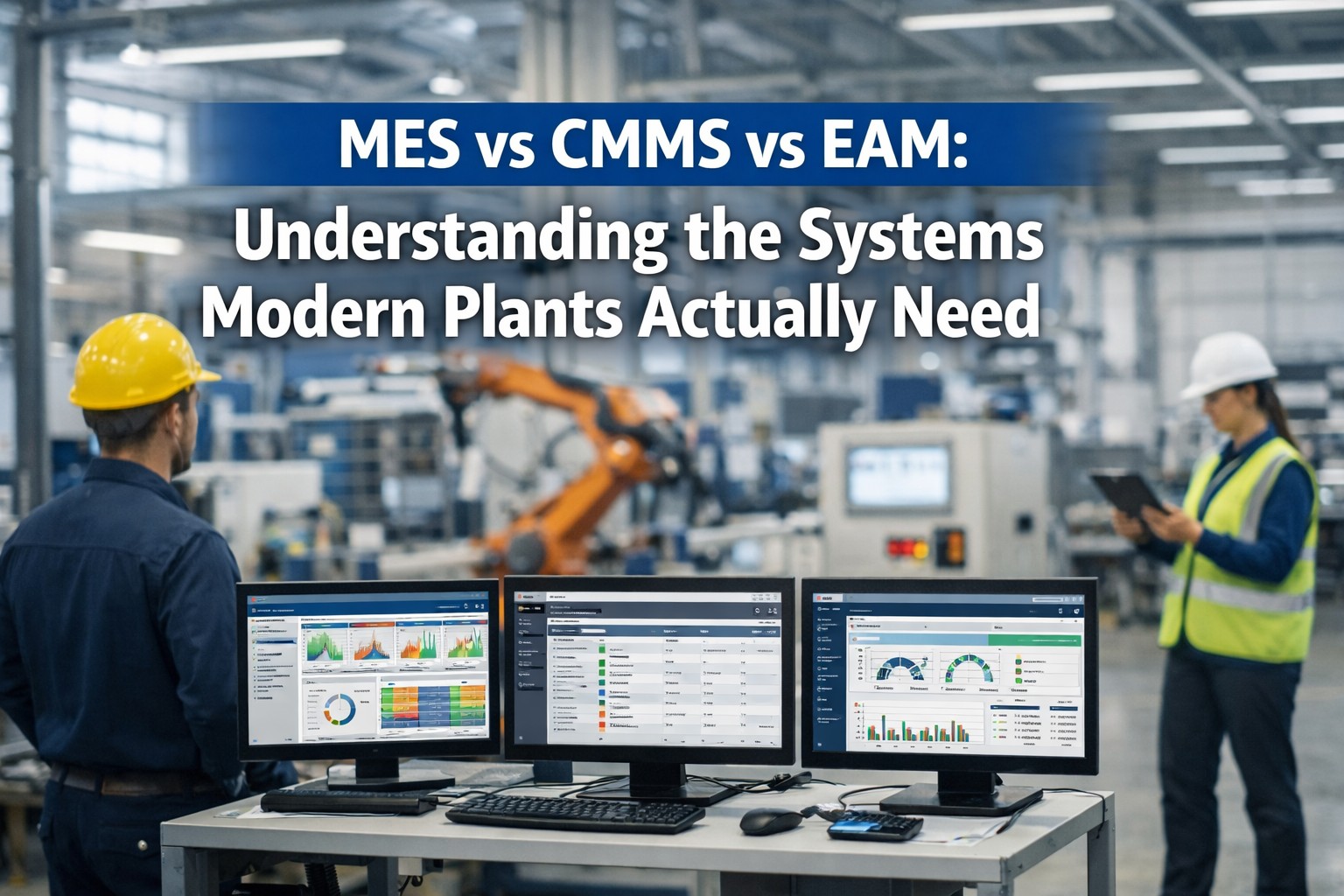
ERP vs MES vs CMMS: Key Differences & What Manufacturing Leaders Should Choose in 2026
By Riley Quinn on February 13, 2026
Your CFO wants an ERP. Your production manager is pushing for an MES. Your maintenance team swears by CMMS. They're all right—and they're all talking about completely different problems. Here's the thing: these three systems aren't competitors. They are layers. Understanding which layer you need (and when you need all three) is the difference between a $50K software investment that transforms your plant—and a $500K implementation that nobody uses.
$17B
MES Market 2025
54%
Manufacturers with MES-ERP Integration
60%
Report $250K+ Annual Downtime Cost
The 30-Second Breakdown
Before we dive deep, here's the fundamental difference between these three systems:
ERP
Enterprise Resource Planning
What does it answer?
"How much money did we make?"
Focus
Dollars & Days
Primary Users
CFO, Purchasing, HR, Executives
MES
Manufacturing Execution System
What does it answer?
"How well are we producing?"
Focus
Seconds & Cycles
Primary Users
Production Manager, Operators, Quality
CMMS
Computerized Maintenance Management
What does it answer?
"Is our equipment reliable?"
Focus
Assets & Uptime
Primary Users
Maintenance Manager, Technicians
What Each System Actually Does
Let's break down the core functions of each system so you can see where they overlap—and where they don't.
Your choice depends on your biggest pain point. Here's a quick decision guide:
If your biggest problem is...
"We don't know our true costs or margins"
Start with ERP
If your biggest problem is...
"We can't see what's happening on the floor in real-time"
Start with MES
If your biggest problem is...
"Equipment keeps breaking down unexpectedly"
Start with CMMS
Dealing with multiple problems? Talk to our team about integrated solutions.
The 2026 Trend: Integrated Platforms
Smart manufacturers are ditching the 3-system approach. iFactory combines MES and CMMS in one AI-powered platform—real-time OEE tracking triggered by maintenance data, all connected to your ERP.
"In 2025, the smartest manufacturers are simplifying. Instead of buying a heavy MES and a separate CMMS, they're choosing unified platforms. You pay for one system, not two. Maintenance is triggered by production data instantly. Your IT team only manages one integration to the ERP."
— Manufacturing Tech Stack Research, 2025
Ready to Simplify Your Tech Stack?
Stop managing three disconnected systems. iFactory's unified MES + CMMS platform integrates with your existing ERP to give you complete visibility—from the shop floor to the top floor.
What's the main difference between ERP, MES, and CMMS?
ERP manages enterprise-wide business processes (finance, HR, supply chain) and operates in "dollars and days." MES manages real-time shop floor production (OEE, quality, cycle times) and operates in "seconds and cycles." CMMS manages equipment maintenance (work orders, PMs, spare parts) and focuses on asset reliability and uptime.
Do I need all three systems?
It depends on your size and complexity. Most mid-sized manufacturers need ERP for financials, but the trend in 2026 is toward integrated MES+CMMS platforms that combine production and maintenance management in one system—reducing cost, complexity, and integration headaches.
Can MES and CMMS replace ERP?
No. ERP handles critical business functions (general ledger, accounts payable/receivable, payroll, purchasing) that MES and CMMS don't address. However, MES and CMMS can significantly reduce your reliance on ERP for shop floor and maintenance operations.
What's the typical ROI timeline for these systems?
ERP implementations typically take 12-24 months to see full ROI due to complexity. Standalone CMMS can show ROI in 3-6 months through reduced downtime. Integrated MES+CMMS platforms often deliver measurable results in 2-4 months through improved OEE and reduced maintenance costs.
How do these systems integrate with each other?
Modern platforms use APIs and standard protocols to exchange data. Typically, ERP sends orders, schedules, and BOMs down to MES/CMMS, while production actuals, costs, and performance data flow back up to ERP. The best results come when MES and CMMS share a unified database—so maintenance triggers are based on real-time production data.