MES Implementation: 12-Month Roadmap From RFP to Go-Live
By Daniel Brooks on May 26, 2026
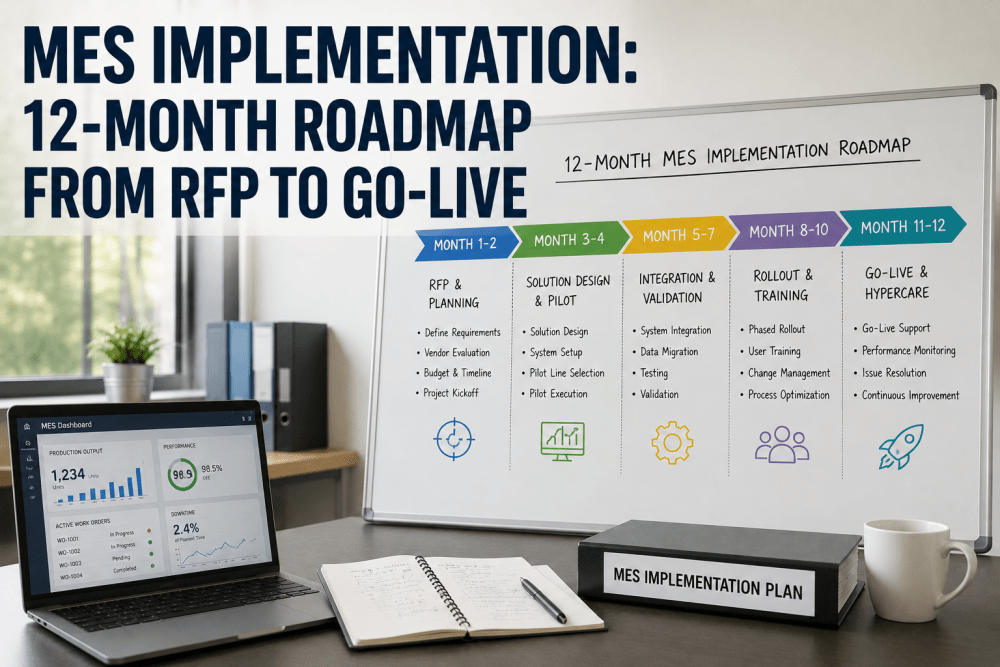
Manufacturing Execution System (MES) projects fail at an alarming rate — not because the software is bad, but because the roadmap is wrong. A well-structured 12-month MES implementation, broken into RFP, design, pilot, rollout, and go-live phases, consistently delivers measurable OEE gains, traceability, and shop-floor visibility. This guide walks U.S. manufacturing leaders through a proven month-by-month plan, the decisions that matter most at each gate, and how iFactory's MES Workflow keeps your project on schedule from kickoff to hyper-care.
12-Month MES Roadmap
MES Implementation: From RFP to Go-Live
A Proven Month-by-Month Roadmap for U.S. Manufacturers
Compressed 90-day MES rollouts make headlines, but for plants with multiple production lines, ERP integrations, and shift-based workforces, a 12-month plan is the realistic sweet spot. It gives discovery enough oxygen, isolates pilot risk on one line, and leaves room for the testing and training that determine whether operators actually use the system after go-live. Skipping phases is the most common reason MES projects stall — one mid-size pharmaceutical manufacturer reportedly had to reset their entire implementation after three months because of inadequate scoping, costing over $400,000 in wasted effort.
12 mo
Realistic Timeline
From kickoff to plant-wide go-live for single-site deployments
20%
Budget for Change Mgmt
Proven allocation to drive 90%+ user adoption
4–8 wks
Pilot Validation Window
Time on one line to prove cycle-time accuracy before scaling
3
Critical Go-Live Gates
120-day, 90-day, and 30-day readiness assessments
The 12-Month Roadmap, Month by Month
Each phase below has a clear deliverable, an owner, and a go/no-go decision point. Treat these as gates — never advance to the next phase until the current one is signed off by both operations and IT.
01
Months 1–2
Discovery & Scoping
Define the business case, baseline current-state KPIs (OEE, scrap, downtime), and lock scope. Assemble a cross-functional team — operations, quality, IT, OT, validation, and finance.
Key Deliverables
Project charter & success metrics
Current-state process maps
Cross-functional RACI
Baseline KPI snapshot
Gate: Sponsor signs off on scope and budget
02
Month 3
RFP & Vendor Selection
Issue a structured RFP designed to reveal real project risk — not just feature checklists. Score vendors on quantitative answers (integration person-days, latency, reference customers in your industry), not marketing prose.
Key Deliverables
RFP issued to 3–5 shortlisted vendors
Scripted vendor demos with your data
Reference calls with production customers
Signed Statement of Work (SOW)
Gate: Vendor contracted, SOW countersigned
03
Months 4–5
Design & Configuration
Translate process maps into MES configuration. Define work orders, routings, BOMs, quality checkpoints, and electronic batch records. Decide upfront what is configuration vs. custom code — the latter inflates timelines.
Key Deliverables
Functional design specification
Integration blueprint (ERP, PLC, SCADA, LIMS)
Master data cleanup plan
Test scripts drafted
Gate: Design review approved by operations + IT
04
Months 6–7
Build & Integration
Stand up the MES in a dev environment. Build interfaces to ERP (work orders down, confirmations up), SCADA/PLC (machine data), and LIMS or QMS where applicable. Run unit tests and the first round of integration testing.
Key Deliverables
Configured MES in test environment
ERP/PLC interfaces operational
Round 1 integration testing complete
Defect log with severity ratings
Gate: All P1/P2 defects closed
05
Month 8
Pilot on One Line
Deploy to a single production line — ideally your bottleneck. Run for 4–8 weeks in parallel with existing paper or legacy systems. Validate cycle-time accuracy, OEE calculations, and operator workflow before scaling anywhere else.
Key Deliverables
Pilot line live with full MES
Operator training certified
Data accuracy validated against manual counts
Go/no-go report for rollout
Gate: Pilot KPIs hit; sponsor approves scale-up
06
Months 9–10
UAT & Training
Full user acceptance testing across all in-scope lines. Role-based training for operators, supervisors, schedulers, quality, and maintenance. Identify and certify super-users on every shift — they become your first line of support after go-live.
Key Deliverables
UAT sign-off by process owners
Super-users certified on every shift
SOPs and quick-reference guides published
120-day & 90-day readiness assessments passed
Gate: 90-day Go-Live Readiness Assessment
07
Month 11
Cutover & Go-Live
Schedule the cutover for a low-volume weekend or planned shutdown. Run a 30-day readiness checklist. Deploy to remaining lines in a controlled wave. Day-one support team on the floor across all shifts.
Key Deliverables
Plant-wide MES live
Legacy systems decommissioned or sunset
Day-one support model active
30-day GLRA signed off
Gate: Go-live declared by steering committee
08
Month 12
Hyper-Care & Stabilization
30 days of dedicated hyper-care — daily standups, rapid defect triage, additional refresher training. Measure actual KPIs against the baseline you captured in Month 1. Transition from project mode to steady-state operations.
Key Deliverables
Post-go-live KPI report vs. baseline
Lessons-learned document
Transition to managed support
Roadmap for Phase 2 modules
Gate: Project closure, value realization confirmed
Planning Your MES Project?
iFactory's MES Workflow ships with pre-built ERP, PLC, and SCADA connectors — cutting integration timelines by weeks. Talk to our team about a tailored 12-month plan for your plant.
Most MES RFPs collect feature checklists that all vendors can claim. The RFPs that actually de-risk your project ask quantitative questions vendors can't spin. Below is a comparison of weak vs. strong RFP questions — use the right column when you draft yours.
Topic
Weak RFP Question
Strong RFP Question
References
"Do you have customers in our industry?"
"List customers in [industry] with [plant size] in production 24+ months."
Integration
"Do you integrate with SAP?"
"Professional services effort in person-days for SAP S/4HANA integration."
Performance
"Is the system fast?"
"Latency in seconds from shop-floor event to dashboard."
Pilot Model
"Can you do a pilot?"
"What is the standard pilot scope, milestones, and acceptance criteria?"
Security
"Are you secure?"
"Provide SOC 2 / ISO 27001 evidence and penetration-test schedule."
Exit
"Can we get our data out?"
"Document data export format, notice period, and transition support cost."
Pilot Strategy: The Single Decision That De-Risks Everything
The pilot is where MES projects either earn trust or lose it. Pick the wrong line and you'll either fail visibly or succeed in a way that doesn't translate to the rest of the plant. The right pilot is your bottleneck or highest-pain line — somewhere a win is meaningful, but small enough to contain risk.
Pick the Right Line
Choose your bottleneck or highest-scrap line. A win here justifies plant-wide rollout. Avoid lines with major equipment overhauls in flight.
Run 4–8 Weeks
Long enough to span every product mix and shift pattern. Run parallel with existing systems so you can validate counts and cycle times.
Validate Real KPIs
Compare MES-reported OEE, scrap, and downtime against manual measurement. If accuracy is <95%, fix the data layer before scaling.
Train Super-Users
Identify 2–3 operators per shift who become your internal champions. They train peers and triage day-one issues faster than any vendor hotline.
Integration Architecture: Where Most Projects Stall
Integration is the single largest source of timeline slip in MES projects. The math is simple: every interface adds person-days, every custom field adds testing, and every vendor handoff adds risk. Plan your integration architecture in Month 4 — don't discover it in Month 9.
Business Layer
ERP
SAP S/4HANA · Oracle · Microsoft Dynamics
Work orders, BOMs, material masters down · Confirmations, scrap, labor up
Execution Layer
MES Workflow
iFactory MES · electronic work instructions · quality · OEE
Single source of truth for production execution and traceability
Operations Layer
PLC / SCADA / Edge
OPC-UA · MQTT · Modbus · sensor & vision feeds
Machine state, cycle times, alarms, quality data up to MES
Common Pitfalls and How to Avoid Them
Across hundreds of MES rollouts documented in industry reports, the same five mistakes show up again and again. The good news: every one is preventable with a roadmap that explicitly mitigates it. If you'd like a working session to pressure-test your plan against these pitfalls, Book a Demo with our team.
01
Fuzzy Scope
"We'll figure it out as we go." Costs months of rework.
Fix: Lock scope in Month 2 with a written charter and a change-control process.
02
Under-Investing in Change Management
Great software, low adoption, no ROI.
Fix: Allocate 15–20% of total budget to communications, training, and super-users.
03
Dirty Master Data
BOMs, routings, and material masters that don't match reality.
Fix: Run a data cleanup workstream in parallel from Month 3. Don't load garbage into MES.
04
Big-Bang Go-Live
Every line at once = every problem at once.
Fix: Pilot one line, then wave rollouts of 2–3 lines at a time.
05
No Hyper-Care Plan
Vendor disappears after go-live, issues linger, users revert to paper.
Fix: Contract 30 days of dedicated hyper-care into the SOW from day one.
Expert Review: What Plant Leaders Should Insist On
Expert Review
Three Non-Negotiables From Industry Practitioners
Consultants who have run dozens of MES rollouts consistently call out three things plant leaders should insist on — regardless of vendor or industry:
1
A Written Pilot Acceptance Criteria
Before the pilot starts, agree in writing on what "success" looks like: cycle-time accuracy threshold, operator adoption rate, defect close-out targets. Without this, the pilot becomes a moving target.
2
Vendor-Provided Integration References
For every interface (ERP, PLC, LIMS), demand a reference customer who has been in production 12+ months. Theoretical capability is not the same as a working interface at scale.
3
Internal Ownership From Day One
A named internal product owner — not the vendor PM — should drive the project. Plants that delegate ownership entirely to integrators tend to end up with systems they can't evolve after go-live.
"The plants that succeed treat MES as an operations program, not an IT project. Operations owns the outcome. IT enables it."
How iFactory's MES Workflow Accelerates Your Roadmap
iFactory was built to compress MES timelines without cutting corners. Pre-built connectors, configurable workflows, and a mobile-first operator interface mean less custom code, faster pilots, and adoption from day one. Book a Demo to see the platform mapped to your specific lines and ERP.
Work orders, routings, quality checkpoints set up through configuration, not custom development
Mobile-First
Operator Experience
Tablet- and scanner-friendly interface that operators actually want to use on the floor
Live OEE
From Day One
Real-time downtime, scrap, and throughput dashboards tied to your existing machine data
Frequently Asked Questions
QHow long does a typical MES implementation actually take?
For a single-site deployment covering core MES modules (work orders, OEE, quality, traceability), 9–12 months is realistic. Accelerated 90-day rollouts are possible for narrow scopes — usually one line and one module like downtime tracking. Multi-site or heavily regulated implementations (pharma, aerospace) commonly stretch to 18–24 months once validation is included.
QWhat's the difference between an MES pilot and a proof of concept?
A PoC validates whether the software can do something in principle — often on a vendor's demo environment. A pilot deploys the configured system on a real production line with real operators, real data, and real KPIs. Skip the PoC if you've seen good production references; never skip the pilot.
QHow much budget should we allocate to change management and training?
Industry practitioners consistently recommend 15–20% of total project budget. One West Coast biopharma reportedly hit 92% user satisfaction within three months of go-live by allocating 20% to change management. Under-investing here is the most common reason for low adoption after go-live.
QShould MES come before or after ERP modernization?
It depends on your bottleneck. If shop-floor visibility is your pain (you find out about problems the next day), MES-first makes sense — start with a pilot on your bottleneck line. If your back-office processes are broken (AR, costing, planning), ERP-first stabilizes the business while you plan MES for phase two. Running both in parallel is rarely a good idea unless you have deep program management capacity.
QHow does iFactory shorten our MES implementation timeline?
iFactory's MES Workflow ships with pre-built connectors for major ERP, PLC, and SCADA systems, plus configurable templates for work orders, OEE, and quality workflows. That removes weeks of custom integration and configuration work — the two areas where MES projects most commonly slip. Our team also provides a structured 12-month roadmap and hyper-care model so go-live is the start of value, not the end of a project.
Ready to Map Your 12-Month MES Roadmap?
Book a 30-minute working session with iFactory. We'll review your current state, identify your best pilot line, and walk you through a tailored month-by-month plan for your plant.