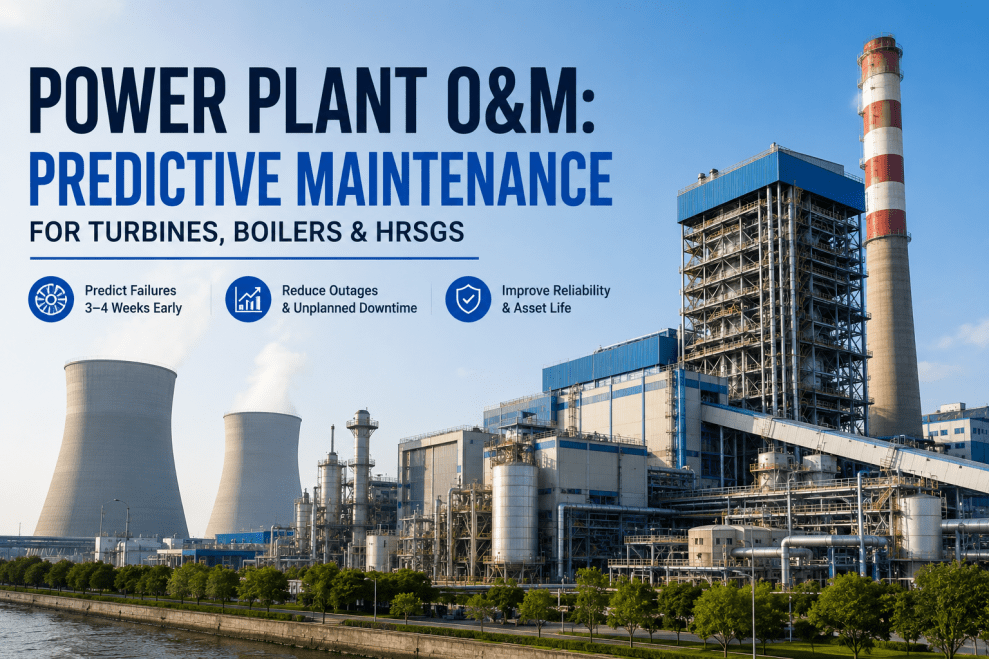
At 2:45 AM on a January night in 2023, a boiler feed pump (BFP) at NTPC's Dadri Super Thermal Power Station began showing unusual vibration patterns. The shift engineer noticed minor fluctuations but nothing alarming — vibration was still within acceptable limits. The AI system, however, had been tracking subtle changes for 18 days: bearing temperature rising 0.3°C weekly, ultrasonic signatures indicating early-stage cavitation, oil debris particle count increasing 15% over baseline. At 3:12 AM, the AI sent an urgent alert: "BFP-2 catastrophic failure predicted in 72–96 hours." The engineer was skeptical — the pump seemed fine. But NTPC's protocol mandated shutdown for AI-flagged critical alerts. They replaced the bearing during the next planned window, 68 hours later. Post-inspection revealed the bearing race was cracked — catastrophic failure would have occurred within 24 more hours of operation. The AI saved ₹4.2 crores in pump replacement, forced outage costs, and generation loss. This is the story of how India's largest power generator deployed AI predictive maintenance across 73 GW of generation capacity, preventing failures and saving ₹850+ crores annually.
NTPC's AI Transformation — How India's Largest Power Generator Uses Predictive Maintenance
₹850+ Crores annual savings, 35% unplanned outage reduction, and 88% prediction accuracy across 70+ power stations — the production blueprint for AI-driven plant reliability.
NTPC at a Glance — India's Power Backbone
NTPC Limited operates 70+ power stations contributing roughly 24% of India's installed generation capacity. With an average fleet age above 20 years and forced-outage costs running ₹5–8 crores per day for a 500 MW unit, predictive maintenance is not a productivity project — it is a grid-stability mandate. Since the first AI deployments in 2018, NTPC has shifted from reactive repair to continuous condition intelligence across turbines, pumps, generators, boilers, mills, and transformers.
Total Capacity
Largest generator in India; 24% of national installed capacity across coal, gas, hydro, solar, and wind.
Power Stations
Thermal, hydro, renewable, and joint-venture stations spread across every major Indian state.
Turbines Monitored
Steam and gas turbines instrumented with vibration, thermal, oil, and acoustic AI sensors 24×7.
Critical Pumps
BFPs, condensate pumps, and cooling water pumps tracked with multi-sensor predictive models.
Why predictive maintenance matters for NTPC
A single forced outage on a 500 MW unit costs ₹5–8 crores per day once generation loss, grid penalty, and replacement-power purchases are combined. A single turbine catastrophic failure can black out multiple states, and the fleet's average age means failure rates are rising — not falling. AI shifts failures from "unexpected emergency" to "scheduled intervention 2–4 weeks ahead," letting outages move into off-peak windows and protecting both reliability and revenue.
Get NTPC-style predictive maintenance for your power plant
We will design an AI monitoring blueprint for your critical equipment — turbines, pumps, boilers, transformers — with sensor placement, model selection, alert thresholds, and projected savings.
- Equipment criticality analysis
- Sensor deployment plan
- AI model selection (vibration / thermal / oil / acoustic)
- Alert threshold configuration
- Expected annual savings calculation
- 12–18 month implementation roadmap
Six AI Applications Across NTPC's Fleet
NTPC's predictive program is not a single dashboard — it is six co-ordinated models, each tuned to a specific failure physics. Combined, they protect roughly ₹850+ crores of annual value across the 70+ station fleet.
Turbine Vibration Monitoring
₹280 Cr / year- 180+ steam and gas turbines monitored 24×7 via triaxial accelerometers at every bearing housing
- FFT and order-tracking analysis detects bearing defects 3–4 weeks ahead of failure
- Unbalance, misalignment, rub, and blade damage signatures classified automatically
- Prevented 24 major turbine failures in FY 2022–23 across the fleet
Pump Cavitation Detection
₹180 Cr / year- 2,500+ BFPs, condensate, and cooling water pumps under continuous monitoring
- Ultrasonic sensors catch cavitation 20–100 kHz signatures weeks before they are audible
- AI correlates pressure, flow, and vibration to confirm impeller wear progression
- Fleet pump failures reduced 42% — from 127 to 74 events per year
Boiler Tube Leakage Prediction
₹150 Cr / year- Continuous thermal imaging and acoustic emission monitoring of waterwall and superheater tubes
- Hotspot detection identifies thinning and creep cracking 10–15 days ahead of leakage
- Repairs scheduled inside planned outages, not as emergency shutdowns
- 85% of emergency boiler trips eliminated since deployment
Generator Stator Winding Health
₹120 Cr / year- Partial discharge sensors detect insulation degradation 4–6 weeks ahead of breakdown
- Distributed temperature sensing identifies winding hotspots and cooling deficits
- Prevented 8 generator rewinding emergencies — each saves roughly ₹15 crores
- Equipment service life extended 15–20% through early-stage intervention
Coal Mill Performance Optimisation
₹80 Cr / year- Vibration and motor current signature analysis flag liner and ball-charge wear
- AI optimises classifier vane angle and grinding pressure for fineness consistency
- Mill downtime cut 28% across fleet — meaningful for unit heat-rate stability
- Better combustion translates to lower unburnt carbon and improved efficiency
Transformer Oil Analysis (DGA)
₹40 Cr / year- Online dissolved gas analysis automated through AI ratio interpretation (Duval, Rogers, IEC)
- Detects arcing, thermal faults, and cellulose breakdown 6–8 weeks before incident
- Prevented 12 major transformer failures averaging ₹3–5 crores each
- Transformer maintenance spend reduced 35% through condition-based scheduling
Turbine Monitoring Deep Dive — Six Signals Fused Into One Verdict
A single 500 MW steam turbine costs ₹180–250 crores to replace and triggers 4–6 weeks of forced outage when it fails catastrophically. NTPC protects each unit by fusing six independent sensing streams into one degradation model — no single signal can be ignored, and no single false alarm can trigger a shutdown.
Vibration Analysis
Triaxial accelerometers at 8–12 points per turbine. FFT analysis identifies bearing defect frequencies (BPFO, BPFI, BSF, FTF), shaft misalignment, and blade cracks. AI learns each turbine's unique vibration fingerprint and flags deviations from 0.5 mm/s upward.
Thermal Monitoring
Infrared cameras paired with PT100 RTDs track bearing temperatures. Sudden +5°C spike signals imminent failure; gradual +15°C drift over three weeks signals progressive degradation. AI correlates thermal data with vibration for root-cause identification, not just anomaly detection.
Oil Analysis
Automated particle counters detect metal debris from bearing wear in real time. Viscosity and dielectric sensors track lubricant degradation. Oil data fused with vibration produces precise prognosis — not "something is wrong" but "LP bearing #3 race defect, 18 days to failure."
Electrical Signature (MCSA)
Motor current signature analysis detects rotor bar cracks, air-gap eccentricity, and stator faults that vibration alone cannot see. MCSA catches an estimated 15–20% of failures the mechanical sensors miss — particularly slow-developing rotor cage issues.
Acoustic Monitoring
Ultrasonic sensors detect steam leaks, valve seat problems, and stress-wave emissions from cracking. AI distinguishes normal operational sounds from anomalies. Identified 47 steam leaks early in FY 2022–23, each representing ₹2–5 lakh per month of energy loss if undetected.
Performance Trending
AI tracks turbine heat rate, stage efficiency, and exhaust enthalpy over time. Gradual degradation indicates fouling, blade erosion, or seal wear. Models recommend the optimal water-wash, blade-cleaning, or overhaul timing to maximise availability without sacrificing efficiency.
Pump Cavitation Detection — Saving ₹180 Crores Annually
Cavitation is the silent killer of power-plant pumps. Vapour bubbles form in low-pressure zones at the impeller eye, then collapse violently — eroding metal, pitting surfaces, and ultimately destroying the pump. Traditional condition monitoring detects cavitation only once it has become severe enough to vibrate or sound. AI catches it weeks earlier through ultrasonic and pressure-fluctuation signatures.
Why cavitation is so costly
A BFP failure forces 4–8 days of unit outage during replacement — ₹3–5 crores of generation loss plus the pump itself. Condensate pump failures trip the unit. Cooling water pump losses cause turbine trips. NTPC operates 2,500+ critical pumps; even a 2% annual failure rate destroys ₹120–180 crores.
How NTPC's AI catches it early
Multi-sensor fusion: ultrasonic sensors detect high-frequency cavitation noise (20–100 kHz), vibration sensors track impeller degradation, pressure transducers identify NPSH violations, and flow sensors validate against the pump curve. No single sensor triggers the alert — the pattern across all four does.
Real example — Dadri BFP-2
January 2023. AI alert: "BFP-2 early-stage cavitation detected; impeller failure predicted in 18–22 days." Action: replacement scheduled in the next weekend window, 68 hours later. Post-inspection confirmed impeller pitting and a cracked bearing race — failure was within 24 hours of operation.
Fleet-wide impact
Before AI (FY 2017–18): 127 pump failures fleet-wide, 89% unplanned, average 5.2 days of downtime each. After AI (FY 2022–23): 74 pump failures (42% reduction), 68% now planned interventions, average 1.8 days of downtime. The annual saving — eliminated emergency repairs plus reduced downtime — is approximately ₹180 crores.
See cavitation detection AI in action
Watch a live demonstration of ultrasonic cavitation monitoring and AI prediction modelled on NTPC's deployment — the same subtle signatures detected 2–3 weeks before any operator could hear them.
Case Study — Dadri Super Thermal Power Station
1,820 MW facility, 4 units × 490 MW, 180+ pieces of monitored equipment across the boiler island and turbine hall. Twenty-four months of AI predictive maintenance, audited against a clean FY 2019–20 baseline.
| Metric | Before AI (FY 2019–20) | After AI (FY 2021–22) | Change |
|---|---|---|---|
| Unplanned outages | 18 incidents | 12 incidents | −33% |
| Average outage duration | 4.8 days | 2.1 days | −56% |
| Plant availability | 92.3% | 95.8% | +3.5 pp |
| Maintenance spend | ₹65 Cr | ₹48 Cr | −26% |
| Major failures prevented | Reactive only | 11 prevented | — |
| Operator action rate on AI alerts | 40% (Month 1) | 85% (Month 12+) | Trust built |
What the 11 prevented failures looked like
Three turbine bearing failures (~₹15 Cr saved), four BFP failures (~₹18 Cr saved), two generator stator insulation issues (~₹6 Cr saved), and two boiler tube failures (~₹3 Cr saved). The 3.5 percentage point availability gain alone delivered roughly 63 million additional kWh — close to ₹19 Cr of incremental revenue at fleet-average tariff.
ROI Breakdown — ₹850+ Crores Annual Fleet Value
Aggregated across 70+ stations, the predictive maintenance program returns more than four-and-a-half times its annual cost. The investment is modest relative to a single avoided turbine catastrophic failure.
Failures Eliminated
₹520 CrAround 350 major equipment failures prevented annually across the fleet. Emergency repair labour, premium-priced spare parts, and forced-outage generation losses all avoided.
Availability Gain
₹240 CrA 2–3% availability improvement translates to roughly 1.5–2 GW-months of additional generation each year, valued at approximately ₹3 per kWh.
Maintenance Efficiency
₹90 CrThe shift from reactive to predictive cuts overall maintenance cost roughly 20%, driven by spare-parts optimisation, less premium-rate overtime, and rationalised contractor engagement.
Implementation Roadmap — Replicating NTPC's Success in 12–18 Months
NTPC did not deploy AI everywhere on day one. It followed a six-phase rollout, starting with the highest-value equipment and earning operator trust through advisory-only mode before mandating action on critical alerts.
Equipment Criticality Assessment Month 1–2
Identify highest-value failure-prevention targets: turbines, generators, BFPs, condensate pumps, boiler tube banks, GT/GSU transformers. For each, calculate the true failure cost — replacement plus forced outage plus generation loss. Prioritise equipment with ₹5+ crore failure impact for Phase 1.
Sensor Infrastructure Deployment Month 3–6
Install vibration sensors (accelerometers), temperature sensors (IR cameras and RTDs), ultrasonic sensors for cavitation, and online oil-analysis systems. Edge gateways aggregate data locally. No equipment downtime required — sensors install during normal operation, mostly on existing inspection ports.
Baseline Data Collection Month 7–9
Collect 3–6 months of "healthy" operation data so the AI can establish normal-state baselines. Every turbine has a unique vibration fingerprint — the model must learn each asset individually before alerts go live. Premature alert activation is the single biggest cause of program failure.
AI Model Training and Validation Month 10–12
Train models on baseline plus historical failure data from the fleet. Validate against held-out failures to confirm 85%+ accuracy. Calibrate alert thresholds carefully: false positives create operator fatigue, false negatives miss the failure. NTPC targets under 5% false-positive rate.
Advisory-Mode Pilot Month 13–15
Deploy AI in "alert only" mode with no mandatory action. Spend 3–6 months building operator trust by tracking which AI-flagged assets actually failed and how early the warning came. Refine the models using real-world feedback before any protocol change.
Full Operational Deployment Month 16+
Codify the protocol: critical AI alerts require mandatory inspection shutdown. Expand to additional asset classes. Typical curve: 3–5% avoided outages in Year 1, 8–12% in Year 2 as models mature with more data. NTPC reached its 35% reduction by Year 3 of full deployment.
Power Plant Predictive Maintenance — FAQ
How long before AI predictive maintenance shows measurable ROI?
Most stations see meaningful savings within 12–15 months of sensor installation — once baseline data is collected and the first prevented failures are recorded. NTPC's stations typically hit positive ROI inside Year 1 even before the model reaches full maturity.
Do we need to shut down equipment to install sensors?
No. Almost all sensors — accelerometers, IR cameras, ultrasonic probes, online oil analysers — install on existing inspection ports or external mounting points during normal operation. Only a small subset of specialised sensors require a scheduled maintenance window.
What happens when AI flags a failure but the equipment looks fine?
This is exactly why NTPC starts in advisory-only mode for 3–6 months. Once the model demonstrates 85%+ accuracy on the specific assets, the protocol shifts to mandatory inspection on critical alerts. Trust is earned through audited prediction history, not declared on day one.
Can predictive maintenance work on older equipment without OEM sensors?
Yes. Most of NTPC's monitored equipment is 15–30 years old. Retrofit accelerometers, RTDs, ultrasonic sensors, and oil-analysis units are added externally and feed an independent AI layer. OEM integration is helpful but not required.
How does this differ from condition-based maintenance (CBM)?
CBM monitors a single parameter against a threshold. AI predictive maintenance fuses multiple signals (vibration + temperature + oil + acoustic + electrical) and uses learned models to project a failure timeline and component. It catches failure modes that single-parameter CBM misses entirely.
Do we buy NVIDIA AI servers separately?
No. Fully-loaded AI servers are supplied, racked, and installed as part of the turnkey package — pre-configured with the predictive models, dashboards, and edge connectivity. Rack it, connect power and Ethernet, and the AI goes live. Cabling, network, PLC and SCADA integration, operator training, and 24×7 remote monitoring are all included.
What is the typical timeline from contract to first live alert?
Live in 6–12 weeks for a single-station pilot. The three-phase delivery — sensors and gateway in weeks 1–4, baseline collection and model calibration in weeks 5–8, advisory-mode go-live in weeks 9–12 — is the same blueprint NTPC followed.
Deploy NTPC-Style Predictive Maintenance at Your Power Plant
Hardware + software bundle, pre-configured NVIDIA AI servers shipped racked and ready. Cabling, network, PLC/SCADA integration, operator training, and 24×7 remote monitoring all included. Live in 6–12 weeks. Trusted by 1000+ industrial clients with 99.9% uptime.