December 2018. JSW Steel's Vijayanagar plant—India's largest single-location steel facility. At 11:47 PM, the main blast furnace blower bearing starts running hot. By 11:52 PM, it's at 110°C (normal: 65-70°C). The night-shift maintenance engineer notices at 11:58 PM during routine rounds. By then, it's too late. The bearing seizes at 12:04 AM. Emergency shutdown. Total production halt for 14 hours while replacement bearing is sourced from backup inventory 200 km away. Cost: ₹4.2 crores in lost production + ₹18 lakhs in emergency repairs.
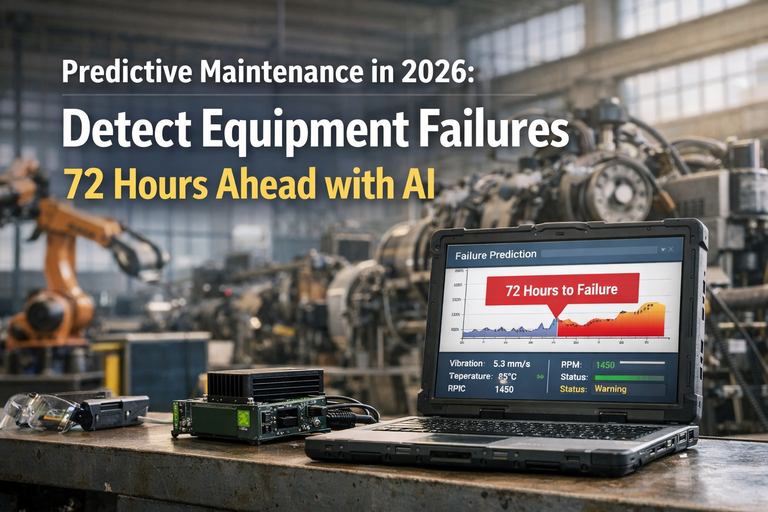
Fast forward to 2024. The same scenario occurs—bearing temperature starts climbing. This time, AI alerts the maintenance team 72 hours before failure. Planned replacement during scheduled maintenance window. Zero production impact. This isn't a hypothetical—it's happening 400+ times per year across JSW's operations. Result: 25,000 hours of unplanned downtime eliminated annually.
JSW Steel's AI Journey: 25,000 Hours of Downtime Saved Through Predictive Maintenance
5-Year Digital Transformation | 2,900+ Assets Monitored | India's Steel Industry AI Leader
The Baseline: JSW Steel's Maintenance Challenge (2017-2018)
JSW Steel in 2017: India's third-largest steel producer, 18 million tonnes annual capacity, 10 integrated plants, and a massive maintenance headache.
Across 10 plants. Major equipment failures occurred every 2-3 days somewhere in the network.
Industry benchmark: 5-6%. JSW was spending ₹1,200+ crores annually on maintenance—40% reactive repairs.
Critical assets idle 22% of the time due to breakdowns. Target: 92-95% utilization for world-class operations.
For critical rotating equipment. Global leaders achieve 1,800-2,200 hours. JSW was facing failures 2x more frequently.
Root Cause Analysis: Why Traditional Maintenance Failed
Run equipment until failure, then fix. 40% of maintenance budget spent on emergency repairs—the most expensive type.
Replace bearings every 6 months regardless of condition. Result: Waste money replacing good components, or miss failures that occur at month 4.
Vibration data in one system, temperature in another, SCADA in third. Maintenance teams couldn't see holistic equipment health.
10 vibration analysts trying to monitor 2,900 assets manually. Humanly impossible to analyze trends across all equipment 24/7.
Benchmark Your Maintenance Against JSW's Transformation
Free maintenance assessment: We'll analyze your current downtime patterns, maintenance costs, and AI readiness. See how you compare to JSW's baseline and potential savings.
- Current downtime cost calculation
- Reactive vs preventive maintenance ratio
- AI predictive maintenance feasibility
- Estimated ROI for your facility
- Implementation roadmap
The Solution: JSW's AI-Powered Predictive Maintenance Platform
January 2019: JSW Steel partnered with Tata Consultancy Services (TCS) to build a custom AI platform called "Kaizn" (Continuous Improvement + Intelligence). The vision: Move from reactive firefighting to predictive intelligence across all 10 plants.
Kaizn Platform Architecture
Data Collection Layer
- 14,000+ sensors across 2,900 critical assets (motors, pumps, compressors, gearboxes, furnaces, mills)
- Real-time streaming: Vibration, temperature, pressure, current, lubrication data every 1-2 seconds
- Integration: Connected to existing SCADA, DCS, vibration monitoring systems (no equipment replacement needed)
Data Processing Layer
- Edge computing: Pre-processing at plant level to reduce cloud data transfer (1TB/day compressed to 50GB)
- Data cleaning: Remove sensor noise, outliers, transmission errors
- Feature engineering: Calculate bearing health scores, motor efficiency indices, thermal signatures
AI/ML Analytics Layer
- Anomaly detection: Identifies deviations from normal behavior patterns 3-7 days before failure
- Remaining useful life (RUL) prediction: Forecasts when equipment will fail (accuracy: 85%)
- Root cause analysis: AI identifies why failures occur (bearing wear? Lubrication issue? Misalignment?)
- Digital twins: Virtual replicas of critical assets for "what-if" scenario testing
Action & Orchestration Layer
- Automated alerts: SMS/email warnings to maintenance teams 72+ hours before predicted failures
- Work order generation: Automatic maintenance work orders in SAP with priority ranking
- Mobile dashboards: Plant managers see equipment health status real-time on smartphones
- Maintenance optimization: AI recommends optimal timing for repairs to minimize production impact
5-Year Implementation Journey (2019-2024)
Pilot Phase - Vijayanagar Plant
Scope: 180 critical assets (blast furnace equipment, rolling mills, power generation)
- Installed 1,200 additional sensors (85% of data came from existing sensors—just needed connectivity)
- Integrated 5 legacy systems (SCADA, vibration monitoring, maintenance management, production planning, quality)
- Trained AI models on 12 months of historical failure data
- Achieved 78% prediction accuracy in pilot (target: 80%+)
- Result: Prevented 8 major equipment failures, saved 2,400 hours downtime in pilot alone
Expansion - 4 More Plants
Scope: 850 assets across Dolvi, Salem, Vasind, Tarapur plants
- Refined AI models based on pilot learnings—accuracy improved to 82%
- Deployed standardized sensor packages for faster installation
- Built centralized AI operations center in Vijayanagar for 10-plant monitoring
- Integrated spare parts inventory optimization (order parts 2 weeks before predicted failure)
- Result: 8,500 hours downtime saved across 5 plants, ₹68Cr production loss prevented
Full Network Deployment
Scope: All 10 plants, 2,900+ assets, 14,000+ sensors
- AI accuracy reached 85% (best-in-class for industrial predictive maintenance)
- Added predictive quality analytics (predict steel grade defects from process parameters)
- Integrated energy optimization (predict energy consumption anomalies)
- Launched mobile app for 2,500+ maintenance technicians across plants
- Result: 18,000+ hours downtime saved, maintenance costs reduced from 8.2% to 6.1% of revenue
Continuous Improvement & Advanced Analytics
Scope: AI maturity escalation, autonomous decision-making pilots
- Deployed generative AI for maintenance procedure recommendations
- Implemented autonomous lubrication systems (AI-controlled based on equipment condition)
- Extended to supply chain optimization (predict raw material quality issues from supplier data)
- Scaled to 3,200+ assets (added auxiliary equipment to monitoring scope)
- Current State: 25,000+ hours annual downtime elimination, ₹200Cr+ production loss prevention
Results Breakdown: The Numbers That Matter
Operational Impact
From 32,000 hrs baseline to 7,000 hrs (78% reduction). Each hour = ₹8-12 lakhs lost production value.
14% improvement = equivalent to adding 2.5 new plants without building them.
Equipment now runs 2.3x longer between failures. World-class steel plants average 2,000+ hours.
400+ correct predictions annually. False alarm rate: <8% (industry benchmark: 15-20%).
Financial Impact
25,000 downtime hours × ₹8 lakhs/hour average = ₹200Cr. JSW produces 49,000 tonnes/day—every hour counts.
From 8.2% to 6.1% of revenue. Reactive repairs down from 40% to 12% of maintenance spend.
Predictive ordering eliminated safety stock bloat. Inventory turnover improved 3.2x.
Total investment: ₹180Cr over 5 years. Annual benefits: ₹365Cr. NPV: ₹1,200Cr+ over 10 years.
Strategic Impact
JSW now has 12-15% lower production costs vs competitors without predictive maintenance. Translates to ₹800-1,200/tonne cost advantage—critical in commodity steel market.
Defect rate reduced 28% by predicting quality issues from equipment health (e.g., worn rolling mill bearings cause surface defects 2 days later).
Zero catastrophic equipment failures in 2023-24 (vs 3-4 annually in pre-AI era). Each avoided failure = lives protected.
JSW recognized as India's most digitally advanced steel manufacturer. Attracts top talent, premium valuations from investors focused on Industry 4.0.
See Live Predictive Maintenance Demo
Watch real-time asset health monitoring, failure predictions, and maintenance optimization in action. See exactly what JSW Steel's teams see every day.
Key Technologies Behind JSW's Success
Hardware & Sensors
- Vibration sensors: Triaxial accelerometers on rotating equipment (0.5 Hz - 10 kHz range)
- Temperature sensors: Infrared thermal cameras + PT100 RTDs for bearing/motor monitoring
- Current sensors: Hall effect sensors for motor load analysis
- Ultrasonic sensors: Lubrication film thickness measurement
- Pressure transducers: Hydraulic system health monitoring
Software & AI Platforms
- TCS Kaizn: Custom-built predictive maintenance platform (cloud + edge architecture)
- Azure IoT Hub: Data ingestion, device management
- Azure Machine Learning: Model training, deployment, retraining pipelines
- Power BI: Real-time dashboards, executive reporting
- SAP PM Integration: Automated work order generation
AI/ML Algorithms
- Anomaly detection: Isolation Forest, Autoencoder neural networks
- Time series forecasting: LSTM (Long Short-Term Memory) networks for RUL prediction
- Classification: Random Forest, XGBoost for failure type identification
- Deep learning: Convolutional Neural Networks (CNN) for vibration signature analysis
- NLP: Generative AI for maintenance procedure recommendations from historical work orders
Lessons for Other Steel Plants (and Heavy Industries)
Start With Critical Assets, Not Everything
JSW didn't try to monitor all 50,000+ assets immediately. They identified 180 critical assets where downtime was most expensive. Focus on 20% of assets causing 80% of problems.
Leverage Existing Sensors (85% Already There)
Most plants already have 70-85% of needed sensors—they're just not connected or analyzed intelligently. JSW reused 85% of existing instrumentation, only added 15% new sensors for gaps.
Operator Buy-In Makes or Breaks Success
Technology is 30% of the challenge. Human adoption is 70%. JSW invested heavily in training, showed operators how AI made their jobs easier (not replaced them), involved them in platform design.
Expect 12-18 Months for AI to "Learn" Your Assets
JSW's AI accuracy improved from 78% (Year 1) to 85% (Year 3) as models learned plant-specific failure patterns. Don't expect perfection on Day 1—plan for continuous improvement.
Integrate With Existing Systems (Don't Rip-and-Replace)
JSW integrated Kaizn with SAP, SCADA, vibration monitoring—didn't replace anything. Retrofitting is faster, cheaper, less disruptive than greenfield deployments.
Executive Sponsorship Is Non-Negotiable
JSW's transformation was driven from the top—Managing Director Sajjan Jindal personally reviewed monthly progress. Without C-suite commitment, predictive maintenance initiatives die in pilot phase.
Want to replicate JSW's success at your plant? Chat with implementation experts — We'll help you build a customized roadmap.
JSW Steel Case Study Takeaways
- 25,000 hours annual downtime eliminated through AI predictive maintenance across 2,900+ assets in 10 plants
- ₹200Cr+ production loss prevented annually by predicting failures 72+ hours early (85% accuracy)
- 5-year journey from pilot to full deployment—Year 1 pilot (180 assets), Year 2 expansion (850 assets), Year 3-4 full network (2,900+ assets)
- 18-month ROI payback despite ₹180Cr investment—annual benefits of ₹365Cr make business case compelling
- 92% asset utilization achieved (from 78% baseline)—equivalent to 2.5 new plants without construction
- Operator buy-in was the secret sauce—technology works only when humans trust and use it daily
Ready to Transform Your Maintenance Operations Like JSW Steel?
Free predictive maintenance feasibility study: We'll analyze your critical assets, baseline downtime costs, and calculate achievable ROI.
See exactly how predictive maintenance can impact YOUR bottom line.