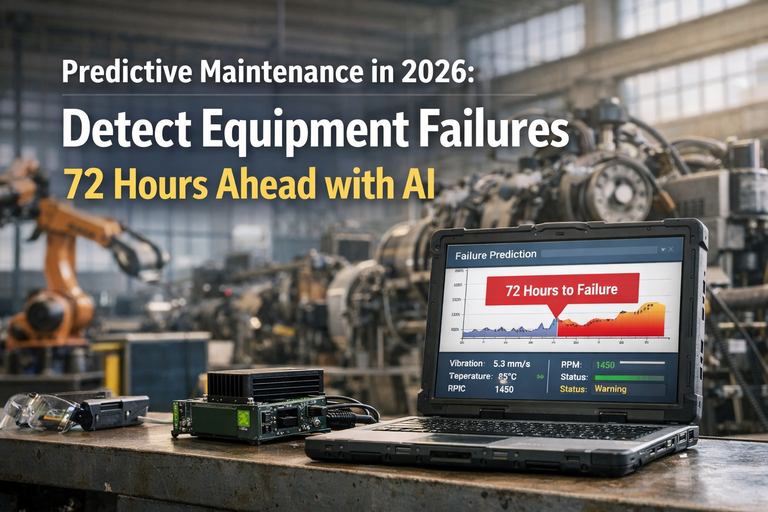
Your CNC spindle motor is about to fail. Not next month — in exactly 68 hours. The vibration signature shifted 0.3mm/s two days ago, thermal drift is accelerating at 0.8°C per cycle, and the AI model that's been learning your machine's behavior for six months just flagged it with 94% confidence. You schedule the bearing replacement for Saturday's planned downtime. Zero production lost. Zero emergency call-outs. Zero surprises. This is what predictive maintenance looks like in 2026 — and it's no longer reserved for Fortune 500 factories.
AI-Native Digital Transformation for Smart Manufacturing
Join iFactory's expert-led session on how AI-native architecture — including predictive maintenance integration, real-time factory intelligence, and edge AI-powered failure detection — is reshaping how manufacturers plan, operate, and optimize production. Learn how leading facilities are using cloud-native CMMS as the operational data backbone for AI-driven maintenance.
The predictive maintenance market hit $14.29 billion in 2025 and is racing toward $98 billion by 2033 at a 27.9% CAGR. The U.S. Department of Energy reports that predictive maintenance delivers a tenfold ROI, 70–75% fewer breakdowns, and 25–30% cost reductions. Yet 95% of adopters report positive ROI — with 27% achieving payback in under a year. The technology has crossed from experimental to essential. The question isn't whether predictive maintenance works — it's how quickly you can deploy it before competitors build an insurmountable reliability advantage.
The 72-Hour Advantage: How AI Sees Failures Before They Happen
Traditional maintenance is binary — equipment either works or it doesn't. AI-powered predictive maintenance sees the gradient between healthy and failing. It detects micro-changes in vibration, temperature, power draw, and acoustic signatures that are invisible to human senses and flag emerging failures 48–72 hours before catastrophic breakdown.
AI detects anomaly
Work order auto-created
Repair completed
Reactive vs. Preventive vs. Predictive: The Evolution That Matters
Most manufacturers still operate in a blend of reactive and preventive modes — fixing things when they break or replacing parts on a calendar. Both approaches leak money. Predictive maintenance changes the game by listening to the machine and acting only when the data says it's necessary.
Still running reactive or calendar-based maintenance? iFactory's AI-powered CMMS transitions your team to predictive in weeks — starting with your 5–10 most critical assets. See how it works in a 30-minute demo →
What AI Actually Detects: The 5 Sensor Signals That Predict Failure
AI predictive maintenance isn't magic — it's pattern recognition at machine speed. Here are the five signal types that feed AI models, what they detect, and how iFactory converts each into an actionable work order before failure occurs:
Key insight: The biggest reason predictive maintenance projects fail isn't the AI — it's disconnected data and manual work order processes. iFactory solves this by unifying sensor data into a single operational layer where AI alerts automatically become scheduled, tracked, and verified maintenance actions.
The ROI Reality: What Predictive Maintenance Actually Delivers
The financial case is no longer theoretical. Across thousands of deployments, the data consistently shows predictive maintenance paying for itself within 6–14 months. Here's what manufacturers are achieving — backed by research from Deloitte, the U.S. DOE, MIT, and Siemens:
A mid-sized manufacturer's pilot program costed $30K–$50K and achieved payback in 3 months — saving $75,600 in eliminated unnecessary PM tasks alone. What would those numbers look like for your plant? Find out in 30 minutes →
iFactory: The CMMS That Makes Predictive Maintenance Actually Work
Most predictive maintenance projects fail because AI insights never reach the maintenance team. iFactory closes this gap — converting sensor data into automated work orders, parts requisitions, and scheduled repairs. No manual steps. No alerts lost in email. No gap between detection and action.
The Market Is Moving: Where Predictive Maintenance Is Heading
Predictive maintenance has crossed from experimental to essential. The market trajectory — and the widening gap between adopters and laggards — makes the direction unmistakable:
How to Start: A 4-Phase Implementation Roadmap
You don't need a Fortune 500 budget. The most successful implementations start focused on 5–10 critical assets and scale from proven ROI. Here's the phased approach iFactory supports at every stage:
Start with iFactory as your cloud-native CMMS. Connect vibration and temperature sensors to your 5–10 most failure-prone assets. Establish the real-time data pipeline. Most teams are operational within weeks.
AI models learn each machine's normal behavior patterns. After 30–90 days of data collection, models begin detecting anomalies with increasing accuracy. iFactory's AI learns 7× faster with proper baseline data.
Models mature to 88–94% accuracy. Failure alerts trigger automated work orders in iFactory, complete with parts lists, priority rankings, and suggested repair windows. ROI typically visible within this phase.
Expand edge AI sensors across all critical assets. Connect every machine into iFactory's unified maintenance intelligence layer. Run whole-plant OEE optimization with predictive scheduling, energy monitoring, and automated reporting.
Phase 1 Starts With a 30-Minute Conversation
We'll show you exactly how iFactory connects to your equipment, what sensor data you'd see from day one, and how fast your maintenance team starts benefiting from AI-driven failure predictions. No commitment. No pressure. Just a live walkthrough.
Frequently Asked Questions
Mature AI models achieve 88–97% failure prediction accuracy for well-defined equipment types like motors, pumps, and compressors. Accuracy improves over time as models learn your specific machines' behavior patterns. By month 6, leading platforms deliver 92%+ accuracy with 48–72 hour lead time — enough to schedule repairs during planned downtime windows.
A focused pilot on 5–10 critical assets typically costs $30,000–$50,000, including sensors, integration, and iFactory's cloud-native CMMS. Most manufacturers see ROI within 12 months, with some achieving payback in as little as 3 months. iFactory's SaaS model eliminates heavy upfront infrastructure costs — you pay per asset, not per server.
Yes. Retrofit IoT sensor kits attach to legacy machines to monitor vibration, temperature, and power draw without any modifications to the equipment itself. Edge computing gateways digitize analog signals from older PLCs. iFactory connects to both modern and legacy equipment, effectively giving machines from the 1980s the same AI-driven monitoring as brand-new equipment.
When AI models detect an anomaly, iFactory automatically generates a prioritized work order with the specific failure mode, recommended repair actions, required parts list, and suggested timing window. The work order is assigned to the right technician, parts are checked against inventory, and the repair is tracked through completion. No manual data entry. No alerts lost in email. The loop from detection to verified repair is fully closed.
Initial anomaly detection begins within weeks of sensor deployment. By month 3, AI models provide reliable failure predictions with escalating accuracy. Full 72-hour prediction capability with 92%+ accuracy typically matures by month 6. Most manufacturers achieve measurable ROI within 3–6 months and full payback within 12–14 months.
Stop Reacting to Failures. Start Predicting Them.
Every hour of unplanned downtime costs $260K. Every breakdown you prevent is money saved, production kept, and customers retained. iFactory's AI-powered CMMS gives your maintenance team the 72-hour head start they need to stay ahead of every failure. See it in 30 minutes.