Every week a mid-market manufacturer delays selecting the right Manufacturing Execution System, the gap between current output and full-capacity potential widens — quietly bleeding margin, compounding scrap rates, and handing competitors ground they will not return. The MES market has matured, but most evaluation processes remain chaotic: vendor demos optimised for spectacle over fit, feature lists that obscure total cost of ownership, and shortlisting committees without a structured framework to separate genuine capability from polished marketing. This guide closes that gap with a ranked evaluation of ten platforms built around the operational realities of manufacturers with one to five production lines.
iFactory MES Intelligence Report — 2026
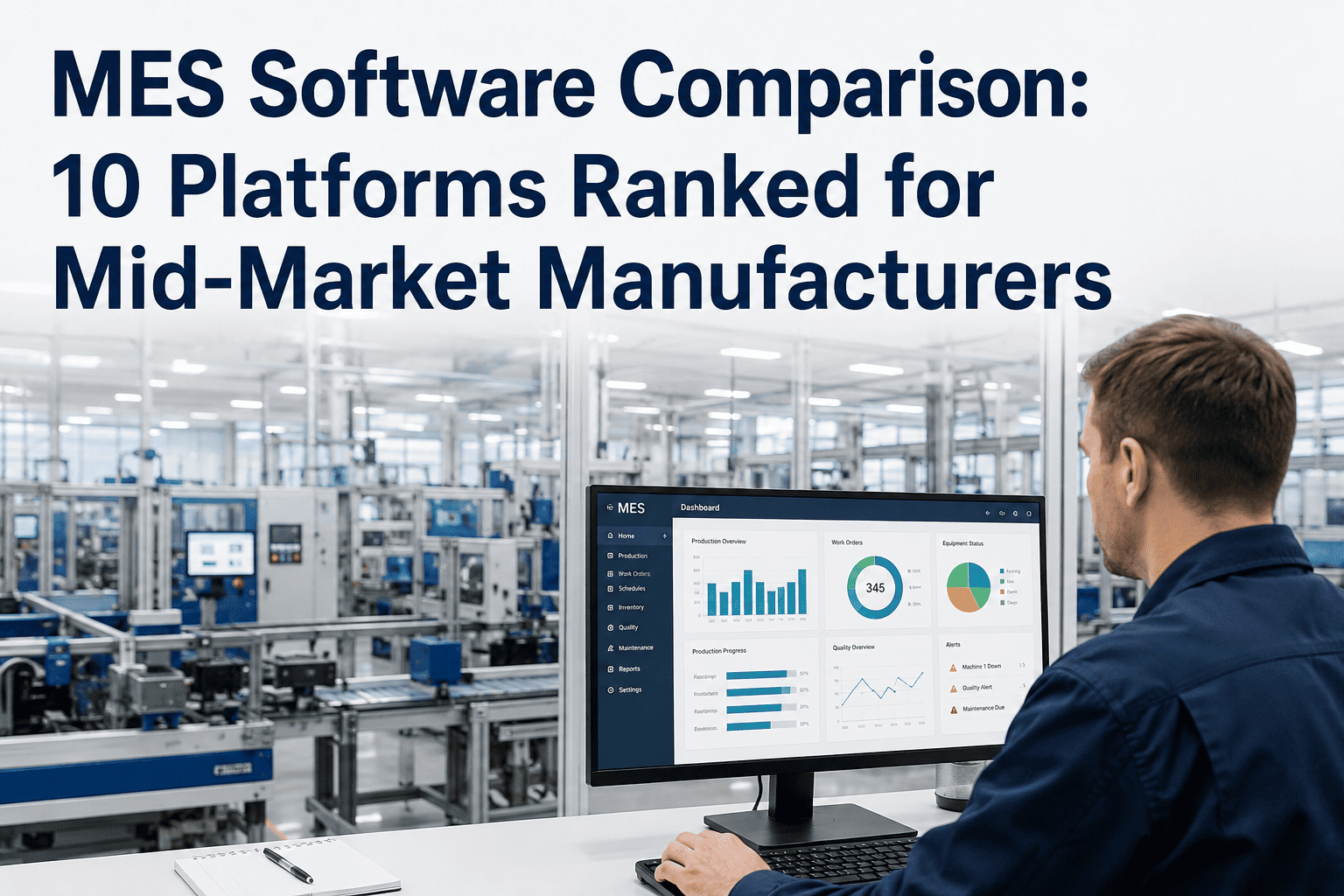
MES Software Comparison: 10 Platforms Ranked for Mid-Market Manufacturers
10 platforms evaluated across workflow automation, ERP integration, industry fit, and 3-year TCO — so your selection committee starts with a shortlist, not a spreadsheet.
3-yr
TCO modelled per platform
18%
Avg. OEE lift post-deployment
What Mid-Market Manufacturers Need — and What Most Vendors Miss
Enterprise MES platforms are engineered for complexity at scale. Lightweight shop-floor tools lack the workflow orchestration mid-market operations require. The manufacturer in the 200–2,000 employee range sits in an underserved gap: sophisticated enough to need real production intelligence, agile enough to need deployment in months rather than years. The right platform for this segment shares four non-negotiable traits.
01
ERP-Native Integration
Bi-directional sync with SAP, Oracle, Epicor, or Infor without bespoke middleware. Work orders, BOM revisions, and inventory movements flow in real time without dual entry or batch delays.
02
Configurable Workflows
Production workflows that adapt to your process — not the reverse. Discrete, process, and mixed-mode manufacturers require fundamentally different routing and dispatch logic at the operator level.
03
Real-Time OEE Visibility
Availability, performance, and quality metrics computed per shift, per line, per asset — with root cause drill-down available within three clicks of any downtime or quality alert.
04
Deployment Under 90 Days
Mid-market operations cannot absorb 18-month implementation cycles. Core scheduling, quality, and OEE modules must be live on production lines within a single business quarter.
Legacy Friction vs. Optimised Excellence: The MES Gap
Before selecting a platform, quantifying the operational gap your current approach creates puts the investment case in financial terms executives can evaluate directly. The comparison below maps the most common legacy friction points against outcomes a properly deployed MES delivers within 12 months of go-live.
| Operational Area | Legacy Friction — Old Way | Optimised Excellence — MES Way |
|---|
| Production Scheduling | Spreadsheet-driven, updated once per shift. Planners react to exceptions after damage is done. | Dynamic sequencing adjusted in real time to machine availability, workforce capacity, and material status. |
| Quality Management | Paper-based inspection records. Defects discovered at end-of-line or by the customer. | In-process SPC with automatic hold triggers. Defect detected at point of origin, not delivery. |
| Work Order Execution | Manual job travellers. Operators make routing decisions from memory or incomplete printed instructions. | Digital work instructions with version control. Correct revision served to operator at correct station automatically. |
| Downtime Tracking | Downtime logged retroactively from shift reports. Root cause analysis delayed 24–72 hours. | Automated downtime capture from PLC signals. Pareto analysis available within minutes of each event. |
| Material Traceability | Lot traceability requires manual record search. Recall scope determination takes days of investigation. | Forward and backward traceability in seconds. Recall scope determined in under 10 minutes. |
| Labour Reporting | Time cards collected and entered manually. Actual-vs-standard comparison available weekly at best. | Labour captured at job clock-on. Actual-vs-standard visible per operator per operation in real time. |
| ERP Synchronisation | Batch uploads once or twice daily. Inventory and WIP positions chronically out of sync with reality. | Real-time bi-directional sync. ERP reflects shop floor reality within seconds of each transaction. |
See how iFactory's MES Workflow closes each of these gaps across your production lines within 90 days.
Book a Demo
10 MES Platforms Ranked for Mid-Market Manufacturers
Rankings weight four equally important criteria: MES workflow depth, ERP and OT integration capability, industry vertical fit, and realistic 3-year total cost of ownership including implementation, licensing, and ongoing support. Each platform is evaluated from the perspective of a manufacturer with one to five production lines and 50–500 shop floor users.
iFactory AI MES
Built specifically for mid-market manufacturers, iFactory combines a full MES workflow engine with AI-powered production intelligence and a native digital twin layer. Deployment is modular — scheduling, quality, traceability, and OEE modules activate independently. ERP integration covers SAP, Oracle, Epicor, Infor, and Microsoft Dynamics via pre-built connectors.
Full MES workflow: scheduling, dispatch, quality, labour, and traceability in a single platform
AI-generated work orders from condition triggers and live production plan synchronisation
Average go-live 6–10 weeks for core modules. 3-year TCO: $180K–$420K by site scale
Plex Smart Manufacturing Platform
Cloud-native MES with strong automotive and food and beverage vertical depth. Credible for manufacturers already planning cloud ERP migration. Implementation timelines run 4–6 months for full deployment.
Strong automotive supplier compliance tooling — IATF 16949 out of the box
Native quality management with SPC and FMEA linkage. 3-year TCO: $280K–$550K
Apriso (Dassault Systèmes DELMIA)
Enterprise-grade MES with process manufacturing strength. Excels in regulated industries — pharma, medical device, aerospace — where full batch records and electronic signatures are mandatory. Overkill for simpler discrete environments.
21 CFR Part 11 and EU Annex 11 compliance built in. Strong multi-site global rollout capability
3-year TCO: $450K–$900K. Implementation typically 9–18 months for full deployment
Epicor Advanced MES
Natural MES extension for Epicor ERP users. Tight integration eliminates dual-entry and provides a single data model from order through shipment. Limited appeal outside the Epicor ecosystem.
Zero-friction integration for existing Epicor customers. Job costing accuracy significantly improved
3-year TCO: $200K–$380K within the Epicor stack. Minimal implementation services required
Tulip Interfaces
Low-code MES builder that empowers operations teams to build their own apps without deep IT involvement. High flexibility, but total MES functionality requires significant internal build effort. Best for non-standard process environments.
No-code work instruction and digital form builder with strong IoT device connectivity
3-year TCO: $150K–$320K plus internal build and maintenance hours not reflected in licensing
Rockwell Automation FactoryTalk
Deep OT integration for Rockwell-heavy environments. FactoryTalk's strength is PLC-level data capture and historian integration. MES workflow capabilities are narrower than purpose-built platforms.
Best-in-class Allen-Bradley PLC and historian connectivity across the shop floor
3-year TCO: $300K–$600K. Strongest ROI in Rockwell-standardised facilities
Infor CloudSuite Industrial MES
Strong choice for Infor ERP customers in industrial manufacturing. Shared data model across ERP and MES creates genuine single-source-of-truth visibility across finance, supply chain, and production operations.
Native Infor ERP integration with shared data model across the full CloudSuite stack
3-year TCO: $250K–$500K within the Infor ecosystem. Standalone value is limited
Sight Machine
Analytics-first platform built for manufacturers with rich machine data but limited MES structure. Excels at surfacing production patterns and quality correlations. Workflow execution tools are thinner than a full MES requires.
AI-powered production analytics and yield optimisation for high-data-volume environments
3-year TCO: $220K–$480K. Best paired with an existing workflow execution layer
Critical Manufacturing MES
Highly capable for semiconductor, electronics, and high-mix low-volume environments. Exceptional lot genealogy and equipment integration. Complexity and implementation cost exceed most mid-market budgets.
Industry-leading semiconductor and PCB assembly support with advanced lot genealogy
3-year TCO: $500K–$1.1M. Justified only in high-value, highly regulated production environments
Katana MRP/MES
Entry-level MES for manufacturers under 50 shop floor users. Simple scheduling and inventory visibility with fast onboarding. Outgrown rapidly by manufacturers scaling beyond two production lines.
Fastest deployment in category — live in under 2 weeks for job shop and make-to-order SMBs
3-year TCO: $40K–$90K. Ceiling reached quickly as operational complexity increases
How the Right MES Transforms Three Core Outcomes
Workflow Efficiency
- Digital work instructions eliminate routing errors at source
- Auto-dispatched work orders remove planner bottlenecks
- Paperless quality records accelerate inspection cycles 40–60%
- Real-time WIP visibility eliminates reactive supervisor floor walks
Overhead Reduction
- Manual data entry labour reduced 70–85% across MES-connected lines
- Compliance documentation auto-generated from production records
- Scrap and rework costs reduced 15–25% through in-process quality
- Inventory carrying costs cut via real-time WIP and material tracking
Output and Growth
- OEE improvements of 12–22% typical within 12 months of go-live
- On-time delivery rates improve as scheduling accuracy increases
- Capacity unlocked without new capital investment in equipment
- Scalable to multi-site without proportional headcount increase
Frequently Asked Questions: MES Selection for Mid-Market
How long does a mid-market MES implementation actually take?
With a phased approach and a platform built for mid-market scale, core modules — scheduling, work order execution, and OEE — can be live within 6–10 weeks. Full deployment including quality, traceability, and ERP integration typically completes within 3–5 months. Avoid any vendor quoting less than 6 weeks or more than 9 months for a single-site deployment at this scale.
What is a realistic 3-year TCO for a mid-market MES?
For a 1–3 line operation with 50–200 shop floor users, budget $180K–$480K over three years including implementation services, licensing, integration, training, and ongoing support. Platforms at the top of this range typically deliver 5–10x ROI through OEE improvement, scrap reduction, and labour efficiency gains. Platforms priced below $100K over three years almost always require significant internal build effort to close feature gaps.
Can we implement an MES without replacing our ERP?
Yes — and the two systems should coexist. The MES handles real-time shop floor execution while the ERP handles financial transactions, customer orders, and inventory accounting. The integration between them — work order release, material consumption, and production completion posting — is where implementation effort concentrates. Platforms with pre-built connectors for your specific ERP reduce this effort from months to weeks.
What internal resources does MES implementation require?
Expect to commit one operations or manufacturing engineer as an internal project lead at 50% time during implementation, an IT resource for network and integration work at 30–40% time for 6–8 weeks, and a production supervisor as a floor champion per line being deployed. Total internal effort for a single-site mid-market deployment runs 200–400 person-hours spread across 10–16 weeks.
Make the Right Call — Once
Get a Shortlist Built Around Your Lines, Your ERP, and Your Budget
iFactory's manufacturing specialists map your production environment against the MES platforms most likely to deliver ROI within 12 months — with direct guidance on where each platform excels and where it falls short for your specific operational profile.
90 day
Core module go-live target
18%
Average OEE improvement year one
10x
ROI potential at full deployment
Free
MES fit assessment session