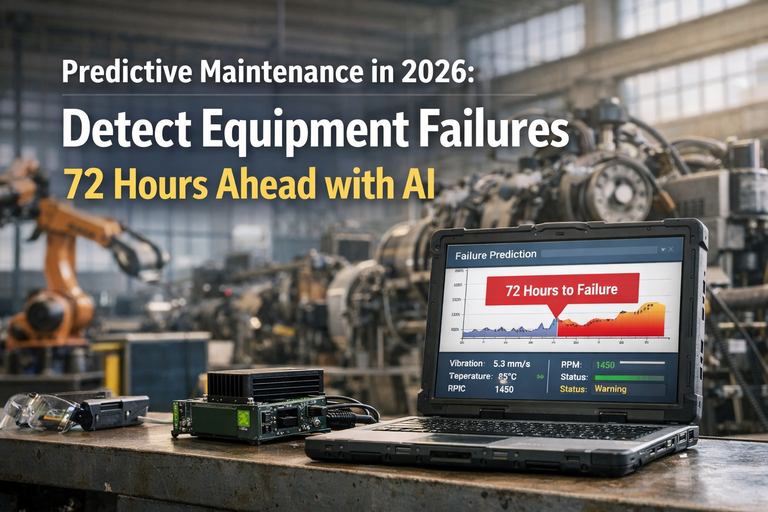
Every unplanned shutdown costs more than the repair bill. It costs you production hours, customer trust, and the compounding penalty of reactive decisions made under pressure. In 2026, manufacturers running legacy maintenance schedules are not just inefficient — they are structurally disadvantaged against competitors who have deployed AI-powered predictive maintenance. The gap between them widens every quarter. This shortlist cuts through vendor noise to identify the platforms that deliver measurable ROI, not just dashboards.
What Decision-Makers Need to Know Before Buying
The predictive maintenance software market has matured rapidly. First-generation platforms competed on sensor compatibility and dashboard aesthetics. The 2026 shortlist is evaluated on harder criteria: prediction lead time, false-positive rate, autonomous workflow generation, and verified ROI timelines. Platforms that cannot demonstrate sub-30-day time-to-value or 90%+ alert accuracy are excluded regardless of brand recognition.
How We Scored the 2026 Shortlist
Each platform was assessed across six weighted dimensions drawn from verified enterprise deployments. Scoring reflects real-world operational performance, not vendor-supplied benchmarks.
| Evaluation Dimension | Weight | What We Measured |
|---|---|---|
| Prediction Lead Time | 25% | Days of advance warning before failure — industry benchmark is 14–21 days |
| Alert Accuracy Rate | 20% | True-positive rate across asset classes; platforms below 90% excluded |
| Time to First Value | 20% | Weeks from deployment to first documented avoided failure or cost saving |
| CMMS & ERP Integration | 15% | Native connectors to SAP, IBM Maximo, Infor, Oracle; API openness |
| Sensor Ecosystem Breadth | 10% | Vibration, thermal, current, ultrasonic, pressure — cost per monitoring point |
| Autonomous Workflow Generation | 10% | AI-generated work orders, RUL projections, natural language query support |
Legacy Maintenance vs. AI-Powered Predictive Intelligence
The operational gap between time-based and AI-predictive maintenance is not incremental — it is structural. The comparison below reflects verified outcomes from manufacturers who made the transition between 2023 and 2025.
- Calendar-based PM schedules replacing parts that have 60–70% useful life remaining
- Reactive repairs averaging 3–7× the cost of planned interventions
- No failure warning — first signal is the alarm or the shutdown
- Maintenance decisions driven by technician intuition, not data
- Compliance documentation assembled manually from paper logs
- Energy waste invisible — no correlation between asset condition and consumption
- CAPEX planning based on age schedules, not actual remaining useful life
- Work orders created by planner judgment after failure is reported
- Condition-based interventions triggered only when asset health data warrants action
- 14–21 day advance warning enables planned repairs at 20–30% of reactive cost
- Remaining Useful Life projections updated continuously for every monitored asset
- AI models trained on actual operational patterns — not generic failure libraries
- ISO 55000, OSHA, and ESG reports auto-generated from live twin data
- Energy monitoring layer identifies consumption anomalies tied to asset degradation
- CAPEX recommendations backed by data-verified RUL across all assets
- AI auto-generates work orders with correct parts, procedures, and scheduling
The 2026 Predictive Maintenance Software Leaders
The following platforms earned shortlist placement based on verified deployment outcomes, not marketing claims. Each entry reflects actual performance data from industrial environments comparable to a mid-size to enterprise manufacturer.
- Phase-based onboarding reaches first value in 4–6 weeks
- LSTM and gradient boosting models deliver 90%+ alert accuracy
- 14–21 day prediction lead time across motors, pumps, compressors
- Native OPC-UA, MQTT, REST integration with existing SCADA and CMMS
- Generative AI natural language queries on asset health and history
- Auto-generated work orders with parts, procedures, and scheduling
- $680K deployment generating $2.1M first-year savings
- 200+ assets monitored within 10 months of pilot launch
- Phase 3 ROI turns positive — typically $400K–$1.2M annually
- Full-scale annual savings of $1.2M–$3.5M at Phase 4–5
- New asset commissioning 30–40% faster via virtual twin testing
- Automated ESG and compliance reporting from live twin data
- Deep integration with existing IBM ERP and EAM environments
- Broad asset class coverage including linear assets and infrastructure
- Strong compliance and audit trail capabilities for regulated industries
- Implementation timelines typically 12–24 months for full deployment
- High total cost of ownership — suited to large enterprise budgets
- Requires significant IT resource and consultant engagement
- Strong hardware-software integration with proprietary sensor ecosystem
- Real-time visibility across distributed multi-site operations
- Accessible pricing model for mid-market manufacturers
- Predictive AI models less mature than specialist PdM platforms
- Limited autonomous workflow generation at current release
- Better suited to condition monitoring than full digital twin deployment
Three Dimensions of Measurable Operational Improvement
- Auto-generated work orders with parts and procedures
- Natural language asset health queries for instant diagnosis
- Seamless CMMS feed — no duplicate data entry
- 30–40% reduction in unnecessary preventive maintenance
- Energy waste identification from asset degradation signals
- Automated ISO 55000, OSHA, ESG reporting
- OEE improvements of 8–15% from uptime recovery
- Cross-site benchmarking for continuous performance gains
- CAPEX decisions backed by RUL data — not age schedules