Your competitors are already using generative AI on the shop floor — not just in chatbots, but embedded inside quality systems, maintenance workflows, process planners, and operator interfaces. If your manufacturing operation is still evaluating whether large language models belong in industrial environments, the window for first-mover advantage is closing fast. Every quarter of inaction translates to measurable gaps in OEE, maintenance cost, and engineering cycle time that compound across every production run.
iFactory AI Analytics Platform
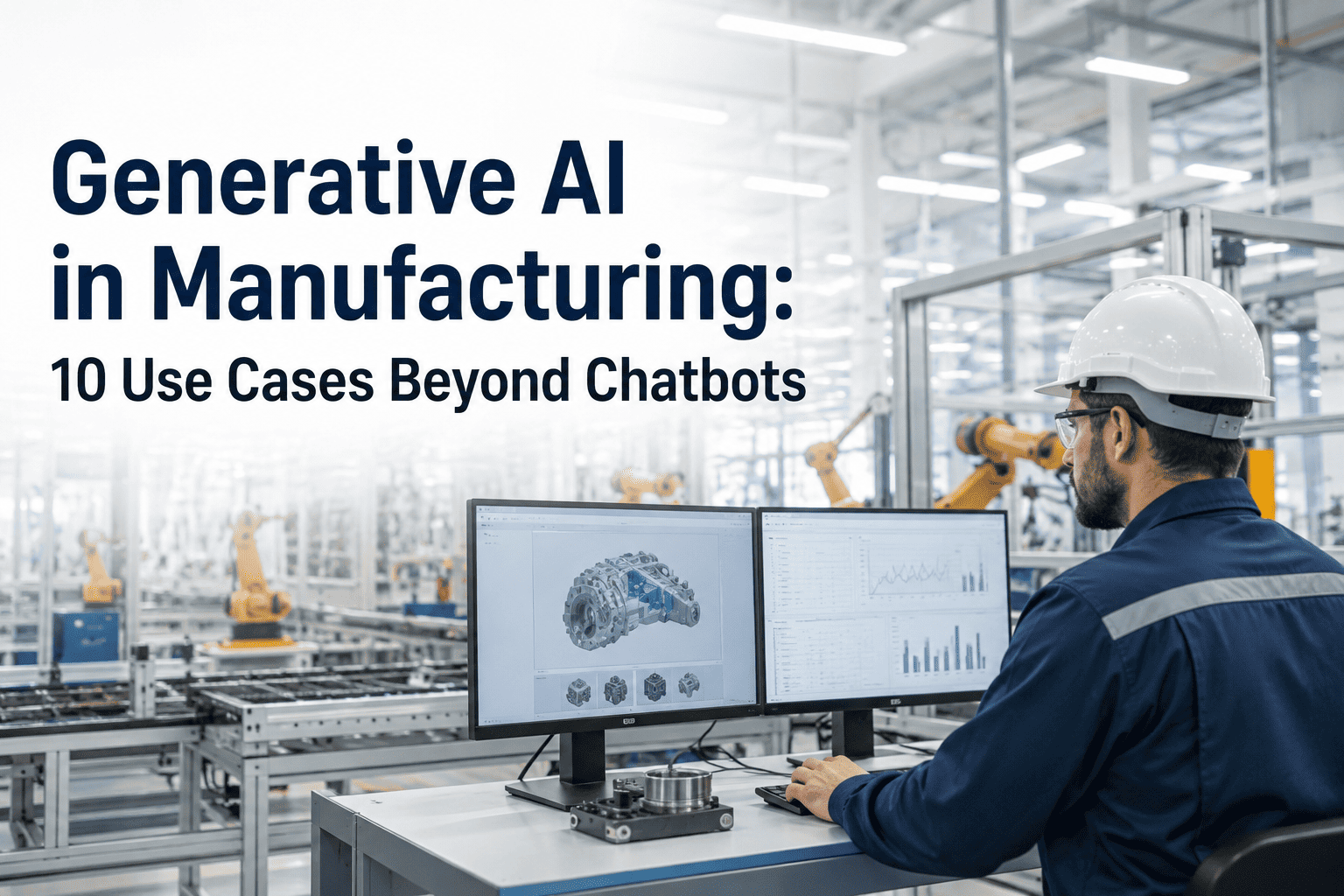
Generative AI in Manufacturing: 10 Use Cases Beyond Chatbots
How production-grade GenAI transforms design, quality, planning, and operator intelligence — with measurable ROI at every step
40%
Reduction in engineering design cycles
3.2x
Faster root cause resolution
$1.4M
Average annual savings per facility
92%
Operator task accuracy improvement
Why GenAI in Manufacturing Is Not a Chatbot Story
The enterprise chatbot narrative has dominated GenAI coverage for two years — and it has done serious damage to how manufacturing leaders perceive the technology's potential. Generative AI applied to industrial operations is fundamentally different: it operates on structured sensor streams, CAD geometry, quality inspection logs, maintenance histories, and process parameter databases. The output is not conversation — it is design geometry, anomaly classifications, process recipes, work instructions, and predictive interventions.
The ten use cases below represent production-grade deployments already generating financial returns across discrete manufacturing, process industries, and hybrid environments. Each maps directly to capabilities within the iFactory AI Analytics Platform.
See all 10 use cases live in your environment
Book a Demo
The 10 Production-Grade GenAI Use Cases
01
Generative Design for Tooling and Fixtures
LLMs paired with topology-optimisation engines generate fixture and tooling geometry from constraint inputs — material limits, load cases, manufacturing method — in hours rather than weeks. Engineers iterate on AI-generated candidates rather than drafting from scratch.
- 40–60% reduction in tooling design cycle time
- Weight reductions of 15–30% with equivalent strength
- Direct export to CAM and additive manufacturing pipelines
02
AI-Generated Work Instructions from Process Data
Generative models ingest SOP libraries, CMMS records, and real-time asset state to produce step-by-step work instructions tailored to the specific asset condition at the moment of maintenance. Instructions update dynamically as conditions change.
- Eliminates outdated static SOP libraries across shifts
- Reduces technician error rate by up to 38%
- Supports multilingual output for global facilities
03
Natural Language Process Optimisation Queries
Operators and engineers query the production environment in plain language — "Why did Line 3 OEE drop below 78% on Tuesday afternoon?" — and receive AI-synthesised analysis across sensor data, shift logs, and maintenance records without SQL or BI tool expertise.
- Root cause analysis time reduced from hours to minutes
- No data science dependency for operational queries
- Answers grounded in live plant historian data
04
Automated Quality Defect Classification and Reporting
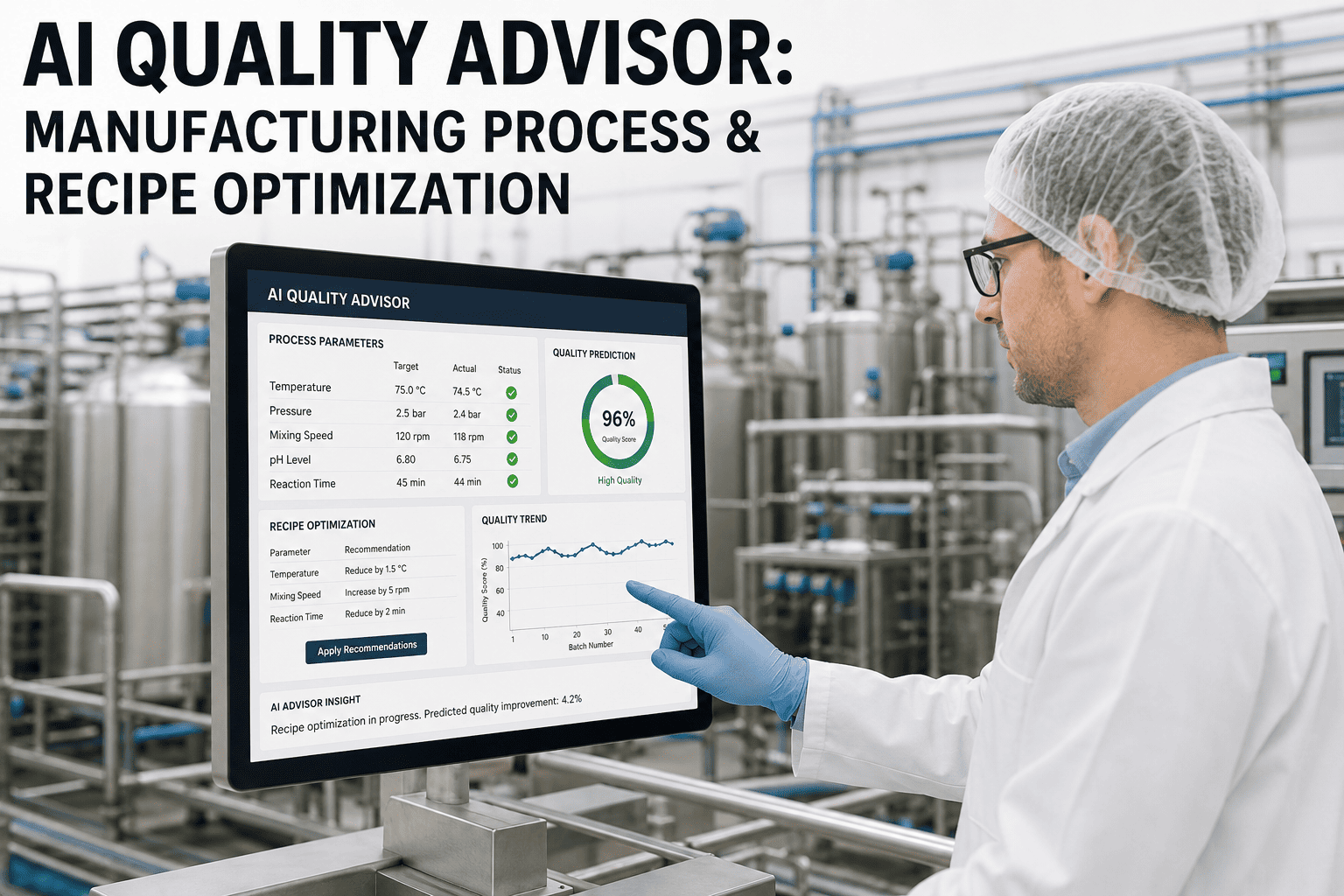
Multimodal GenAI models combine vision inspection images with process parameter streams to classify defects, identify probable root causes, and draft non-conformance reports with corrective action recommendations — automatically, without quality engineer intervention.
- NCR generation time drops from 45 minutes to under 3 minutes
- Defect classification accuracy exceeds 94% on trained categories
- Feeds directly into CAPA and ERP quality modules
05
GenAI-Powered Predictive Maintenance Narratives
Traditional predictive maintenance platforms surface alerts and probability scores. GenAI translates those signals into plain-language maintenance narratives — explaining what is degrading, why it matters, what should be done, and when — enabling maintenance planners to act without interpreting model outputs.
- Alert-to-action time reduced by 55% on average
- Maintenance planner cognitive load measurably reduced
- Work order generation triggered from narrative output
06
Synthetic Training Data Generation for Vision Models
Rare defect categories are chronically underrepresented in real inspection datasets. GenAI generates photorealistic synthetic defect images — scratches, voids, delaminations, contamination — to balance training sets and improve vision model performance on edge cases that matter most.
- Model accuracy on rare defects improved 20–35%
- Eliminates months of defect sample collection
- Supports rapid deployment of new inspection categories
07
Automated Compliance and ESG Report Generation
GenAI ingests operational data — energy consumption, emissions readings, waste streams, safety incidents — and generates ISO 55000, OSHA, and ESG compliance documentation in board-ready format. What previously required weeks of analyst time compresses to hours.
- Compliance reporting cycle reduced from 3 weeks to under 48 hours
- Audit-ready documentation generated on demand
- Consistent methodology across facilities eliminates discrepancies
08
AI-Assisted Production Scheduling and Changeover Optimisation
LLMs parse order books, inventory positions, asset condition scores, and shift calendars to generate optimised production sequences that minimise changeover time, reduce WIP inventory, and respect maintenance windows — surfaced as editable schedules that planners approve rather than build.
- Changeover time reductions of 18–25% in pilot deployments
- WIP inventory reduction of 12–20%
- Scheduler preparation time reduced from half-day to 30 minutes
09
Knowledge Capture from Retiring Workforce
The manufacturing sector faces a structural knowledge transfer crisis as experienced technicians retire. GenAI facilitates structured knowledge extraction through conversational interviews, transforming tacit expertise into searchable, structured knowledge bases that junior operators can query at point of need.
- Critical tribal knowledge preserved before retirement
- Junior technician ramp-up time reduced 30–45%
- Knowledge base continuously enriched from operational outcomes
10
Generative Scenario Simulation for Capital Planning
Finance and operations leaders can query the digital twin with natural language scenarios — "What is the projected maintenance cost impact if we defer the compressor replacement 18 months?" — receiving AI-synthesised financial projections grounded in asset condition data, failure probability models, and historical cost records.
- CAPEX decision cycles accelerated by 35–50%
- Scenario modelling democratised beyond finance specialists
- Projections grounded in real asset data, not spreadsheet assumptions
Legacy Friction vs. Optimised Excellence
The gap between traditional manufacturing operations and GenAI-augmented environments is not incremental — it is structural. The comparison below illustrates the operational and financial distance between where most facilities are today and where early adopters are already operating.
| Capability |
Legacy Friction |
Optimised Excellence |
| Root Cause Analysis |
2–4 hours across multiple BI tools and shift logs |
Natural language query returns synthesised answer in minutes |
| Work Instructions |
Static PDF SOPs, often outdated, not condition-aware |
Dynamic AI-generated instructions matched to current asset state |
| Quality Reporting |
Manual NCR completion, 45+ minutes per incident |
Automated classification and report generation in under 3 minutes |
| Tooling Design |
3–6 week design cycle, single engineer-led iteration |
AI generates 10+ candidates in hours, engineer selects and refines |
| Compliance Docs |
3-week analyst sprint for each reporting cycle |
On-demand generation from live operational data in under 48 hours |
| Maintenance Alerts |
Numeric probability scores requiring specialist interpretation |
Plain-language narratives with recommended actions and timing |
| Scheduling |
Half-day planner effort, manually reconciling constraints |
AI-generated optimised sequence reviewed and approved in 30 minutes |
| Knowledge Transfer |
Tribal knowledge lost at retirement with no systematic capture |
Conversational extraction builds searchable institutional knowledge base |
Ready to close the gap? Start with a 30-minute deployment session.
Book a Demo
Three Dimensions of Operational Impact
Workflow Acceleration
GenAI eliminates the handoffs, interpretation layers, and manual synthesis steps that inflate cycle times across engineering, quality, maintenance, and planning functions. Tasks measured in days compress to hours. Hours compress to minutes.
- Design iteration cycles cut 40–60%
- Compliance reporting reduced from weeks to hours
- Alert-to-action latency reduced by over half
Overhead Reduction
Specialist labour currently consumed by data preparation, report writing, SOP maintenance, and alert interpretation is redirected to higher-value decisions. GenAI does not replace engineers — it removes the administrative burden that prevents engineers from engineering.
- Quality analyst report time reduced 85%
- Maintenance planner prep time reduced 70%
- Junior technician ramp-up compressed 30–45%
Output and Growth
Higher quality decisions made faster, grounded in complete operational data rather than partial information, produce compounding improvements in OEE, defect rate, energy efficiency, and capital allocation. GenAI creates a continuous improvement flywheel driven by data rather than periodic reviews.
- OEE improvement of 8–15% within 12 months
- Defect escape rate reduced 20–35%
- CAPEX decision cycles accelerated 35–50%
Implementation Realities: What to Expect
GenAI deployments in manufacturing succeed when they follow the same phased logic as successful digital twin rollouts: start with high-value, well-defined use cases, demonstrate measurable ROI, then scale. The following timeline represents a realistic deployment arc for a mid-size facility deploying three to five use cases in sequence.
Weeks 1–4
Data Integration and Use Case Selection
Connect historian, CMMS, ERP, and quality systems to the AI platform. Select two to three initial use cases based on highest pain point and fastest measurable ROI. Establish baseline KPIs.
Weeks 5–10
First Use Cases Live
Natural language querying, AI maintenance narratives, and automated quality reporting typically go live in this window. First measurable time savings documented. Team confidence builds.
Months 3–6
Expansion to Engineering and Planning
Generative design, AI scheduling, and knowledge capture use cases layer on as the platform accumulates operational data. ROI business case fully validated for executive reporting.
Month 12+
Enterprise Intelligence Layer
GenAI operating as the decision layer across engineering, maintenance, quality, planning, and compliance. Continuous model improvement. Cross-facility deployment at scale.
iFactory AI Analytics Platform
Your Factory Has the Data. GenAI Unlocks What It Has Been Telling You.
iFactory's AI Analytics Platform brings all ten production-grade GenAI use cases to your environment — integrated with your existing SCADA, CMMS, and ERP systems, with measurable ROI from week six onward.
10
Production-grade use cases
6wk
Time to first measurable ROI
$1.4M
Average annual savings
92%
Operator accuracy improvement