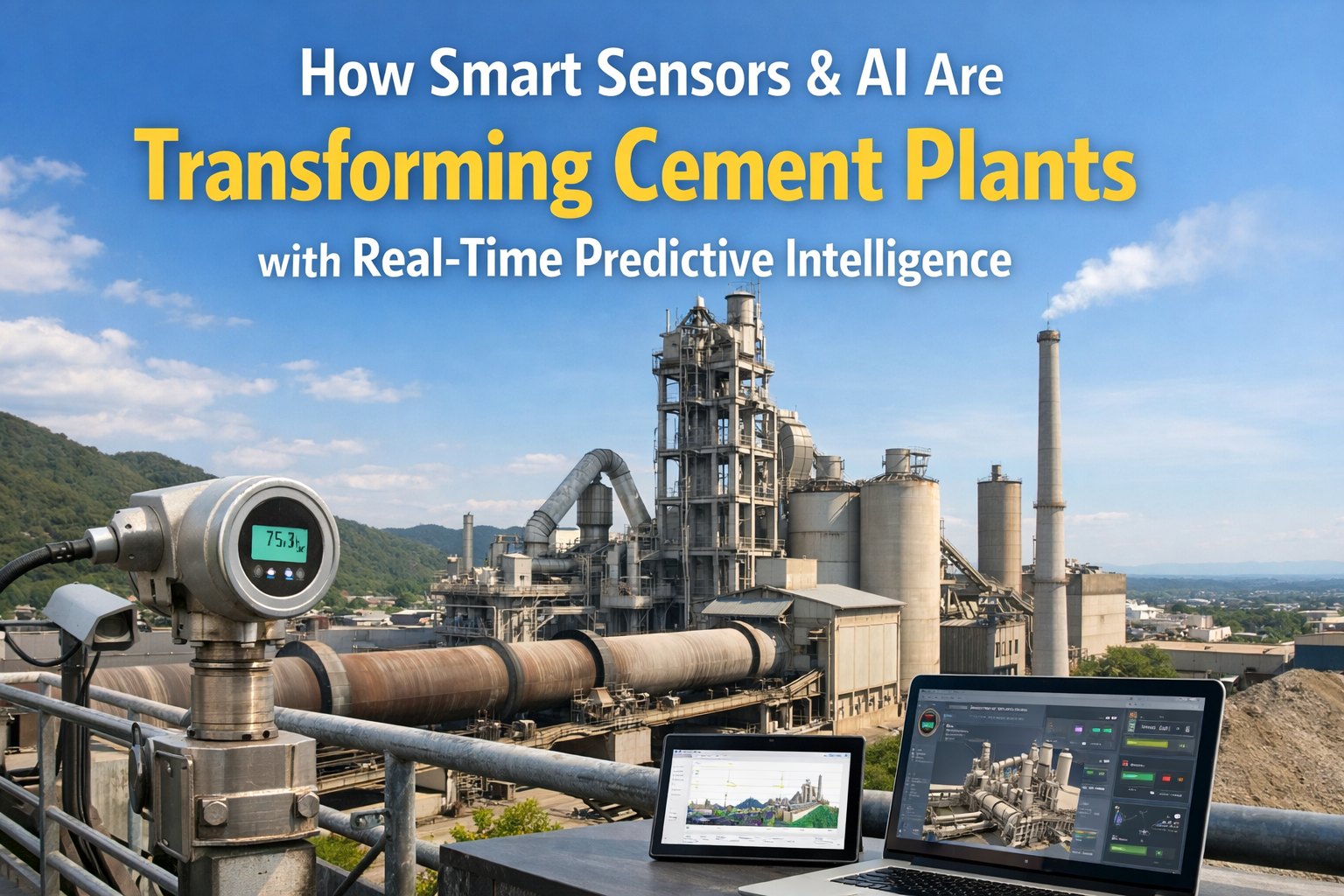
Cement plants are among the most energy-intensive manufacturing environments on the planet — rotary kilns running at 1,450°C, ball mills grinding around the clock, and conveyor systems stretching across kilometers of dusty, high-vibration terrain. Smart IoT sensors and AI analytics now make it possible to monitor every critical asset in real time, predict failures weeks before they happen, and optimize energy consumption across the entire production line. Book a Smart Plant Demo to explore how sensor-driven intelligence can transform your cement operations.
How Smart Sensors & AI Are Transforming Cement Plants with Real-Time Predictive Intelligence
IoT-Powered Monitoring, AI Failure Prediction, and Energy Optimization for the Cement Industry's Most Critical Equipment
Why Traditional Cement Plant Monitoring Fails
Manual inspections and reactive maintenance cost cement plants millions every year in lost production, wasted energy, and unplanned downtime.
Types of Smart Sensors Deployed Across Cement Plants
Every stage of cement production — from quarry to dispatch — has critical equipment that smart sensors can monitor continuously.
Crushers and conveyors operate under extreme vibration and abrasive conditions. Accelerometers detect bearing wear in crushers, while belt-speed sensors catch slippage and misalignment before material flow is disrupted.
Vertical roller mills and ball mills are the highest energy consumers. Vibration signatures identify roller bearing degradation, gear mesh faults, and liner wear — while power meters flag grinding inefficiency in real time.
The kiln is the heart of cement production, operating at 1,450°C. Thermal scanning arrays detect hot spots indicating refractory brick loss, while gas analyzers optimize combustion efficiency and prevent dangerous CO buildups.
Cooler airflow directly impacts clinker quality and energy recovery. Downstream, cement mill sensors monitor grinding efficiency, separator performance, and final product fineness — closing the loop on quality control.
Data Collection & Integration Architecture
How sensor data flows from the plant floor to AI analytics and enterprise decision-making systems.
IP68-rated wireless sensors deployed on kilns, mills, crushers, fans, and conveyors — collecting vibration, temperature, pressure, and gas data continuously, even in the harshest dust and heat conditions.
Edge computing devices aggregate sensor data locally, perform initial anomaly filtering, and transmit compressed data packages to the cloud platform via industrial protocols — maintaining connectivity even in remote plant sections.
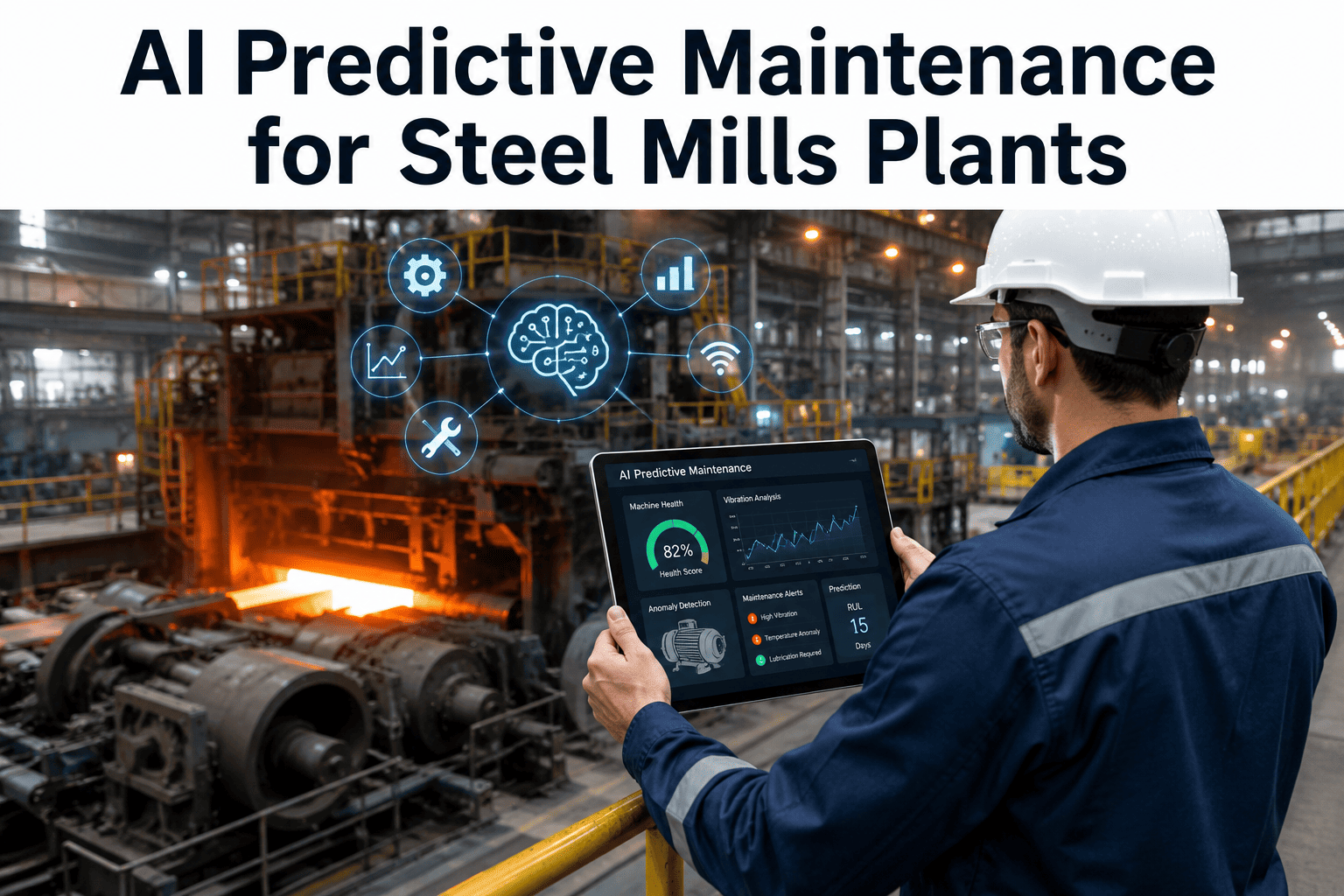
Machine learning algorithms analyze real-time sensor streams against historical baselines — detecting bearing degradation, thermal anomalies, vibration pattern shifts, and energy consumption spikes weeks before they become critical failures.
AI-generated insights flow directly into maintenance management, ERP, and control systems — automatically creating work orders, ordering spare parts, updating compliance records, and feeding digital twin models for continuous process optimization.
AI Predictive Analytics & Failure Detection
From raw vibration data to weeks-ahead failure predictions — here's how AI transforms sensor signals into maintenance intelligence.
Bearing & Gearbox Failure Prediction
ML models trained on spectral vibration data identify bearing defects, gear mesh anomalies, and shaft misalignment across mills, fans, and crushers. Pattern recognition catches degradation signatures that human analysts miss — providing 3–6 weeks advance warning before catastrophic failure.
Kiln Refractory & Hot Spot Detection
Infrared thermal scanner data is continuously analyzed by AI models that map kiln shell temperature distribution, predict refractory brick degradation zones, and calculate optimal replacement timing — preventing the $2M+ cost of emergency kiln shutdowns.
Combustion & Quality Optimization
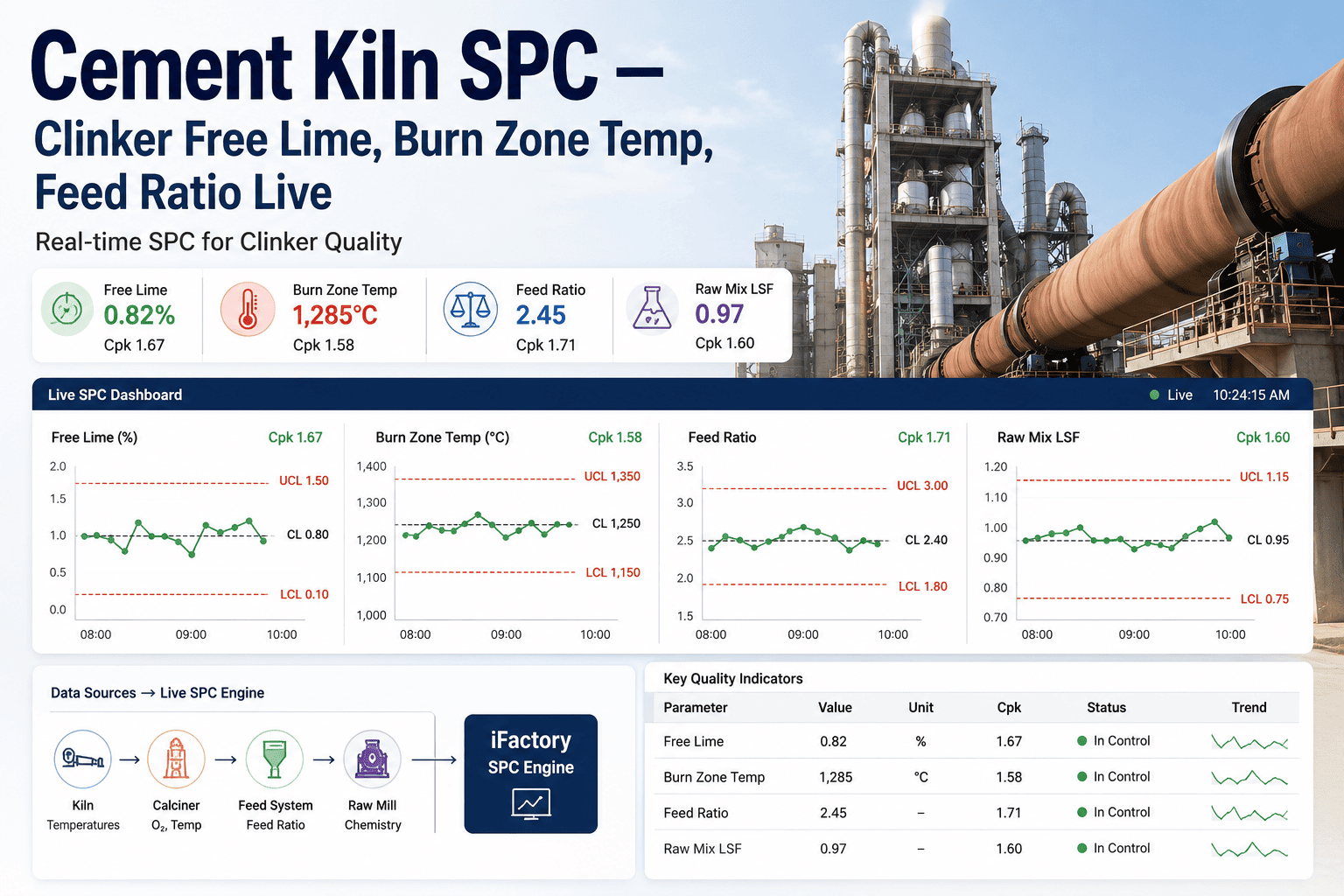
AI models correlate gas analyzer readings, kiln feed rates, fuel inputs, and clinker quality samples to predict free lime content in real time — enabling operators to optimize combustion parameters without waiting 40 minutes for lab analysis results.
Grinding Circuit Energy Optimization
Cement milling circuits consume up to 4% of global electrical energy. AI analyzes clinker feed rates, mill speed, separator efficiency, and power draw to eliminate over-grinding — achieving target fineness with minimum energy input per tonne of cement produced.
Still Relying on Scheduled Maintenance and Manual Inspections?
iFactory connects smart sensor data from your kilns, mills, and conveyors directly to AI-powered analytics and your CMMS — transforming raw data into automated work orders, energy savings, and compliance-ready reports.
Energy Optimization & Production Efficiency Gains
Smart sensors and AI don't just prevent breakdowns — they actively optimize how your plant consumes energy and produces cement.
AI-optimized kiln firing, mill grinding parameters, and cooler airflow management dramatically reduce thermal and electrical energy waste across the entire production chain.
Continuous condition monitoring with predictive alerts enables maintenance teams to plan interventions during scheduled stops — not emergency shutdowns that disrupt production.
AI pinpoints the exact component degrading — bearing, liner, gearbox, refractory — so maintenance crews fix the right thing the first time, with the right parts already on hand.
Real-time monitoring of grinding fineness, clinker composition, and blending ratios keeps product quality within specification — reducing off-spec batches and customer complaints.
Every sensor reading, anomaly alert, and maintenance action is automatically logged with timestamp and equipment tag — creating compliance-ready documentation for regulators.
From a single dashboard, operations managers see real-time health status of every critical asset — kiln, mill, crusher, fan, and conveyor — across all production lines and shifts.
Implementation Roadmap & ROI Timeline
A phased approach that delivers measurable returns at every stage — starting fast, scaling smart.
Sensor Deployment & Data Foundation
Install wireless vibration, temperature, and power sensors on the 20% of equipment that causes 80% of downtime — kilns, main mills, and primary fans. Connect to edge gateways and establish baseline health signatures.
AI Model Training & CMMS Integration
Train predictive models on baseline sensor data. Integrate AI analytics with iFactory CMMS to automatically generate maintenance work orders when anomalies are detected. Connect to existing SCADA/DCS for unified monitoring.
Full-Plant Rollout & Energy Optimization
Expand sensor coverage to all critical and semi-critical assets. Deploy energy optimization AI for kiln firing, grinding circuits, and cooler operations. Launch digital twin for route simulation and coverage analysis.
What Leading Cement Manufacturers Are Achieving
Deployed comprehensive wireless monitoring across rotary kilns, mills, fans, and auxiliary equipment. Vibration monitoring for mills and fans, thermal monitoring for kilns, and electrical monitoring for motor drives — all integrated into a unified analytics platform.
Integrated machine learning and big data analytics for predictive maintenance across their global cement operations. Cloud-based platform enables real-time data synchronization with remote expert support and predictive analysis to optimize production processes.
Frequently Asked Questions
What types of sensors are used in cement plants?
Common sensor types include vibration accelerometers, infrared thermal scanners, gas analyzers (O2, CO, NOx), acoustic emission sensors, power consumption meters, oil quality analyzers, and particle size sensors. Industrial-grade sensors with IP68 ratings are required to withstand the extreme dust, heat, and vibration conditions found in cement manufacturing.
How quickly can we see ROI from smart sensor deployment?
Most plants see initial returns within 3–6 months as predictive alerts prevent the first unplanned shutdowns. Full ROI — including energy optimization and comprehensive predictive maintenance — typically achieves 12–18 month payback with ongoing annual savings of 15–25% on maintenance costs.
Can smart sensors integrate with our existing SCADA and PLC systems?
Yes. Modern IoT sensor platforms connect to existing DCS, SCADA, and PLC infrastructure via OPC-UA, Modbus TCP, and MQTT protocols. iFactory CMMS integrates through standard REST APIs — wrapping existing systems without requiring replacement.
How does AI predict equipment failures from sensor data?
Machine learning algorithms are trained on historical sensor data to establish normal operating baselines. When real-time vibration, temperature, or power signatures deviate from these baselines in patterns that match previous failure events, the AI triggers early warnings — typically 3–6 weeks before the component would fail.
What equipment should be monitored first?
Start with the assets that cause the most downtime and cost: rotary kilns, primary mills (ball or VRM), main ID fans, and clinker coolers. These typically represent 80% of your unplanned downtime risk. Expand to crushers, conveyors, and secondary mills once the high-impact equipment is covered.
What role does iFactory play in smart sensor integration?
iFactory CMMS ingests all sensor data and AI-generated insights, automatically converting anomaly detections into maintenance work orders, spare part requisitions, and compliance reports. It bridges the gap between raw sensor intelligence and actionable plant maintenance operations — no manual data entry required.
Your Cement Plant Deserves Predictive Intelligence
See how iFactory connects smart IoT sensors, AI predictive analytics, and your enterprise systems into one intelligent monitoring and maintenance platform purpose-built for cement manufacturing.