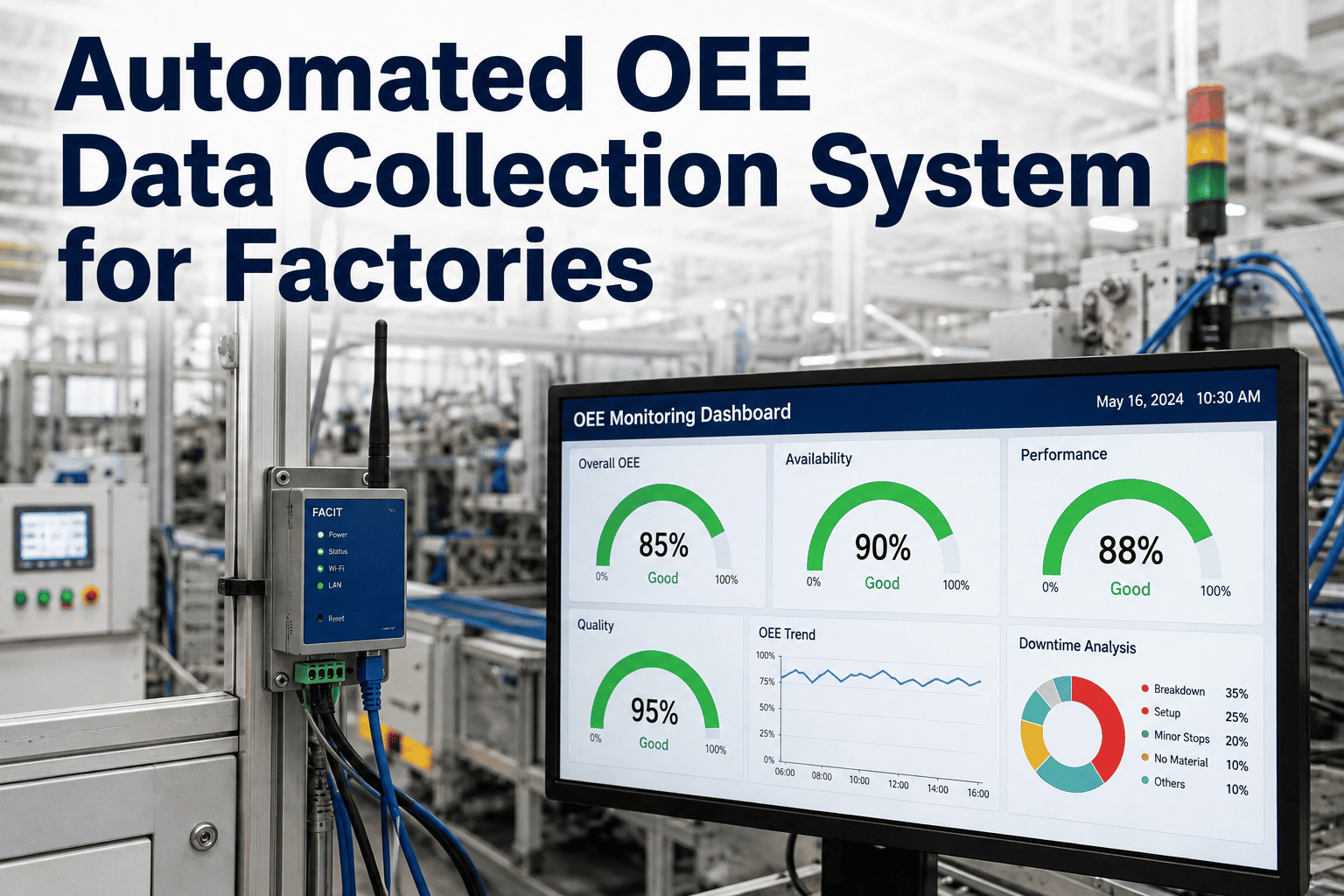
Your OEE dashboard says 78%. Your operators say the line was down half the shift. Someone is wrong — and if it is your data, every production decision built on top of it is compromised. Manufacturers who switch from manual reporting to automated, CMMS-integrated OEE tracking see data accuracy improve dramatically and unplanned downtime drop by up to 44%. Here is how to make your OEE numbers tell the truth. Book a free demo to see how iFactory eliminates OEE reporting errors.
OEE Data Accuracy: Best Practices to Eliminate Production Reporting Errors
Stop Making Million-Dollar Decisions on Guesswork — Fix Your OEE Data Pipeline from Shop Floor to Dashboard
Why Most OEE Numbers Are Wrong
The metric is only as powerful as the data feeding it. Here is where accuracy breaks down.
Manual Data Entry
Operators scribble downtime on paper hours after an event. Production counts are estimated. Shift handovers lose context. The result is OEE scores that reflect memory, not reality.
Inconsistent Definitions
Shift A counts changeover as planned downtime. Shift B counts it as unplanned. One plant defines ideal cycle time differently from another. Same formula, wildly different outcomes.
Missing Micro-Stops
Small stoppages under 5 minutes — jams, sensor trips, material feed delays — rarely get logged manually. They accumulate invisibly and erode Performance scores without anyone noticing.
Delayed Reporting
When OEE is calculated end-of-shift or next-day, the data is already stale. Patterns that could have been caught in real time become yesterday's problem — too late to act.
Siloed Systems
Production data lives in MES. Maintenance data lives in spreadsheets. Quality data sits in a separate database. Without integration, OEE calculations miss entire categories of loss.
Understanding OEE: The Three Pillars That Must Be Accurate
Each component has its own data traps. Fix all three or your overall score is meaningless.
Availability
Operators underreport unplanned stops. Changeover durations are estimated. Planned vs. unplanned downtime categories are inconsistently applied across shifts.
Auto-capture machine state via PLC signals. Use standardized downtime reason codes enforced through digital dropdowns — not free-text fields.
Performance
Ideal cycle time is set too high, inflating scores. Micro-stops under 5 minutes are invisible. Slow cycles caused by worn tooling go undetected.
Validate ideal cycle time against machine telemetry, not nameplate specs. Deploy IoT sensors to capture every stop — even 10-second jams.
Quality
Scrap data lags production by hours or days. Rework is not counted as a quality loss. First-pass yield is confused with final yield after corrections.
Integrate inline quality inspection data in real time. Count only first-pass good parts. Connect quality events to upstream process parameters automatically.
7 Proven Practices to Fix OEE Data Accuracy
Actionable steps manufacturers use to transform OEE from a vanity metric into a decision-making engine.
Standardize Definitions Across Every Shift and Plant
Create a single OEE data dictionary that defines planned vs. unplanned downtime, ideal cycle times for every product-machine combination, and quality rejection criteria. Every operator, supervisor, and manager must use the same language. Without this, cross-shift and cross-plant comparisons are meaningless.
Automate Machine State Detection
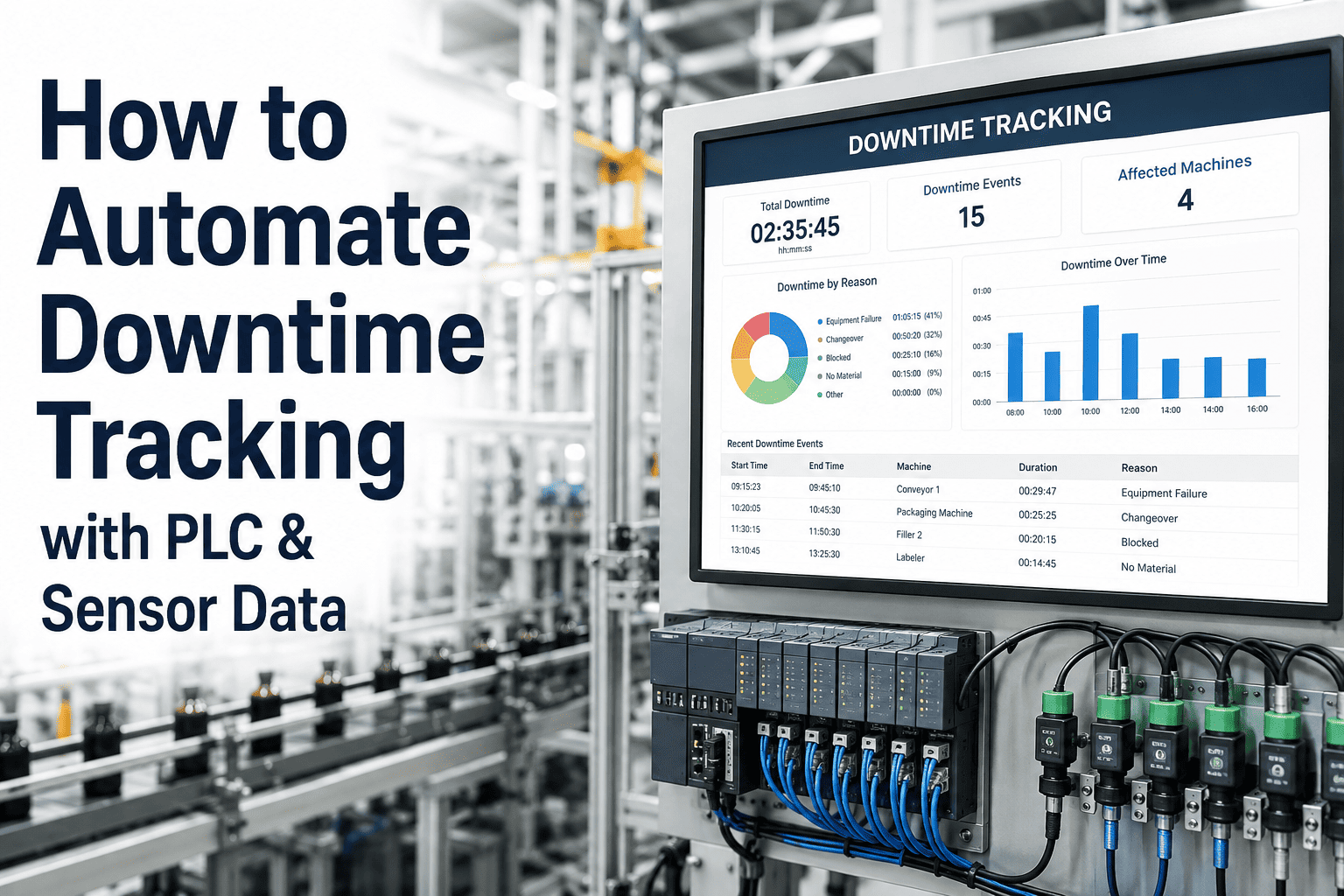
Connect directly to PLCs, CNC controllers, or IoT edge devices to capture machine running, idle, and fault states automatically. This eliminates the single biggest source of OEE error — human recall and transcription. Automated capture reduces misreporting by more than 50% compared to manual logging methods.
Use Structured Downtime Reason Codes
Replace free-text downtime descriptions with a pre-defined, hierarchical reason code tree. Level 1 captures category (Mechanical, Electrical, Material, Operator). Level 2 captures specifics (Bearing Failure, Sensor Trip, Material Jam). This makes root cause analysis possible and prevents the "miscellaneous" black hole.
Deploy Live OEE Dashboards on the Shop Floor
When operators see their OEE score updating in real time — not at end of shift — they self-correct immediately. Visual scoreboards near production lines create instant feedback loops. Problems get flagged in minutes, not days. Real-time visibility is not a luxury; it is the backbone of accurate OEE.
Connect CMMS, MES, and ERP into One Data Pipeline
When maintenance logs in CMMS, production counts in MES, and quality records in ERP are unified, OEE calculations become holistic. A machine breakdown automatically updates Availability. A rejected batch instantly adjusts Quality. No manual re-entry, no data gaps, no contradictions between systems.
Audit OEE Data Weekly — Not Quarterly
Cross-verify dashboard data with operator logs, sensor readings, and maintenance reports. When OEE spikes unexpectedly, investigate before celebrating. Look for impossible Performance scores above 100%, which indicate incorrect ideal cycle time settings. Treat validation as a weekly discipline, not a quarterly event.
Reward Accurate Reporting, Not High Numbers
If teams are penalized for low OEE, they will inflate it. Shift the culture to reward transparency — the team that uncovers a hidden loss is more valuable than the team that hides one. Accurate data that shows 55% OEE is worth infinitely more than fabricated data that shows 80%.
Your OEE Is Only as Good as Your Data Pipeline
iFactory CMMS automates downtime capture, enforces structured reason codes, and integrates with MES and ERP — so your OEE dashboard reflects reality, not guesswork.
Manual vs. Automated OEE Data Collection
The most effective approach is hybrid: automated machine data capture enriched with structured operator context through digital forms. iFactory CMMS supports both — giving you numbers you can trust and context you can act on.
The Accurate OEE Data Architecture
From sensor to boardroom — every layer must be airtight.
What Accurate OEE Data Actually Unlocks
When you trust your numbers, everything downstream improves.
Organizations investing in data-driven maintenance programs decrease unplanned downtime significantly by addressing root causes — not symptoms.
OEE software within smart factory contexts has shown overall effectiveness improvements of up to 21% through automated data collection and integrated reporting.
Companies that adopt predictive maintenance powered by accurate, real-time data reduce equipment breakdowns by up to 70% while optimizing resource allocation.
When maintenance and quality data are connected, organizations see defect rates drop dramatically — because root causes are found and fixed, not just documented.
OEE Data Accuracy Audit: Rate Your Plant
Score yourself honestly. Each "No" is a data gap that is costing you money.
Frequently Asked Questions
What is a realistic OEE target for most manufacturers?
World-class OEE is considered 85% (90% Availability, 95% Performance, 99% Quality). However, most factories operate at 60% or below. The first priority should be ensuring your data is accurate before chasing higher scores — a true 55% is more valuable than a fabricated 80%.
How does a CMMS improve OEE data accuracy?
A CMMS like iFactory automatically logs maintenance events against equipment, links downtime to specific work orders, and feeds Availability data directly into OEE calculations. This eliminates the gap between what maintenance records say and what production reports show.
Can we automate OEE on older, legacy equipment?
Yes. Legacy machines that lack native connectivity can be retrofitted with IoT sensors that detect machine state through current sensors, vibration monitors, or light-stack signals. These feed into edge gateways that publish data to your OEE system without modifying the machine itself.
What is the biggest single fix for inaccurate OEE?
Standardizing definitions. If every shift, operator, and plant defines downtime categories, ideal cycle times, and quality criteria the same way, you eliminate the most common source of OEE data corruption — inconsistency. Automation is second; standardization is first.
Stop Guessing. Start Knowing Your True OEE.
iFactory CMMS automates downtime tracking, enforces standardized reason codes, integrates with your MES and ERP, and delivers live OEE dashboards your team can trust.