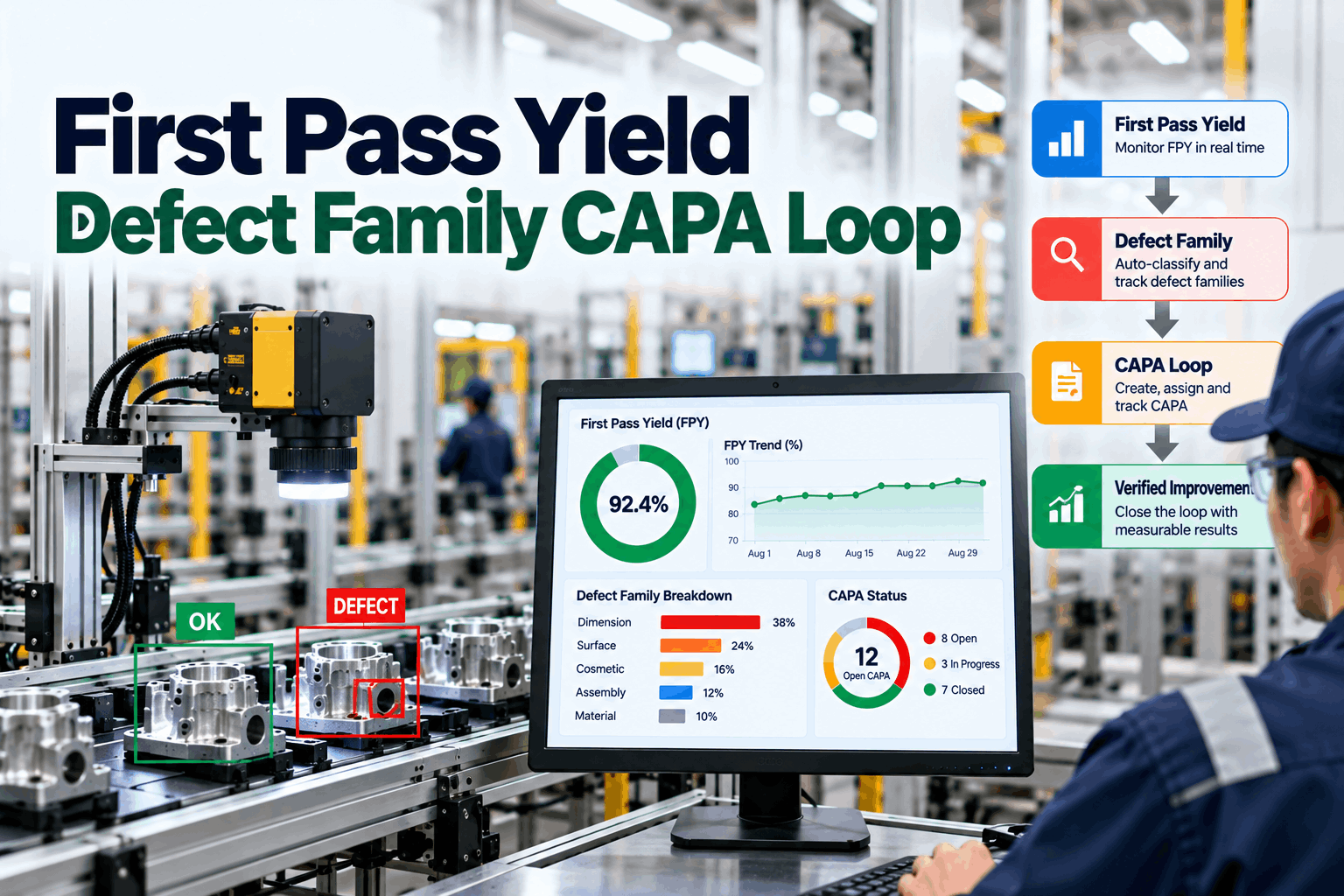
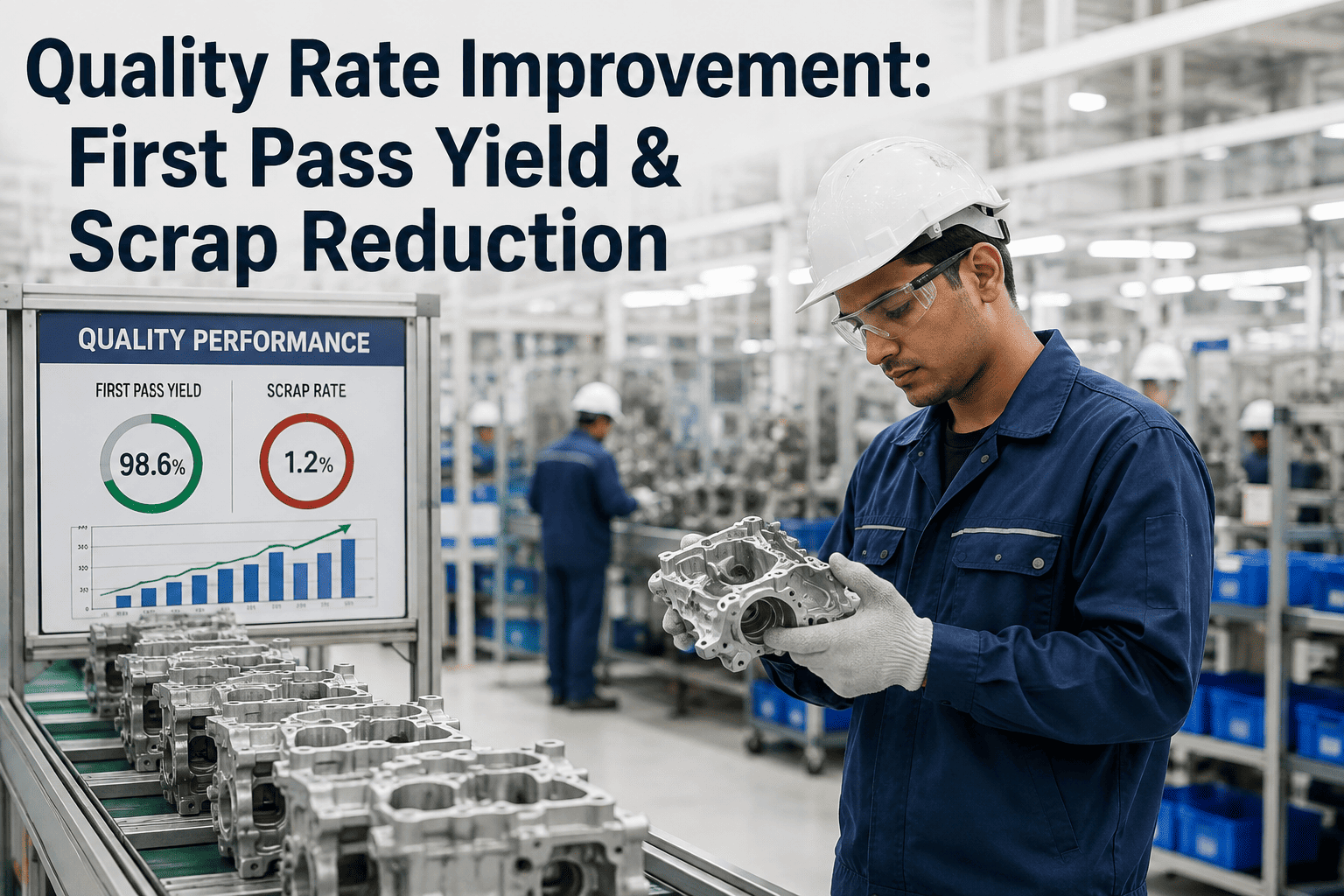
Every percentage point of quality loss in your OEE score silently drains revenue — a plant producing 10,000 units daily at 95% quality instead of 99.9% loses 490 good parts every single day. The Quality KPI is the most financially impactful and least understood component of OEE, yet it holds the key to eliminating scrap, slashing rework costs, and building a production line that gets it right the first time. Book a free demo to see how iFactory tracks quality in real time.
Quality KPI Explained for OEE: Reduce Defects and Improve Yield
Understand the Quality Factor in OEE, Master the Formulas, and Build a Data-Driven Quality Culture That Eliminates Scrap and Rework
What Is the Quality KPI in OEE?
The third pillar of OEE that separates good plants from world-class operations.
OEE (Overall Equipment Effectiveness) is calculated by multiplying three factors: Availability x Performance x Quality. While Availability measures uptime and Performance measures speed, the Quality KPI answers the most critical question of all — of everything you produced, how much was actually sellable?
The Quality factor is expressed as a simple ratio: the number of good units divided by the total units produced. It captures every defect, every rework cycle, and every scrapped part — making it the most direct indicator of process health on the shop floor.
Quality KPI Formula and Calculation
A 4% quality improvement adds 2.9 percentage points to OEE — translating to thousands of additional sellable units per month.
5 Quality Metrics Every Plant Manager Must Track
Quality is not one number. It is an ecosystem of interconnected measurements.
First Pass Yield (FPY)
FPY = Good Units (No Rework) / Total Units Started x 100
The percentage of products manufactured correctly on the first attempt. A FPY above 95% is considered good, and world-class operations target above 99%. It is the purest measure of process efficiency and directly maps to the Quality factor in OEE.
Benchmark: 95%+ Good | 99%+ World-ClassDefect Rate
Defect Rate = Defective Units / Total Units Produced x 100
Tracks how frequently quality issues arise. An acceptable industry standard is below 5%, but leading manufacturers push below 1%. Essential for identifying problem areas in your process.
Benchmark: Below 1% for leading manufacturersScrap Rate
Scrap Rate = Scrapped Units / Total Units Produced x 100
Measures the proportion of materials permanently discarded due to defects that cannot be repaired. High scrap directly impacts profitability — every scrapped unit is raw material, machine time, and labor wasted.
Benchmark: Below 5% acceptable | Below 2% targetRework Rate
Rework Rate = Reworked Units / Total Units Produced x 100
Units requiring additional processing to meet specifications. While rework recovers product, it doubles cycle time and labor costs. A rework rate that hides behind an acceptable quality score is a silent profit killer.
Benchmark: Below 3% for process stabilityCost of Poor Quality (COPQ)
COPQ = Internal Failure Costs + External Failure Costs
The total financial impact of quality failures — including scrap, rework, warranty claims, inspections, and customer returns. COPQ typically accounts for 15–20% of total manufacturing costs in average-performing plants.
Benchmark: Below 5% of revenue for world-classWhere Quality Losses Actually Happen
Not all defects are created equal. Understanding the source changes the fix.
Most plants track in-process rejects but completely ignore startup rejects. On a line with 3 changeovers per shift, those "expected" rejects silently consume 5% of your capacity — a productivity loss that never appears in your OEE score unless you measure it.
6 Common Causes of Poor Quality in Manufacturing
Defects are symptoms. These are the diseases.
Equipment Degradation
Worn bearings, dull tooling, misaligned fixtures, and servo drift produce parts that gradually fall out of spec. Without continuous monitoring, the quality decline is invisible until scrap rates spike.
Process Variability
Inconsistent machine settings, temperature fluctuations, and pressure variations between shifts introduce defects. When operators use different parameters for the same product, quality becomes unpredictable.
Raw Material Inconsistency
Supplier changes in chemical composition, dimensional tolerance, or surface quality affect downstream processes. A machining operation optimized for one steel grade will produce rejects when the grade changes without notification.
Operator Error and Training Gaps
Incorrect loading, skipped inspection steps, or falling back on outdated procedures account for a significant proportion of defects. Skill matrices and standardized work instructions are essential but often incomplete.
Poor Changeover Procedures
Every setup is a quality risk. Without standardized changeover checklists, the first 10–50 parts off a new run are often scrapped as "warm-up waste" — a hidden capacity loss that compounds across shifts.
Lack of Real-Time Visibility
If defect data takes hours or days to reach decision-makers, the window for corrective action is already gone. Manual quality logs, paper-based audits, and end-of-shift reporting create lag that allows scrap to accumulate unchecked.
Stop Counting Defects. Start Preventing Them.
iFactory CMMS connects quality data with equipment health, maintenance schedules, and production analytics — giving your team real-time visibility into quality performance before scrap hits the bin.
7 Proven Strategies to Improve Quality KPI
From quick wins to systemic transformation — a practical improvement roadmap.
1. Standardize Work Instructions at Every Station
Create clear, visual SOPs for every operation. When every operator follows the same procedure, you eliminate the human variability that drives defect rates up. Digital work instructions on tablets replace paper binders that nobody reads.
2. Implement Real-Time Quality Dashboards
Replace end-of-shift reports with live quality metrics visible on the shop floor. When operators and supervisors can see defect rates spiking in real time, they react in minutes instead of hours. iFactory provides exactly this visibility.
3. Link Maintenance Data to Quality Outcomes
Track which maintenance events correlate with quality dips. When you can prove that overdue PM tasks on Machine 5 cause a 3% FPY drop, maintenance becomes a quality investment — not just a cost center.
4. Deploy Statistical Process Control (SPC)
Use control charts to monitor critical process parameters in real time. SPC detects when a process is drifting toward out-of-spec before a single defective unit is produced — the difference between prevention and reaction.
5. Strengthen Supplier Quality Management
Incoming material quality directly impacts FPY. Implement incoming quality checks, establish clear specifications with suppliers, and track supplier defect rates. When a supplier changes material composition, your process should know before the defects appear.
6. Build Predictive Quality Models
Use machine sensor data — vibration, torque, temperature — to predict quality failures before they occur. When rising torque on a specific joint correlates with dimensional drift, the system triggers maintenance before parts go out of spec.
7. Conduct Root Cause Analysis on Every Defect
Use 5 Whys, Fishbone diagrams, and Pareto analysis to trace every defect back to its source. Document findings and feed them into your CMMS to prevent recurrence. Plants that analyze every quality event improve FPY 3x faster than those that rely on technology alone.
How Quality Connects to the Full OEE Picture
Quality does not exist in isolation. It drives — and is driven by — the other two OEE pillars.
Quality Affects Availability
Frequent quality failures trigger unplanned stops for machine inspection, calibration, and repair. A rising defect rate is often the first warning sign of an impending equipment breakdown that will take the line down entirely.
Quality Affects Performance
Rework cycles consume machine capacity. Every unit that runs through the line twice halves the effective throughput for that unit. Scrap during startup forces extended warm-up periods that reduce effective run speed.
Availability and Performance Affect Quality
Rushed restarts after downtime increase startup defects. Running machines above optimal speed to "catch up" after delays produces more defective parts. Overdue maintenance creates the equipment degradation that causes quality drift in the first place. All three OEE factors are deeply interconnected.
Quality KPI Benchmarks: Where Does Your Plant Stand?
Frequently Asked Questions
What is considered a good Quality score in OEE?
The world-class benchmark for OEE Quality is 99.9%, meaning only 1 defective part per 1,000 produced. Average-performing plants typically score between 95–98%. Every percentage point gained has a direct impact on profitability and overall OEE.
What is the difference between Quality KPI and First Pass Yield?
In the context of OEE, they measure the same thing — the percentage of parts made correctly the first time without rework. FPY is the operational metric; the OEE Quality factor is how it feeds into the overall effectiveness calculation.
How does quality loss affect overall OEE?
Since OEE multiplies Availability x Performance x Quality, even a small quality drop has a compounding effect. If Availability and Performance are both 85%, improving Quality from 95% to 99% lifts OEE from 68.6% to 71.5% — equivalent to gaining almost 3 full points of OEE.
Can a CMMS really improve quality metrics?
Absolutely. An integrated CMMS like iFactory connects equipment health data with quality outcomes, automatically generating maintenance work orders when quality signals degrade. This turns quality data into a predictive tool that prevents defects before they happen.
What is Cost of Poor Quality (COPQ)?
COPQ is the total financial cost of quality failures — including scrap, rework, warranty claims, inspection costs, and customer returns. In average plants, COPQ accounts for 15–20% of total manufacturing costs. Tracking it makes quality improvement a CFO-level priority.
How quickly can plants see results from quality improvement?
Quick wins like standardized work instructions and real-time dashboards can reduce defect rates within weeks. Systemic improvements like predictive maintenance and SPC typically deliver measurable FPY gains within 2–3 months of implementation.
Turn Quality Data Into Your Competitive Advantage
iFactory CMMS connects equipment health, quality metrics, and maintenance scheduling into one intelligent platform — so your team catches defects before they become scrap.