Chemical plants are among the most hazardous industrial environments on earth — explosive atmospheres, toxic gas pockets, corrosive chemicals, and multi-level pipe racks that demand inspection around the clock. Quadruped robots navigate stairs, grating, and confined spaces that wheeled systems cannot reach, while ROS 2 provides the unified middleware layer that connects these robots to PLCs, digital twins, CMMS, and enterprise systems in real time. Request a ROS 2 Integration Workshop to explore quadruped robot deployment for your chemical facility.
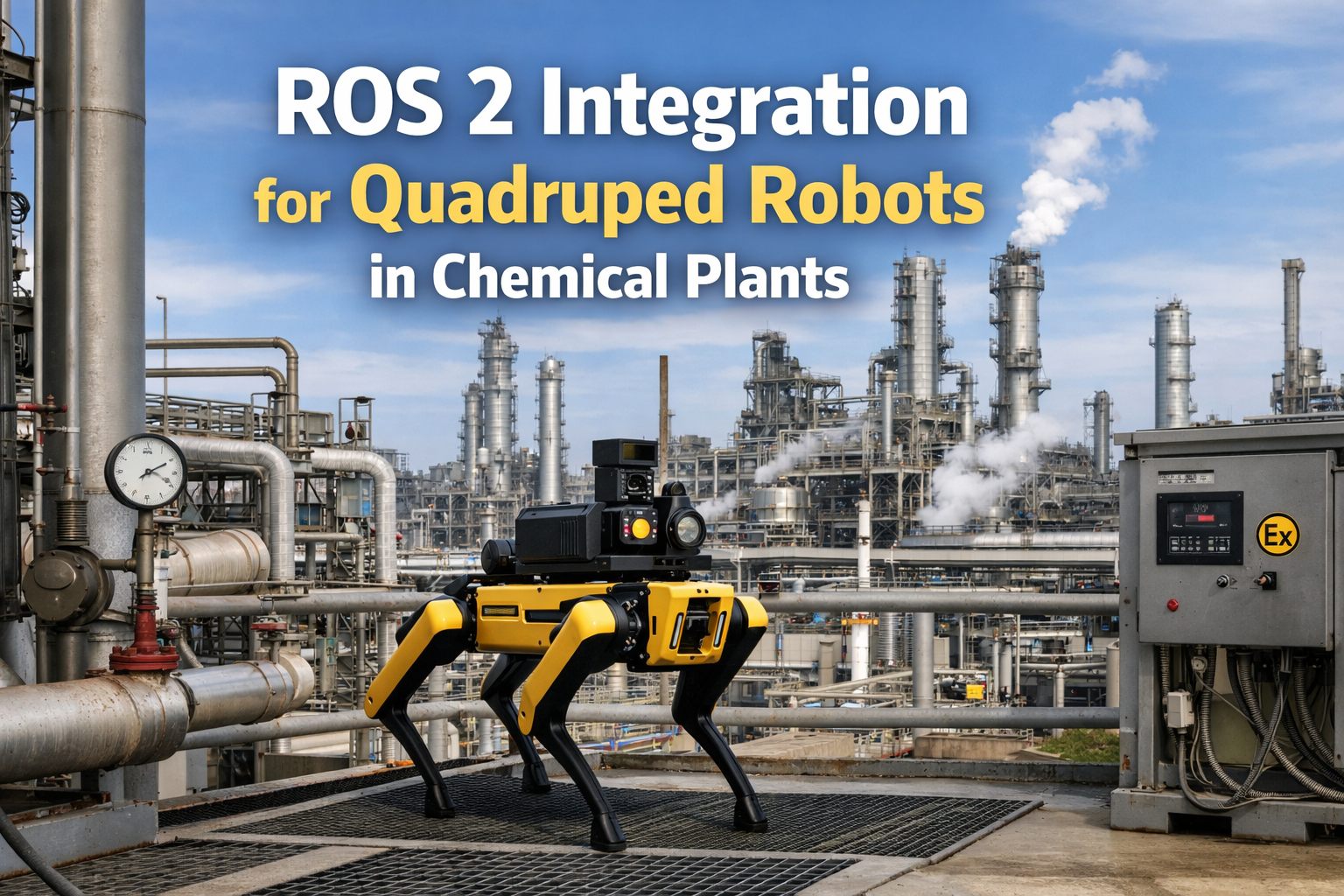
ROS 2 Integration for Quadruped Robots in Chemical Plants
Autonomous Inspections, Leak Detection, Thermal Monitoring, and Enterprise Integration for the Chemical Industry's Most Dangerous Zones
Why Chemical Plants Need Quadruped Robots
Wheeled robots fail where four legs succeed — and manual inspections put people in harm's way.
Explosive Atmospheres
Large areas of chemical plants are classified ATEX Zone 1, where flammable gases and vapors can be present during normal operations. Any equipment deployed must be intrinsically safe and certified to prevent ignition — eliminating most standard robotic platforms.
Complex Multi-Level Terrain
Pipe racks, mezzanines, catwalks, grated stairways, and cable trays create a three-dimensional maze that wheeled or tracked robots cannot navigate. Quadrupeds climb stairs at up to 45 degrees, step over 30 cm obstacles, and traverse gravel, grating, and wet surfaces.
Human Safety Risk
Routine inspection rounds expose workers to toxic gases (H2S, CO, methane), extreme temperatures, and confined spaces. Every manual inspection is a potential safety incident — quadruped robots eliminate this exposure entirely for routine rounds.
Data Silos and Manual Logging
Traditional inspections produce paper-based reports that take hours to digitize and days to analyze. Without real-time data flow into CMMS and ERP systems, anomalies are flagged too late for preventive action — turning inspections into documentation exercises rather than decision tools.
ROS 2 Architecture for Quadruped Inspection Systems
How ROS 2 connects every layer — from the robot's legs to the enterprise dashboard.
How ROS 2 Powers Quadruped Autonomy
The software components that turn a four-legged platform into an intelligent inspection system.
Nav2 provides autonomous path planning and obstacle avoidance for quadrupeds navigating chemical plant environments. Using pre-built SLAM maps augmented with real-time LiDAR data, the robot plans efficient patrol routes, dynamically reroutes around unexpected obstacles, and returns to its charging dock autonomously after completing inspection missions.
GPS does not work inside chemical plant structures. ROS 2 SLAM algorithms fuse LiDAR, IMU, and leg odometry data to build and maintain 3D maps of the facility. The robot knows its exact position at all times — even in GPS-denied, multi-floor environments with metallic structures that confuse standard localization systems.
Manages the 12 actuated joints of a quadruped in real time. ros2_control abstracts the hardware interface so that the same high-level gait commands work across different quadruped platforms — whether you deploy Boston Dynamics Spot, ANYbotics ANYmal, Unitree B2, or other ROS 2-compatible robots.
ROS 2 nodes aggregate data from thermal cameras, RGB cameras, gas detection sensors, LiDAR, acoustic sensors, and vibration analyzers into unified inspection reports. Each data stream is a DDS topic — timestamped, geo-tagged, and correlated with the robot's position on the facility map.
Inspection Use Cases in Chemical Plants
Gas Leak Detection Rounds
Quadrupeds equipped with methane, H2S, CO, and VOC sensors patrol classified zones on scheduled routes. ROS 2 publishes gas concentration readings as real-time topics, triggering instant alerts to control rooms when thresholds are exceeded — replacing manual sniff tests that expose operators to toxic environments.
Equipment Thermal Monitoring
Onboard FLIR thermal cameras capture heat signatures of pumps, compressors, heat exchangers, and electrical panels. ROS 2 nodes compare readings against digital twin baselines, flagging bearing overheating, insulation degradation, and cooling system failures before they cause unplanned shutdowns.
Analog Gauge and Valve Reading
AI-powered vision nodes running on ROS 2 automatically read analog pressure gauges, liquid levels, lever positions, and valve states. Data is digitized, timestamped, and fed directly into SCADA and CMMS — eliminating manual transcription errors and providing a complete digital audit trail.
Vibration and Acoustic Analysis
Mounted accelerometers and microphones capture vibration signatures from rotating equipment. ROS 2 publishes spectral analysis data that identifies bearing degradation, impeller imbalance, and cavitation in pumps — conditions that traditional visual inspections cannot detect.
Incident Response and Reconnaissance
When alarms trigger in hazardous zones, teleoperated quadrupeds provide immediate eyes-on-scene before human teams enter. ROS 2's low-latency DDS communication enables real-time video feed and gas readings to the emergency command center — drastically reducing response decision time.
Regulatory Inspection Documentation
Every inspection point is automatically logged with timestamp, GPS-denied location coordinates, sensor readings, and visual evidence. ROS 2 data pipelines generate compliance-ready reports for OSHA, EPA, and PSM audits — transforming inspection from a manual burden into an automated digital workflow.
Your Plant Inspections Deserve Better Than Clipboards.
iFactory connects ROS 2 quadruped robot data with your CMMS, digital twin, and enterprise systems — transforming raw sensor data into actionable maintenance work orders and compliance reports.
ROS 2 + PLC + Enterprise System Integration
The robot collects the data. The integration layer turns it into decisions.
Robot to PLC
ROS 2 bridges to Siemens S7 and Allen-Bradley PLCs via OPC-UA and Modbus TCP. Robot inspection data triggers PLC-controlled safety actions — valve shutoffs, ventilation activation, or alarm escalation — without human intervention in the loop.
Robot to SCADA
Inspection telemetry streams into existing SCADA dashboards alongside process data. Operators see robot health, location, and sensor readings on the same screens they use to monitor reactors, distillation columns, and utility systems.
Robot to CMMS (iFactory)
When a quadruped detects a thermal anomaly, gas leak, or vibration spike, iFactory CMMS automatically generates a maintenance work order — complete with location, severity, sensor data, and photographic evidence. No manual data entry required.
Robot to SAP / ERP
Inspection data flows into SAP Plant Maintenance (PM) or equivalent ERP modules. Spare part consumption, maintenance labor hours, and compliance records update automatically — closing the loop between field inspection and financial planning.
Digital Twin Integration for Chemical Plant Robotics
Simulate routes. Mirror live missions. Predict failures. Optimize coverage.
Route Simulation
Build a complete 3D model of your chemical facility in Gazebo using point cloud data. Test inspection routes, stair navigation, and obstacle avoidance in simulation before deploying the physical robot — validating every waypoint and sensor angle virtually.
Live Mission Mirroring
During active patrols, the digital twin mirrors the robot's exact position, sensor feeds, and inspection status in real time via DDS topics. Control room operators watch the robot's progress through the virtual plant without needing direct camera feeds.
Anomaly Correlation
ML models running against twin data correlate thermal readings, vibration patterns, and gas concentrations with historical maintenance events. When sensor signatures match patterns that preceded past failures, the system triggers early warnings weeks in advance.
Coverage Optimization
Analyze inspection coverage maps against actual incident data. The digital twin identifies under-inspected zones and high-risk areas, enabling data-driven patrol route optimization that maximizes coverage while minimizing robot battery consumption and mission time.
Hazardous Area Compliance for Quadruped Robots
Deploying robots in classified zones requires rigorous certification and engineering.
Zone 1 classified areas require all equipment to be intrinsically safe — guaranteed not to cause ignition even in the presence of explosive gases. Ex-certified quadrupeds like ANYmal X use pressurized enclosures, intrinsically safe actuators, and advanced thermal management to meet these standards.
Chemical plant environments involve water spray, chemical splashes, and corrosive dust. Industrial quadrupeds are rated IP67 — fully dust-tight and capable of temporary water immersion — ensuring reliable operation in washdown areas and outdoor exposed installations.
Process Safety Management (PSM) regulations require documented inspection of process equipment. ROS 2-powered autonomous inspections generate timestamped, geo-tagged digital records that exceed manual logging standards — providing auditable evidence of compliance at every inspection point.
Robot actions that trigger safety responses — valve shutoffs, emergency ventilation, alarm escalation — route through SIL-rated PLC safety systems. ROS 2 handles intelligence and coordination; PLCs own the safety-critical execution layer. The robot never directly controls safety functions.
Business Impact of Autonomous Quadruped Inspections
From safety improvement to operational savings — the measurable returns.
Early detection of equipment anomalies through continuous automated inspection translates directly into reduced unplanned downtime — a 1.5% improvement in uptime represents significant revenue recovery for chemical operations running 24/7.
Quadrupeds do not fatigue, do not require safety briefings, and can operate overnight and on weekends. Autonomous inspection coverage that would require three shifts of human inspectors runs uninterrupted with a single robot fleet.
Every routine inspection round removed from human operators is a potential safety incident prevented. For chemical plants where a single H2S exposure event can be fatal, the safety ROI alone justifies the investment.
Automated timestamped reporting eliminates manual data entry, transcription errors, and paper-based compliance gaps. Every inspection data point flows directly into CMMS and ERP — creating an unbroken digital audit trail for regulators.
Implementation Challenges and Solutions
ATEX Certification Costs
Ex-certified robots cost 3–5x more than standard platforms, and every component must be independently certified.
Start with non-ATEX zones — utilities, storage, and general process areas — where standard IP67 quadrupeds operate. Expand to Ex-zones with certified platforms once ROI is proven on initial deployment.
Legacy System Integration
Chemical plants run decades-old DCS, PLC, and SCADA infrastructure with proprietary protocols.
ROS 2 bridges to legacy systems via OPC-UA, Modbus, and MQTT gateways. iFactory CMMS connects through standard REST APIs — wrapping existing infrastructure without requiring a rip-and-replace.
Connectivity in Metal Structures
Dense pipe racks and metal structures create dead zones that disrupt Wi-Fi and standard wireless communication.
ROS 2's DDS middleware supports store-and-forward messaging. Quadrupeds cache inspection data during connectivity gaps and synchronize when they return to coverage zones — no data is lost.
Operator Trust and Adoption
Plant operations teams are skeptical of autonomous systems operating in safety-critical environments.
Begin with supervised teleoperation mode, where operators control the robot remotely. Gradually increase autonomy as confidence builds. iFactory dashboards provide full visibility into what the robot sees, detects, and reports — maintaining human oversight at all times.
Frequently Asked Questions
Which quadruped robots are compatible with ROS 2?
Major platforms include Boston Dynamics Spot, ANYbotics ANYmal, Unitree B2 and A2, and Ghost Robotics Vision 60. All offer ROS 2 SDKs or compatible interfaces. ANYmal X is the only Ex-certified legged robot for ATEX Zone 1 environments.
Can quadruped robots operate in ATEX Zone 1?
Yes. ANYmal X holds ATEX and IECEx Zone 1 certification, using pressurized enclosures and intrinsically safe components. It has been deployed at BASF Ludwigshafen and PETRONAS facilities for autonomous inspection in classified explosive atmospheres.
How does the robot navigate without GPS indoors?
ROS 2 SLAM algorithms fuse LiDAR, IMU, and leg odometry data to build and maintain 3D maps of the facility. The robot localizes against these maps in real time, achieving centimeter-level accuracy in GPS-denied multi-floor chemical plant structures.
How does inspection data reach our CMMS and SAP?
ROS 2 nodes publish inspection data as DDS topics. iFactory CMMS ingests this data via REST APIs and webhooks, automatically generating work orders. SAP integration flows through standard RFC or OData connectors — no custom middleware required.
What sensors can the robot carry?
Typical payloads include thermal cameras (FLIR), pan-tilt-zoom visual cameras, LiDAR, gas detection sensors (CH4, H2S, CO, VOC), acoustic microphones, vibration accelerometers, and 3D scanners. Payload capacity ranges from 15–40 kg depending on the platform.
What role does iFactory play in quadruped robot integration?
iFactory CMMS ingests all robot inspection data and converts anomaly detections into maintenance work orders, spare part requisitions, and compliance reports. It bridges the gap between robotic data collection and actionable plant maintenance operations.
Bring Autonomous Inspection to Your Chemical Plant
See how iFactory connects ROS 2 quadruped robots, PLCs, digital twins, and enterprise systems into one intelligent inspection and maintenance platform purpose-built for chemical manufacturing.