Vibration Monitoring for Automotive Motors & Gearboxes
By Lucas Reed on February 17, 2026
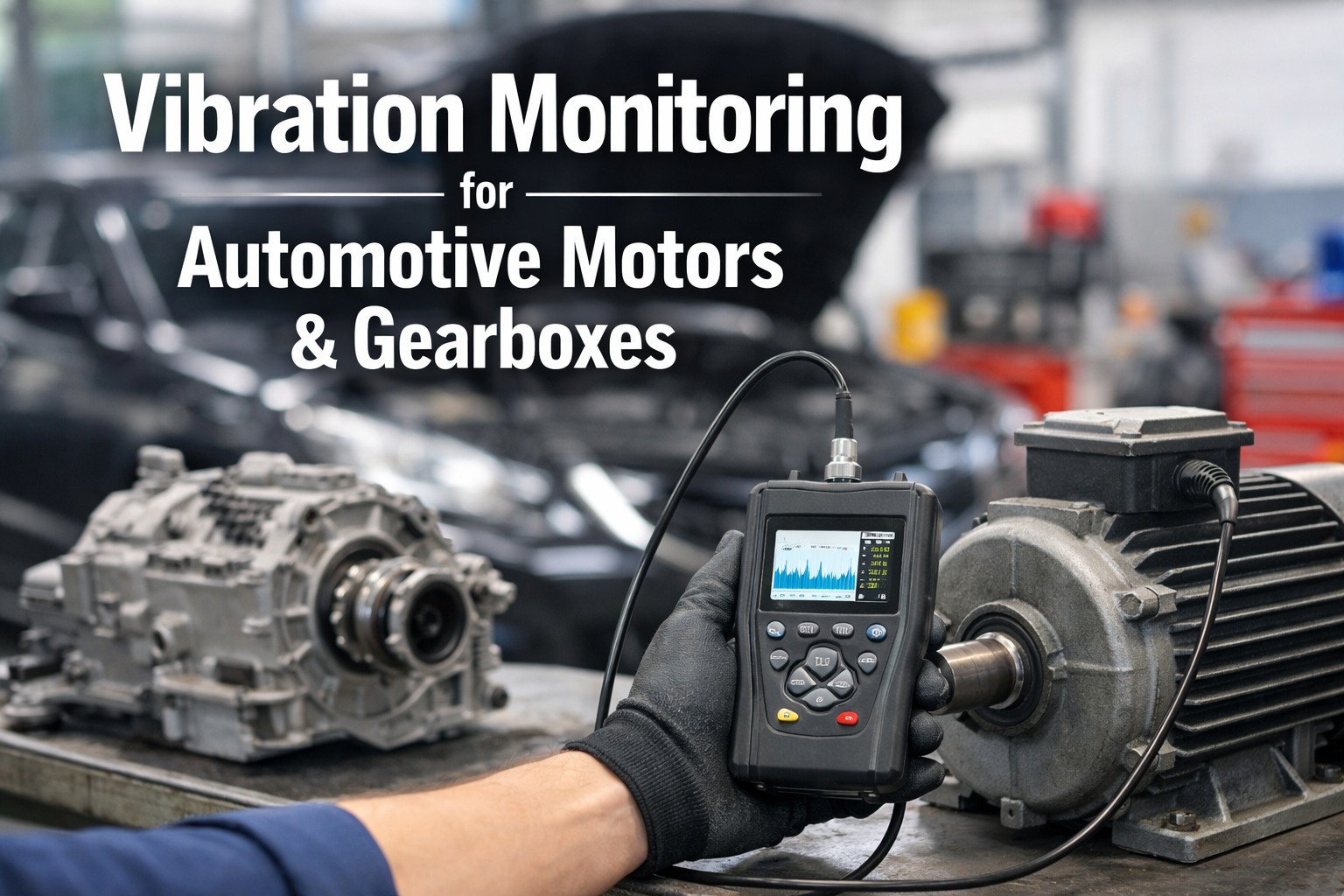
An automotive assembly plant runs thousands of motors and gearboxes 24/7conveyor drives, press motors, robot axis gearboxes, paint booth fans, and stamping press flywheels. When one seizes, the entire line stops. Unexpected shutdowns cost industrial manufacturers nearly $50 billion annually, and in automotive, downtime runs $2.3 million per hour at the highest end. But every motor and gearbox tells you it's failing—weeks before it does—through vibration. Bearing defects shift frequency patterns. Gear teeth wear creates harmonic sidebands. Misalignment produces distinctive phase signatures. The question isn't whether the warning signs exist. It's whether you have sensors listening. Today, 54% of manufacturing plants integrate vibration sensors as standard maintenance infrastructure, and facilities using vibration monitoring report 37% fewer unexpected equipment failures. Here's how vibration analysis works for automotive motors and gearboxes—and why it's the highest-ROI predictive maintenance investment you can make.
$520M
Vibration Monitoring Market 2024
90%+
Fault Detection Accuracy
37%
Fewer Unexpected Failures
Why Motors & Gearboxes Are the #1 Monitoring Priority
In an automotive plant, rotating equipment drives everything. When these assets fail without warning, entire production zones go dark. Here's why vibration monitoring on motors and gearboxes delivers the highest reliability return.
Conveyor Drive Motors
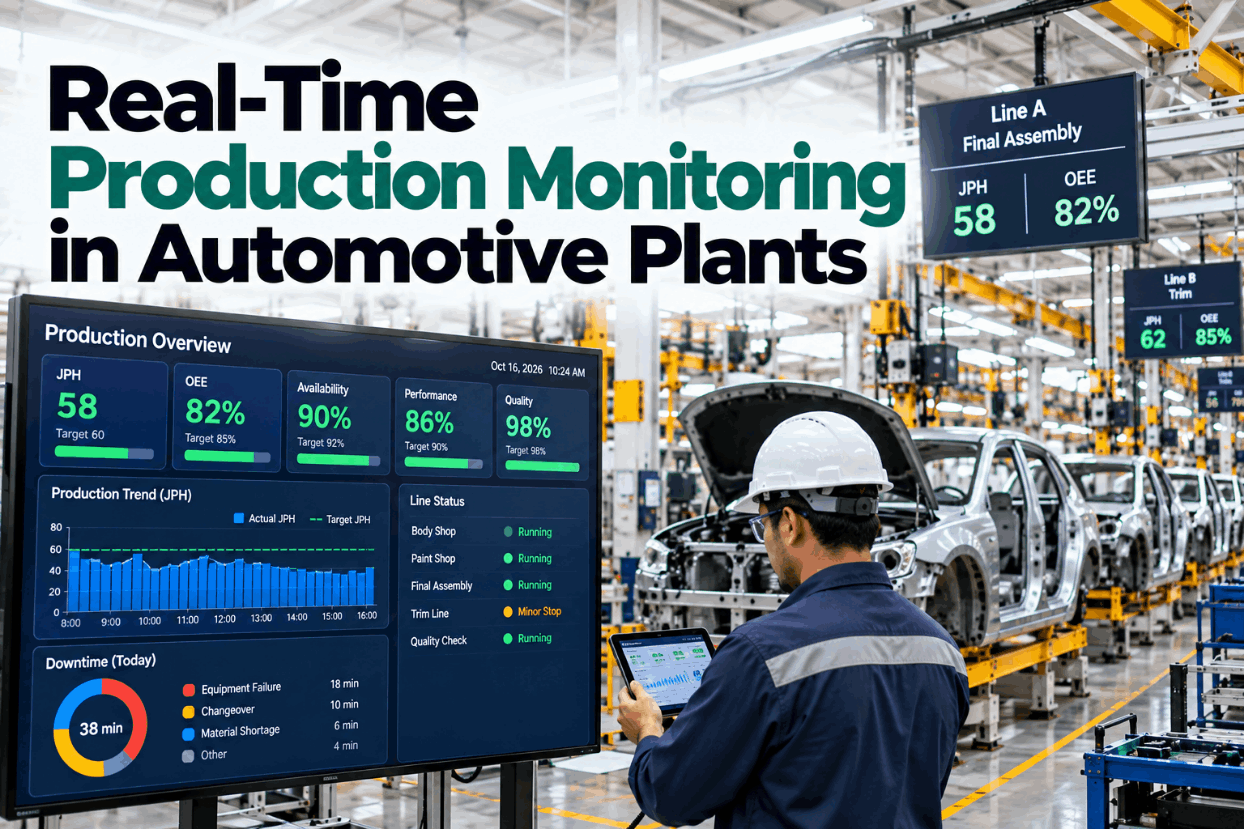
Body shop, paint shop, and final assembly conveyors run continuously. A single drive motor failure stops the entire line—every station upstream and downstream.
Impact: Full line stoppage, $8,000-$50,000+/hr
Press & Stamping Motors
Flywheel motors on stamping presses handle extreme cyclic loads. Bearing damage progresses rapidly under high inertia, and replacement requires crane operations.
Impact: 1-3 week lead time for replacement
Robot Axis Gearboxes
Welding and material handling robots depend on precision gearboxes. Backlash from worn gears causes positioning errors that degrade weld and assembly quality.
Impact: Quality escapes + robot downtime
HVAC & Booth Fans
Paint booth supply and exhaust fans maintain critical airflow and temperature. Fan motor failure changes booth pressure balance, causing immediate paint quality defects.
Every rotating component produces a unique vibration "signature." When defects develop, those frequencies shift—creating patterns that AI algorithms classify with over 90% accuracy. Here's the fault-to-frequency map for automotive motors and gearboxes:
01
Bearing Defects
Most Common
Rolling-element bearings are the most common failure point in motors and gearboxes. As balls and races pit and degrade, they create characteristic defect frequencies (BPFO, BPFI, BSF, FTF) detectable weeks before audible noise or temperature rise. Envelope analysis and kurtosis-based detectors isolate bearing signals even in electromagnetically noisy motor environments.
4-8 weeks early warningEnvelope spectrum analysisHigh-frequency acceleration
02
Gear Mesh Wear
Gearbox Critical
Gear defects create harmonics at the gear mesh frequency (GMF = teeth × shaft RPM) with modulation sidebands at shaft speed. Pitting, scoring, or cracked teeth produce amplitude modulation visible in the spectrum. As wear progresses, mesh stiffness fluctuates and sidebands sharpen—allowing maintenance teams to track degradation rate and schedule intervention.
Shaft misalignment between motors and gearboxes creates elevated 2× and 3× running speed vibration, especially in the axial direction. Left unchecked, it accelerates bearing wear, loosens couplings, and generates excessive heat. Precision alignment verified through vibration readings is one of the simplest yet highest-impact reliability improvements.
Mass imbalance produces elevated vibration at exactly 1× running speed. Common after motor rewinds, fan blade fouling, or coupling damage. Single-plane or two-plane balancing corrects it—but only if detected before the imbalance damages bearings permanently.
Rotor bar cracks, stator eccentricity, and winding faults produce vibration at 2× line frequency (120 Hz / 100 Hz) with pole-pass sidebands. Combining vibration with Motor Current Analysis (MCA) distinguishes mechanical from electrical issues—preventing unnecessary bearing replacements when the real problem is electrical.
2× line frequencyMCA + vibration combinedDemagnetization detection
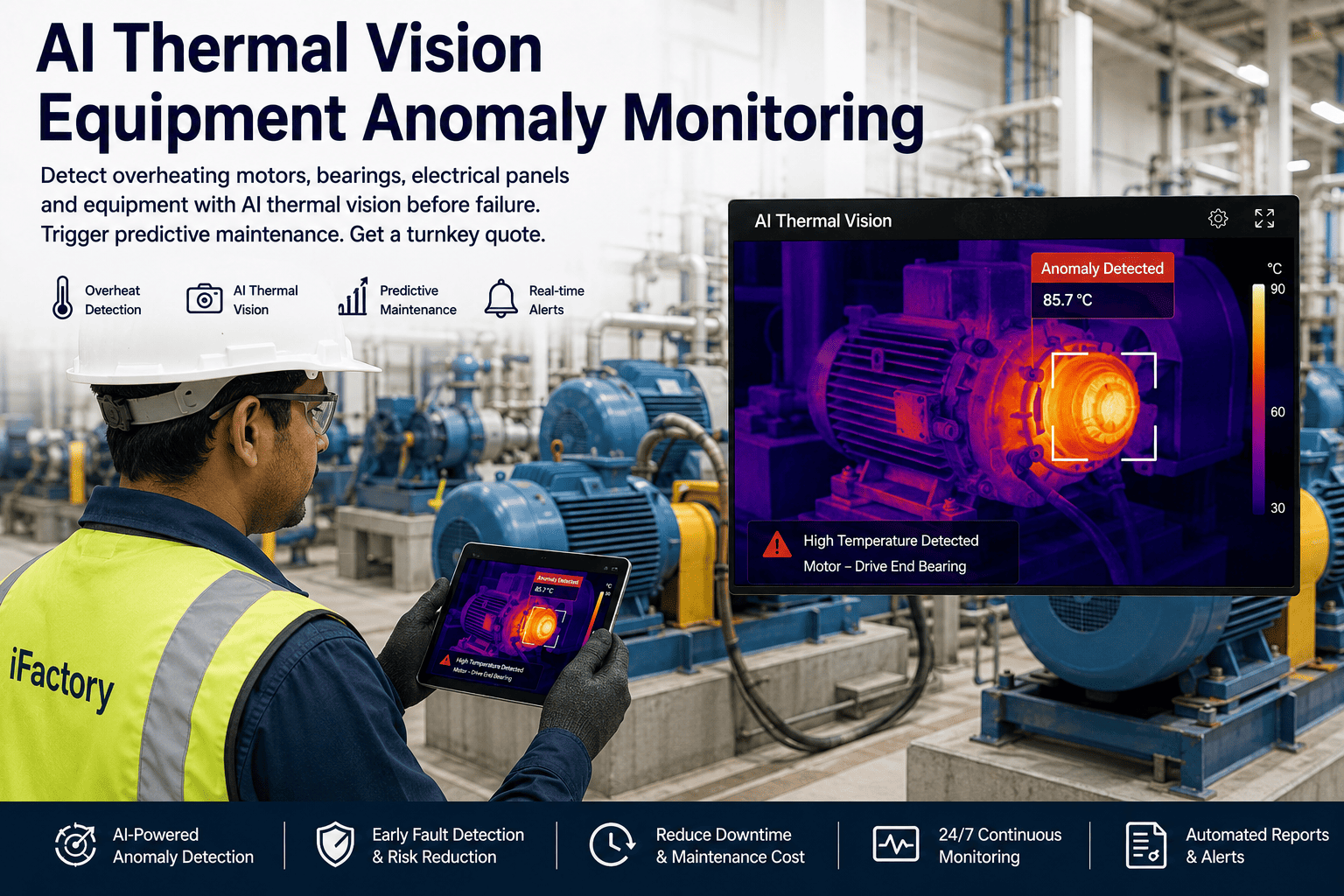
iFactory connects vibration sensors, AI diagnostics, and CMMS work order automation into one platform—so faults generate work orders, not production stoppages.
One prevented gearbox failure saves $8,000-$10,000 in rebuild costs plus $50,000-$150,000+ in avoided downtime and secondary damage.
$50K-$150K+saved per prevented failure event
Reduce Unplanned Downtime
Facilities with vibration monitoring report 37% fewer unexpected equipment failures. Planned repairs during scheduled shutdowns eliminate production impact.
37%fewer unexpected failures
Extend Asset Life
Catching misalignment and imbalance early prevents cascading secondary damage to bearings, seals, shafts, and housings—extending motor and gearbox service life.
20-40%longer equipment life
Reduce Maintenance Costs
Shift from time-based PM (replacing parts on schedule) to condition-based (replacing when needed). Eliminate unnecessary rebuilds while catching real problems.
25-40%maintenance cost reduction
Expert Perspective
"Vibration monitoring remains one of the most effective techniques in the reliability toolkit. It detects a wide spectrum of mechanical and electrical failures—bearings, imbalance, gear wear, looseness, and more—often long before any visible symptoms appear. By combining vibration data with Motor Current Analysis, maintenance teams can identify whether a problem is mechanical or electrical—preventing unnecessary part replacements and enabling targeted repairs."
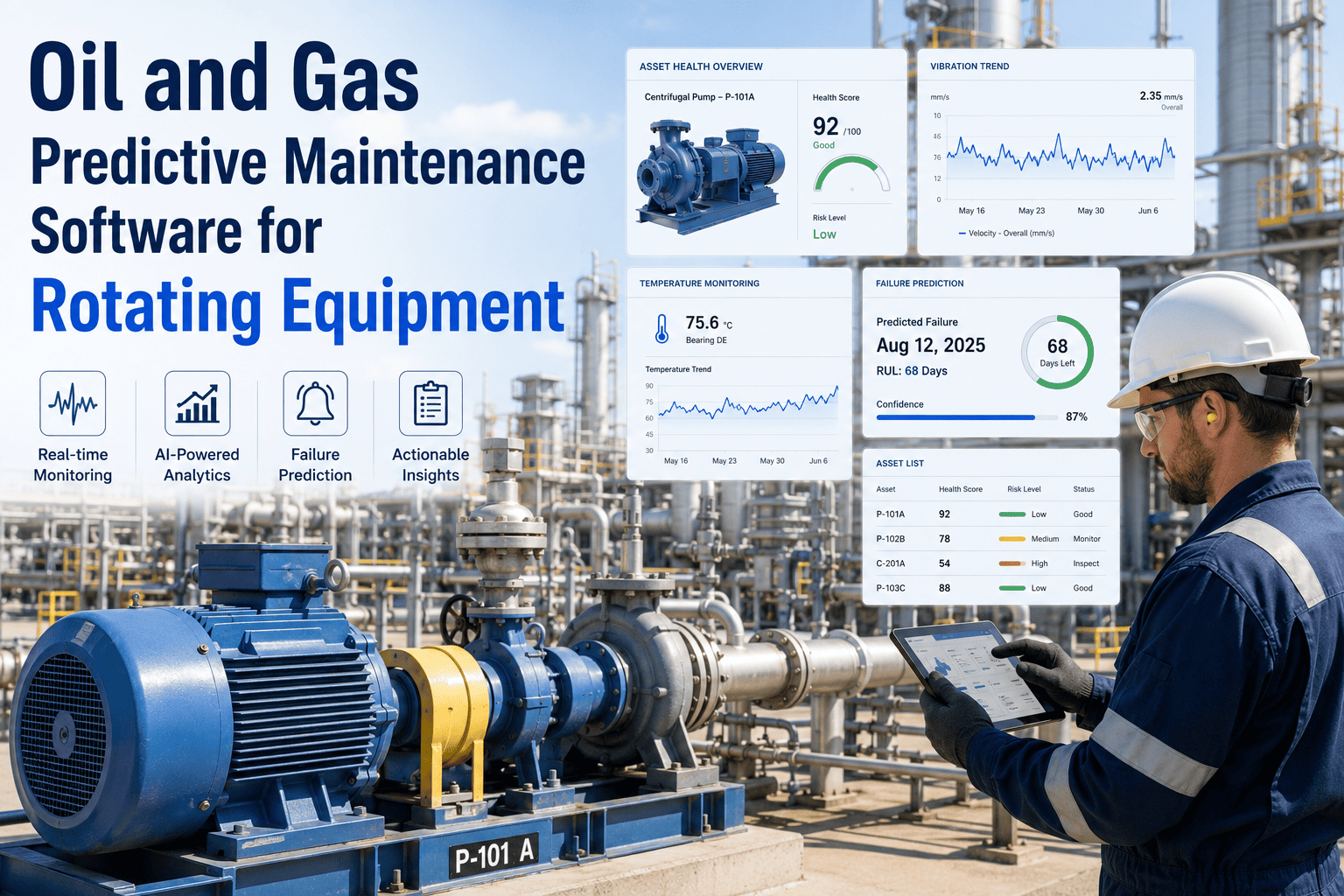
iFactory connects wireless vibration sensors to AI diagnostics and CMMS—auto-generating prioritized work orders when fault signatures are detected, so your team acts on data, not guesswork.
What faults can vibration analysis detect in motors and gearboxes?
Vibration analysis detects bearing defects (pitting, wear, contamination), gear mesh wear and tooth damage, shaft misalignment, rotor imbalance, mechanical looseness, belt and coupling problems, and electrical faults such as rotor bar cracks and stator eccentricity. Each fault produces a characteristic frequency signature. Bearing defects create specific frequencies (BPFO, BPFI, BSF), gear problems show up at gear mesh frequency with sidebands, and misalignment elevates 2× and 3× running speed. Modern AI systems classify these patterns with over 90% accuracy.
How far in advance can vibration monitoring detect motor or gearbox failure?
Warning lead time depends on the fault type and asset. Bearing defects in motors and gearboxes are typically detectable 4-8 weeks before failure using high-frequency acceleration measurements. Gear mesh wear in gearboxes produces detectable changes 2-6 weeks early. Misalignment and imbalance are detectable immediately once they develop. Ultrasonic analysis (frequencies above 30 kHz) provides the earliest possible detection—identifying lubrication problems before any physical damage occurs. Continuous wireless monitoring catches developing faults between scheduled route-based checks, closing the gap where problems can go unnoticed.
What sensors are needed for vibration monitoring?
Start with wireless vibration sensors measuring RMS velocity (overall machine health indicator) and high-frequency RMS acceleration (early bearing wear detector). Mount sensors as close as possible to the component you want to monitor—typically at motor bearings or shaft bearings. For gearboxes, triaxial accelerometers capture vibration in all three axes to detect gear mesh issues and misalignment. Add temperature sensors for bearing and lubrication monitoring. Modern wireless sensors (IP67/IP68 rated) install in minutes without cabling and transmit data directly to your CMMS or analytics platform. Over 32% of newly deployed industrial vibration systems are now wireless.
How does vibration monitoring integrate with CMMS?
Modern platforms connect vibration data directly to your CMMS via API. When the AI detects a fault signature—say, a developing bearing defect at BPFO frequency with rising amplitude—it automatically creates a prioritized work order with diagnostic data: fault type, severity level (green/yellow/red), affected asset, recommended action, and parts needed. This eliminates manual data entry and ensures nothing falls through the cracks between detection and repair. iFactory's platform provides this end-to-end integration from sensor to work order to completion verification.
What's the cost and ROI of implementing vibration monitoring?
Wireless vibration sensors cost $200-$1,500 per monitoring point depending on capability. A typical automotive plant might start with 20-50 critical assets (conveyor drives, press motors, key gearboxes) at $10,000-$50,000 total sensor investment. The global vibration monitoring market reached $520 million in 2024 and is growing at 4.9% CAGR, driven by proven ROI. One prevented gearbox failure saves $50,000-$150,000+ in avoided downtime and repairs. Facilities report 37% fewer unexpected failures and 25-40% maintenance cost reduction. Most operations achieve full payback from a single prevented failure event.