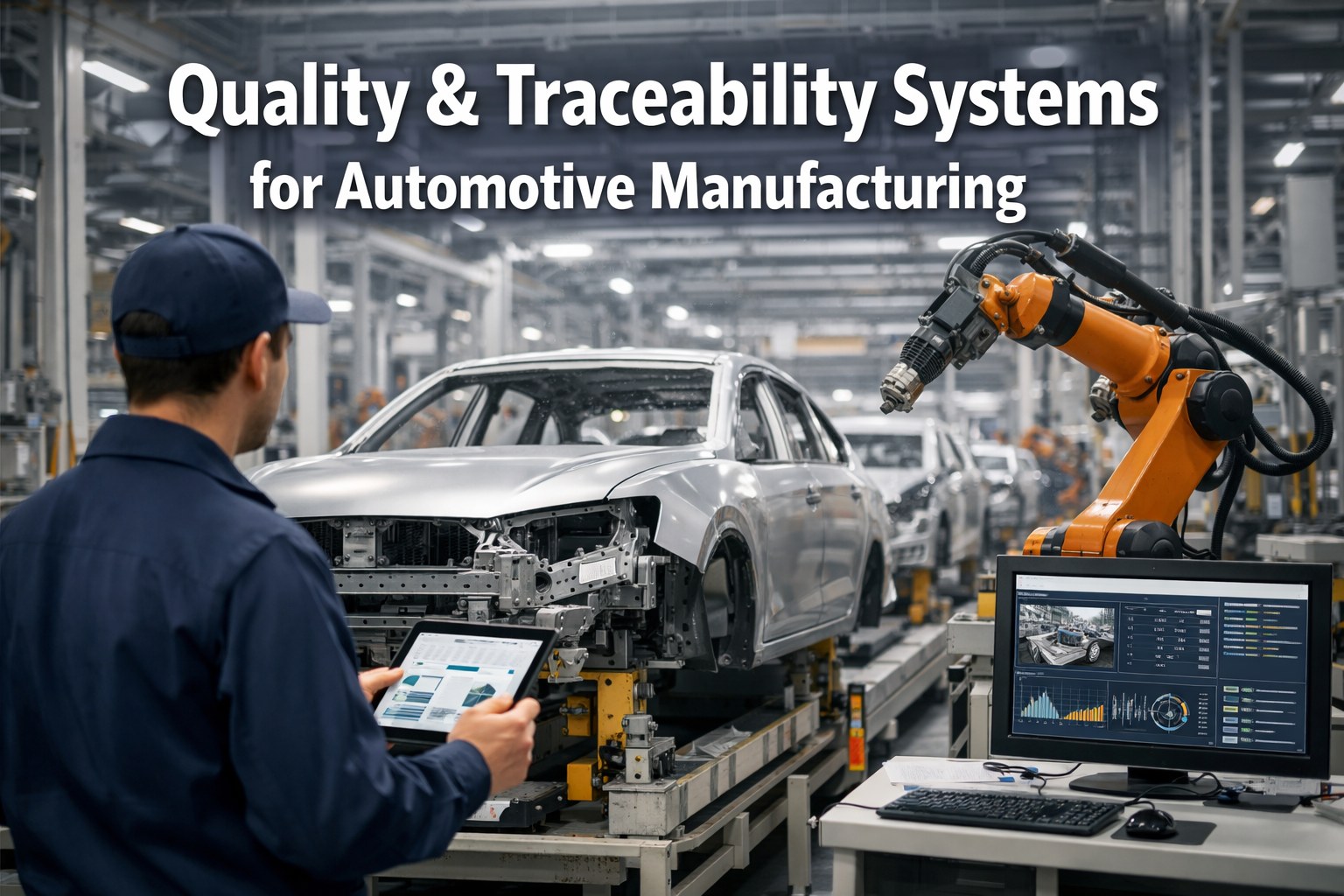
Visual Documentation for Automotive Compliance Using Robotics
By Baelor Targaryen on February 16, 2026
An auditor walks into your plant and asks: "Show me the visual evidence for weld quality on VIN ending 7249 from last Tuesday's second shift." You open a filing cabinet. You flip through blurry photos stapled to handwritten forms. You can't find it. The auditor writes a major non-conformance. That single finding triggers a 60-day corrective action window, a special audit, and puts your IATF 16949 certification at risk. Meanwhilethe plant down the road pulls up the same request in 4 secondstimestamped robotic images, GPS-tagged to the exact station, linked to the operator, the work order, and the part number. That's the difference between documentation as liability and documentation as competitive advantage.
Why Paper-Based Documentation Is a Ticking Time Bomb
IATF 16949 Rules 6th Edition (effective January 2025) has raised documentation standards higher than ever. Here's where most plants are falling short:
Incomplete Audit Trails
Paper forms, manual photos, and scattered spreadsheets can't prove who inspected what, when, and how. The top major non-conformance in 2024 global IATF audits: problem solving and corrective action documentation.
Risk: Major non-conformance, certification suspension
No Traceability to VIN
Without linking visual evidence to specific vehicle identification numbers, a single defect finding can force a recall of thousands of vehicles instead of just the affected units.
Risk: Takata recalled 67M vehicles; GM recalled just 4 with proper traceability
Human Inspector Inconsistency
Manual visual inspection carries a 20–30% error rate. Inspectors fatigue, standards drift across shifts, and subjective judgments vary from person to person—creating compliance gaps that compound.
Over 415,000 manufacturing jobs remain unfilled in 2025. Experienced quality inspectors are retiring faster than they can be replaced—taking decades of visual pattern recognition with them.
How audit-ready is your documentation? Book a free assessment to find your compliance gaps.
The 1-10-100 Rule of Defect Costs
Catching a defect at raw material stage costs $1. After assembly, it costs $10. After delivery to the customer, it costs $100. With 10.8 million vehicles recalled in just the first half of 2025 at ~$300 per vehicle, the industry is hemorrhaging billions on defects that robotic visual documentation could have caught at the $1 stage.
What Changes with Robotic Visual Documentation
The same inspection. The same compliance requirement. Completely different audit outcome.
Manual Documentation
Operator takes phone photos
Fills out paper checklist
Files into binder, folder lost
Auditor can't find records
Result
Major Non-Conformance
60-day corrective action + special audit
VS
Robotic Documentation
Robot captures HD evidence
Every part, every cycle
AI tags to VIN + station
Full traceability
Stored in CMMS + cloud
Immutable records
Auditor retrieves in 4 sec
Always audit-ready
Result
Zero Findings
Certification maintained, OEM confidence
Make Every Inspection Auditor-Proof
iFactory's robotic documentation platform captures, tags, stores, and retrieves visual compliance evidence automatically—integrated directly with your CMMS.
Automated visual inspection reduces defect escape rates vs. manual methods
20%
Lower Warranty Costs
Digital traceability catches issues before they reach customers
95%+
Detection Accuracy
AI vision systems vs. 70–80% accuracy with human inspectors
80%
Audit Prep Reduction
Always-ready digital records eliminate weeks of pre-audit scrambling
5 Capabilities That Make Robotic Documentation Work
01
Automated Visual Evidence Capture
Every part, every cycle
Robotic systems equipped with high-resolution cameras capture standardized images at every inspection point—weld integrity, paint finish, gap measurements, fastener torque markings. Consistent angles, consistent lighting, consistent quality across every shift.
02
VIN-Level Traceability
Surgical recall precision
Every image is automatically linked to the specific VIN, station, timestamp, operator, and work order. When a defect surfaces months later, you trace it to the exact unit—not thousands. This is the difference between recalling 4 vehicles and recalling 67 million.
03
AI-Powered Defect Detection
95%+ accuracy at line speed
Deep learning models trained on your specific product line detect scratches, dents, weld anomalies, paint defects, and assembly errors in milliseconds. They don't fatigue, they don't drift between shifts, and they improve with every inspection cycle.
04
CMMS-Integrated Compliance Records
IATF 16949 aligned
Visual evidence flows directly into your CMMS as part of work orders, corrective actions, and preventive maintenance records. When auditors request documentation, every record is cross-referenced, timestamped, and digitally signed—ready for instant retrieval.
05
Trend Analytics & Early Warning
From reactive to predictive quality
Aggregated visual data reveals quality trends invisible to individual inspectors—gradual weld tip degradation, paint thickness drift, alignment creep. The system flags emerging patterns before they become defects, turning documentation into prevention.
Which capabilities matter most for your compliance goals? Schedule a consultation to find out.
Functional test evidence, alignment, cosmetic sign-off
IATFOEM Gate
Ship-ready quality gate verification
"The automotive industry surpassed 100,000 IATF 16949-certified manufacturing sites in 2024–2025. With the Rules 6th Edition raising the bar on documentation, digitalization, and audit rigor, organizations that can't produce instant, traceable visual evidence will face increasingly severe consequences—from special audits to certification withdrawal."
— Based on IATF Global Oversight data and Quality Magazine analysis, 2025
Turn Documentation from Your Weakness into Your Edge
iFactory combines robotic visual capture, AI defect detection, VIN-level traceability, and CMMS-integrated compliance records—so you're audit-ready before the auditor even arrives.
How does robotic documentation help with IATF 16949 audits?
Robotic systems create unalterable, timestamped visual records linked to specific VINs, stations, and operators. This directly supports IATF 16949 requirements for documented process monitoring, corrective action evidence, and complete traceability. When auditors request records, retrieval takes seconds instead of hours—and the records include visual proof, not just checkmarks on paper.
Can robotic documentation reduce our recall exposure?
Significantly. The key is VIN-level traceability. Without it, a defect finding forces broad recalls affecting thousands or millions of vehicles. With robotic documentation linking every inspection image to a specific VIN, you can isolate defects to the exact affected units. The contrast is stark: Takata's poor traceability led to a 67 million vehicle recall, while GM's automated tracking limited one recall to just 4 vehicles.
What types of defects can robotic vision systems detect?
Modern AI vision systems detect surface defects (scratches, dents, paint imperfections), structural issues (weld penetration, panel gaps, fixture alignment), assembly errors (missing components, incorrect routing, improper torque markings), and dimensional anomalies—all at production speed with 95%+ accuracy, compared to the 70–80% accuracy of manual inspection.
How does this integrate with our existing CMMS?
Visual evidence captured by robotic systems flows directly into your CMMS via API integration. Images attach automatically to work orders, corrective actions, and PM records. This means your maintenance and quality documentation systems share the same visual evidence base—eliminating duplicate records and ensuring every compliance artifact is cross-referenced.
What's the ROI and payback period?
Most automotive plants see ROI within 12–18 months. The business case builds on three pillars: defect reduction (35% fewer escapes = lower warranty costs), recall precision (narrow vs. broad recall scope saves millions per incident), and audit readiness (80% less prep time + zero major findings = protected certification). A single prevented broad recall can pay for the entire system multiple times over.


.png)