Your factory produced 1,000 parts yesterday. Your OEE report says 72%. Looks decent. But here's what you didn't see: 47 micro-stops that lasted 2-10 seconds each. A machine running 8% slower than it should. 23 startup rejects that nobody logged. By the time you read that report this morning, you've already lost another $15,000 in hidden production capacity. Welcome to the real cost of delayed OEE tracking.
The Hidden Factory Problem
Most factories track only 2 of the 6 big losses. The other 4 represent 15-20% of your production capacity that bleeds away invisibly every single day.
What Really Happens Without Real-Time OEE
When you calculate OEE at the end of a shift—or worse, the next day—you are not measuring performance. You're writing a history book. And by the time you read it, the problems have already compounded.
6:00 AM
Shift Starts
Machine #3 cycle time is 8% slower than ideal. Nobody notices—it looks "normal."
-$0
8:30 AM
Micro-Stops Begin
Small jams clear themselves every 12 minutes. Operators don't log them—"too quick to matter."
-$340
11:00 AM
Quality Drift
Reject rate creeps from 2% to 5%. Won't be discovered until QC audit at 3 PM.
-$1,200
2:00 PM
Breakdown
The slow cycle time was an early warning. Now the bearing fails completely. 2-hour repair.
-$8,500
4:00 PM
Shift Ends
Supervisor fills out the OEE spreadsheet from memory. Micro-stops? Not logged.
-$2,100
Next Day
Report Says: OEE 68%
Reality: OEE was actually 54%. But you'll never know—the data was never captured.
-$12,140
How much is delayed OEE tracking costing your plant? Get a free production loss assessment from our experts.
The 6 Big Losses You're Missing
OEE breaks down into three factors: Availability, Performance, and Quality. Each factor has two types of losses. Without real-time tracking, most factories only catch the obvious ones.
Usually Tracked
Equipment Failures
Breakdowns, tooling failures, unplanned maintenance
Usually Tracked
Setup & Adjustments
Changeovers, cleaning, planned stops
Often Missed
Micro-Stops
Jams, misfeeds, sensor blocks (2-10 seconds each)
20-30% of total losses
Often Missed
Reduced Speed
Running slower than ideal cycle time
Nearly invisible without automation
Often Missed
Startup Rejects
Defects during warmup/after changeover
5% capacity loss per shift
Often Missed
Production Defects
Quality drift during steady-state production
Discovered hours later
15-20%
of total production capacity is lost to the 4 "hidden" losses that manual tracking misses
Manual vs Real-Time: The Visibility Gap
The difference between delayed OEE and real-time OEE isn't just speed—it's the difference between reacting to problems and preventing them.
When you see data
Next day (or later)
Instantly
Micro-stops captured
Almost none
Every single one
Slow cycles detected
Rarely
Within minutes
Quality drift response
Hours of bad parts
Immediate alert
Data accuracy
50%+ misreporting
Automated, accurate
Operator engagement
Passive observers
Active participants
Ready to see your real OEE? Talk to our team about implementing real-time tracking in your plant.
Stop Reading History. Start Seeing Now.
iFactory's real-time OEE dashboard captures every stop, every slow cycle, every defect—the moment it happens. See your true production performance, not yesterday's guesswork.
Where Does Your Factory Stand?
Most manufacturers don't know their true OEE. Here's how the industry breaks down—and what each level really means.
85%+
World Class
Only ~5% of manufacturers achieve this. Requires real-time data and continuous improvement culture.
Target
60-85%
Good
Solid performance with room to grow. Typically missing 15-25% hidden capacity.
Improving
40-60%
Typical
Where most factories operate. Losing nearly half of potential capacity—often without knowing it.
Average
<40%
Starting Point
Common for plants just beginning to track. Huge improvement potential with basic fixes.
At Risk
Not sure where you stand? Book a free OEE benchmark assessment to find out.
The Real-Time Advantage
When operators see their OEE score building minute by minute—not reading about it the next day—everything changes.
Immediate Response
Quality drops 5% at 10 AM? Investigate now—not after 500 more bad parts.
Predictive Warnings
Cycle time creeping up? That's tomorrow's breakdown—fix it today.
Operator Ownership
Teams see their impact in real-time. Engagement and accountability soar.
Recovered Capacity
10-25 OEE points recovered = 10-25% more output from existing equipment.
Expert Insight
"Real-time OEE turns the logic on its head. Each connected machine instantly transmits its operating data. As soon as a stoppage occurs, it appears on the workshop screens. The operator sees the duration displayed, identifies the cause, and the information is passed on to the whole team. This immediate visibility changes everything."
— Manufacturing Performance Research, 2025
See What You've Been Missing
Join manufacturers who've recovered 10-25% hidden capacity with iFactory's AI-powered real-time OEE tracking. No more spreadsheets. No more guesswork.
Frequently Asked Questions
What is real-time OEE tracking?
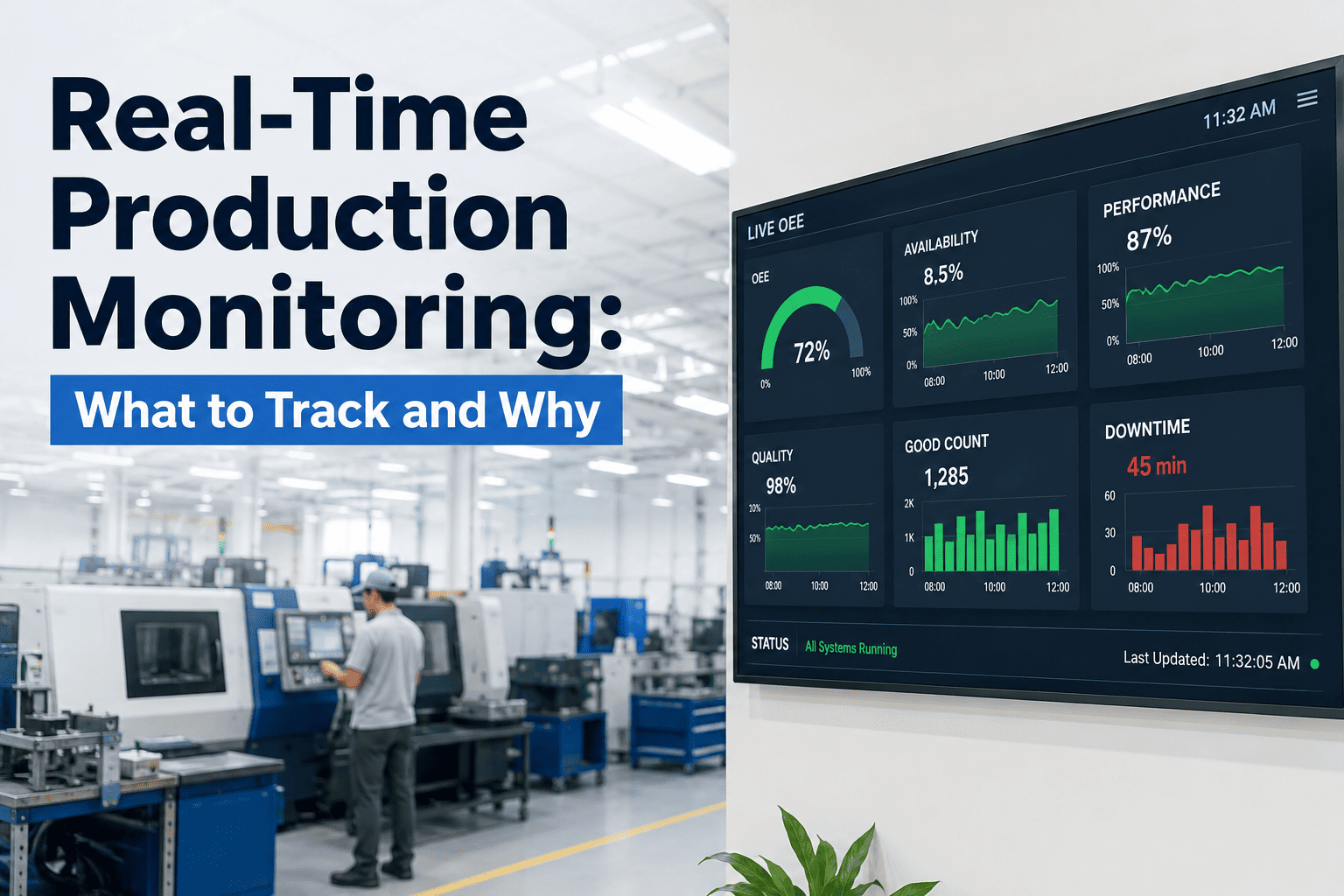
Real-time OEE tracking automatically captures machine data (run time, stops, speed, quality) as it happens—not from operator memory at shift end. Connected sensors transmit data instantly to dashboards, allowing teams to see and respond to performance issues within minutes instead of days.
What production losses does manual OEE tracking miss?
Manual tracking typically misses micro-stops (2-10 second jams), reduced speed (machines running slower than ideal), startup rejects (first parts after changeover), and gradual quality drift. These "hidden" losses represent 15-20% of total production capacity in most factories.
What OEE score should my factory target?
85% OEE is considered world-class for discrete manufacturing. Most factories operate between 40-60%. If you're just starting to track, 40% is common and represents huge improvement potential. Moving from 45% to 60% is equivalent to adding 25-50% more capacity without buying new equipment.
How quickly can real-time OEE improve my production?
Most manufacturers see 10-25 OEE points improvement within the first 3-6 months of implementing real-time tracking. Initial gains come from simply making hidden losses visible—once you can see micro-stops and slow cycles, fixing them becomes obvious.
Do I need to replace my equipment for real-time OEE?
No. Modern OEE systems use external sensors or connect to existing machine controls (via protocols like MTConnect or OPC-UA) to capture data. Most implementations work with equipment of any age and can be installed in hours, not weeks.