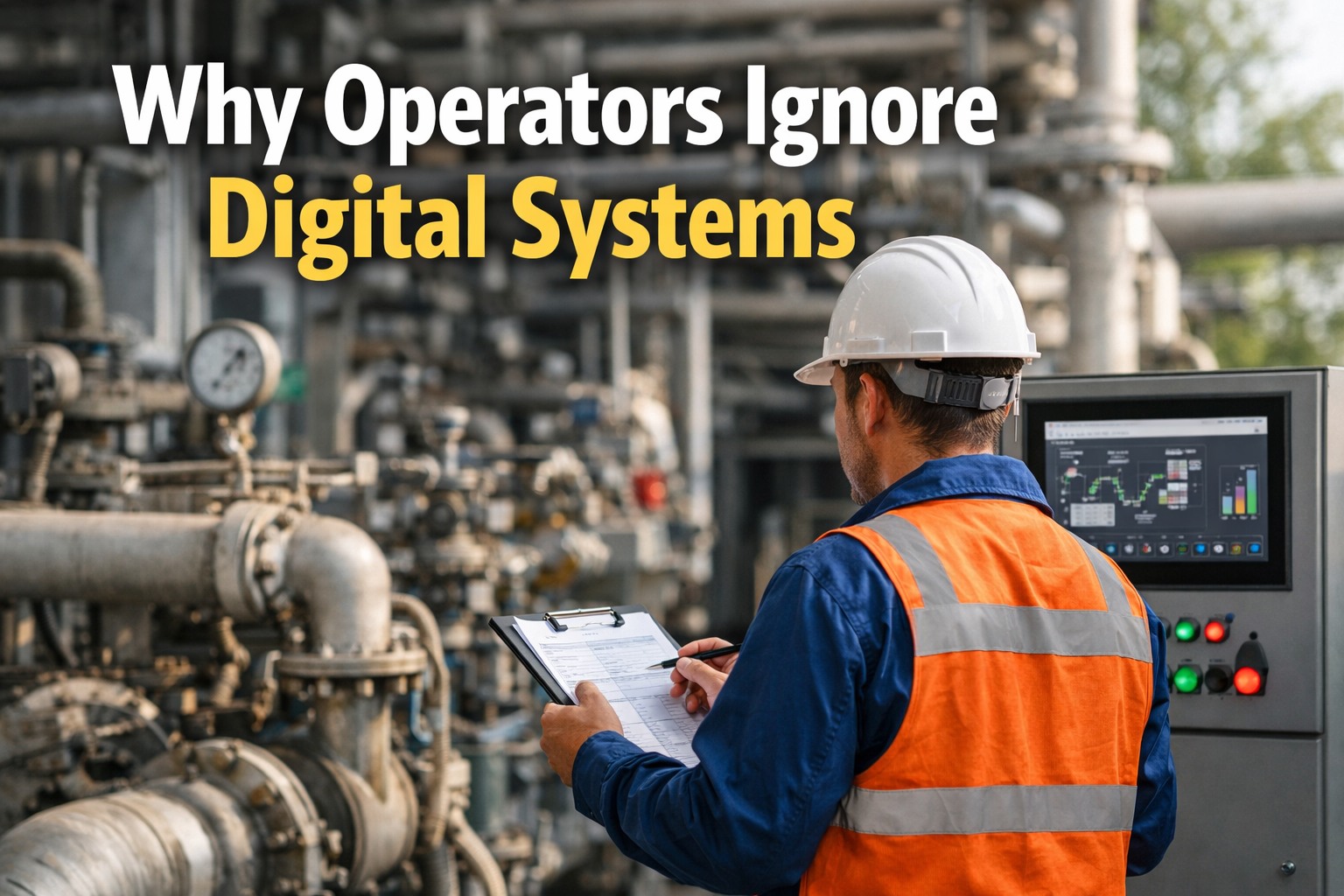
A plant spends $500,000 on a new MES. Six months later, operators are logging data on clipboards, supervisors check spreadsheets instead of dashboards, and the system sits half-empty—an expensive digital ghost town. This isn't a technology failure. It's a people failure. And it happens constantly: 70% of digital transformations fail, and McKinsey identifies employee resistance as the #1 cause. Not bugs. Not integrations. People choosing not to use the system they were given. In manufacturing, where operators are the system—where every data point, every quality check, every production log depends on a human choosing to tap a screen instead of scribbling on paper—low adoption doesn't just waste the software investment. It kills the entire digital strategy. Deloitte's 2025 survey of 600 manufacturing executives found that human capital ranks at the lowest maturity level of all smart manufacturing categories. That's the gap. Here's why it exists—and how to close it.
70%
Digital Transformations Fail
#1
Cause: Employee Resistance
75%
ERPs Fail to Deliver ROI
77%
Say AI Added to Workload
The 6 Real Reasons Operators Ignore Digital Systems
When operators bypass digital tools, it's not laziness or resistance to change. It's a rational response to real problems. Here's what's actually happening—and what operators are thinking but rarely saying out loud.
01
The System Adds Work Without Removing Any
"Now I have to do my actual job AND enter data into a system that doesn't help me do it better."
Most digital systems are designed to extract data from operators—not deliver value back to them. If the only thing a system does is create more steps in an already-pressured shift, operators will find workarounds. A 2024 Forbes study found that 77% of employees using AI tools say the technology actually increased their workload rather than reducing it.
02
The Interface Wasn't Designed for Gloves and Grease
"I can't use tiny buttons wearing work gloves. The screen washes out in sunlight. It crashes when the WiFi drops."
Factory floors are loud, dirty, poorly lit, and vibrating. Operators wear PPE that makes precision touchscreen use impossible. Yet most manufacturing software is designed in an office, tested in an office, and demoed in an office. The World Economic Forum notes that if a tool requires extensive training to use, the problem isn't the workforce—it's the design.
03
Nobody Asked Them Before Buying It
"Management picked this system. IT configured it. I got a 2-hour training. Now it's 'my fault' I don't use it."
When operators are excluded from the selection and design process, the system reflects management's view of how work happens—not how it actually happens. Gartner reports that nearly half of manufacturers regret their software purchases, citing difficult implementation. The operators knew from day one. Nobody asked.
04
It Feels Like Surveillance, Not Support
"Every tap I make gets tracked. This isn't a tool for me—it's a tool to monitor me."
When digital systems track individual operator performance without giving them access to their own data or using it to help them improve, operators perceive the system as surveillance. Trust erodes. Data gets gamed. The system becomes a compliance checkbox rather than a genuine productivity tool.
05
Training Was One-Time and Already Forgotten
"I had a 2-hour class 3 months ago. I forgot half of it by the next shift. There's no one to ask now."
75% of employees need reskilling but only 35% receive adequate training, according to the World Economic Forum. In manufacturing, traditional one-off classroom training is disconnected from the actual workflow. Workers need learning that's embedded in their workday—contextual, real-time, and repeatable. Static manuals gathering dust on shelves don't count.
06
The Old Way Still Works (Sort Of)
"My clipboard works. My whiteboard works. I know where everything is. Why change?"
If the existing process works well enough for the operator's daily needs—even if it creates invisible problems downstream—there's no rational incentive to switch. Change fatigue is real: workers feel repeatedly instructed to change processes, creating the perception that leadership has no clear direction. Without visible, personal benefit, the path of least resistance wins.
Recognize these patterns on your shop floor? Book a free adoption assessment with our manufacturing UX team—we'll help you identify exactly where and why your operators are bypassing digital tools.
The Hidden Cost of Low Adoption
When operators ignore digital systems, the cost isn't just an underused software license. It cascades through every layer of operations.
System Goes Unused
Operators revert to paper, spreadsheets, and workarounds. Data entry is partial, late, or skipped entirely.
Data Becomes Unreliable
Incomplete or inaccurate data poisons dashboards, analytics, and reports. Decisions based on bad data are worse than no data.
Advanced Features Die
Predictive maintenance, SPC, and AI analytics require clean, consistent data. Without operator input, these capabilities never work.
ROI Never Materializes
The organization concludes "digital doesn't work here"—and the cycle repeats with the next vendor. Up to 73% of companies fail to capture any business value from digital transformation efforts.
Digital Tools Should Make Work Easier, Not Harder
iFactory is built for the shop floor first—large touch targets, glove-friendly interfaces, offline capability, and workflows that reduce operator steps instead of adding them. Because a system that operators actually use is the only system that delivers ROI.
The gap between what operators need from digital tools and what they typically receive explains why adoption stalls. Here's the reality check:
What They Get
What They Need
Complex desktop interface shrunk to a tablet
Purpose-built mobile UX with large touch targets
20+ field data entry forms per task
3-tap workflows with auto-populated fields
Cloud-dependent system that fails when WiFi drops
Offline-first design that syncs when connected
One-time classroom training 3 months ago
In-app guidance and contextual help at the point of need
Data goes into a black hole—no feedback
Real-time dashboards showing how their input drives outcomes
English-only interface for multilingual workforce
Multi-language support and visual/icon-based navigation
Tracking and surveillance without value exchange
Transparency—operators see their own data and trends
Want a system built for operators, not against them? Sign up for iFactory or schedule a demo to see how shop-floor-first design drives adoption naturally.
The Adoption Playbook: 5 Steps That Actually Work
Closing the adoption gap isn't about more training or stricter mandates. It's about redesigning the entire approach—from selection to rollout to sustained engagement.
1
BEFORE
Involve Operators in Selection
Put the system in front of operators before you buy it. Run a 2-week trial on one line. If operators can't navigate it within 15 minutes without a manual, it's the wrong tool. Include frontline workers in tech decisions to ensure tools reflect real-world use.
Test: Can an operator complete a core task in under 3 taps?
2
DURING
Start With One Pain Point They Care About
Don't launch the full system on day one. Start with the one feature that solves a problem operators already complain about—downtime logging, defect reporting, or shift handover. Win them there, then expand. Pilot on one line, validate, then scale.
Focus: What's the #1 frustration on the floor today?
3
DURING
Embed Training in the Workflow
Replace classroom training with in-app guidance, on-screen walkthroughs, and peer mentoring. A consumer goods manufacturer using wearable-enabled on-the-job training achieved 53% improvement in OEE and 56% reduction in non-value-added tasks. Make training part of the product, not separate from it.
Rule: If it requires a manual, it's too complex.
4
AFTER
Close the Feedback Loop
Show operators what happens with their data. When an operator logs a defect and the next week sees that defect rate drop because engineering fixed the root cause—that's the moment digital adoption clicks. Give operators visibility into their own performance trends, not just management.
Prove: "Your data entry last week led to this fix."
5
ONGOING
Measure Adoption, Not Just Deployment
Deployment is not adoption. Track active daily users, task completion rates, and data quality scores—not just licenses purchased. 48% of manufacturers report having a training standard in place, but human capital maturity remains the lowest category. What gets measured gets managed.
KPIs: Daily active users, data completeness, time-to-task.
Expert Analysis
The familiar refrain is that the sector needs more highly skilled workers. But what if the real issue isn't a lack of skills, but that we've made digital transformation harder than it needs to be? Many of today's digital manufacturing tools aren't designed with frontline workers in mind. Interfaces are complex, workflows are rigid, and training is outdated. If interpreting a machine health dashboard requires an engineering degree, the problem isn't the workforce—it's a usability crisis.
— World Economic Forum, June 2025
Ready to build a system your operators will actually use? Schedule a demo to see iFactory's operator-first design, or sign up now and start your free trial.
The Best System Is the One Operators Actually Use
iFactory is built from the shop floor up—not the boardroom down. Purpose-designed for operators wearing gloves, working night shifts, and running 60 JPH lines. Because your digital transformation only succeeds when the people doing the work trust the tool in their hands.
Why do operators resist digital manufacturing systems?
Operators resist digital systems for practical, rational reasons—not because they fear technology. The most common causes are: the system adds work without removing any (77% of employees say AI increased their workload), the interface wasn't designed for factory conditions (gloves, noise, poor lighting), operators weren't involved in the selection process, training was insufficient and one-time (75% need reskilling but only 35% receive adequate training), the system feels like surveillance rather than support, and the old way still works well enough for their daily needs. Addressing these root causes requires redesigning the implementation approach, not just re-training workers.
What is the cost of low operator adoption?
Low adoption creates a cascading failure: incomplete data poisons analytics, predictive features fail without clean inputs, dashboards become unreliable, and management loses trust in the system. Up to 75% of ERP implementations fail to deliver their promised ROI, with poor user adoption as the primary driver. The financial impact includes the direct software investment ($200K-$2M+ for enterprise MES), the lost operational improvements (typically 10-30% throughput gains that never materialize), and the opportunity cost of delayed digital maturity while competitors move ahead. Perhaps worst: the organization develops "digital fatigue" and resists the next system even more.
How do you improve operator adoption of digital tools?
Five proven strategies drive adoption: involve operators in system selection before purchasing (run a 2-week trial on one line), start with one high-value pain point rather than launching the full system, embed training in the workflow through in-app guidance instead of classroom sessions, close the feedback loop so operators see how their data drives improvements, and measure adoption metrics (daily active users, data completeness) not just deployment. The World Economic Forum emphasizes designing for the operator—if a tool requires extensive training, it's too complex. A consumer goods manufacturer using embedded on-the-job training saw 53% OEE improvement and 56% reduction in non-value-added tasks.
What makes a manufacturing system "operator-friendly"?
An operator-friendly system has: large touch targets usable with work gloves, high-contrast displays readable in variable lighting, offline-first architecture that works when WiFi drops, 3-tap-or-less core workflows that reduce steps instead of adding them, multi-language and icon-based navigation for diverse workforces, contextual in-app help instead of separate manuals, and transparency—operators see their own data and trends, not just management. The interface should be designed by observing actual factory conditions: noise, vibration, PPE requirements, and shift pressure. If you can't complete a core task in under 15 seconds, the UX needs redesigning.
How does iFactory approach operator adoption?
iFactory is built from the shop floor up—starting with operator workflows, not management dashboards. The platform features glove-friendly touch interfaces, offline capability for unreliable connectivity zones, minimal-tap data entry with auto-populated fields, visual work instructions at the point of need, and real-time feedback loops so operators see the impact of their input. Rather than forcing operators to adapt to the software, iFactory adapts to how operators actually work. The result is higher data quality, faster onboarding, and sustainable adoption that delivers the ROI your digital transformation promised. Book a demo to see it in action.