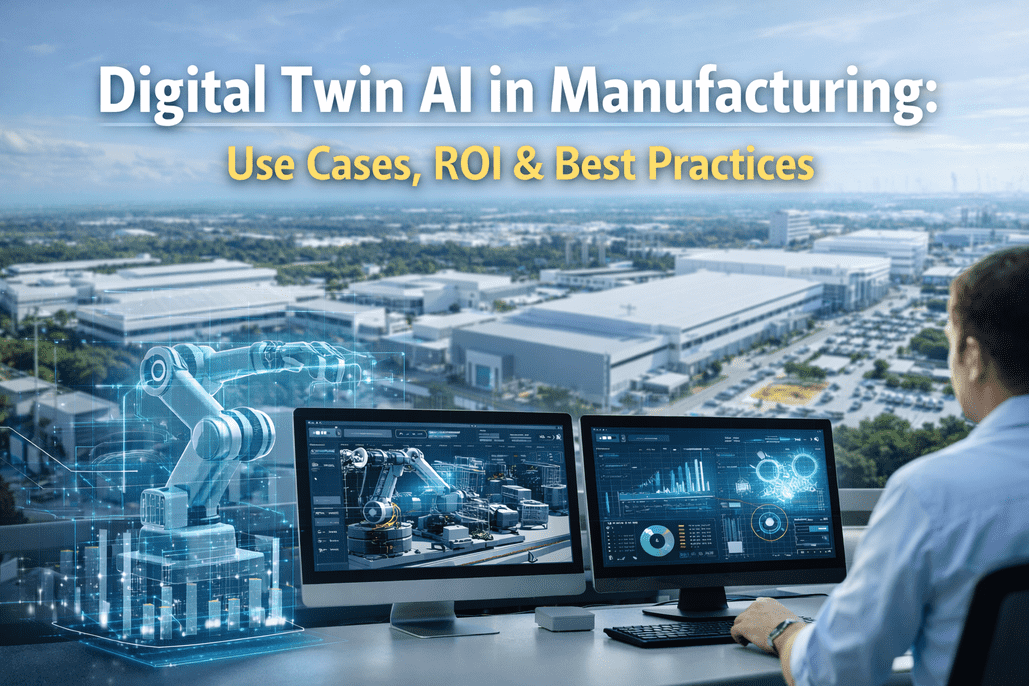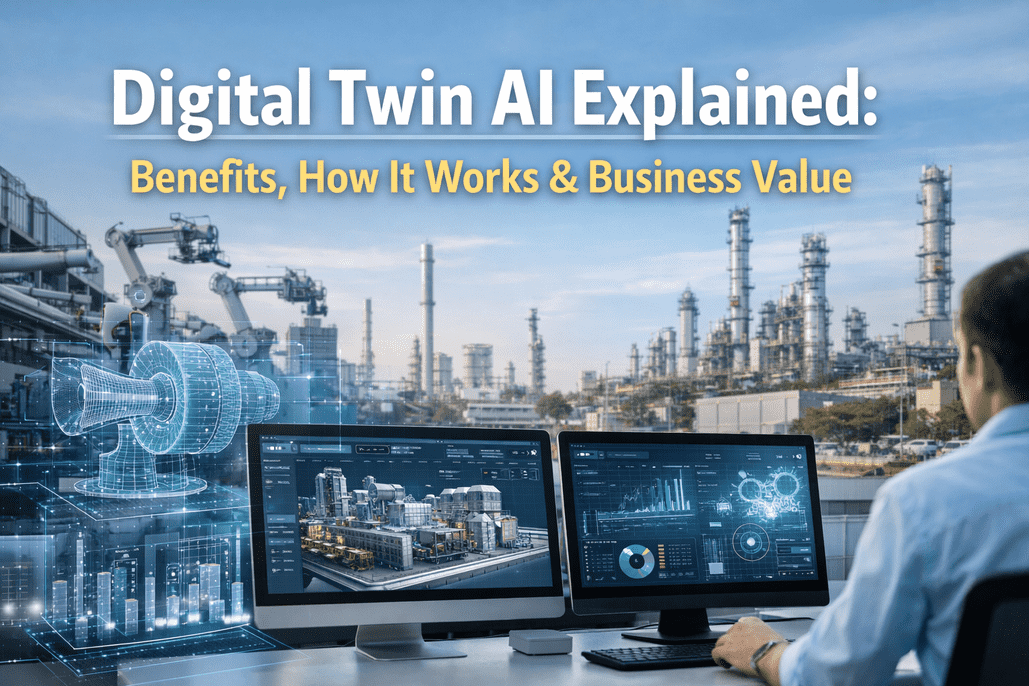
Every minute of unplanned downtime costs factory operations an average of $260,000. Digital Twin AI changes that equation entirely — by creating a living, breathing virtual replica of your production floor, equipment, and processes that doesn't just mirror reality, it predicts failures, optimizes throughput, and triggers corrective actions autonomously. The global digital twin market is projected to surge from $34 billion in 2026 to over $150 billion by 2030, growing at nearly 48% CAGR. With 75% of industrial enterprises already investing in digital twin technology and 92% reporting ROI above 10%, this isn't emerging tech anymore — it's the new factory operating standard. Here's how Digital Twin AI is transforming factory industries, and how iFactory helps you implement it from day one.
What Is Digital Twin AI?
A Digital Twin AI is a real-time virtual replica of your factory floor — every machine, production line, and process — supercharged with artificial intelligence to continuously learn, predict failures, and optimize output.
Unlike static 3D models or basic simulations, a Digital Twin AI maintains a constant two-way data flow with your physical factory. IoT sensors on CNC machines, conveyors, compressors, and assembly cells feed real-time data into the virtual model, while AI and machine learning algorithms analyze patterns, detect anomalies, and simulate future scenarios — all before a single production line is paused or a single maintenance crew is dispatched.
Think of it this way: a traditional factory dashboard tells you what happened. A Digital Twin AI tells you what's happening now across every asset, what will happen next on every line, and what corrective action to take — autonomously.
Want to see how Digital Twin AI applies to your factory operations? Book a free 30-minute demo — our team will walk you through real factory use cases.
How Digital Twin AI Works
Digital Twin AI in factory environments operates through a continuous closed-loop cycle — collecting data from shop-floor assets, building intelligence, simulating production outcomes, and feeding decisions back into operations. Here's the four-stage engine that powers it:
Sense & Collect
IoT sensors on CNC machines, robotic arms, conveyor belts, PLCs, SCADA systems, and edge devices continuously stream real-time data — vibration, temperature, pressure, throughput, energy consumption — from every factory asset into the digital model.
Model & Mirror
The digital twin constructs a dynamic virtual replica that mirrors the exact state of your factory floor. Every machine, production line, assembly cell, and material flow is represented with real-time fidelity — not as a static snapshot, but as a living factory model.
Analyze & Predict
AI and machine learning algorithms process incoming data streams against historical production patterns. They detect anomalies in motor vibration, predict bearing failures and pump seizures, forecast quality drift on production batches, and simulate "what-if" scenarios for line rebalancing — all in real time.
Optimize & Act
Insights flow back as prescriptive actions — automated maintenance work orders, production schedule adjustments, energy rebalancing across plant zones, or quality hold interventions on specific batches. The loop closes: the factory improves, new data feeds back, and the twin gets smarter with every production cycle.
Core Components of a Factory Digital Twin AI Platform
IoT Sensor Network
Vibration, thermal, pressure, and flow sensors capture real-time operational data from every physical asset and environment.
Edge & Cloud Compute
Hybrid infrastructure processes data at the edge for low-latency responses, with cloud scaling for heavy simulations and model training.
AI & ML Engine
Machine learning models for predictive maintenance, anomaly detection, quality forecasting, and prescriptive optimization.
Unified Data Layer (UNS)
A Unified Namespace connects every sensor, PLC, MES, ERP, and CMMS into one event-driven data bus — the backbone of context-aware AI.
Simulation Engine
Physics-based and data-driven simulations for scenario planning, virtual commissioning, and production line stress testing.
Visualization & Dashboards
3D visual interfaces and real-time dashboards that translate complex data into intuitive, actionable insights for operators and managers.
Business Benefits for Factory Operations
Digital Twin AI isn't a science project — it's a factory profit driver. Here's what industrial operations are actually achieving:
AI-powered twins predict bearing seizures, motor failures, and pump breakdowns days or weeks in advance, enabling planned maintenance windows that eliminate costly factory production stoppages.
Virtual commissioning and production line simulation eliminate physical testing cycles, allowing factories to validate new line configurations and product changeovers digitally before any physical retooling.
Real-time optimization of production parameters — machine speed, quality checkpoints, changeover sequencing — pushes factory OEE toward world-class benchmarks across every shift.
Factory digital twins identify wasted energy in compressed air systems, HVAC units, motor loads, furnaces, and process heat — optimizing plant-wide consumption in real time.
With simulation-ready factory data, plant managers test strategic decisions in minutes rather than weeks — from layout changes and capacity expansion to new product line feasibility.
See the ROI for Your Factory Operations
Book a personalized demo — our team will map Digital Twin AI benefits to your specific production environment, equipment profile, and business goals.
Factory Industry Applications: Where Digital Twin AI Delivers
Manufacturing
Predict CNC spindle failures, optimize production scheduling across shifts, reduce scrap rates through real-time quality monitoring, and achieve virtual commissioning of new production lines before physical installation begins.
68% of industrial manufacturers have active digital twin programsEnergy & Utilities
Simulate grid behavior under varying loads, optimize renewable energy output, manage distributed resources, and slash energy waste across facilities.
GE Vernova saved clients over $1.6B via AI-powered digital twinsSmart Cities
Model traffic patterns, optimize energy distribution, plan disaster response, and manage water systems through comprehensive urban digital twins.
Singapore's Virtual Singapore is the world's largest city-scale digital twinHealthcare
Create patient-specific digital twins for personalized treatment, simulate surgical outcomes, optimize hospital workflows, and accelerate drug development.
66% of healthcare executives plan to increase digital twin investmentAutomotive & Aerospace
Simulate vehicle performance, test autonomous driving systems, optimize assembly lines, and manage the full product lifecycle from design to decommission.
Automotive holds 22%+ share of the global digital twin marketSupply Chain & Logistics
Simulate warehouse operations, optimize transportation routes, model inventory flows in real time, and build resilience against disruption scenarios.
AI-optimized supply chains report 150-250% ROIWondering how Digital Twin AI fits your factory setup? Schedule a personalized demo — we'll show you real use cases for your specific production environment, or talk to our support team for quick answers.
Future Trends Shaping Factory Digital Twins
Agentic AI Integration
Factory digital twins evolve from passive models to autonomous agents. They don't just simulate your production line — they observe shop-floor conditions, reason through scheduling constraints, and execute corrective actions like rebalancing workloads or triggering maintenance work orders independently. Agentic AI adoption in manufacturing is quadrupling this year.
Edge AI + Federated Learning
Simulation and inference move to edge devices installed directly on the factory floor, enabling sub-millisecond response times for critical equipment. Federated learning lets factory twins across multiple plant sites learn from each other without sharing sensitive production data.
Quantum-Enhanced Optimization
Hybrid quantum-classical solvers begin tackling NP-hard production scheduling and factory logistics problems that classical computers can't solve at scale. BASF already demonstrated a 7,200x scheduling speedup in a proof of concept — compressing 10-hour optimization runs to 5 seconds.
Cognitive Twins & Digital Thread
Digital twins become "cognitive" — understanding not just data patterns but business context. They know that a temperature spike during a heatwave is normal, but the same spike in winter signals bearing failure. The digital thread connects twins across the entire product lifecycle.
Digital Twin as a Service (DTaaS)
Cloud-native, subscription-based digital twin platforms make the technology accessible to mid-market factories and regional manufacturers. Over 90% of IoT platforms are projected to support digital twinning natively by 2027, and the market is on track to exceed $400B by 2034.
Your Factory Has a Digital Future. Start Building It Today.
iFactory integrates Digital Twin AI, agentic intelligence, predictive maintenance, and edge-ready architecture into one platform — purpose-built for factory operations that demand real results.