Unilever linked digital twin models to live energy monitoring on its detergent production lines and discovered something the maintenance team had never noticed: three ageing mixers were consuming 23% more electricity than identical units on adjacent lines. The root cause was not a motor fault or a control error — it was progressive impeller erosion that increased drag so gradually that shift operators never registered the change. The twin spotted it because it compared real-time energy draw against the physics-based model of what each mixer should consume at each speed and viscosity setting. Fixing those three impellers saved $187,000 in annual energy costs. Multiply that pattern across hundreds of assets in a typical plant, and the picture becomes clear: degraded equipment is the largest hidden energy cost in manufacturing — and digital twins are the only technology that can see it continuously, across every asset, in real time. IBM's deployment on the Great Belt Bridge in Denmark went further: the twin extended the structure's lifespan by 100 years while negating 750,000 tons of CO2 emissions. Energy optimisation and asset longevity are not competing goals. With the right intelligence layer, they are the same goal.
iFactory Sustainability Intelligence
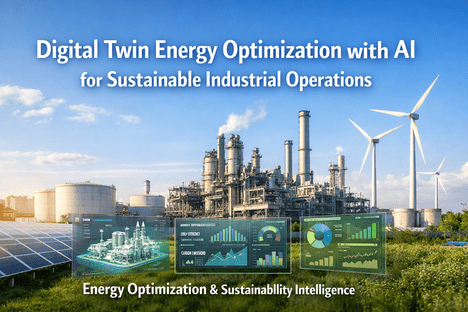
Digital Twin Energy Optimization with AI for Sustainable Industrial Operations
How AI-powered digital twins are turning energy waste into measurable savings — cutting consumption by 12-25%, reducing carbon emissions, and converting sustainability mandates into operational advantage
12-25%
Energy savings from AI-driven optimisation
10-30%
Excess energy consumed by degraded equipment
50%
Carbon reduction possible with digital twins
$33.9T
ESG-focused investment projected by 2026
Where Industrial Energy Actually Disappears
Manufacturing accounts for roughly one-third of global energy consumption. Yet most plants have only facility-level visibility into where that energy goes. The gap between what a plant consumes and what it should consume — the energy efficiency gap — hides in places that traditional monitoring systems were never designed to see.
15-20%
Motor and Drive Losses
10-15%
Compressed Air Leaks and Waste
8-12%
Thermal and Steam Losses
10-30%
Equipment Degradation Waste
30-55%
Productive Energy Output
AI digital twins address every loss category simultaneously — identifying motor inefficiencies, detecting compressed air leaks, flagging thermal anomalies, and catching degradation-driven energy waste that no other system can see at the individual asset level.
How AI Digital Twins Optimise Energy at the Asset Level
Traditional energy management operates at the facility or line level — monitoring total consumption without understanding which specific assets are wasting energy and why. AI digital twins invert this approach by creating an energy profile for every individual asset, continuously comparing actual consumption against the physics-based model of what that asset should consume under current operating conditions.
01
Baseline Energy Profiling
The twin builds an energy consumption model for each asset based on nameplate specifications, operating parameters, and learned behaviour during the initial training period. This baseline accounts for load variations, ambient conditions, and production cycle phases — creating a dynamic reference that adjusts to context rather than using a static threshold.
02
Continuous Deviation Detection
Every asset's real-time energy consumption is compared against its twin baseline continuously. When a motor starts drawing 8% more current than expected at a given load and speed, the system flags the deviation immediately — not at the next monthly energy review. The twin distinguishes genuine inefficiency from normal operational variation using multi-variable correlation.
AI correlates energy deviations with condition signals — vibration patterns, thermal profiles, pressure drops — to identify the root cause. Excess energy consumption caused by bearing wear presents differently from consumption caused by impeller fouling or belt slippage. The diagnosis drives targeted intervention rather than generic energy-saving campaigns.
04
Optimised Scheduling and Load Balancing
AI analyses energy tariff structures, demand charge patterns, and production schedules to recommend optimal run times for energy-intensive assets. Load balancing across parallel equipment — running three compressors at 70% rather than two at 100% and one at 10% — can reduce total energy consumption by 8-15% with zero capital expenditure.
05
Closed-Loop Improvement
After each maintenance intervention or operational adjustment, the twin verifies whether energy consumption returned to baseline. If a bearing replacement restored motor efficiency but energy draw remains elevated, the system identifies the residual cause — perhaps misalignment introduced during reassembly. The feedback loop ensures every action produces verified results.
Want to see where your biggest energy savings opportunities are hiding? Book a free energy optimisation assessment.
The Regulatory Pressure Making This Urgent
Energy optimisation is no longer just a cost-saving opportunity. It is becoming a compliance requirement. Three converging regulatory forces are making asset-level energy intelligence mandatory for manufacturers operating in or selling to major markets.
EU CSRD
Corporate Sustainability Reporting Directive
Mandates asset-level environmental disclosures for companies operating in the EU. Energy consumption, emissions, and sustainability metrics must be reported at granular levels that facility-wide meters cannot provide. AI digital twins generate this data automatically as a byproduct of their normal monitoring function.
ISO 50001
Energy Management Systems
Requires systematic energy performance improvement with documented evidence of continuous optimisation. The standard demands energy baselines, performance indicators, and improvement verification — all of which AI digital twins produce automatically through their ongoing comparison of actual versus expected consumption.
ESG Mandates
Investor and Market Requirements
ESG-focused investment is projected to reach $33.9 trillion by 2026. Institutional investors, major customers, and supply chain partners increasingly require quantified sustainability data. Manufacturers without asset-level energy intelligence will face growing pressure from capital markets, procurement requirements, and competitive benchmarking.
Measurable Results from Energy-Focused Digital Twin Deployments
The financial and environmental returns from AI-powered energy optimisation are documented across industries. These are not theoretical projections — they are measured outcomes from manufacturers that have deployed twin-based energy intelligence platforms.
Average energy consumption savings
12-25%
Carbon emissions reduction with digital twins
Up to 50%
Compressed air system waste eliminated
20-30%
Demand charge reduction through load optimisation
10-18%
Maintenance cost savings from efficiency-driven interventions
18-25%
Want to calculate your specific energy savings potential? Get a customised energy ROI analysis from our engineers.
Frequently Asked Questions
How is digital twin energy optimisation different from traditional energy management systems?
Traditional energy management monitors total facility or line consumption. Digital twins monitor energy at the individual asset level, comparing actual consumption against physics-based models of expected consumption under current conditions. This granularity reveals hidden inefficiencies — a motor drawing 12% excess current due to progressive bearing wear — that facility-level monitoring cannot detect.
How quickly do energy savings become measurable?
Quick wins from load balancing and scheduling optimisation produce measurable savings within 4-6 weeks. Degradation-driven waste identification — the largest savings category — begins generating alerts within 6-8 weeks as the twin learns baseline energy profiles. Full optimisation across all asset classes typically matures over 3-6 months, with cumulative savings growing as the system identifies progressively subtler inefficiencies.
Does energy optimisation require additional sensors beyond what we have?
Many plants already have the foundational data in their SCADA and power monitoring systems. The twin platform integrates this existing data immediately. For asset-level granularity, adding current transformers and power monitors to critical high-consumption assets is typically required — but these are low-cost additions ($50-200 per monitoring point) that pay for themselves within weeks through identified savings.
How does energy optimisation support our ESG and CSRD reporting requirements?
AI digital twins automatically generate the asset-level energy consumption, emissions calculations, and efficiency improvement documentation that CSRD and ESG frameworks require. Because the twin tracks energy continuously and links consumption to specific assets and production outputs, the data is audit-ready by default — no separate reporting effort required.
Can energy optimisation conflict with production output targets?
AI twin optimisation does not reduce energy by curtailing production. It reduces energy by eliminating waste — running equipment more efficiently, scheduling energy-intensive operations during lower-cost tariff periods, and maintaining assets at peak efficiency so they consume less energy per unit of output. Production throughput remains the same or improves alongside energy reduction.
Efficient. Sustainable. Compliant.
Turn Energy Waste into Savings. Turn Sustainability Mandates into Competitive Advantage.
iFactory's AI-powered digital twin platform monitors energy at the individual asset level, identifies hidden waste, optimises consumption continuously, and generates the sustainability reporting your regulators and investors demand.
25%
Energy savings potential
50%
Carbon reduction possible
4-6wk
Time to first savings
100%
CSRD reporting automated