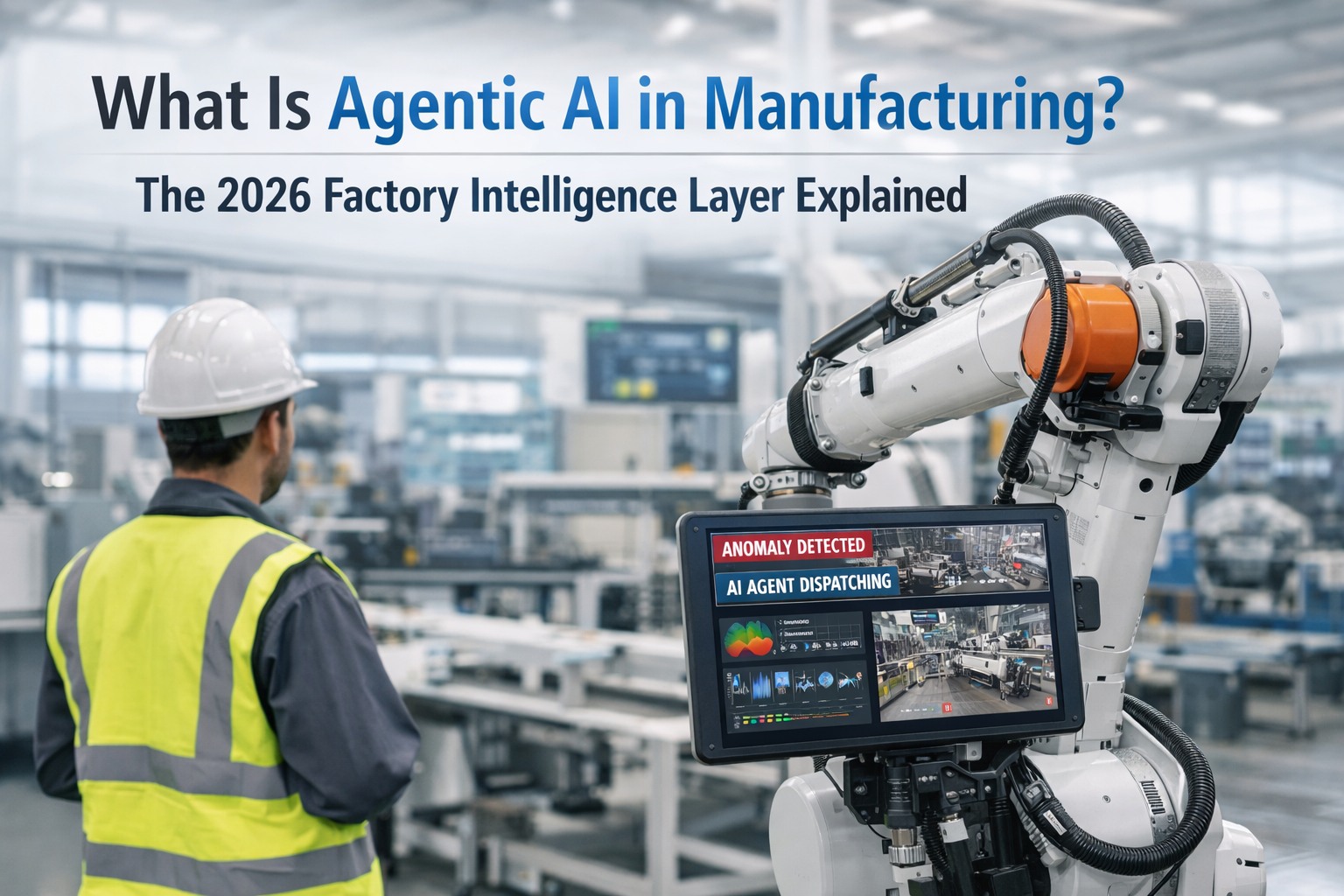
Your factory sensors detect a bearing vibration anomaly at 2:47 AM. By 2:48 AM, an AI agent has diagnosed the root cause, checked the ERP for spare parts, scheduled a technician for the next shift, and generated a work order in your CMMS — all without a single human touch. This isn't science fiction. This is agentic AI in manufacturing, and it's operational right now in 2026.
The Factory Intelligence Layer
From Dashboards to Autonomous Decisions
Traditional AI tells you what happened. Agentic AI fixes it — before your team clocks in.
4x
Growth in agentic AI adoption in manufacturing by 2026 — from 6% to 24%
Deloitte
$230B
Projected AI in manufacturing market by 2034 at 44.2% CAGR
Industry Research
40%
Enterprise apps will embed AI agents by end of 2026
Gartner
So What Exactly Is Agentic AI?
Think of traditional factory AI as a weather forecast — it tells you rain is coming. Agentic AI is the system that closes the windows, moves the inventory inside, and reschedules the outdoor work. It perceives, reasons, plans, and acts — autonomously executing multi-step workflows across your factory systems while keeping humans in the loop for strategic decisions.
2018–2022
Predictive AI
Forecasts when a machine might fail. Sends an alert. Waits for a human to act.
2023–2024
Generative AI
Writes reports, summarizes logs, generates SOPs. Still needs a human to decide and execute.
2025–2026
Agentic AI
Detects the anomaly, diagnoses root cause, checks parts inventory, generates work orders, and dispatches a technician — autonomously.
The Self-Healing Factory: How It Actually Works
A self-healing factory doesn't mean machines magically repair themselves. It means your AI layer continuously monitors, diagnoses, and orchestrates corrective actions across interconnected systems — turning a 72-hour breakdown response into a 72-second automated workflow.
01
Sense
IoT sensors detect vibration spike, temperature drift, or acoustic anomaly on a critical pump at 2:47 AM.
0 sec
02
Diagnose
AI agent cross-references sensor data against the digital twin, maintenance history, and failure pattern library. Identifies: inner bearing race wear.
8 sec
03
Decide
Agent queries ERP for part availability, checks technician schedules, evaluates production impact, and determines optimal repair window.
15 sec
04
Act
Generates work order in CMMS, reserves the bearing from inventory, assigns the certified technician, and adjusts the production schedule.
22 sec
05
Learn
After repair, agent updates the failure model, refines prediction thresholds, and improves future diagnosis accuracy for the entire asset class.
Continuous
72 hrs
Traditional response time (detect, diagnose, order parts, schedule, repair)
vs
22 sec
Agentic AI response (fully orchestrated, zero human delay)
Want to see how the self-healing workflow maps to your facility? Book a free consultation and our team will design an agentic AI architecture tailored to your plant layout and equipment mix.
5 AI Agents Every Smart Factory Needs in 2026
Agentic AI isn't one monolithic system. It's a team of specialized agents — each with a defined role, working together like a high-performing maintenance crew that never sleeps.
Continuously monitors vibration, thermal, acoustic, and electrical signatures across all connected assets. Detects deviations from baseline patterns and triggers the diagnostic chain within seconds.
99%+
defect detection accuracy on high-speed lines
Uses RAG (Retrieval-Augmented Generation) to query maintenance manuals, historical failure data, and digital twin simulations. Delivers a ranked list of probable causes with confidence scores.
95%
reduction in diagnostic query time
Automatically generates detailed work orders in your CMMS — including part numbers, procedures, safety lockout steps, and estimated repair time. Assigns the right technician based on certification and availability.
80%
of transactional maintenance decisions automated
Dynamically rebalances production schedules when maintenance events, material delays, or demand shifts occur. Evaluates trade-offs in real time and executes adjustments within defined guardrails.
40–60%
faster workflow execution with multi-agent coordination
Captures tribal knowledge from retiring experts by converting repair videos into step-by-step SOPs, generating shift handoff reports on OEE, and making institutional memory searchable for every operator.
80%
of industrial dark data now made accessible
Traditional Maintenance vs. Agentic AI: A Side-by-Side
The gap between reactive maintenance and agentic intelligence isn't incremental — it's a generational leap in how factories operate.
Detection
Alert sent to dashboard
Alert triggers autonomous diagnosis chain
Diagnosis
Engineer investigates manually
Agent queries digital twin + failure library in seconds
Work Orders
Planner creates WO next business day
Auto-generated with parts, procedures, and assignment
Parts
Manual inventory check, then procurement
Auto-reserved or auto-ordered from preferred supplier
Scheduling
Fixed calendar-based PM schedules
Dynamic scheduling based on real-time production impact
Learning
Lessons recorded (maybe) in a spreadsheet
Every repair refines the model for all similar assets
Human Role
Task executor
Strategic orchestrator and exception handler
The ROI of Agentic AI in Manufacturing
The business case for agentic AI isn't theoretical — early adopters are reporting measurable gains across maintenance costs, downtime, and operational efficiency. BCG research indicates AI-driven maintenance delivers a 10:1 to 30:1 ROI within the first 18 months.
10:1–30:1
ROI on AI-driven maintenance within 18 months
75%
Reduction in average downtime with AI maintenance chatbots
171%
Average return on investment reported by enterprises deploying AI agents
3–6 mo
Time to ROI for prescriptive maintenance and vision-based quality control
Ready to calculate the ROI for your specific plant? Book a free demo and our team will map expected savings based on your asset mix, current downtime costs, and maintenance spend.
Why Greenfield Plants Have the Agentic Advantage
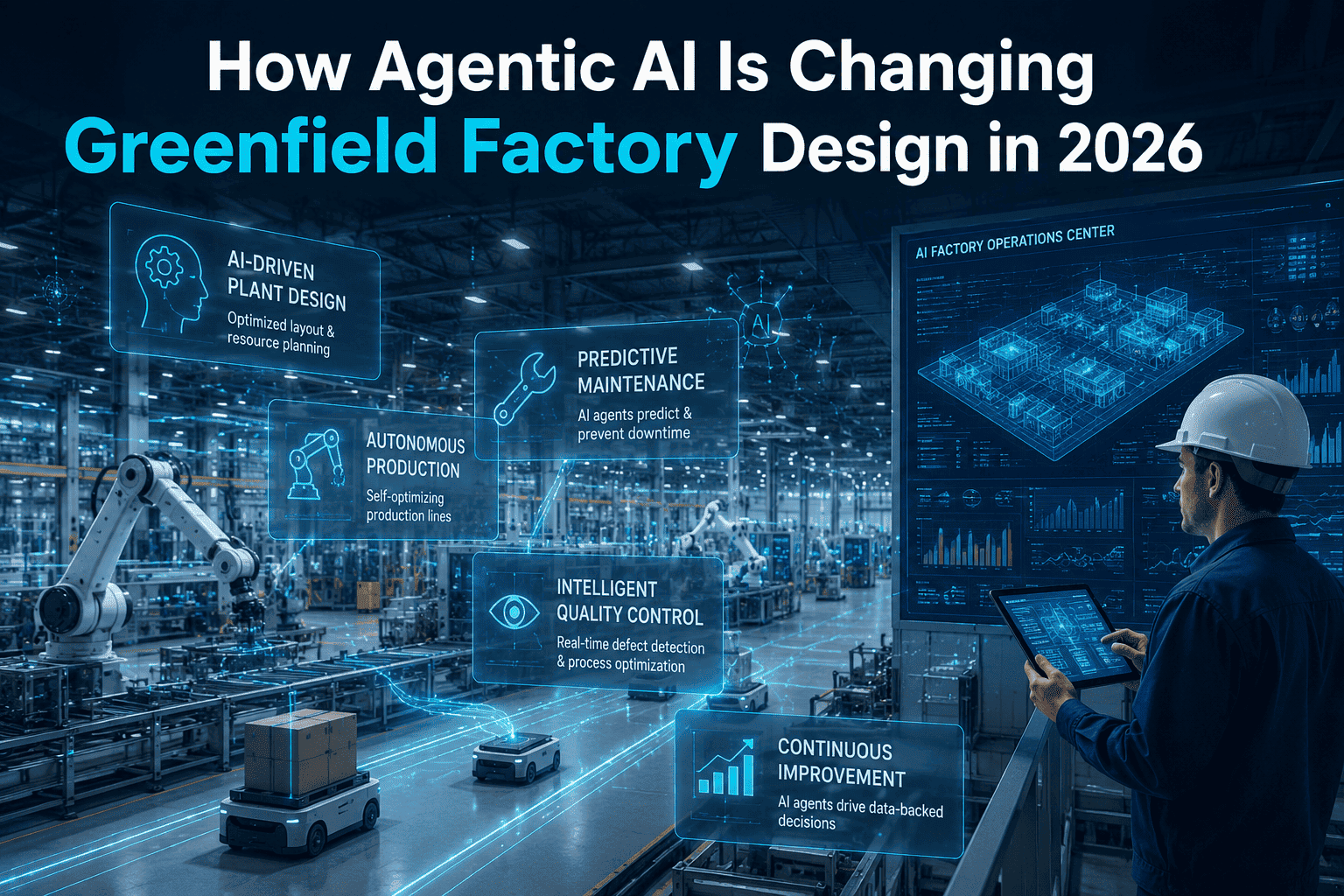
Brownfield factories can adopt agentic AI — but greenfield plants can be born with it. When you design the intelligence layer into the blueprint, every sensor, gateway, and data pipeline feeds your AI agents from day one. No protocol workarounds. No data silos. No six-month retrofit ramp-up.
01
Unified Data Architecture — Sensors, edge nodes, and cloud platforms designed as a single system. Agents get clean, structured data from startup.
02
Optimal Sensor Placement — Vibration, thermal, and acoustic sensors engineered into machine foundations — not bolted on as afterthoughts.
03
Edge-AI Ready Infrastructure — Edge computing nodes positioned at aggregation points for sub-millisecond agent response times.
04
Faster Model Training — Baseline data collection starts from day one. Predictive models reach accuracy 3–6 months sooner than retrofit scenarios.
05
3–5x Lower Cost — Embedding sensor infrastructure during construction costs a fraction of retrofitting the same capability later.
Planning a New Facility?
iFactory's greenfield consulting team designs your agentic AI architecture before construction begins — ensuring every sensor, agent, and data pipeline is production-ready from day one.
The Human Role in an Agentic Factory
Agentic AI doesn't replace your maintenance team — it transforms them. The industrial worker in 2026 shifts from reactive task executor to strategic orchestrator. They set goals, define guardrails, supervise agents, and handle the complex exceptions that require human creativity and judgment.
Before Agentic AI
Manually monitoring dashboards for alerts
Investigating failures after they happen
Writing work orders by hand
Calling vendors for parts availability
Updating spreadsheets with repair notes
After Agentic AI
Setting strategic goals and agent guardrails
Reviewing AI-recommended actions for approval
Handling complex exceptions that require judgment
Training junior staff with AI-generated SOPs
Focusing on continuous improvement and innovation
How iFactory Deploys Agentic AI
iFactory's AI-powered CMMS is purpose-built for agentic manufacturing operations. Whether you're building a greenfield plant or modernizing an existing facility, our platform connects every sensor to an intelligent action layer.
Autonomous Work Order Generation
Sensor anomaly detected? Work order created, parts reserved, technician assigned — automatically, within your CMMS.
300+ Protocol Support
Connects to wired and wireless sensor networks, edge gateways, and legacy PLCs. No rip-and-replace required.
Edge-AI Processing
On-premise LLM deployment for sub-second response times and data sovereignty. Your factory data stays in your factory.
Greenfield Architecture Consulting
Our team designs sensor placement, network topology, and AI agent architecture before construction starts.
Build Intelligence into Your Factory from Day One
iFactory's agentic AI platform connects every sensor, automates every work order, and learns from every repair. Don't bolt on intelligence later — architect it in.
Frequently Asked Questions