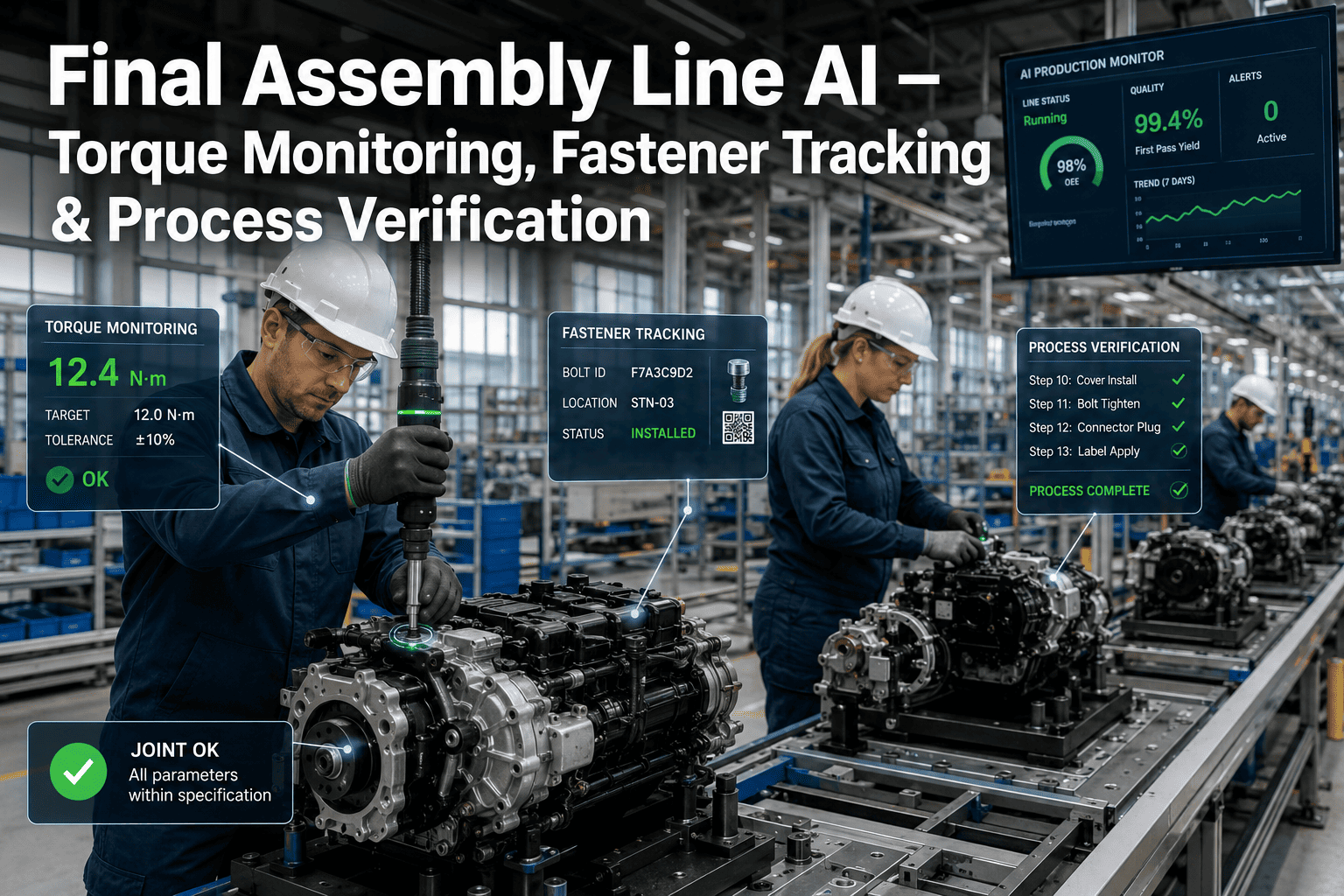
A modern vehicle leaves final assembly with more than 4,000 fastening operations behind it, and a meaningful share of those are classified as safety-critical — seatbelt anchors, steering components, suspension mounts, battery pack fasteners on an EV. Most plants still verify this work with statistical sampling: check a percentage of joints, assume the rest followed the same pattern, move on. That assumption is exactly what falls apart the day a recall investigation needs to know the torque and angle applied to one specific bolt on one specific vehicle, and the record simply doesn't exist. Plant managers who have already lived through that conversation with an OEM tend not to need convincing about full-coverage torque monitoring, so this is written for the ones who haven't yet — book a demo to see full-joint traceability running on a live assembly line.
Final Assembly · Plant Leadership
Final Assembly Line AI Torque Monitoring & Fastener Tracking
Monitor every critical fastener with AI-powered torque and angle verification, so every joint is traceable and every audit has an answer ready.
4,200+
Fastening operations across a typical vehicle build
1,200+
Torque-critical fasteners in a typical EV battery module alone
$8,400
Estimated field failure cost tied to a single under-torqued fastener
15+ yrs
Typical retention requirement for torque records under IATF audits
Where Sample-Based Verification Runs Out
Statistical process control was built to confirm that a process stays stable on average. It was never designed to answer the question a recall investigation actually asks: what happened at this one joint, on this one vehicle, on this one day.
Traditional Sampling
Checks a percentage of joints per shift
Confirms overall process stability, not individual joints
Recall response requires isolating suspect date ranges broadly
Full-Coverage AI Monitoring
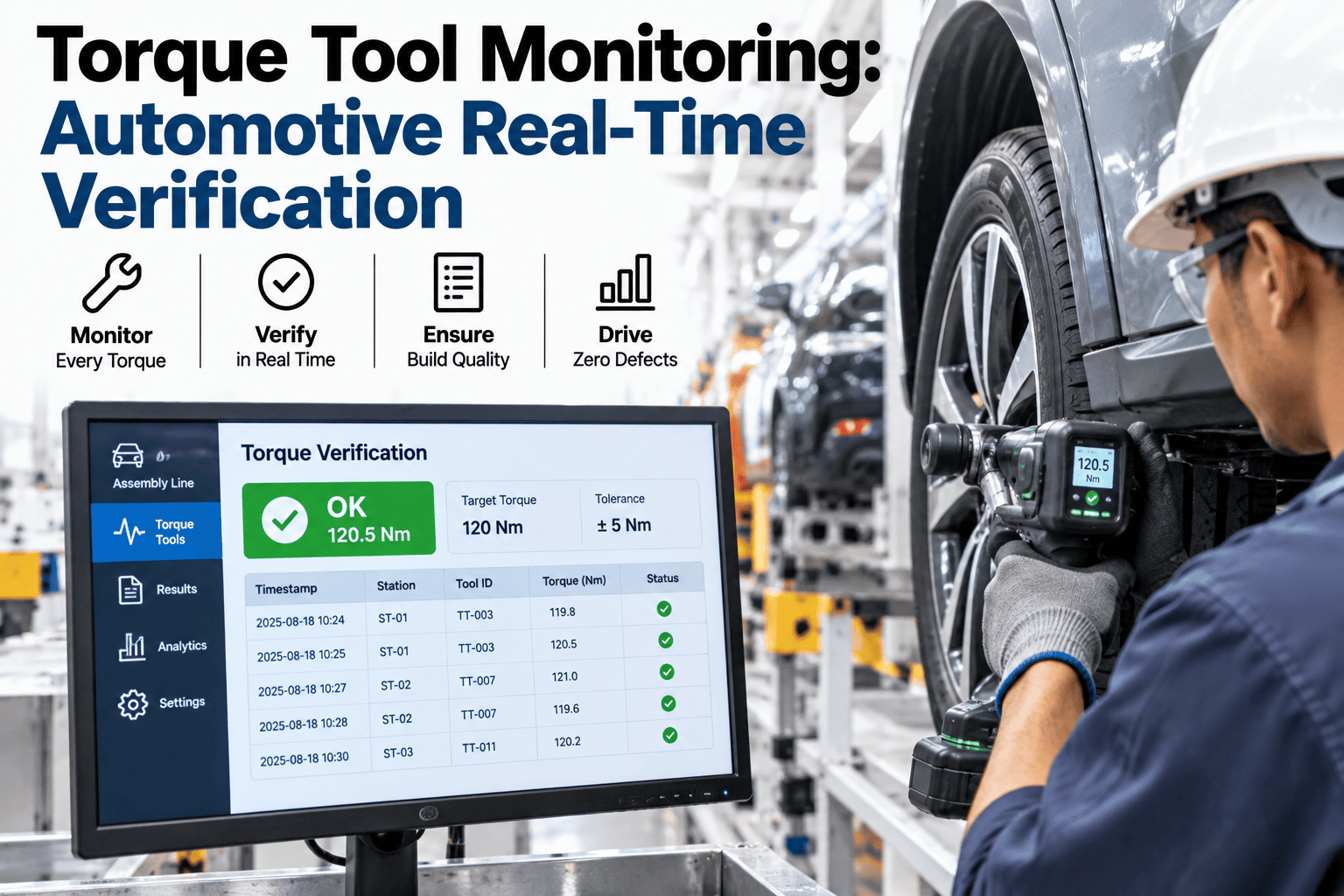
Records torque, angle, and timestamp for every joint
Links each fastening event to a specific VIN and station
Recall response narrows to exact affected vehicles in minutes
What Every Fastening Event Actually Captures
Torque-angle monitoring in particular catches what torque-only checks miss — a fastener can reach the correct torque reading while the joint itself is compromised by a lubrication variation, a galled thread, or a soft gasket. Tracking the angle from the snug point to final torque verifies clamp load and joint stiffness together, not just one number in isolation.
A joint that "reached torque" isn't the same as a joint that's actually sound. Full torque-angle coverage tells the difference on every single fastener.
Where the Real Cost Shows Up
Recall Scope Creep
Without joint-level traceability, a suspected torque issue forces a recall across an entire production window instead of the narrow set of vehicles actually affected.
Warranty Claims From Field Failures
Under-torqued electrical connections in EV battery assemblies can raise resistance and generate heat, while over-torqued fasteners on cell housings can compromise structural integrity — both surface as warranty claims months later.
Audit Preparation Time
Reconstructing torque compliance evidence from paper logs and spot-check records ahead of an IATF 16949 or VDA audit consumes staff time that a continuous digital record eliminates.
Sampled Verification vs. Full-Coverage AI Torque Monitoring
Plant Leadership Perspective
The shift from sample-based SPC to full fastening traceability isn't really about catching more defects day to day — most torque tools already run reliably most of the time. It's about what happens on the one day something drifts. A plant with joint-level records turns a potential fleet-wide recall into a narrow, defensible, VIN-specific correction, and that difference alone justifies the investment for most safety-critical assembly programs.
Reflects published guidance on torque traceability requirements in EV and automotive final assembly.
Frequently Asked Questions
Do we need to replace our existing torque tools to get this level of monitoring?
In most cases, no. Sensor-enabled torque wrenches and screwdrivers already used on many assembly lines can feed torque and angle data into a monitoring system rather than requiring a full tool replacement program. Where tooling genuinely lacks the needed sensors, upgrades can be phased in station by station instead of all at once.
Book a demo to review compatibility with your current tooling fleet.
How does full torque monitoring actually shorten a recall investigation?
Because every fastening event is linked to a specific VIN, station, and timestamp, a suspected torque issue can be traced directly to the exact set of vehicles that passed through that station during the affected window. Investigations that used to require querying weeks of production and inspecting a wide sample instead narrow to a defensible, specific list in minutes.
Contact support to see how record queries work in practice.
What's the difference between torque-only and torque-angle monitoring?
Torque-only monitoring confirms a fastener reached a target value, which catches gross errors like a missing fastener or a cross-threaded bolt but misses subtler joint problems. Torque-angle monitoring tracks the rotation from the snug point to final torque, which verifies both clamp load and joint stiffness and catches issues like lubrication variation or a soft gasket that torque alone would miss.
Book a demo to see torque-angle curves from a live station.
Can this detect calibration drift in torque tools before it produces bad joints?
Yes, ML-based trend analysis on torque curves across a tool's usage history can flag calibration drift, spindle wear, or process shifts before they produce a run of out-of-spec fasteners. This turns tool maintenance from a fixed calibration schedule into a condition-based one guided by actual performance data.
Contact support to discuss calibration drift alerting for your tool fleet.
How long is torque record data typically retained, and why does that matter?
Many OEM and IATF 16949 requirements call for torque records to be retained for 15 years or more, since a field issue or recall investigation can surface long after a vehicle was originally built. Tamper-proof, timestamped digital storage handles this retention requirement automatically rather than depending on paper archives or disconnected spreadsheets surviving a decade and a half.
Book a demo to see how long-term record retention and retrieval work.
Know Exactly Which Vehicles Are Affected, Before You're Asked
Give every critical fastener a torque, angle, and VIN-level record you can produce in minutes, not weeks.