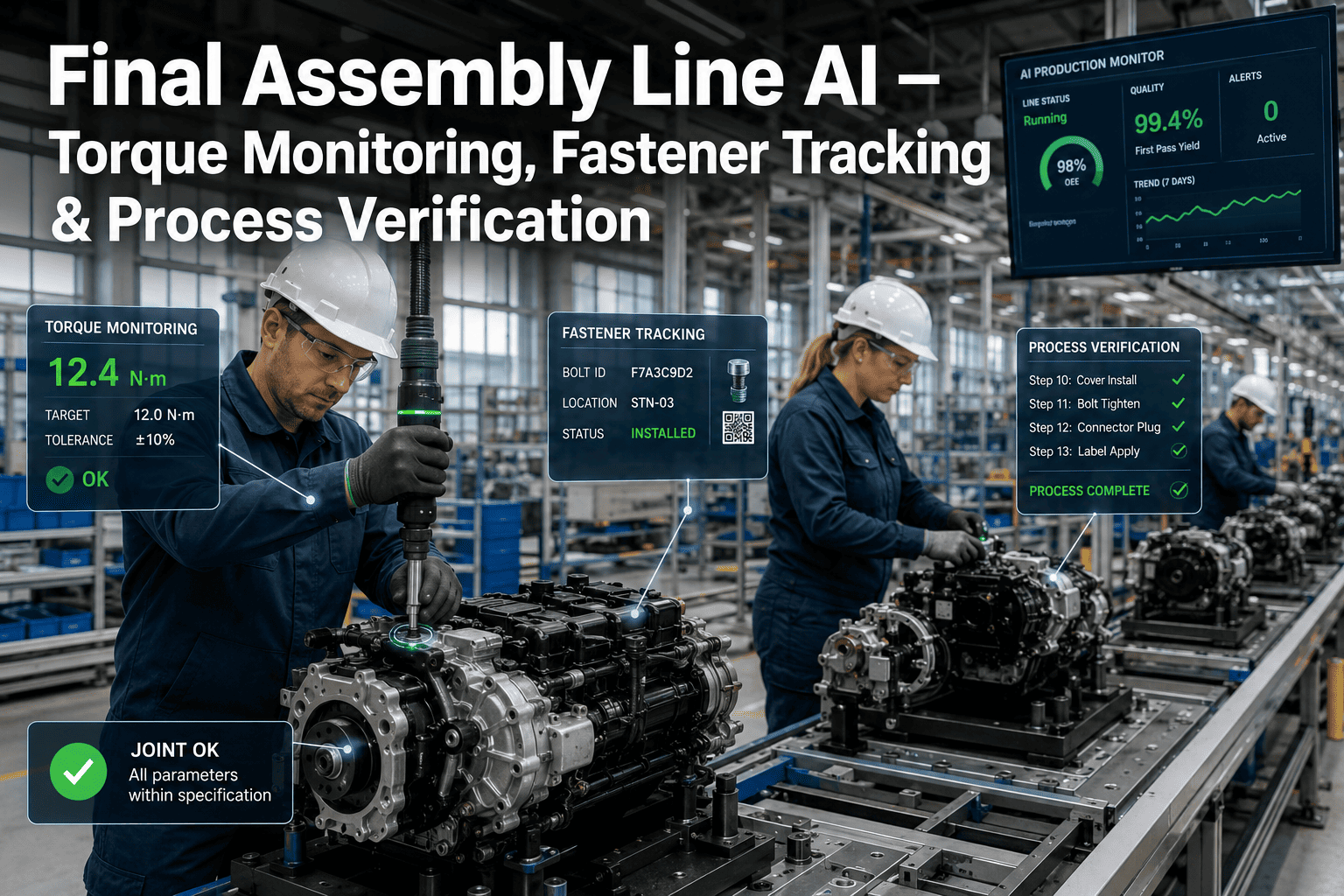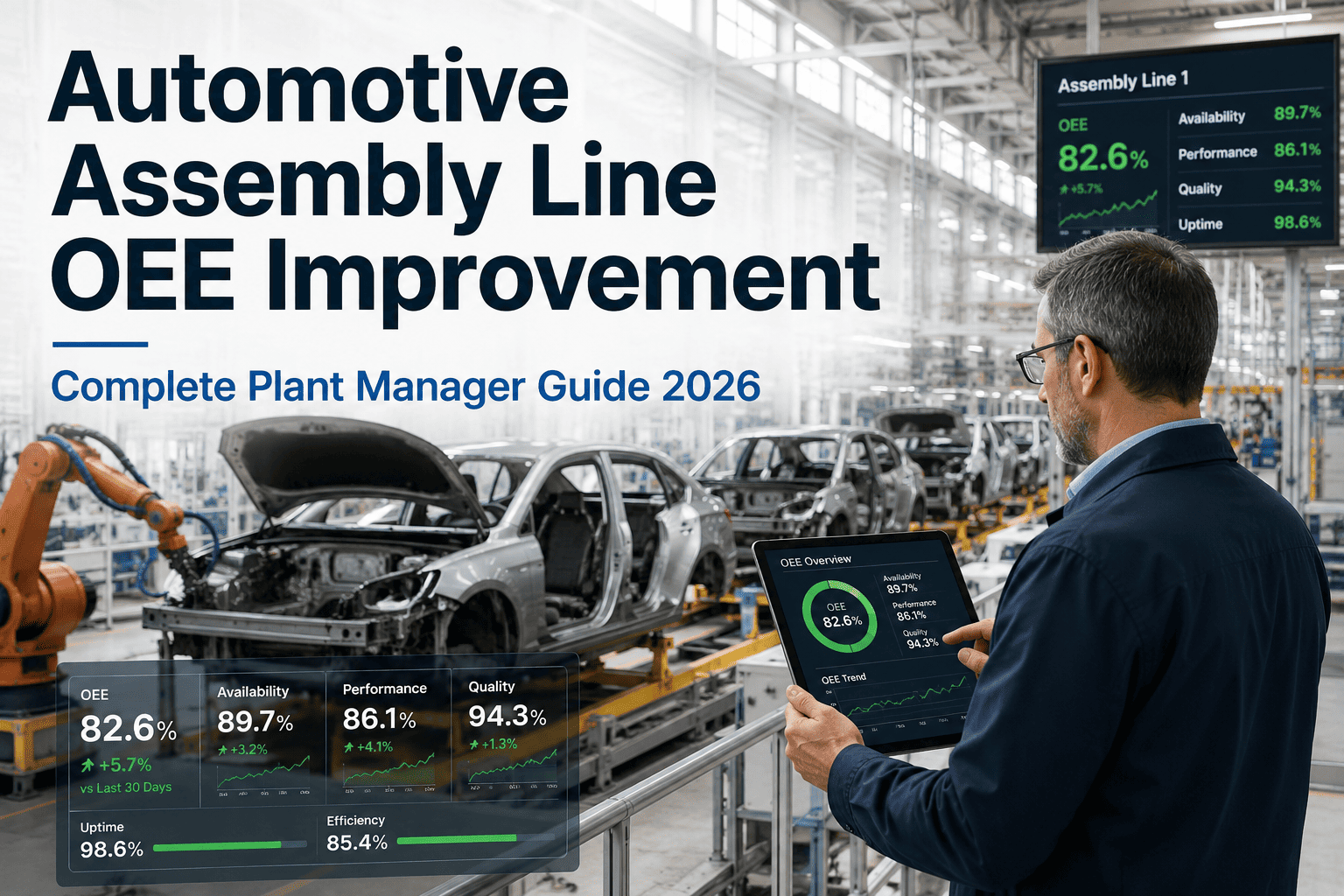
Most automotive plant managers can quote last month's output number from memory, yet very few can say with confidence which of the Six Big Losses is quietly eating their OEE this week. The gap between a 65% line and an 85% world-class line is rarely a single dramatic failure, it is dozens of small changeover delays, micro-stops, and speed losses that never make it onto a shift report. This guide walks through what actually separates average automotive assembly lines from world-class ones, why the math behind OEE punishes even strong-looking numbers, and where the fastest gains usually hide. Plant leaders who want to see their own line's loss breakdown mapped out can book a demo to get started.
PLANT MANAGER GUIDE · OEE IMPROVEMENT · 2026
Close the Gap Between 65% and 85% OEE
Automotive assembly lines lose most of their OEE to changeover time and micro-stops under five minutes, not the dramatic breakdowns everyone remembers. See where your line actually stands.
Why 85% Is Rarely the Real Target
The 85% world-class OEE figure comes from Toyota-era TPM research on dedicated, single-product lines with minimal changeover, and it still applies reasonably well to automotive assembly and stamping. Discrete manufacturing plants, automotive included, sit closest to that original benchmark of any industry, with world-class performers landing between 85 and 90 percent and the broader industry average closer to 70 to 75 percent.
The problem is not the target, it is the measurement underneath it. Plants running on manual, paper-based OEE logs consistently overstate their true performance by eight to fifteen percentage points, because short stops and minor speed losses are invisible to hand tracking. A line that looks like it runs at 78% on the whiteboard is often closer to 65% once every micro-stop is captured automatically.
This is why two plants can report the same OEE number on a Monday meeting slide and mean completely different things by it. One measured with a stopwatch and a clipboard, the other with continuous sensor data. Only one of those numbers is safe to build a capital investment decision around.
60%
Median OEE across discrete manufacturing plants in 2026
75%
Top-quartile OEE, the realistic near-term stretch goal
85%
World-class OEE, sustained by roughly the top decile of plants
The Multiplicative Trap Most Plants Miss
OEE is not an average of Availability, Performance, and Quality, it is a product of the three. That single distinction explains why a line that looks strong on every individual dimension can still land well below what the team expects. A line running 95% Availability, 95% Performance, and 95% Quality sounds close to perfect on a scorecard, yet multiplied together it lands at roughly 86%, barely above world-class and nowhere near the 95% intuition suggests.
Availability
95%
× Performance
95%
× Quality
95%
= True OEE
86%
This is exactly why plants that look strong across the board are sometimes surprised to find themselves barely above the world-class line, and why a plant sitting at 67% with perfect Availability but weak Performance still has real, recoverable losses hiding in plain sight.
01
Breakdowns
Unplanned tooling and equipment failures that stop the line without warning
02
Changeovers
Setup and adjustment time lost every time the line switches between models
03
Micro-Stops
Stops under five minutes that rarely get logged but add up across a shift
04
Speed Loss
Running below rated cycle time due to wear, minor jams, or operator pacing
05
Startup Scrap
Defects produced while a line ramps back up after a stop or shift change
06
Process Scrap
Ongoing rework and rejects during otherwise stable, steady-state running
Realistic Ranges by Line Segment
Automotive manufacturing is not one uniform process, and benchmarking a stamping press against a final assembly line produces misleading conclusions in both directions. Each segment carries a different structural ceiling based on changeover frequency, tooling complexity, and how much of the process depends on manual labor versus fixed automation.
| Line Segment | Typical OEE Today | Best-in-Class Range | Primary Loss Driver |
|---|---|---|---|
| OEM Final Assembly | 70% – 82% | 82% – 87% | Model mix changeovers |
| Stamping & Presses | 60% – 75% | 78% – 82% | Die change time |
| Tier-1 Component Assembly | 65% – 78% | 80% – 85% | Manual content variability |
| Injection & Molding | 65% – 78% | 80% – 85% | Tooling lifecycle gaps |
AI-DRIVEN OEE TRACKING
See Where Your Own Line Sits Today
Get a plant-specific loss breakdown across availability, performance, and quality before your next production review.
A Four-Stage Path to World-Class OEE
1
Establish a True Baseline
Replace manual logs with direct-sensor capture so every micro-stop and speed loss is counted, not estimated.
2
Rank the Real Losses
Build a Pareto of actual downtime causes instead of relying on which failures are most memorable to the team.
3
Attack Changeover First
Changeover and micro-stops are usually the largest recoverable losses on automotive lines, ahead of breakdowns.
4
Shift to Condition-Based Maintenance
Predictive alerts on failing components move the plant from reactive fixes to planned interventions.
What Plant Managers Are Saying
We assumed our biggest OEE problem was the stamping press that broke down every few weeks. Once we had real sensor data, changeover time on the trim line turned out to be costing us three times as much every single week, and nobody had ever put a number on it before.
Plant Manager, Tier-1 Automotive Assembly
Frequently Asked Questions
Is 85% OEE a realistic target for every automotive line?
Not for every line, though it is closer to realistic in automotive than in most other industries. Dedicated final assembly lines with low model-mix variation can reasonably target 85 to 90 percent, while high-mix component assembly or tooling-heavy stamping operations may see a lower practical ceiling. The right benchmark depends on changeover frequency, product variety, and how much of the process is manual versus automated, so comparing your line against its own structural peers matters more than chasing a single universal number.
Why do manual OEE logs overstate real performance?
Manual tracking depends on someone noticing, remembering, and writing down every stop, and short stoppages under five minutes are the easiest to miss during a busy shift. Speed losses are even harder to catch by hand because a line can run measurably slower than its rated cycle time without ever fully stopping. Automated, sensor-based capture closes this gap by recording every state change continuously, which is why plants typically discover five to fifteen points of previously invisible loss within the first month of direct measurement.
Which loss category should we tackle first?
For most automotive assembly and component lines, changeover time and micro-stops under five minutes represent the largest recoverable loss, even though breakdowns tend to get the most attention because they are dramatic and visible. Building an honest Pareto chart of actual downtime causes, rather than relying on which failures the team remembers most vividly, usually reveals that the fastest wins are in setup reduction and minor-stop elimination rather than large capital projects. Teams can review this prioritization approach through support before committing resources.
How quickly can OEE improvements show up after adopting real-time tracking?
Most plants see the first meaningful losses surface within the first two weeks of connecting sensors, simply because previously invisible micro-stops and speed losses finally get counted. A ranked Pareto of the top loss drivers typically forms within the first month, giving the team a clear, data-backed priority list. Measurable OEE gains from acting on that list generally appear within sixty to ninety days, and plant leaders can book a demo to see a timeline modeled on their own line.
Does improving OEE require new equipment on the line?
Rarely at the outset. Most automotive plants already generate enough PLC and sensor data to build an accurate real-time OEE picture without new machinery, and the initial gains typically come from process and scheduling changes rather than capital investment. Additional sensors are sometimes added selectively once a data audit identifies specific blind spots on the line, but this is a targeted addition rather than a blanket requirement for getting started.
AUTOMOTIVE OEE IMPROVEMENT
Turn Your Loss Data Into a Priority List
See a live breakdown of availability, performance, and quality losses across your own assembly line.