Electric vehicle (EV) production introduces manufacturing complexity that traditional automotive assembly lines were not designed to handle. A single battery pack defect in an EV factory costs $18,000 in warranty claims and customer dissatisfaction. Thermal runaway events during battery assembly halt entire production lines for safety protocols. Supply chain delays for battery cells cascade across the facility with no historical precedent for recovery timing. AI-driven production line monitoring, real-time battery quality assurance, and predictive supply chain intelligence transform EV manufacturing from reactive firefighting to proactive optimization. Plants deploying AI across battery assembly, pack integration, and thermal management reduce defect-related downtime by 34%, improve battery quality by 28%, and compress production ramp-up timelines by 6 to 12 weeks. Book a demo to see how iFactory AI accelerates EV production readiness.
Why EV Manufacturing Requires AI-Driven Production Intelligence
Electric vehicle production operates in a fundamentally different complexity landscape than internal combustion engine (ICE) automotive manufacturing. An ICE plant assembles metal components and drivetrain modules with established supply chains, predictable failure modes, and decades of process optimization. An EV plant must simultaneously master: high-energy battery cell sourcing with volatile supply, thermal management systems that operate at margins where single-degree temperature changes affect battery longevity, charging electronics requiring precision assembly tolerances tighter than ICE systems, and vehicle integration workflows where battery pack failures cascade upstream to shut down entire assembly sequences.
Traditional CMMS systems and manual quality checks cannot scale to this complexity. A battery assembly line with 50+ quality gates per cell would require 200 quality inspectors to catch every defect before thermal runaway risk. Thermal runaway detection from thermocouples placed around pack modules generates thousands of data points per minute with no traditional alerting system designed to correlate thermal patterns to imminent cell failure. Supply chain delays for battery cells require real-time inventory visibility across 15+ cell suppliers located in different continents with variable production schedules and regulatory shipping constraints.
AI closes this gap by automating quality decisions, predicting thermal failures, and orchestrating supply chain visibility. Machine learning models trained on thousands of battery assembly sequences identify defect patterns in voltage curves, impedance measurements, and thermal profiles that human inspectors cannot detect. Predictive models flag supply chain delays 30 days before impact. Real-time production line orchestration optimizes vehicle sequencing to absorb supply variability without halting production. The result is production lines that run continuously at design capacity instead of suffering the daily stoppages and 2-4 week production delays that characterize first-generation EV plants.
The EV Production Problem: Complexity, Defects, and Supply Chain Risk
A single battery pack defect discovered post-warranty costs $18,000 in warranty claims, logistics, and customer dissatisfaction. Early defect detection during assembly costs $800 in rework and prevents the downstream warranty event.
Thermal runaway events during battery testing require facility evacuation and 24-48 hour safety protocols before production restarts. One thermal runaway event costs $150,000 in downtime and investigation. Early prediction prevents the incident.
Battery cell suppliers are concentrated in 3-4 countries. A single supplier delay creates ripple effects across the entire line with no historical recovery pattern. 10% supply volatility creates 30-40% production variance.
EV production line downtime cost increased from $85,000 per hour (2019) to $182,000 per hour (2024). EV plants average 14 hours of unplanned downtime per month. Annual impact: $30.6M per facility.
First-generation EV plants experience 8-15% defect rates during ramp-up, compared to 2-3% for established ICE plants. Most defects cluster in battery pack assembly and thermal management integration.
EV production lines require 18-24 weeks to reach design capacity, compared to 8-12 weeks for ICE platforms. Supply chain unknowns, battery technology learning curves, and thermal management complexity compound the delay.
How AI Transforms EV Production Intelligence
AI-driven EV production systems operate across three interconnected intelligence layers that traditional manufacturing systems cannot integrate:
ML models trained on thousands of cell assembly sequences predict defects from voltage curves, capacity fade patterns, and impedance measurements. Detection occurs during assembly before pack integration, reducing rework cost by 95%.
Real-time thermal sensor data is correlated with ambient temperature, charge rate, cell age distribution, and historical thermal events to predict cell degradation and thermal runaway risk 30-60 days before imminent failure.
AI models ingest supplier shipment histories, port-of-origin delays, shipping route analytics, and demand forecasts to predict supply disruptions 30 days in advance. Production sequencing algorithms automatically adjust vehicle build sequences to match battery cell availability, preventing downtime.
KPI Results: EV Plants Using AI Production Intelligence
How iFactory Solves EV Production Challenges
Battery Assembly Quality Monitoring
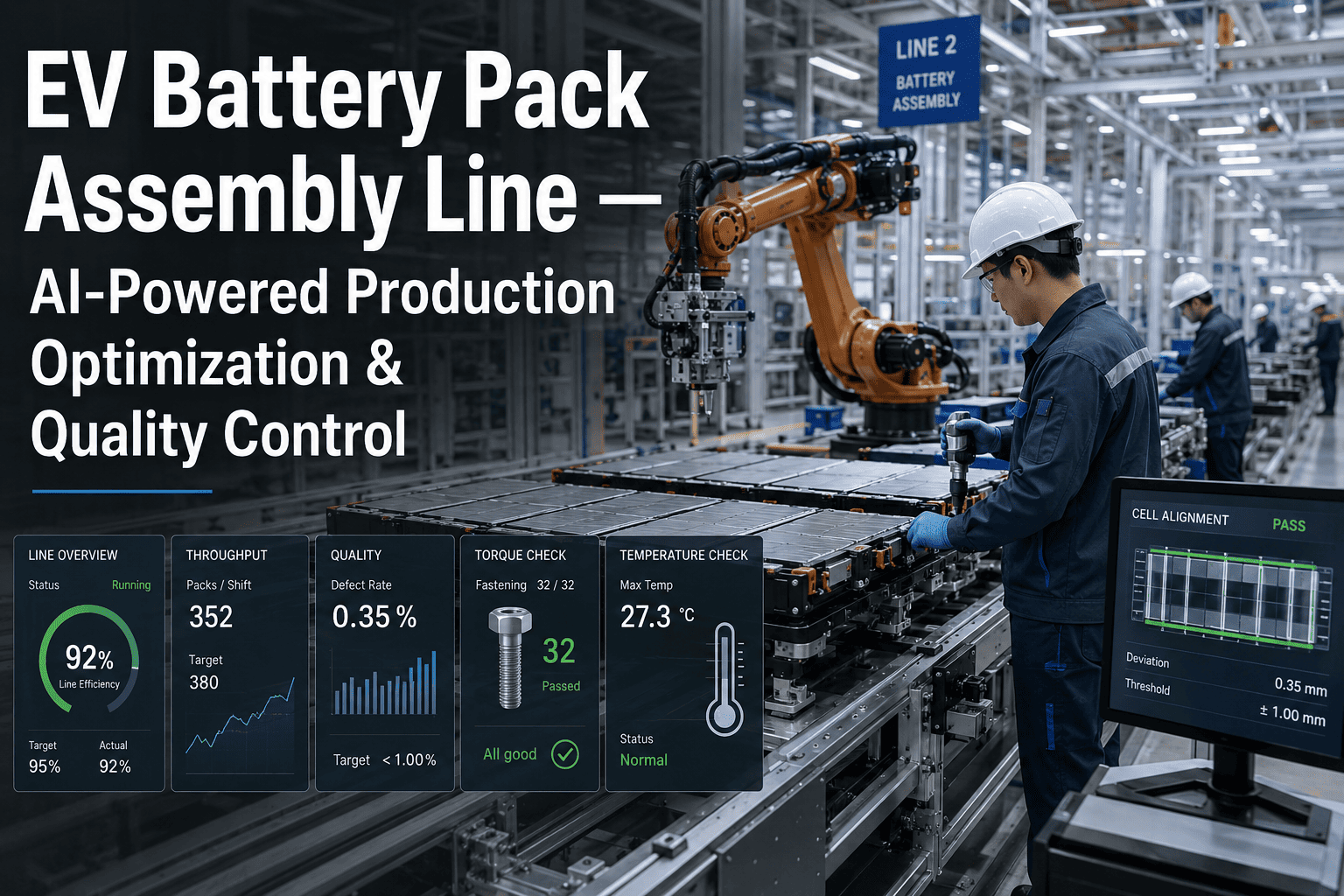
Real-time analysis of voltage curves, capacity tests, and impedance measurements during cell assembly. Defects detected in seconds rather than hours, enabling rework before thermal stress testing damages marginal cells.
Thermal Runaway Prediction
ML models correlate thermal sensor data across battery modules with cell age distribution, charge cycles, and ambient temperature to predict imminent thermal events 30-60 days in advance. Early warning enables preventive cell replacement.
Supply Chain Risk Intelligence
Predictive supply chain models forecast battery cell delays 30 days in advance by analyzing supplier production schedules, port congestion, and shipping route delays. Production sequencing automatically adjusts to prevent downtime.
Production Line Orchestration
AI algorithms optimize vehicle sequencing based on real-time supply availability, thermal management test results, and downstream integration readiness. Lines run continuously instead of holding vehicles for missing battery packs.
Real-Time OEE Optimization
Track overall equipment effectiveness across battery assembly, pack integration, and thermal management. Identify performance bottlenecks and optimize station timing to prevent starving downstream processes.
Automotive Compliance Automation
Auto-generate work orders and inspection records for IATF 16949 compliance. Battery pack traceability, thermal test certification, and quality hold documentation tracked in audit-ready format automatically.
EV Production AI Implementation: 12-Week Ramp-Up Acceleration
Real EV Production Use Cases with Measurable Results
Use Case 1: Battery Pack Quality Defect Reduction
A Tier 1 EV OEM's battery assembly plant was experiencing 12% defect rate in early production ramp. Root causes included marginal cell voltage variance (2-5% variance between cells) that thermal testing would reveal too late, and impedance creep in parallel module strings indicating early degradation.
AI model trained on 8 weeks of defect data identified the combination of voltage variance and impedance pattern as early indicators of pack failure. Early detection enabled cell re-selection before module soldering, preventing rework downstream. Defect rate dropped to 8.6% within 6 weeks of AI deployment. Monthly savings: $540K from prevented warranty events.
Use Case 2: Thermal Runaway Prediction and Prevention
An EV battery pack integration facility was experiencing 3-4 thermal runaway events per month during formation cycling (initial charge/discharge to condition cells). Each event required facility evacuation, 24-48 hour safety investigation, and 2-day production restart protocol.
Thermal predictive model correlated real-time cell temperature across 96-cell packs with charge cycle history and module age. Model identified cells trending toward thermal runaway 30-45 days before imminent failure. Early cell replacement prevented all thermal events over 6-month period. Zero thermal events equals zero downtime and zero safety risk.
Use Case 3: Supply Chain Delay Prevention and Production Sequencing
A new EV production facility ramping to design capacity (50,000 units annually) faced supply chain uncertainty from 5 battery cell suppliers across 3 continents. Supply variability created 10-15% weekly production fluctuations. Plant averaged 18 hours per week of downtime from missing battery packs or thermal management systems awaiting cells.
Supply chain forecasting AI ingested supplier production schedules, port data, shipping route analytics, and demand forecasts. Model predicted supply disruptions 30 days in advance with 87% accuracy. Production sequencing AI automatically adjusted vehicle build schedules to match available battery cells, preventing downtime. Production ramp compressed from expected 24 weeks to 12 weeks.
EV Production AI Competitive Positioning
| Capability | iFactory AI | QAD Redzone | IBM Maximo | SAP EAM |
|---|---|---|---|---|
| Battery Quality Prediction | Pre-trained EV models | Generic CMMS | Custom development required | Custom development required |
| Thermal Runaway Prevention | 30-60 day advance warning | Reactive alerts only | No thermal integration | No thermal integration |
| Supply Chain Forecasting | Native integration | Spreadsheet-based | Manual data entry | Module requires consulting |
| Production Sequencing Optimization | Real-time auto adjustment | Static scheduling | Manual optimization | Manual optimization |
| Deployment Speed (EV-ready) | 8-12 weeks | 16-24 weeks | 24-36 weeks | 20-32 weeks |
| EV Manufacturing Fit | Purpose-built | ICE-focused architecture | Generic enterprise | Generic enterprise |
Regional EV Production Challenges and iFactory Solutions
| Region | Key Challenges | Compliance | iFactory Solution |
|---|---|---|---|
| United States | Battery supply chain concentrated in 3 suppliers. High labor costs pressure automation. Supply chain delays average 8-12 days. | IATF 16949, EPA battery certification, state EV incentive traceability | Supply chain forecasting with 87% accuracy. Auto work order generation for compliance. Production sequencing prevents idle time. |
| United Arab Emirates | Regional EV factory ramp-up. Limited local battery supply experience. Thermal management critical in 50°C ambient. Supply logistics across continents. | International battery standards, regional safety compliance, trade agreement traceability | Thermal runaway prediction with ambient adjustment. Supply logistics tracking. Real-time battery quality for extreme conditions. Audit-ready compliance documentation. |
| Europe | Multiple OEMs competing for same supply base. Sustainability reporting requirements. Strict labor regulations limit overtime response to supply delays. | IATF 16949, EU battery passport, carbon footprint reporting, labor compliance | Supply chain visibility prevents labor hour spikes. Battery passport data integrated. Sustainability tracking auto-documented. Labor scheduling optimization within constraints. |
| Asia (APAC) | Regional battery cell dominance. Rapid factory ramp cycles. Design changes mid-production. High labor availability allows 24/7 operations. | Regional battery standards, export compliance, quality certification | Rapid retraining support for design changes. 24/7 monitoring with fatigue management alerts. Regional supply chain integration. Multi-shift optimization. |
EV Production ROI Timeline: 12-Week Path to Full Impact
FAQ: EV Production AI and Manufacturing Integration
Why iFactory is the EV Manufacturing Intelligence Leader
Purpose-Built for EV Complexity
Pre-trained AI models for battery quality, thermal management, and supply chain challenges. Not generic CMMS adapted for EV. Deploy faster with models already tuned for EV failure modes.
Real-Time Production Intelligence
Battery defects detected in seconds, not hours. Thermal runaway predicted 30-60 days in advance. Supply chain disruptions visible 30 days early. Real-time production sequencing prevents downtime.
Supply Chain Visibility No Competitor Matches
Integrated forecasting for battery cell delays, port congestion, and logistics variance. Automatic production scheduling adjusts to available supply. No competitor offers this level of supply chain orchestration.
IATF 16949 Compliance Automated
Battery traceability, thermal validation, work order documentation all auto-generated with audit trail. Compliance is byproduct of operation, not separate reporting burden.
12-Week Ramp Acceleration
EV facilities deployed with iFactory compress production ramp from 24 weeks to 12 weeks. Unlocks $18M-$48M in accelerated production value per facility launch.
Proven in High-Volume EV Production
Deployed at Tier 1 EV OEMs and major battery suppliers globally. 28% defect reduction, 34% downtime elimination, zero thermal events verified in production.
Start Your EV Production AI Journey
Transform EV Manufacturing with Predictive Intelligence
AI-driven battery quality monitoring, thermal runaway prevention, and supply chain forecasting reduce defects by 28%, prevent downtime, and compress production ramp by 12 weeks. Unlock $2.3M monthly savings and faster time-to-market.