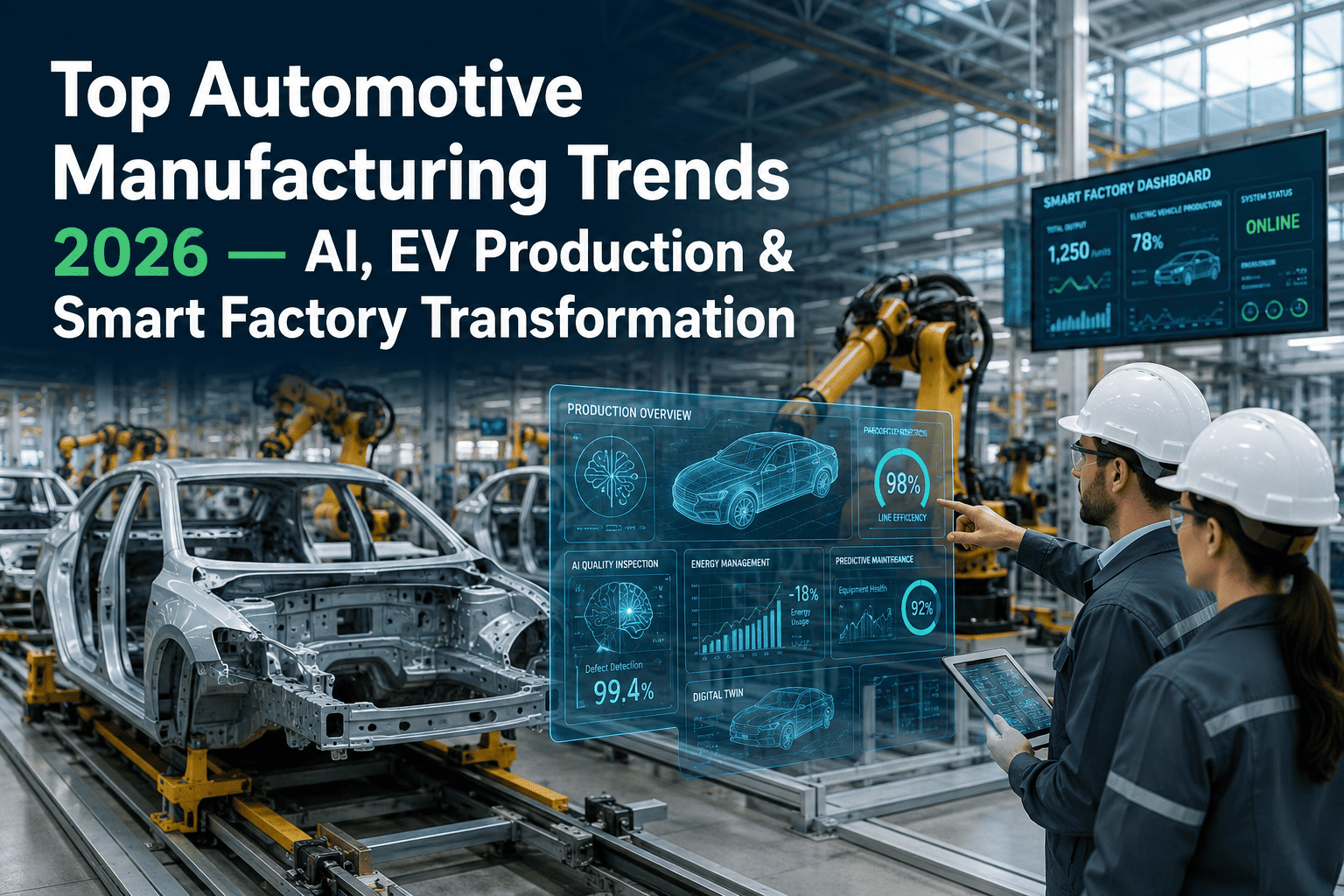
Automotive manufacturing in 2026 bears little resemblance to the industry of five years ago, and the distance between plants that adapted and plants that didn't is no longer a matter of opinion, it shows up directly in the numbers. Facilities that have embraced AI-driven production, predictive maintenance, and smart factory technology are running with a meaningful productivity advantage over traditional operations, and that gap is widening every year rather than leveling off. For a VP of Operations, the question is no longer whether to modernize, it is which trends deserve capital and attention first. Leaders mapping their own transformation priorities can book a demo to see where the fastest wins sit.
VP OPERATIONS GUIDE · INDUSTRY TRENDS · 2026
The Plants Pulling Ahead Are Not Waiting for Certainty
AI-powered production, EV manufacturing expansion, and smart factory transformation have moved from pilot programs to production reality, and the competitive gap they create keeps growing.
The Widening Productivity Gap
Plants that adopted AI-driven optimization, predictive maintenance, and connected quality control early are not just ahead, they are extending their lead year over year, while traditional facilities running on legacy processes have largely plateaued. The chart below reflects the pattern operations leaders are reporting across the industry: a gap that was manageable in 2024 has become structurally difficult to close by 2026.
AI-Enabled Plants
Traditional Plants
2024
2025
2026
The metric behind these bars is a composite production performance score, but the underlying story holds regardless of exactly how it is measured: manufacturers who delay digital transformation another twelve to eighteen months risk facing a gap that capital investment alone can no longer close quickly.
Ten Trends at a Glance
Not every trend deserves equal budget or urgency. The list below reflects what is actually moving from pilot to production floor across automotive manufacturing right now, ordered roughly by how broadly it has already been adopted.
AI-Powered Production Optimization
Real-time scheduling and quality decisions driven by live plant data rather than static plans.
Advanced Robotics & Cobots
Collaborative robots now handle complex assembly steps once considered too variable to automate.
Digital Twin Technology
Virtual line models let engineers test changes before touching physical equipment.
EV Manufacturing Expansion
Dedicated EV and battery lines continue to draw the largest share of new capital investment.
Smart Factory & IT/OT Convergence
Shop-floor data and enterprise systems increasingly share one connected architecture.
Sustainable Supply Chains
Energy use and emissions tracking are becoming procurement criteria, not just compliance items.
Predictive Maintenance
Condition-based servicing is replacing calendar-based maintenance across critical assets.
Additive Manufacturing
3D printing now supports tooling and low-volume parts alongside traditional production.
Connected Quality Control
Inline inspection data feeds directly into corrective action systems instead of static reports.
Workforce Upskilling Programs
Structured training pipelines are becoming as strategic as the equipment itself.
| Trend | Current Adoption Stage | Where VPs Should Focus First |
|---|---|---|
| AI Production Optimization | Scaling across leading plants | Pilot on highest-loss line first |
| Predictive Maintenance | Mainstream on critical assets | Expand beyond top five machines |
| IT/OT Convergence | Early majority | Establish a shared data model first |
| Digital Twins | Early adoption | Start with one high-value line |
AI-POWERED PRODUCTION OPTIMIZATION
See Where Your Plant Sits on the Curve
Get a assessment of which trends offer the fastest return for your specific production environment.
Three Strategic Responses to Electrification
Not every OEM or supplier is responding to the EV transition the same way, and the differences matter for how production systems get designed, tooled, and operated over the next several years.
Full-Commitment EV Investment
Purpose-built EV platforms and dedicated production infrastructure, betting fully on electrification timelines.
Hybrid-First Flexibility
Multi-powertrain lines capable of running ICE, hybrid, and BEV models to hedge against uncertain demand.
Alliance-Based Technology
Leveraging external partners for EV platforms and technology at lower capital cost and risk.
What Operations Leaders Are Saying
We spent two years treating AI-driven production as a pilot project we could evaluate at our own pace. Once we saw how far ahead our best-performing sister plant had pulled, we realized the pace was never really up to us.
VP Operations, Automotive Tier-1 Manufacturing Group
Frequently Asked Questions
Which trend delivers the fastest return for a plant just getting started?
Predictive maintenance and AI-driven production optimization tend to deliver the fastest measurable returns, since both work directly with data most plants already generate rather than requiring new capital equipment first. Digital twins and additive manufacturing typically pay off over a longer horizon and are better suited to plants that have already established solid data foundations from the first two trends.
Is the productivity gap between AI-enabled and traditional plants really widening?
Industry reporting through 2026 consistently describes this gap as structural rather than temporary, driven by compounding advantages: better data leads to better decisions, which generates more data, which improves the models further. Traditional plants are not necessarily doing anything wrong, they are simply missing the compounding effect that continuous, connected data creates over successive improvement cycles.
Do we need to pick one EV strategy and commit fully?
Not necessarily. Many manufacturers are deliberately maintaining flexibility, particularly through multi-powertrain lines that can run ICE, hybrid, and BEV models depending on regional demand shifts. The right approach depends heavily on your customer base, existing platform investments, and how confident you are in demand forecasts for your specific vehicle segments. Teams can review strategic options through support based on their current platform mix.
How should a VP of Operations prioritize among ten trends with limited budget?
Start with trends that improve the data foundation the rest of the list depends on, since predictive maintenance and connected quality control both generate structured data that AI production optimization and digital twins later rely on. Sequencing matters more than trying to fund everything simultaneously, and most successful transformations move through this data foundation stage before tackling more capital-intensive additions like additive manufacturing.
How quickly can a plant start closing the productivity gap?
Plants connecting existing PLC and sensor data to AI-driven monitoring typically see the first actionable insights within weeks, since the underlying data usually already exists on the floor. Meaningful movement in overall production performance metrics generally follows within one to two quarters once the team begins acting on that data consistently. Operations leaders can book a demo to map a realistic timeline against their own current systems.
AUTOMOTIVE MANUFACTURING TRENDS 2026
Turn Industry Trends Into a Plant-Specific Plan
See which of these trends offers the fastest, most relevant return for your production environment.