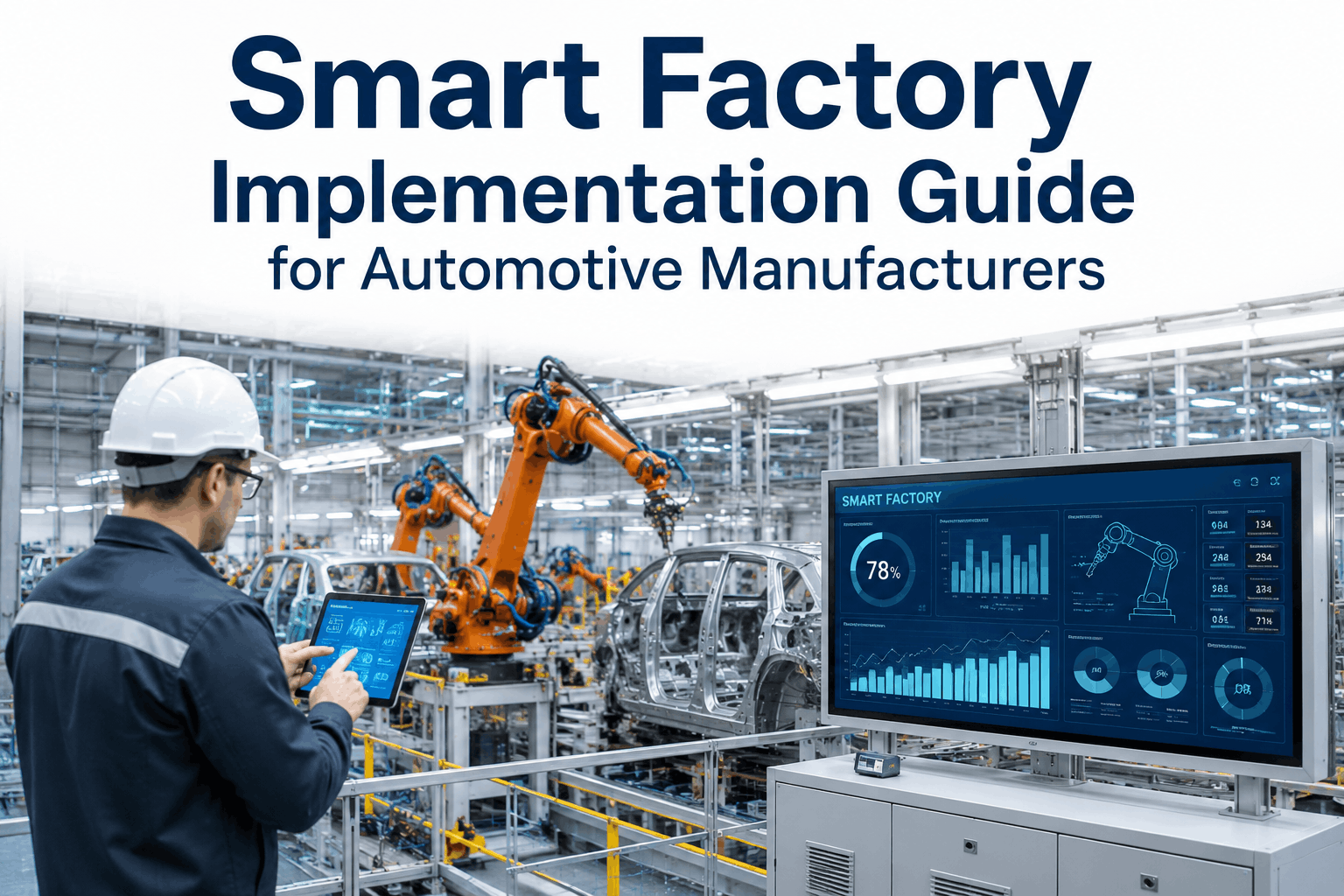
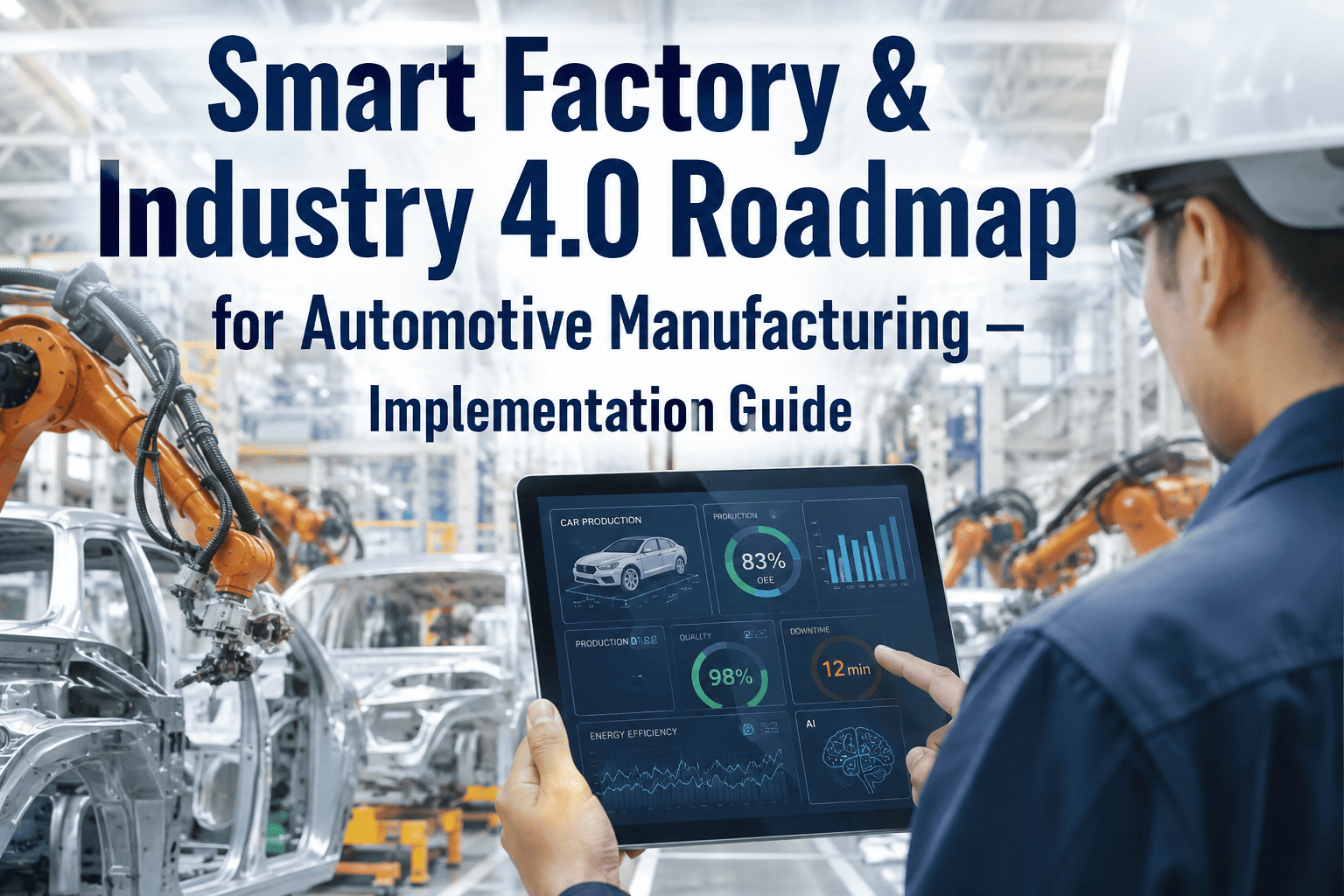
Most automotive manufacturers know they need a smart factory. Few know where to start — or how to move from pilot projects to plant-wide transformation without disrupting live production. This guide breaks down the entire implementation journey: from readiness assessment through full deployment, with real cost data, technology decisions, and the sequencing that separates successful programs from stalled ones. Book a demo to see how iFactory accelerates your smart factory journey.
Implementation Guide
The Automotive Smart Factory: A Practical Implementation Roadmap
Step-by-step guidance for automotive manufacturers moving from legacy operations to connected, AI-driven production — with ROI benchmarks at every stage.
What Makes a Factory "Smart"
A smart factory is not defined by how much technology it contains — it is defined by how well its systems communicate and how intelligently they respond to real-time conditions. The benchmark definition used by leading automotive OEMs has three requirements: machines and processes are continuously monitored via sensors, data flows in real time to a unified platform connected to MES and ERP, and AI or automation uses that data to make or recommend decisions without waiting for human intervention.
By this standard, fewer than 14% of global automotive plants qualify as fully smart today — but over 68% have active programs underway. The gap between starting and completing is where most manufacturers stall. iFactory's platform is designed specifically to close that gap for automotive production environments.
Smart Factory Maturity Model
Level 1
Connected
Sensors deployed. Data collected in historians. No real-time analysis.
31% of plants
Level 2
Visible
Real-time dashboards. OEE tracked live. MES integration active.
23% of plants
Level 3
Predictive
AI-driven maintenance alerts. Quality anomaly detection. Supply risk scoring.
18% of plants
Level 4
Optimized
AI optimizes scheduling, energy, and logistics automatically. Digital twin active.
10% of plants
Level 5
Autonomous
Closed-loop AI control. Self-adjusting processes. Minimal human intervention.
4% of plants
Phase 1 — Readiness Assessment: Know Before You Build
The single most common reason smart factory programs stall is that they begin with technology selection rather than infrastructure assessment. Before buying sensors or software, every automotive plant needs a clear picture of its current data environment, network capacity, and organizational readiness. iFactory's readiness assessment covers all four dimensions below.
01
Data Infrastructure Audit
Map every data source: PLCs, SCADA systems, MES, ERP, quality systems. Identify what data exists, at what frequency, in what format, and where it is stored. Gaps here become integration blockers later.
Key questions: Can your MES expose data via API? Do historians retain data beyond 90 days? Is OPC-UA supported on production equipment?
02
Network & Connectivity Audit
Assess OT network architecture, bandwidth capacity, and segmentation between IT and OT environments. Smart factory platforms require reliable, low-latency connectivity across every production zone.
Key questions: Is your OT network segmented from IT? What wireless coverage exists on the shop floor? Can edge nodes be deployed near equipment?
03
Equipment Baseline
Catalogue all production equipment by age, communication capability, and criticality. Prioritize the 20% of assets that cause 80% of unplanned downtime — these are your highest-ROI IoT targets.
Key questions: Which equipment has the most unplanned downtime? Which lacks native communication protocols? Where are your highest-impact quality control points?
04
Organizational Readiness
Evaluate skills, change management capacity, and executive sponsorship. Technology deployments fail more often from people and process gaps than technical ones. Assess your team's data literacy and operational willingness to act on AI-generated recommendations.
Key questions: Is there a cross-functional smart factory team? Do operators trust data-driven recommendations? Is there a budget owner with multi-year commitment?
Phase 2 — Pilot Design: Prove Value Fast
The most effective smart factory programs start with a single high-visibility pilot that proves ROI within 90 days, generates internal champions, and establishes the technical patterns that scale across the plant. Choosing the wrong pilot — too broad, too complex, or in a low-impact area — is the second most common failure mode.
Pilot Use Case Selection Matrix
Predictive Maintenance
3–6 months
Low
300–600%
First pilot — fastest value
AI Quality Inspection
6–9 months
Medium
200–400%
High scrap / rework costs
OEE Live Monitoring
4–8 weeks
Low
150–300%
Baseline visibility — quick win
Energy Optimization
6–12 months
Medium
150–250%
High energy cost environments
Digital Twin / Scheduling
9–18 months
High
400–800%
After Levels 1–2 complete
Phase 3 — Core Technology Deployment
Once the pilot validates value and the team has practical implementation experience, the plant is ready to deploy the four core technology layers that form the smart factory foundation. Each layer depends on the one below — deploying them out of sequence is a common source of cost overruns and integration failures. Book a demo to see iFactory's layered deployment approach.
Layer 1 — Foundation
IoT Sensor Infrastructure
Deploy vibration, temperature, current, vision, and RFID sensors on all priority assets. Install edge gateway nodes in each production zone. Validate data quality and sampling rates before moving to Layer 2.
Typical duration: 8–14 weeks
200–400
Sensor points typical for a single assembly plant
Layer 2 — Connectivity
Data Platform & MES Integration
Connect sensor streams to a unified time-series data platform. Integrate with your existing MES and ERP to add production context — vehicle, station, operator, work order — to every data point.
Typical duration: 6–10 weeks
2–5 TB
Daily data volume in a connected automotive plant
Layer 3 — Intelligence
AI Models & Analytics
Train AI models on 6–12 months of collected data. Deploy predictive maintenance, quality anomaly detection, and supply chain risk scoring. Launch live dashboards and automated alert workflows.
Typical duration: 10–16 weeks
92%
Prediction accuracy on well-calibrated automotive AI models
Layer 4 — Optimization
Digital Twin & Closed-Loop Control
Build a digital twin fed by live IoT data for production simulation and scheduling optimization. Close control loops where AI decisions execute automatically — adjusting schedules, routing maintenance work orders, and flagging supply exceptions without human intervention.
Typical duration: 12–20 weeks
23%
Average OEE improvement at full Layer 4 deployment
Smart Factory ROI: What the Numbers Look Like
ROI from smart factory investment is real and well-documented — but it is not evenly distributed. The highest returns come from predictive maintenance and quality improvements, and both require sufficient AI model maturity before delivering full value. Here is the typical value capture timeline for an automotive plant with 500–800 employees and a single final assembly line.
Cumulative Value Captured vs Investment
Cumulative value captured
Remaining to breakeven
Based on a 500–800 employee automotive assembly plant. Initial investment range: $1.8M–$2.6M.
38%
Reduction in unplanned downtime
21%
Reduction in quality defect rate
18%
Reduction in energy cost per unit
14 mo
Average payback period
The 6 Most Common Smart Factory Implementation Mistakes
01
Starting with technology, not use cases
Buying a platform before defining which production problems you are solving leads to capability without purpose. Define your top-3 ROI use cases first, then evaluate technology against them.
02
Underestimating data quality requirements
AI models trained on poor-quality or inconsistently labelled data produce unreliable predictions. A 6-week data quality remediation phase before AI model training is not optional — it is what separates 92% prediction accuracy from 71%.
03
Skipping the IT/OT integration design
Smart factory platforms must connect operational technology (PLCs, SCADA) with information technology (ERP, MES). Without a deliberate integration architecture, these systems remain in silos — defeating the purpose of a connected factory.
04
No operator change management
Smart factory tools fail when operators do not trust or use them. Invest in operator training, involve shift leads in dashboard design, and establish clear workflows for acting on AI-generated alerts. Technology adoption is 60% human and 40% technical.
05
Treating it as an IT project
Smart factory implementation requires operations leadership ownership, not IT project management. The KPIs that matter — OEE, downtime, scrap rate — are owned by production, and the program must be governed accordingly.
06
Scaling too fast before pilot validation
Deploying plant-wide before a pilot proves the integration approach, alert thresholds, and operator workflows creates compounding technical debt. Run one line to production-grade maturity before scaling.
iFactory's phased deployment model is designed to prevent exactly this.
FAQ: Smart Factory Implementation for Automotive
Start Your Smart Factory Journey With a Clear Plan
iFactory helps automotive manufacturers assess readiness, design the right pilot, and deploy smart factory technology in the sequence that delivers fastest ROI — without disrupting live production.
Readiness Assessment
Phased Deployment
IoT & AI Integration
Digital Twin
MES & ERP Connected