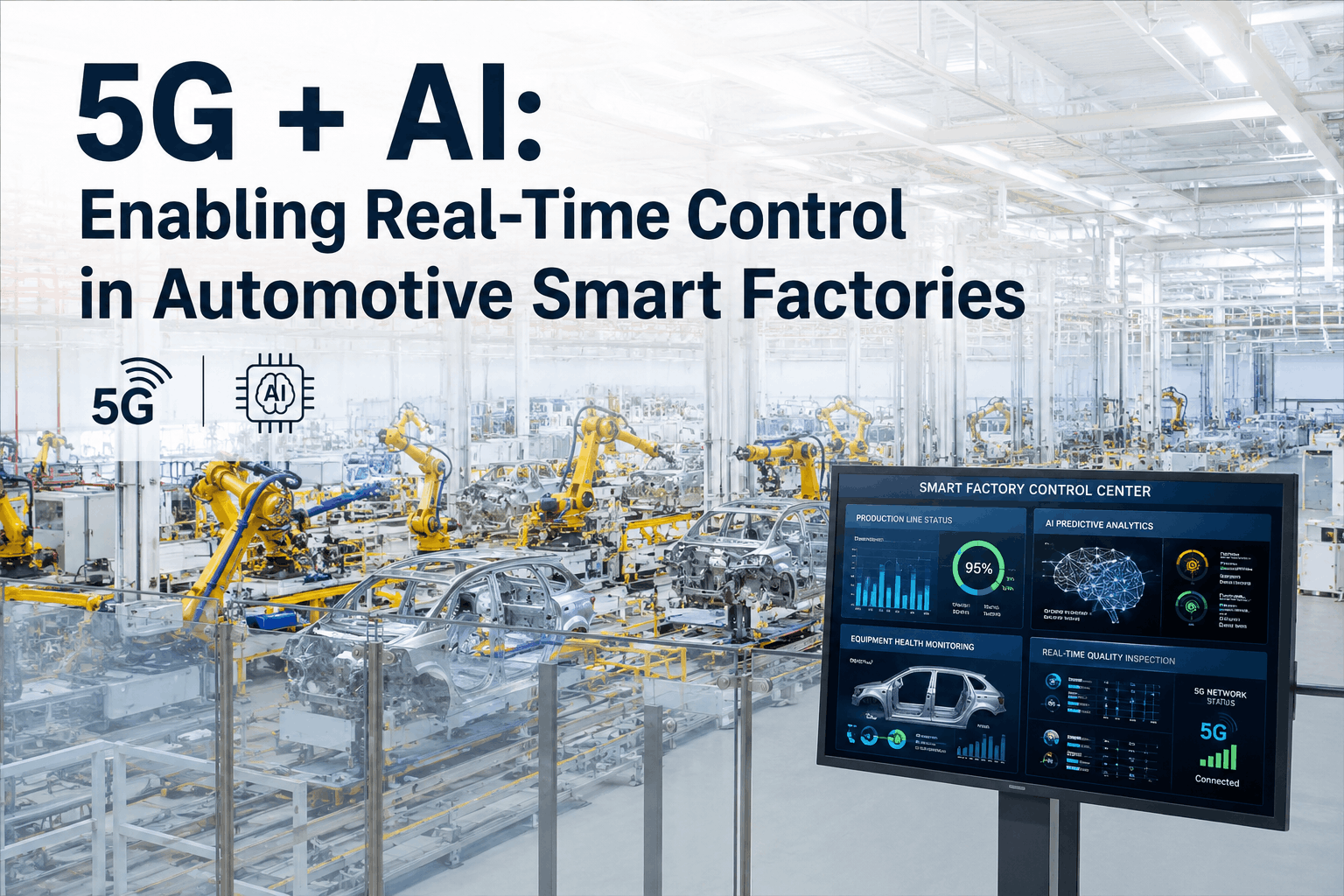
Speed is the competitive variable that matters most in automotive manufacturing. A welding robot needs quality feedback in 40 milliseconds. An AGV fleet needs rerouting instructions in under a second. An AI model detecting a press fault needs to halt the line before the next stamping cycle. None of this is possible on legacy Wi-Fi or wired industrial Ethernet at scale — but it is exactly what 5G private networks were engineered to deliver. Combined with edge AI, 5G transforms the automotive factory from a connected plant into a real-time control system. Book a demo to see how iFactory deploys 5G-enabled AI on automotive production lines.
Why Latency Is the Limiting Factor in Smart Factory Control
Most smart factory discussions focus on data volume — terabytes of sensor data, thousands of connected devices, AI models processing millions of events. But the true limiting factor for real-time control is not volume. It is latency: the time between a physical event occurring and the system responding to it.
In automotive production, the response windows are measured in milliseconds. A resistance weld completes in 200ms — quality feedback must arrive before the next weld begins. A press stroke takes 80ms — fault detection must halt the ram before material fracture. An AGV approaches an intersection at 2m/s — collision avoidance must resolve in under 100ms. iFactory's edge AI platform is built around these automotive-specific latency requirements.
What Private 5G Delivers That No Prior Network Could
Private 5G networks — deployed and operated within a single manufacturing facility — are fundamentally different from public 5G or enterprise Wi-Fi. They are purpose-built for deterministic, high-reliability industrial communication, with three capabilities that automotive smart factories require above all others.
How 5G and AI Work Together: The Control Architecture
5G is the nervous system. AI is the brain. Neither delivers full value without the other. Understanding how they integrate — specifically where AI runs and how 5G moves data between layers — is essential for manufacturers designing a real-time control architecture. Contact iFactory to design your 5G + AI architecture.
Five 5G + AI Use Cases Already Running in Automotive Plants
Current draw and electrode force sensors on every weld gun stream data over 5G to an edge AI node at 500Hz. The AI model classifies each weld as accept/reject within 30ms — before the robot moves to the next weld point. Rejected welds trigger automatic re-weld commands without operator intervention. A Tier-1 body shop reduced weld rework by 94% in the first 6 months of deployment.
See closed-loop weld AI in a live demoA 60-unit AGV fleet runs on a private 5G network with AI fleet management software dispatching vehicles based on real-time MES production sequencing. 5G enables the AGVs to receive route updates in under 800ms — fast enough to dynamically reroute around obstacles and line stoppages. Material starvation events dropped from 18 per shift to under 3 after deployment.
Book a demo — see 5G AGV fleet management liveForce and vibration sensors on 24 stamping presses transmit data via 5G to edge AI nodes at 1kHz. The AI detects die misalignment, lubrication failure, and material feed anomalies within a single press stroke and halts the ram before the next cycle. Die damage incidents — each costing $40,000–$180,000 in tooling repair — fell by 41% in the first year. See iFactory's stamping AI in action.
High-resolution cameras at paint booth exit connect via 5G to an edge AI vision server. The system analyses 360-degree surface images of each vehicle body in under 2 seconds, classifying defects by type and location. 5G connectivity allows cameras to be repositioned anywhere on the line without recabling — a flexibility that traditional wired vision systems cannot match in a plant environment.
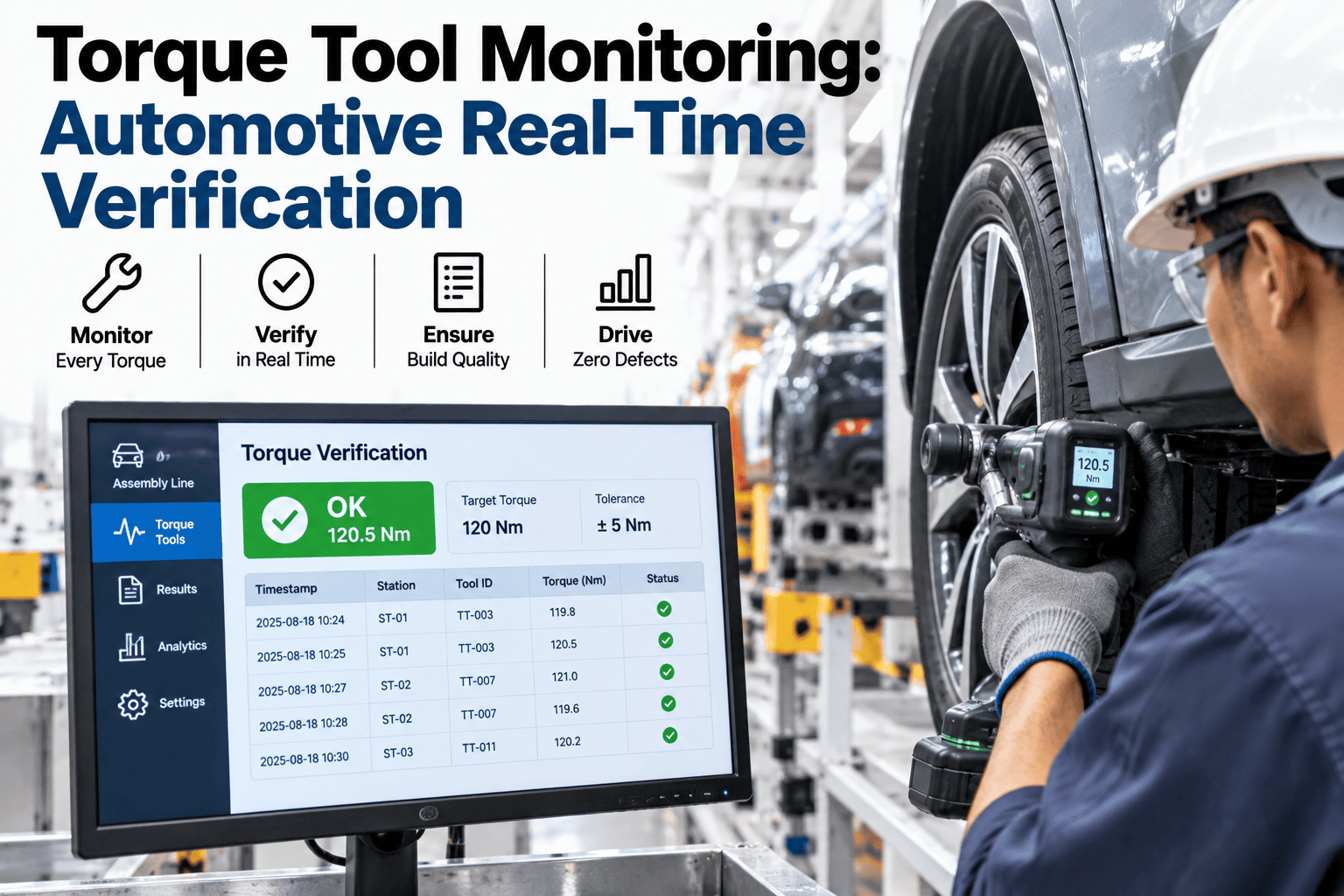
Request a demo of AI vision inspectionOperators on final assembly carry 5G-connected tablets and smart tools that receive real-time work instructions from the AI system based on which vehicle variant is at the station. Torque tools report fastening results over 5G; AI validates each result against the vehicle's spec and alerts the operator to re-torque before the vehicle moves forward. The system reduced operator-attributable quality escapes by 34%.
See connected worker AI — schedule a demo5G vs Wi-Fi vs Wired: The Honest Comparison
Deployment Considerations: What Automotive Plants Need to Plan For
FAQ: 5G and AI in Automotive Smart Factories
Build the Real-Time Control Foundation Your Plant Needs
iFactory helps automotive manufacturers design and deploy 5G + AI architectures that deliver sub-5ms control loops, autonomous production decisions, and measurable efficiency improvements — starting with your highest-impact use case.