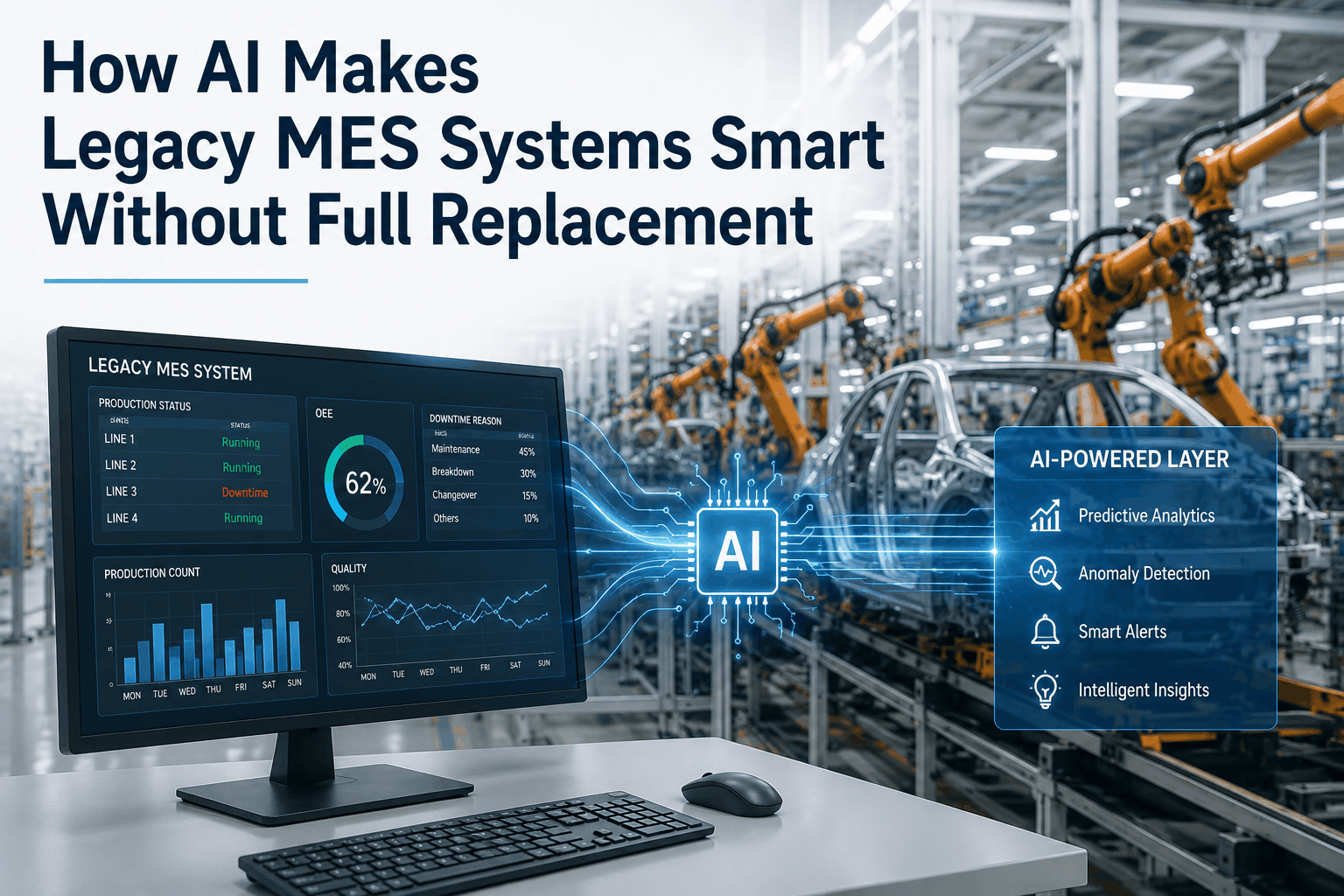
Legacy MES systems hold decades of production logic, process knowledge, and operational data — but they were never built for AI-driven decision-making. The result: manufacturers are caught between costly full-system replacements that take 3–5 years, and stagnation with tools that can't keep up with modern production demands. AI-powered integration changes this equation entirely. Book a demo to see how iFactory brings AI intelligence to your existing MES.
The Legacy MES Problem Every Manufacturer Knows
Most automotive plants run MES platforms installed between 2005 and 2015. These systems were designed for stability — they record production events, track WIP, and enforce process sequences reliably. What they were not designed for is intelligence: they cannot predict a bottleneck before it happens, adapt to supply chain disruptions in real time, or surface actionable insights from the data they collect every day.
Replacing these systems sounds logical until you see the numbers. A full MES replacement in an automotive plant averages $8–14M in direct costs, 3–5 years of implementation risk, and significant disruption to live production. Most manufacturers postpone replacement indefinitely — and live with the intelligence gap. Talk to iFactory about the alternative.
- Records production events
- Tracks WIP status
- Enforces process sequences
- Generates historical reports
- Predicts downtime before it occurs
- Detects supply chain risk in real time
- Optimizes scheduling automatically
- Surfaces actionable production insights
How AI Integrates With — Not Replaces — Your MES
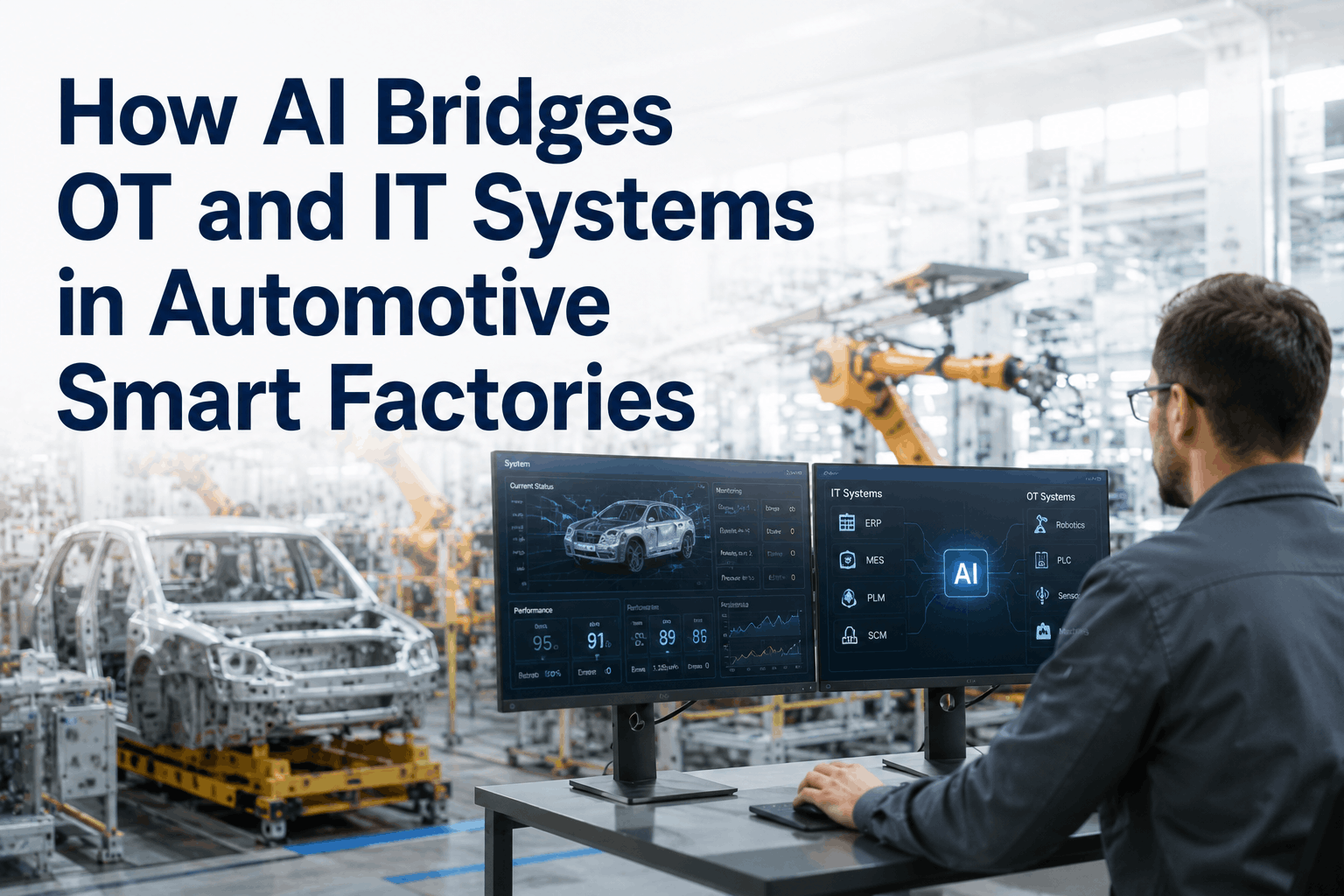
AI integration works as an intelligence layer that sits above your existing MES and ERP. It reads the data your systems already produce, applies machine learning models and simulation, and returns decisions, alerts, and recommendations — all without touching your core production logic. iFactory's platform connects to SAP, Oracle, Siemens Opcenter, and other major MES platforms through standard APIs and OPC-UA protocols.
AI connectors pull structured and unstructured data from MES, ERP, SCADA, and IoT sensors — normalizing it into a unified production data model in real time.
Machine learning models trained on your plant's historical data identify recurring failure signatures, bottleneck precursors, and supply timing anomalies before they surface on the line.
Actionable recommendations are returned to operators and managers through dashboards, MES alerts, or automated workflow triggers — no manual data mining required.
Every production cycle feeds back into the AI model. Predictions improve over time, and the system adapts automatically when new vehicle variants, equipment, or suppliers are introduced.
What Changes on the Plant Floor
Real-World Impact: What Manufacturers Gain
Three AI Use Cases Already Running in Automotive Plants
A Tier-1 body-in-white line running 12-year-old resistance welders integrated AI vibration and current-draw analysis on top of its existing MES. The AI layer identified weld gun degradation patterns 6 hours before failures — reducing unplanned downtime by 41% without replacing a single PLC or modifying the MES configuration. See how iFactory enables this for your line.
An OEM using SAP as its production backbone added an AI risk-scoring module that ingests supplier lead time data, delivery history, and logistics signals. When a supplier's risk score crosses threshold, the MES automatically adjusts buffer target levels and flags procurement — without any change to the underlying SAP configuration or license structure.
A plant with 14 active vehicle variants used AI to optimize the daily build sequence, minimizing changeover time and balancing sub-assembly buffer loads. The AI model runs overnight against the next day's order mix and pushes an optimized sequence to the existing MES scheduler — improving throughput by 7% without altering the MES sequencing engine itself.
The Integration Roadmap: From Legacy to Smart in 12 Weeks
FAQ: AI Integration With Legacy MES Systems
Make Your MES Smart — Without the Rip-and-Replace
AI integration delivers predictive intelligence, real-time supply chain visibility, and automated scheduling on top of the MES you already run. See how iFactory connects to your production environment in under 12 weeks.